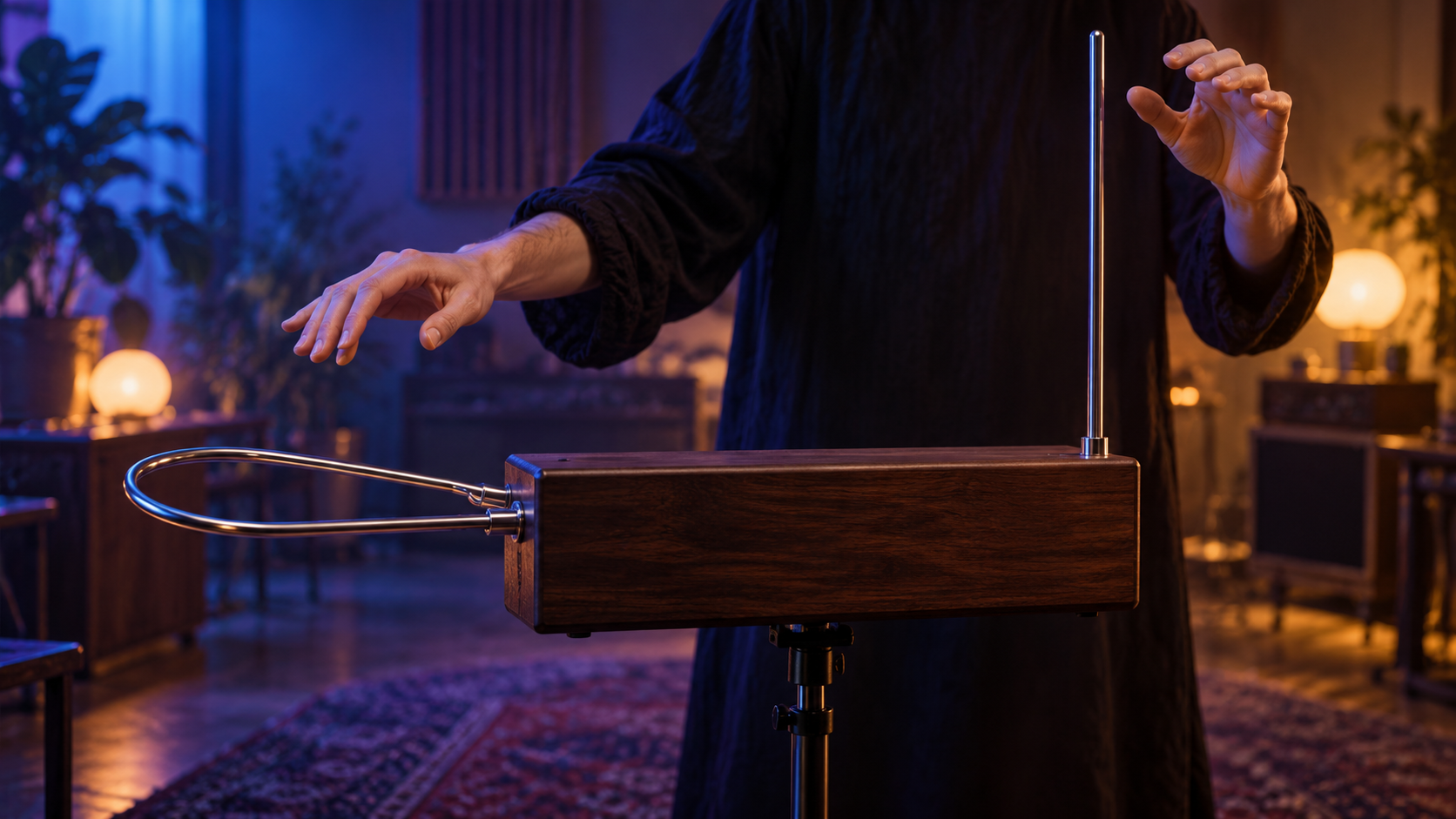
A musician raises a hand beside a metal rod, and a note slides upward. The hand touches nothing. At the other end of the instrument, another hand shapes the loudness beside a curved loop. The theremin turns the space around its player into a musical interface.
Two gestures, two musical jobs
On the traditional two-antenna arrangement used by Moog's Etherwave, the straight antenna controls pitch and the loop controls volume. That division lets a player shape the height of a note separately from its entrance, sustained strength and ending.
There are no frets or piano keys to provide a physical landing place. A movement between pitches can remain audible as a continuous slide. To make a phrase sound deliberate, the performer must coordinate where the pitch settles with how the sound is articulated.
Moog also explains that the instrument is sensitive to its immediate surroundings. Nearby objects are part of its electrical surroundings, so placement and adjustment matter before a performance begins.
The body participates in an electrical circuit
The antennas respond to changes in capacitance associated with a nearby hand and body. The Bob Moog Foundation describes this as capacitance actuation: a change in the instrument's electrical conditions changes the frequency or amplitude of its sound.
The hand is therefore influencing electronics, rather than vibrating a string or interrupting a visible beam. The graceful appearance can conceal a demanding task: the player continually hears the result and adjusts a gesture in response.
The short sound example below demonstrates a smooth pitch rise and fall. It is an original synthesized tone, not a theremin recording or an imitation of a named musician. Listen for the uninterrupted path between the low and high points.
A concert instrument beyond the eerie effect
Clara Rockmore helped establish the instrument's expressive musical possibilities. The foundation preserves material from Bob Moog's 1993 interview with her and describes the long relationship behind his work repairing the instrument Léon Theremin built for her in the 1930s.
Moog's own connection began with building theremins before his famous modular synthesizers. That history places the instrument within a sustained exchange between musicians and electronics builders.
One familiar recording can confuse the story: the sound on the Beach Boys' Good Vibrations came from an Electro-Theremin with a mechanical pitch control. The foundation distinguishes it from the space-controlled instrument. A similar sliding tone does not necessarily reveal the same playing method.
The distinctive achievement is the combination of electrical sensitivity and practiced human movement. Empty space becomes useful musical territory because the performer learns to navigate it.
Hear a continuous pitch glide
Sources and further reading: Moog Music support: Tuning the Etherwave; Bob Moog Foundation: Capacitance-actuated instruments; Bob Moog Foundation: Bob Moog interview with Clara Rockmore; Bob Moog Foundation: The theremin and its musical history.
Explore more creative work at Incoprea.




