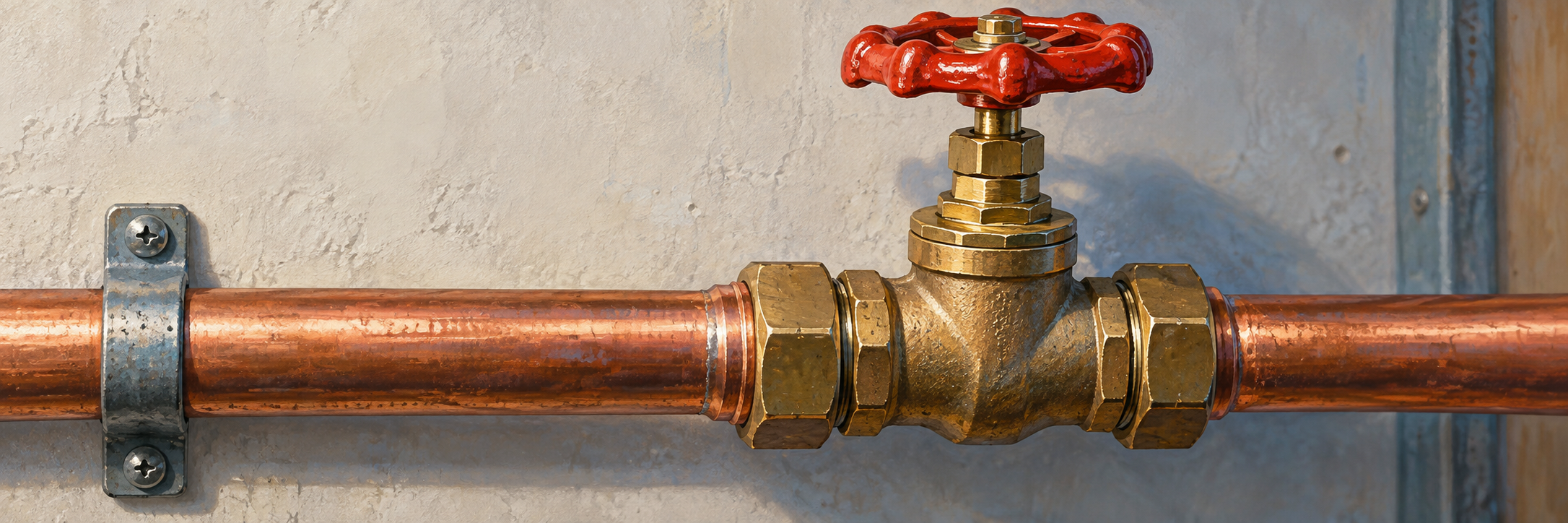
A pipe can make a sharp knock when a valve closes. The sound offers a small clue to an invisible event: moving liquid has been forced to change speed, and a pressure disturbance is traveling through the system.
Water is almost incompressible, not perfectly rigid
A rapidly closing valve interrupts flowing water. Upstream, pressure rises as the liquid decelerates. Water compresses slightly and the pipe wall can expand slightly, allowing energy to be stored elastically rather than making the whole water column stop everywhere at once.
The disturbance propagates along the pipe. Its speed depends on the liquid and the surrounding pipe, including the material and wall properties. It is distinct from the ordinary flow speed: the water need not be racing down a pipe at the speed of the pressure signal.
That distinction is useful in picturing the event. A message about a change in motion can travel through a material much faster than the material itself moves from one end to the other.
The pipe network answers back
Branches, tanks, valves and changes in cross-section can reflect a pressure wave. Several returning disturbances can then combine at the same place. This is why a system's layout matters alongside the initial valve movement.
Surges can also involve falling pressure. If pressure drops sufficiently, vapor-filled regions and separation of the liquid column can occur. The subsequent collapse or reunion of moving columns may create another severe surge. The term water hammer therefore covers more than a single push against a closed tap.
| What changes | Why it matters |
|---|---|
| Flow speed | An abrupt change initiates the pressure disturbance. |
| Pipe properties | They help determine wave propagation and the system's elastic response. |
| Network geometry | Reflection points influence where waves return and overlap. |
A brief noise can describe a large system
A household knock and a surge in a long pumped pipeline share relevant physics, although their consequences and operating conditions differ. Large installations must account for events such as a sudden pump shutdown as well as normal valve operation.
Engineered controls may change the timing of a flow change or provide somewhere for energy and liquid to go. Their selection depends on the specific installation; the visible valve alone cannot describe the whole response.
The interesting lesson is how much flexibility is hidden inside apparently rigid plumbing. A moving liquid, a slightly yielding wall and a network of reflection points can turn one local action into a traveling event.
Sources and further reading: KSB: Surge pressure; KSB: Why water pipes bang; KSB: Water hammer.
Explore more creative work at Incoprea.




