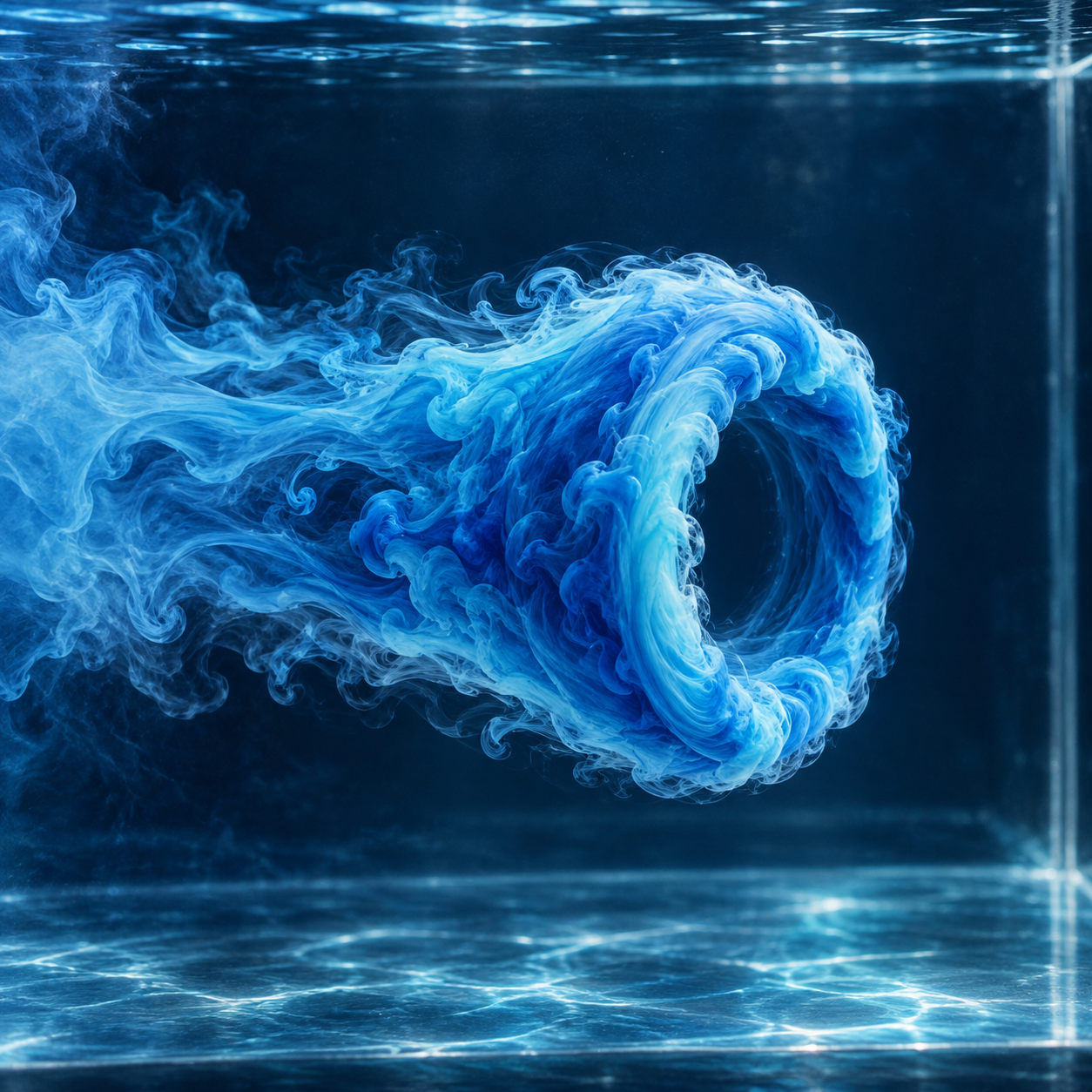
A ring of dye can travel through water while curling around its own circular core. The result looks briefly like a soft doughnut with a life of its own. It is a recognizable pattern made from moving fluid.
A ring is a motion, not a solid object
The Feynman Lectures describe a smoke ring as a torus-shaped bundle of vortex lines. Fluid circulates around the ring's core, and different parts of that circulating flow help carry the structure forward.
Seeing the colored outline is only a beginning. Smoke or dye makes some of the motion visible, while surrounding fluid also participates. The visible tracer should not be mistaken for a rigid boundary enclosing every moving particle.
This is a useful way to look at a familiar effect: a shape can persist because of organized motion. The ring's identity comes from how the fluid moves, rather than from a solid surface holding it together.
Watching order become more complicated
In research reported by Harvard SEAS in 2020, scientists sent differently dyed vortex rings into head-on collisions in a water tank. They combined rapidly scanned imaging with numerical simulations to investigate how the organized structures broke down.
The rings stretched and developed waves. Filaments formed, followed by smaller interacting vortices. The team observed a cascade through three generations of structures, offering a closely examined route toward turbulent flow.
The controlled collision does not reproduce every turbulent river or aircraft wake. Its value is that researchers can isolate an interaction, measure it and compare the observations with calculations.
Beautiful pictures can test serious models
Caltech researchers have also modeled underwater bubble rings merging and separating. Their account describes using comparisons with real footage to judge how well simulations captured the evolving geometry.
A bubble ring and a dyed water vortex have different visible ingredients. Both can nevertheless draw attention to curved vortex structures and the difficulty of predicting their interactions. The resemblance encourages questions; it does not make every swirling ring physically identical.
That is part of their appeal. A simple-looking loop gives us something the eye can follow, then reveals stretching, interaction and breakdown that demand much more than a simple picture.
Sources and further reading: Caltech: Feynman Lectures, vortex lines; Harvard SEAS: Unraveling turbulence; Caltech: Bubble rings and ink chandeliers.
Explore more creative work at Incoprea.




