Showing posts with label China. Show all posts

Thursday, October 22, 2026

The Diamond Sutra’s Last Line: What a Dated Printed Book Lets Us Know

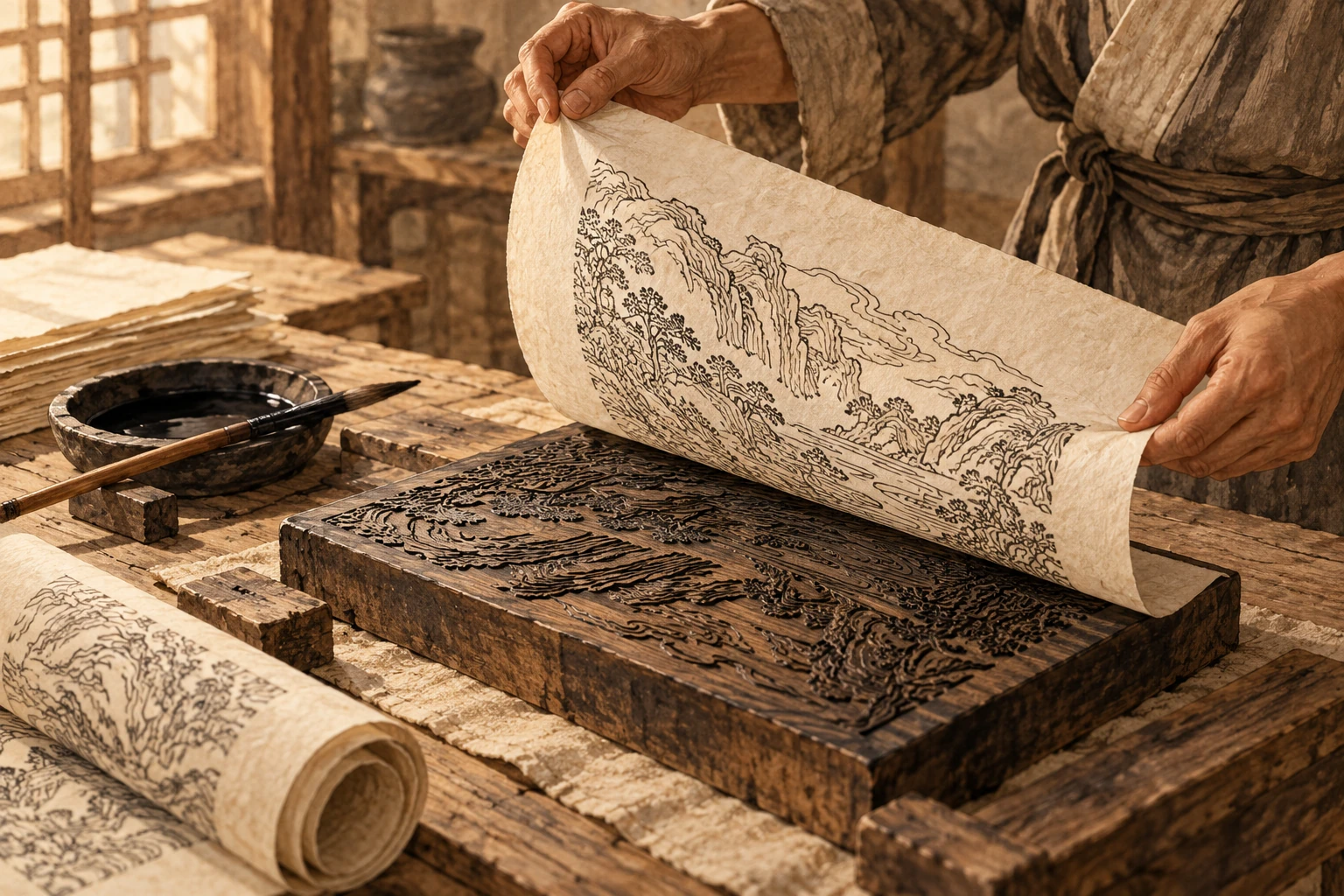
Illustrative hands lift thin paper from a wooden relief-printing block beside a roll of paper and an ink brush.
Conceptual woodblock-printing scene. It depicts no named printer and reproduces no Diamond Sutra text.

At the end of a five-metre printed scroll, a short note changes the history of the whole object. It identifies a sponsor, an intention, and a date equivalent to 11 May 868. The final lines let us make a much more precise claim than the appearance of old paper alone would allow.

The Diamond Sutra in the British Library is often introduced as the world’s oldest printed book. The careful wording is more interesting: it is the earliest surviving complete printed text with a date. Earlier printing exists. This scroll’s special power comes from the particular evidence that survives with it.

The last line is part of the work

The International Dunhuang Programme’s guide explains that the copy was sponsored by Wang Jie and woodblock printed onto seven joined sheets. The colophon records the date and dedicates the production to his parents, for distribution. It is a Buddhist act as well as an achievement of printing.

That distinction prevents a common substitution. The sponsor is not automatically the block-cutter, printer, translator, or author of the ancient teaching. A single surviving name can tempt a modern account to assign all the work to one person. The object itself supports a more limited, and more socially interesting, attribution.

The scroll format matters too. A “book” need not consist of leaves turning around a spine. Here, text and image unfold horizontally. The reader’s sequence of encounter differs from flipping through a modern bound volume, even if both objects carry a sustained text.

Printing multiplies a surface; it does not remove labor

In woodblock printing, a prepared relief surface carries the design that transfers to paper. The IDP account identifies the scroll’s separate printed sections and the joining that made the long format. Once a block exists, repeated impressions become possible; preparing it still requires skilled work.

Think about the difference between writing a message once and making a tool that can reproduce it. The second task can be worthwhile because of the copies it permits. It also requires decisions about layout, line width, ink, paper, and handling. A printing history focused only on the first surviving date can miss those practical choices.

The University of Oxford’s object resource emphasizes the colophon’s devotional purpose. This is a useful corrective to treating the scroll as if it were produced solely to mark a stage on a modern technological timeline. Its makers and sponsor had reasons that belonged to their own religious world.

A text people used, not only an object people display

An IDP newsletter devoted to the Diamond Sutra discusses the text’s place within Mahayana Buddhism and its transmission, alongside research into the scroll’s paper and conservation. The connection is important: the printed object carried a teaching that could be read, copied, recited, and understood within a living practice.

An introductory article cannot replace that tradition’s interpretation. It can avoid turning the sutra into an exotic prop. If you follow the text further, choose a clearly identified translation and commentary and distinguish a religious explanation from a simplified museum label.

The printed frontispiece adds another form of encounter before the main text. Rather than treating it as an optional illustration, ask how an image prepares the reader for what follows. Where are the figures looking? What arrangement makes the act of teaching visible? The answers begin with the picture, while identifying every figure requires the accompanying scholarship.

Conservation changes what access means

The IDP’s film resources connect the scroll’s story with science and conservation. Its later conservation and digitization newsletter explains that the scroll remained in separate panels after extensive treatment, enabling the panels to be displayed in turn. A digitized long view can therefore give an impression of continuous access that differs from the object’s physical conservation arrangement.

A British Library collection-care paper by Helen Shenton discusses virtual reunification and preservation through dispersed collections, including Dunhuang material. Digital access can reunite information for study without undoing the physical histories of collection, dispersal, and treatment.

This is a useful distinction for any online museum visit. Ask whether you are seeing one photograph, several images joined digitally, a reconstruction, or a moving view of the physical object. Each can be helpful; each makes different things visible.

Compare the first and last portions of the scroll as distinct encounters. The opening can invite attention through an image; the ending supplies a dated statement. Between them lies the physical labor of reading a long format. An online image that puts everything on one screen changes that sequence, so try examining the sections individually before viewing the whole.

The image you can read depends on the support you cannot see

Conservation can change the information available in a digital encounter. Wood and Barnard’s account of the Diamond Sutra treatment in IDP News 38 describes old linings and adhesive residues that placed stress on the paper. Removing them required investigation and careful treatment, and exposed creases and variations that had been obscured. This was work on the named scroll, not a general instruction for treating old paper at home.
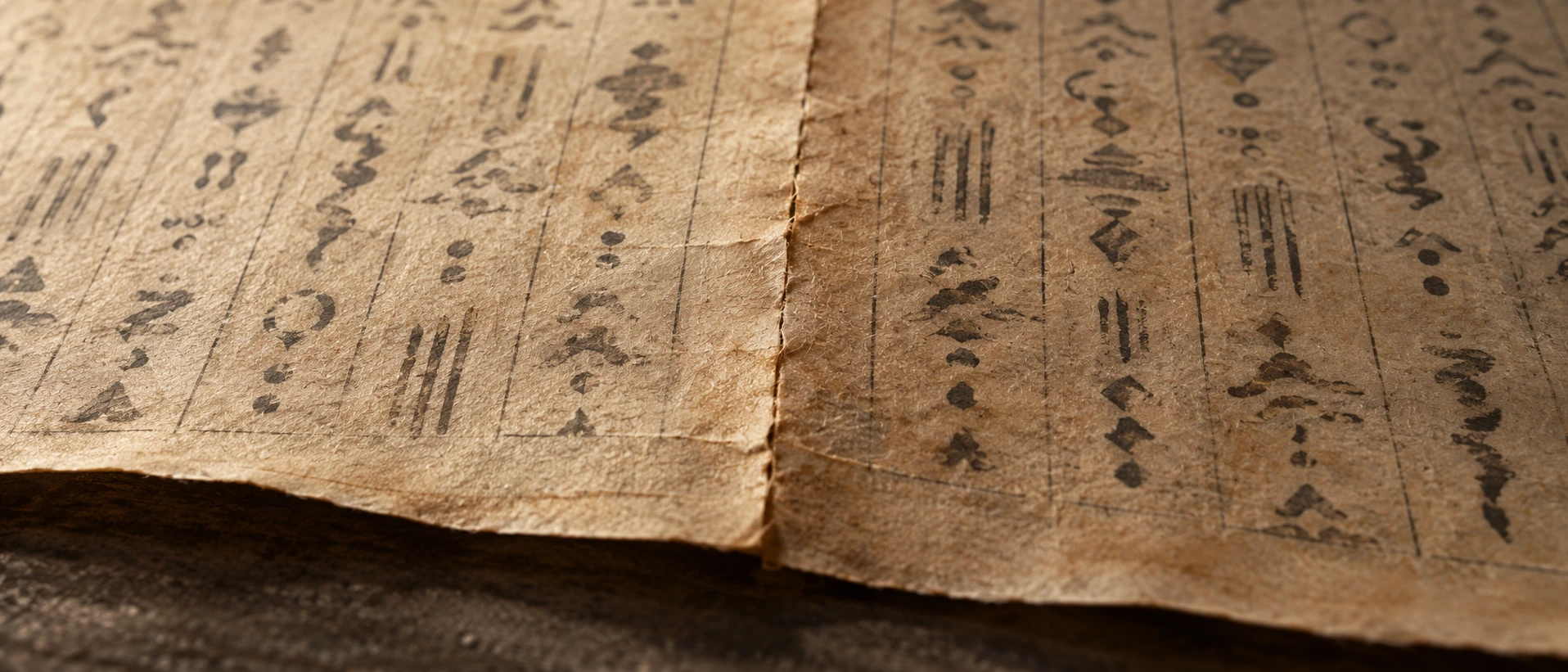
Close paper scroll join and fibers with faint nonlinguistic ink columns.
Conceptual paper-and-join study. No Diamond Sutra text is reproduced.

A separate project makes the access problem visible at another scale. IDP’s Lotus Sutra project report describes conserving and photographing 790 scrolls and three booklets, completed in 2022. Those are manuscripts of a different sutra. They are useful comparisons for how fragile scrolls become available online; they should not be described as extra sections of the Diamond Sutra.

Look at the report’s before-and-after views of Lotus Sutra scroll Or.8210/S.3796. Choose one tear or edge that appears in both. Ask what the later view makes easier to follow, and what part of the appearance is now a support or repair. The point is not to score the object for looking “new.” A successful intervention can preserve access while allowing the older material and later work to remain distinguishable.

Next compare a whole-scroll digital image with a close image of a join. The first helps establish sequence and scale. The second makes fibers, overlaps, and local damage more accessible. Neither view supplies everything the other provides. A long object reduced to a narrow strip on a phone can look continuous while hiding the labor required to make its parts safely readable.

For a two-minute viewing task, write down three nouns before zooming: paper, ink, support. Under each, note one feature you can actually see and one question you need the conservation record to answer. Resist assigning every pale area to missing ink or every straight boundary to an original sheet edge. Photography, mounting, repair, and digital stitching can introduce other boundaries.

The same exercise changes the famous final line. Its date remains remarkable, but our ability to encounter that line today depends on acts of care, imaging, cataloging, and interpretation. The surviving words and their present accessibility belong to connected histories. Reading both brings unnamed later work into the story without confusing it with the act of printing in 868.

Read the evidence in reverse order

Try a five-minute visit to the institutional images. Start at the end, where the colophon appears. Then move to the joins between sheets, the main text, and finally the frontispiece. This reverses the dramatic museum habit of beginning with the most beautiful picture.

  1. Write down what the dated note actually establishes.
  2. Find one material feature that a transcription of the words would omit.
  3. Identify one person or task that must have existed but is not individually named in the surviving note.
  4. Write a caption that preserves the word “dated” in the claim about early printing.

For an optional paper model, join several ordinary scrap sheets end to end and lay them on a table. Put a short original dedication at the end. Roll and unroll the strip gently. Notice how the dedication becomes information encountered after a physical journey through the object. This models format, not Buddhist practice or historical printing.

The Diamond Sutra’s date is a remarkable anchor, but the scroll is richer than a world-record label. It joins devotion, sponsorship, repeated images and words, delicate paper, and centuries of preservation. A small final note opens that larger world because it tells us exactly enough—and leaves the unnamed work around it available for thoughtful attention.

Sources and a closer look

IDP: Diamond Sutra learning guide; Oxford Cabinet: earliest dated printed book; IDP News 38: text, paper and conservation; IDP: Diamond Sutra film resources; IDP News 43: conservation and digitization; Helen Shenton: virtual reunification and conservation.

Find more art, ideas, and unexpected connections at Incoprea.

A Garden Larger Than Its Walls: How Suzhou Frames a View

Stand beside a window, then take two steps to the left. A branch that seemed to grow out of a roof suddenly separates from it. A distant building disappears behind the frame. Nothing outside has moved, yet the composition has changed. That small experience offers a useful entrance to the classical gardens of Suzhou: their subject is not only the ground inside a wall, but what a moving person can see, anticipate, and imagine.

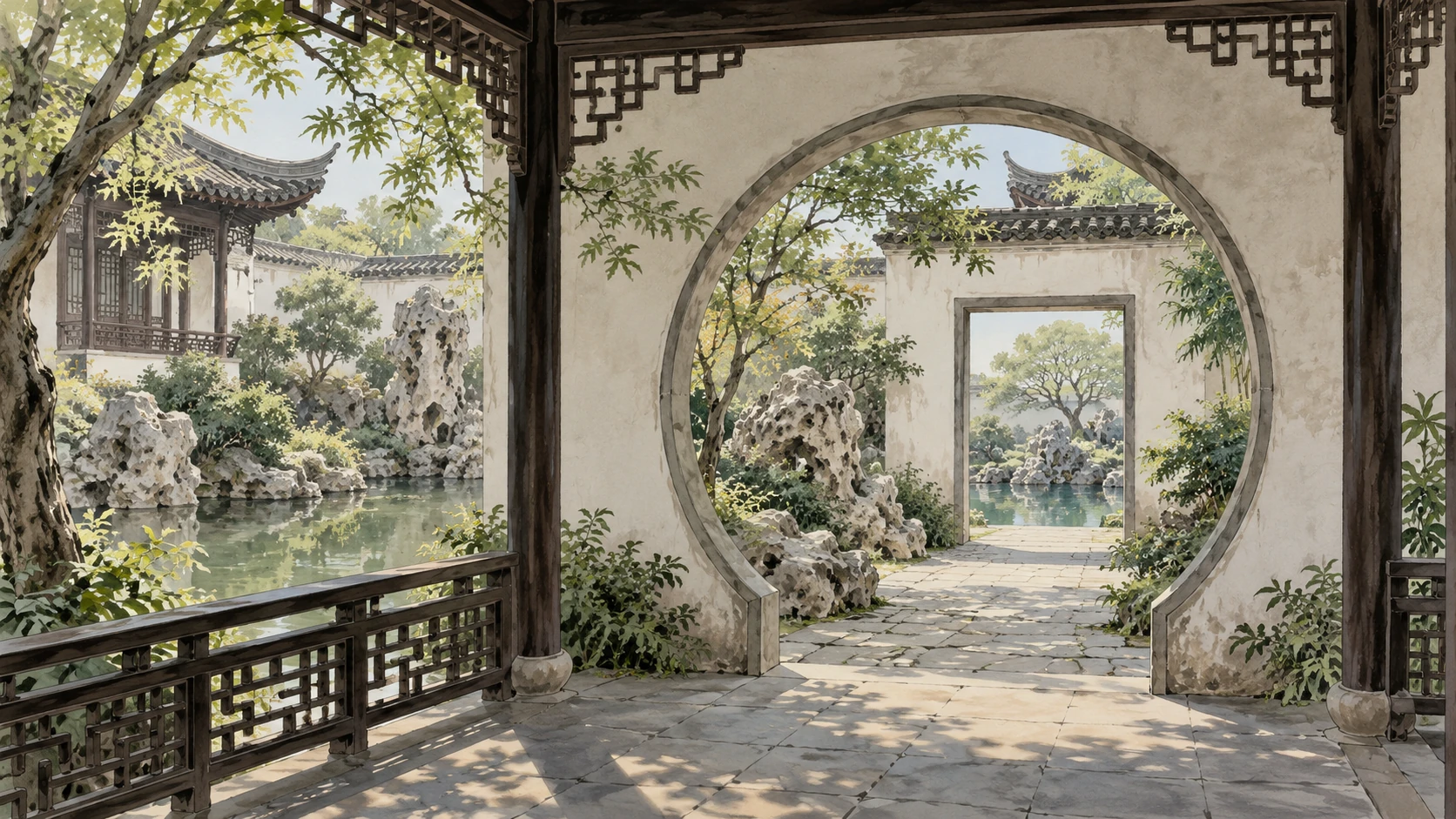
Watercolor concept of a Suzhou-inspired garden seen through a circular opening.
Conceptual garden study inspired by Suzhou design; it does not depict a documented garden.

The nine gardens recognized by UNESCO date from the eleventh through nineteenth centuries. Their designers assembled water, rocks, plants, buildings, and literary associations within constrained urban sites. UNESCO describes a miniature natural world shaped partly through the language of landscape painting. A garden could therefore offer a mountain journey without possessing a mountain.

A wall can edit a landscape

A useful way to begin looking is to treat an opening as a decision. A wall conceals most of what lies beyond it. Its doorway reveals a selected portion. A visitor approaches, the opening grows, and the view becomes a passage. The same architectural feature can be a picture frame at one moment and a route at the next.

That observation is an interpretation of spatial experience, not a claim that every garden has an identical hidden code. Suzhou gardens have different histories, patrons, rebuilding campaigns, and arrangements. The phrase “borrowed scenery” is helpful when a composition recruits something beyond its immediate enclosure, but not every framed view is borrowed from outside the property. Some frames connect one carefully designed internal scene to another.

Make that distinction when looking at a photograph. Is the tree beyond the opening in the next courtyard, beyond the garden wall, or impossible to locate from the image? A beautiful composition cannot answer a property-boundary question by itself. A plan and a sequence of views may be needed.

A modern court that makes the choices visible

You can examine this spatial vocabulary through the Metropolitan Museum’s Astor Chinese Garden Court. It is a modern construction in seventeenth-century style, not an ancient Suzhou garden transplanted intact. Its material record names Taihu rocks, granite, ceramic tiles, several woods, and brass fittings. Even the catalog encourages you to see an assembled environment rather than an abstract “Chinese style.”

The Met’s educator guide identifies its model as a Ming-period scholar’s courtyard in Suzhou’s Garden of the Master of the Fishing Nets. It proposes looking at pathways, transitions between interior and exterior, and contrasting qualities of materials. Rock groups can suggest mountains; a small body of water can invite the imagination of a much larger one. Scale is something the visitor negotiates.

A separate Met account of the court’s construction records Chinese craftspeople building it in 1980 using materials brought from China. That modern history matters. A museum court is also an act of translation, made for a different building, public, and setting. It teaches through particular choices; it does not contain the whole history of the gardens that informed it.

Read a view in three distances

Try this looking sequence with institutional photographs or a garden you can visit. Begin with the nearest edge: a door jamb, eave, screen, or stone at your feet. It tells you where your body is. Next identify the middle distance: a pond edge, pavilion, path, or planting. Finally locate the farthest visible element, even if it is only a branch against the sky.

Now ask which of those layers overlaps another. Overlap can suggest depth without requiring a long uninterrupted vista. A narrow gap can imply that more space continues behind an obstruction. That does not make the garden a trick. It makes the limits of your view part of the work.

On a second pass, search for an invitation to move. A half-hidden doorway may make you curious about the next enclosure. A path that turns may postpone the answer. A seat may offer a reason to remain with one composition. These are observations you can test against the actual layout, rather than a universal formula imposed on every garden.

A five-minute framing experiment

Cut a rectangle from a scrap of paper, leaving a broad border. Hold this simple frame at arm’s length toward an ordinary scene. Avoid photographing people without permission. Choose a view containing something near and something distant: perhaps a houseplant and a tree outside.

  1. Keep your feet still and move only the paper. Record what the border removes.
  2. Keep the paper in the same position relative to your face and move sideways. Notice how nearby objects shift against distant ones.
  3. Lower the frame and choose a path toward what attracted you. Does the view improve, dissolve, or reveal something previously hidden?
  4. Write two sentences: one describing what you actually saw, and another describing what the view made you imagine.

This is a study of framing, not a miniature reconstruction of a Chinese garden. Its value is that it separates physical arrangement from imaginative association. You can demonstrate the first and discuss the second without pretending everyone experiences the same response.

See the view being built

The Met’s 1983 film Ming Garden documents the installation of its courtyard. The museum identifies twenty-one craftspeople, five engineers, and a chef brought from Suzhou. The film is a record of a modern project and a particular collaboration. It does not show a Ming-period construction site or all the work that went into a historical Suzhou garden.

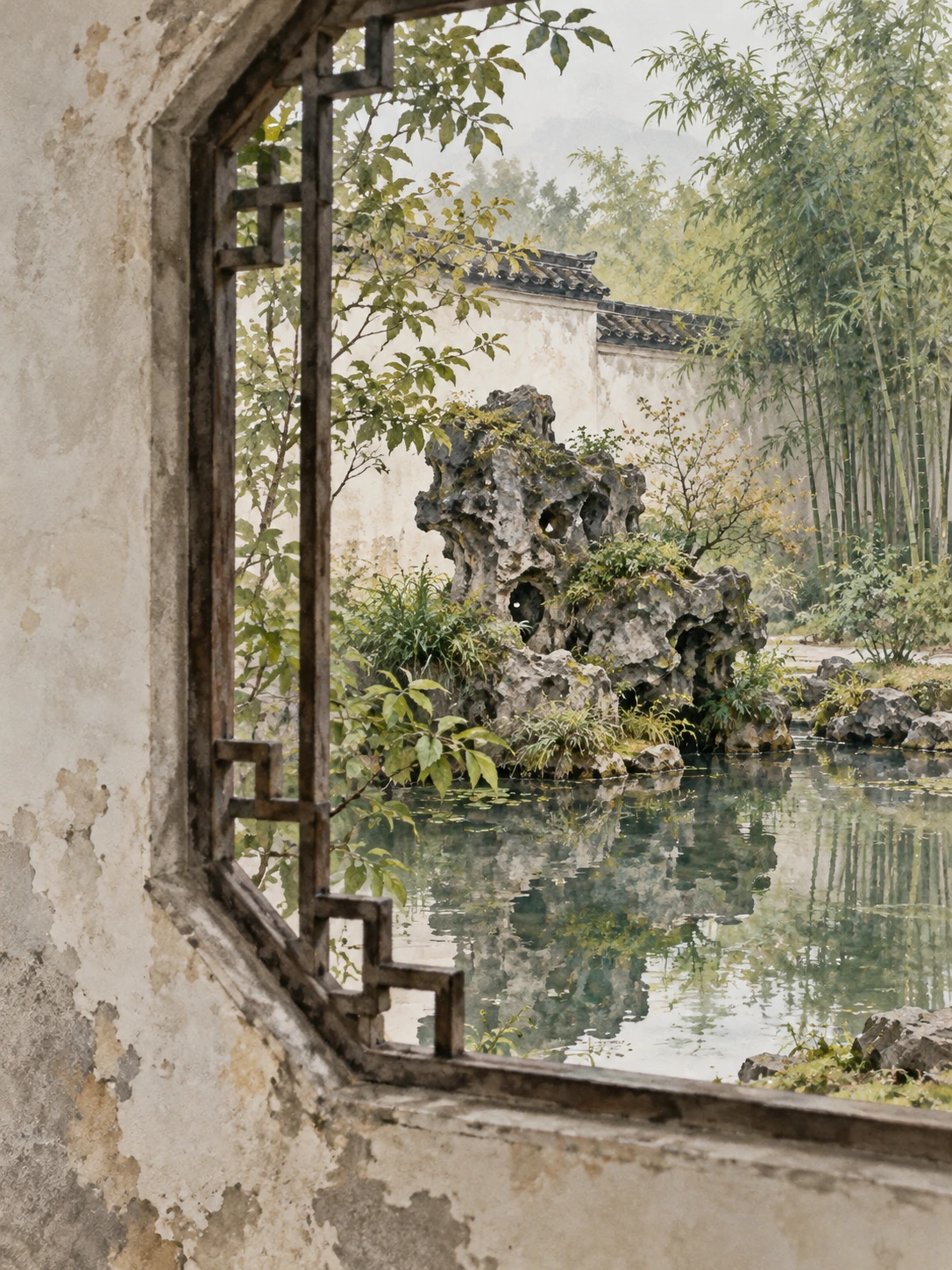
Window edge frames a pond, dark rock, and a more distant pale wall and bamboo.
Original spatial study inspired by garden framing, not a documented Suzhou view.

Pair that moving record with Alfreda Murck and Wen Fong’s A Chinese Garden Court. A publication and a film can organize the same environment differently: the page allows a reader to pause over a view or plan; the moving image can show gestures, handling, and a sequence of assembly. The useful task is to ask which question each medium answers most clearly.

While watching, choose one modest material relationship rather than trying to absorb the whole project. Look for a piece being positioned against another surface. Pause and describe the contact: edge, corner, joint, support. Then look for the finished relationship in an institutional photograph. The completed view can conceal the sequence that made its apparent calm possible.

The small geometric model below isolates a different relationship: a moving observer, an opening, and a distant target. Change the observer’s sideways position and note where the line of sight crosses the wall plane. A target can disappear even though it does not move. The model is a top-down ray calculation, not a garden plan or a representation of a specific design tradition.

A window selects a direction

Change observer, target, and opening width in an explicit ray model.

Open this activity in its own window.

Use the controls in pairs. First change only the observer; then restore that position and change only the width of the opening. The first changes the viewing relationship; the second changes the frame. Similar results can arise from different physical choices. A photograph of one successful view cannot tell us which other views the layout makes possible.

The model omits reflections, vegetation, light, and the meanings attached to actual places. Those omissions are useful when they keep the calculation honest. Return to the garden images afterward and identify one feature that the model cannot explain. The gap restores the richness of the designed environment rather than reducing it to geometry.

A garden can reward both approaches: following a precise line through an opening and following the people who made that opening. One explains part of what a visitor can see. The other reminds us that a composed view is also the result of material work.

Keep the work behind the view in sight

Garden photographs often exclude maintenance. A view that appears effortless still depends on decisions about plants, water, structures, surfaces, and access. When visiting, look for what a still photograph cannot preserve: the sound of movement, changing light, another visitor passing through the frame, or the distance between two scenes that look adjacent online.

Also notice the conditions of your own viewing. A crowded afternoon, a mobility limitation, a closed path, or a small phone screen changes what is available. There is no requirement to achieve a supposedly perfect contemplative state. An attentive question about a doorway is already a serious encounter with design.

The most rewarding souvenir may be a revised habit of looking. Once you notice how a wall selects a tree, an opening connects spaces, or a reflected edge doubles a roof, an urban garden becomes larger in a precise sense: it gives you more relationships to discover within the same ground.

Sources and a closer look

UNESCO: Classical Gardens of Suzhou; The Met: Astor Chinese Garden Court collection record; The Met: Garden Court educator guide; The Met: Poetry, Pavilions, and Patterns.

Find more art, ideas, and unexpected connections at Incoprea.
Cracks, Questions, and Records: How to Read an Oracle Bone Carefully

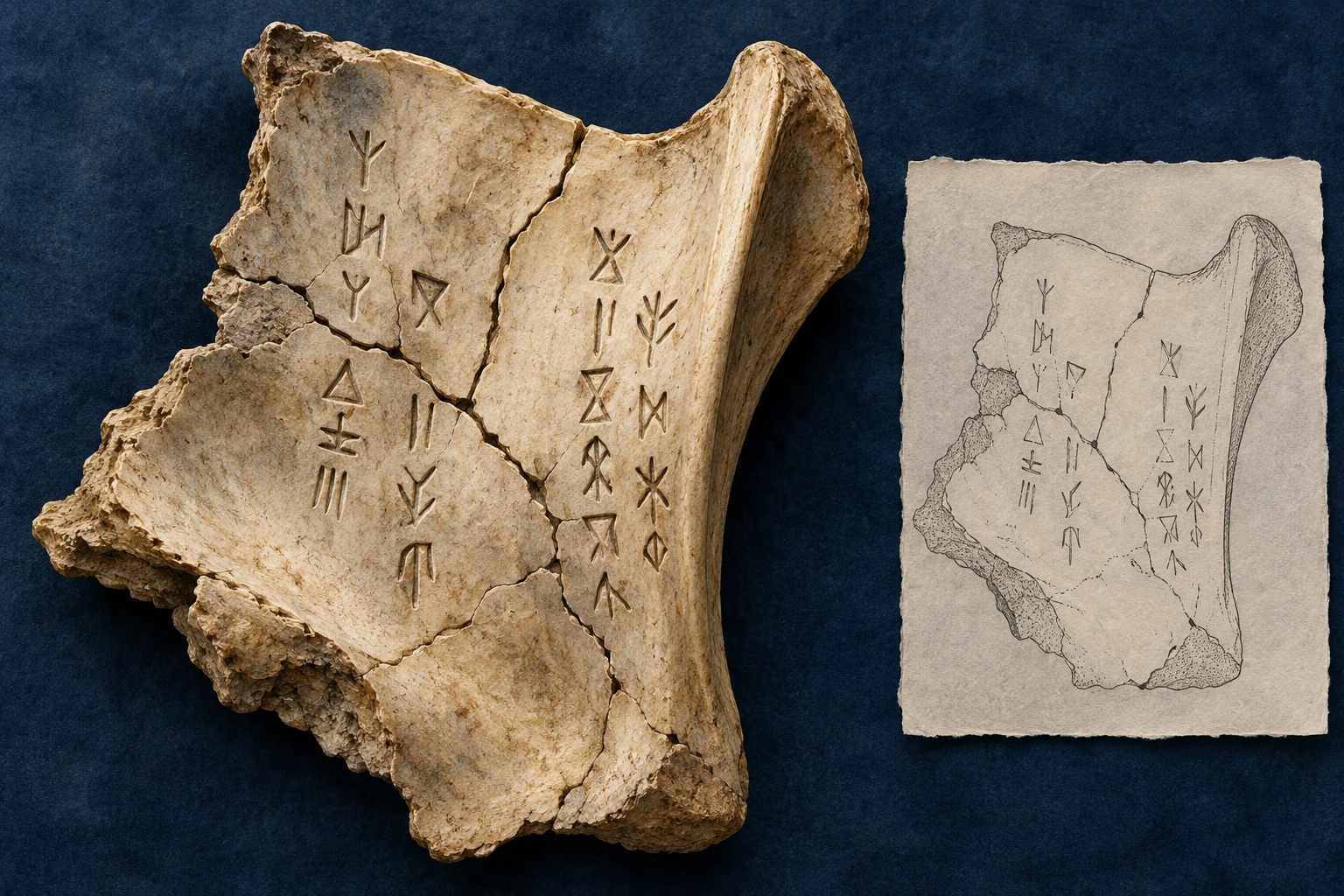
Conceptual oracle-bone fragment with branching cracks and abstract marks beside a paper tracing.
Archaeological concept; the marks are invented and carry no translation.

An oracle bone can carry two kinds of lines that are easy to confuse in a small photograph. Some are fractures. Others were deliberately cut as writing. Both belong to the object’s history, but they did different jobs. Begin by separating them, and the fragment becomes more than an evocative relic of prediction: it becomes evidence of preparation, ritual action, record keeping, and later interpretation.

Shang-period diviners used cattle shoulder blades and turtle plastrons in procedures involving heat and the reading of cracks. Inscriptions could record the subject and interpretation of a divination. The Penn Museum’s object guide places that practice in a royal context, concerned with political, social, and personal matters. It describes the cracks as a means through which diviners believed they received supernatural guidance.

The crack is not the sentence

That distinction is the first reading skill. A fracture does not turn into a written character merely because both are visible on the same surface. Nor does every surviving written passage include a complete question, prediction, and subsequent outcome. Breakage, omission, and the kind of record being made affect what remains.

Before asking for a translation, ask what the image shows. Is it the inscribed face, the reverse, a rubbing, a tracing, a modern reconstruction, or a photograph of a cast? Do the caption and catalog number identify the same object? Can you see where the fragment ends, rather than where an illustration has merely been cropped?

The Met’s oracle bone 67.43.16, for example, has an object record identifying inscribed bone, Shang attribution, and dimensions of 12.7 by 23.5 centimeters. Those modest facts give the image a material scale and an institutional identity. They do not by themselves provide a translation or establish that every visible mark is ancient writing.

A misplaced fragment and a careful refusal

In a 2001 first-person research account, scholar Victor H. Mair describes examining an oracle-bone fragment found among Penn’s cuneiform tablets. The object’s location in a museum drawer was a modern problem, not evidence of a Bronze Age journey from China to Mesopotamia. Registration records helped investigate its collection history.

Mair also discusses another fragment, 49-14-7B, only 1.4 by 1 centimeter. Too little of its inscription survived for him to offer a reading. That refusal is useful evidence of method: recognizing a category of object is not equivalent to recovering a lost sentence.

The same article raises concerns about a possibly later-added graph on one object and identifies another as a likely fake. These judgments belong to Mair’s published analysis; they remind us that cataloged collections can contain complicated histories of alteration, attribution, and reassessment. “It looks ancient” is not a sufficient authentication method.

Turn the object around

A surface with writing attracts attention first, but a three-dimensional object contains information that a front-facing image hides. Cambridge University Library’s Hopkins collection guide links digitized bones and records fifty in three-dimensional format. Its account of the imaging project describes how a model makes both finely incised marks and reverse-side divination pits available for closer viewing.

Use a model as an object study, not only as a rotating novelty. Choose one edge and follow it from front to back. Look for changes in thickness, the relation of a pit to a crack, and the difference between a deliberate hollow and a broken margin. If lighting controls are available, change the illumination gradually and notice which marks become clearer.

A digital surface is still an interpretation made through a recording process. Its resolution, texture, lighting, and completeness set limits. A feature absent from a model may have been too shallow, inaccessible, or poorly captured. That is different from demonstrating its absence on the physical object.

A four-column notebook for one fragment

You can do a serious ten-minute exercise without reading ancient Chinese. Choose one institutional object and make four short columns:

  • Visible: describe only what you can point to, such as a broken edge, a row of incisions, or a darkened area.
  • Cataloged: copy a few factual identifiers in your own notes, including the collection number, material, dimensions, and attributed period.
  • Interpreted: summarize the institution’s explanation and identify whose reading it is.
  • Unanswered: record what the available evidence cannot tell you.

Now review your first column. Did “burn mark” slip into it when you could only observe a dark patch? Move the proposed explanation into the interpretation column unless the source establishes it. Did “the king asked” appear when the translated fragment contains no surviving name? Mark that leap too.

The point is not to remove interpretation. It is to give it an address, so another reader can tell what supports it. A note with fewer confident claims may be more informative because its evidence remains visible.

A drawn line can clarify—and select

A modern research image may have passed through several transformations before it reaches a screen. The 2026 OBIMD dataset paper by Bang Li and colleagues distinguishes rubbing images, facsimiles, character annotations, and reading sequences. Its account explains that some non-character features emphasized in published drawings were omitted from its redrawn image layer to keep the selected representations aligned. A clear drawing is therefore a reason to ask what it was made to show.

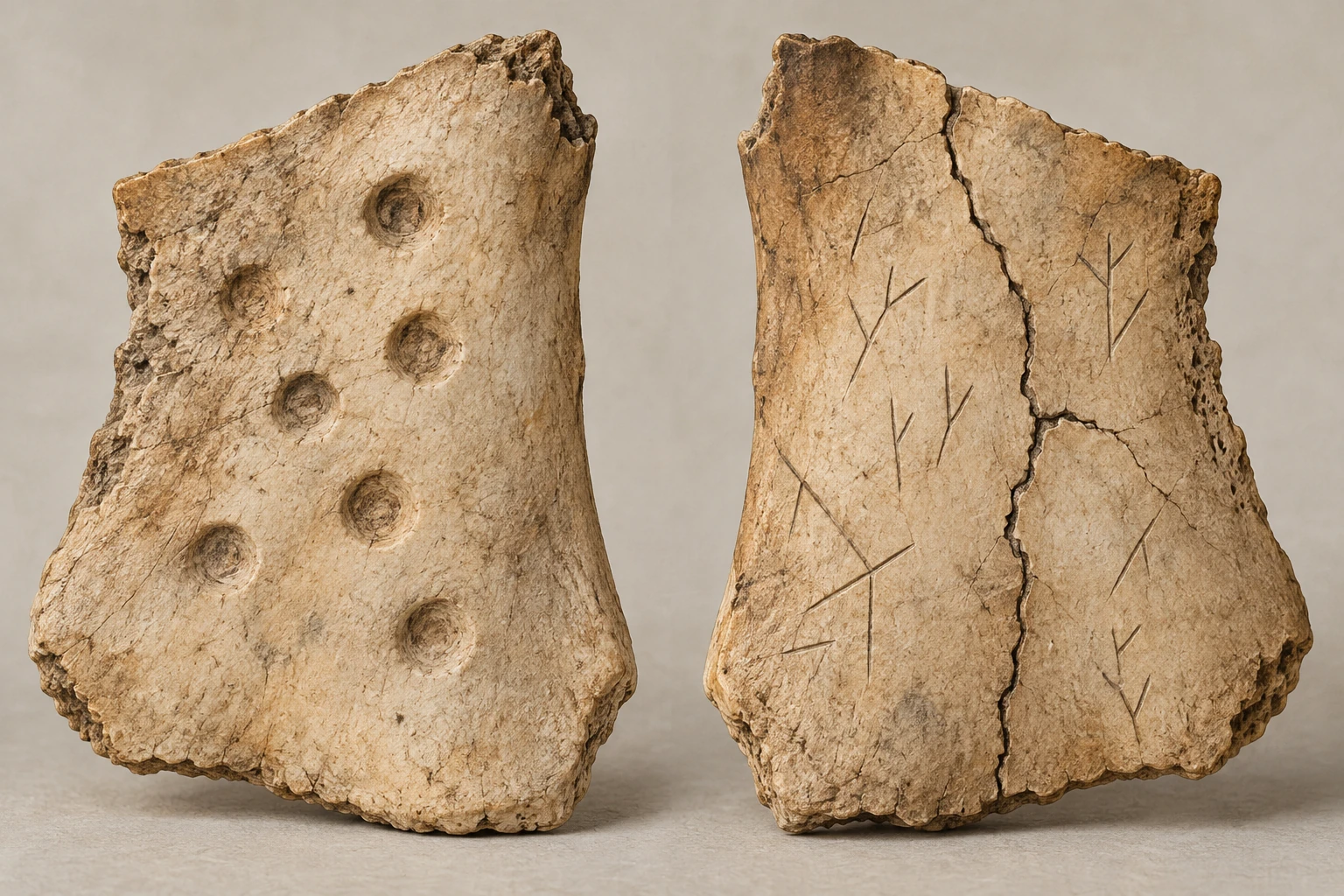
Paired conceptual bone views separate prepared pits from fractures and nonlinguistic incisions.
Archaeological concept only. The marks have no translation and do not document an object.

Cambridge’s digital Chinese collections guide also places oracle-bone images alongside other recording formats and collection types. The presence of two-dimensional and three-dimensional resources gives a reader choices. It does not turn a tracing, rubbing, photograph, and surface model into equivalent substitutes for every question.

Try an ordinary analogy with a pencil drawing of a leaf. One drawing can emphasize the outline, another the veins, and a photograph the texture and shadows. All may accurately select features from the same object. Comparing them requires knowing the aim of each representation. It would be a mistake to conclude that the leaf had no veins because an outline drawing left them out.

For an oracle-bone viewing session, make a small “image passport”: object or publication identifier, representation type, stated creator or institution, and features the image emphasizes. Add a fifth line for what the image cannot establish alone. If the available page does not identify the format, record that uncertainty before attempting a character comparison.

Now look at the article’s conceptual illustration as a deliberately different case. Its generic marks carry no transcription and supply no historical evidence. It can focus attention on the distinction between a prepared surface, a fracture, and cut marks, while the actual reading must return to documented objects and scholarship. Visual appeal should not give an illustration the authority of a recorded specimen.

The same care applies to computational work. Grouping marks into an inscription, choosing a reading order, and assigning a character label are related but separate tasks. The dataset’s attention to contextual structure is a useful reminder that recognizing one isolated sign is not equivalent to reading a fragment’s complete statement.

When a line looks unusually clear, ask one more question before celebrating: clear for which task? That question gives the reader a practical way to appreciate modern access while keeping the underlying bone, the act of recording it, and the interpretation of its marks distinct.

Why a question is not an event report

Here is a deliberately invented modern example: “Will rain damage the harvest?” It records a concern. It does not establish that rain came, that a harvest failed, or even that rain was unusually likely. A later note reporting an outcome would provide a different kind of information.

The same logical care matters with ancient records. A translated concern about warfare, weather, or illness should not automatically become an event in a historical timeline. Grammar, textual convention, context, and surviving follow-up records have to carry that argument. Our invented sentence is a reminder about inference, not a translation of an oracle-bone inscription.

These objects are valuable partly because belief and practical concern meet on their surfaces. A record can reveal what mattered to a court without giving direct access to every life around it. Look at the crack, the cut line, the reverse, and the catalog history together. The resulting encounter is slower than a dramatic prediction story—and far more revealing.

Sources and a closer look

Penn Museum: Oracle bone fragment 49-14-7B; The Met: Oracle bone 67.43.16; Victor H. Mair: The Case of the Wayward Oracle Bone; Cambridge University Library: Hopkins collection guide; University of Cambridge: Oracle bones in 3D.

Find more art, ideas, and unexpected connections at Incoprea.
Wednesday, October 14, 2026

Dunhuang's Library Cave: An Archive Larger Than Its Nickname

Start with a room, then imagine the scale of what came out of it. In 1900, Wang Yuanlu discovered a sealed chamber at the Mogao Caves near Dunhuang in northwestern China. The objects associated with that small space now support research across languages, religions, book forms and everyday activities.

“Library Cave” is a convenient name, but it can mislead if it suggests shelves of uniformly bound books. Cave 17 held manuscripts, printed documents, paintings, textiles and other materials. To explore it well, follow one object closely, then step back to consider the extraordinary range around it.

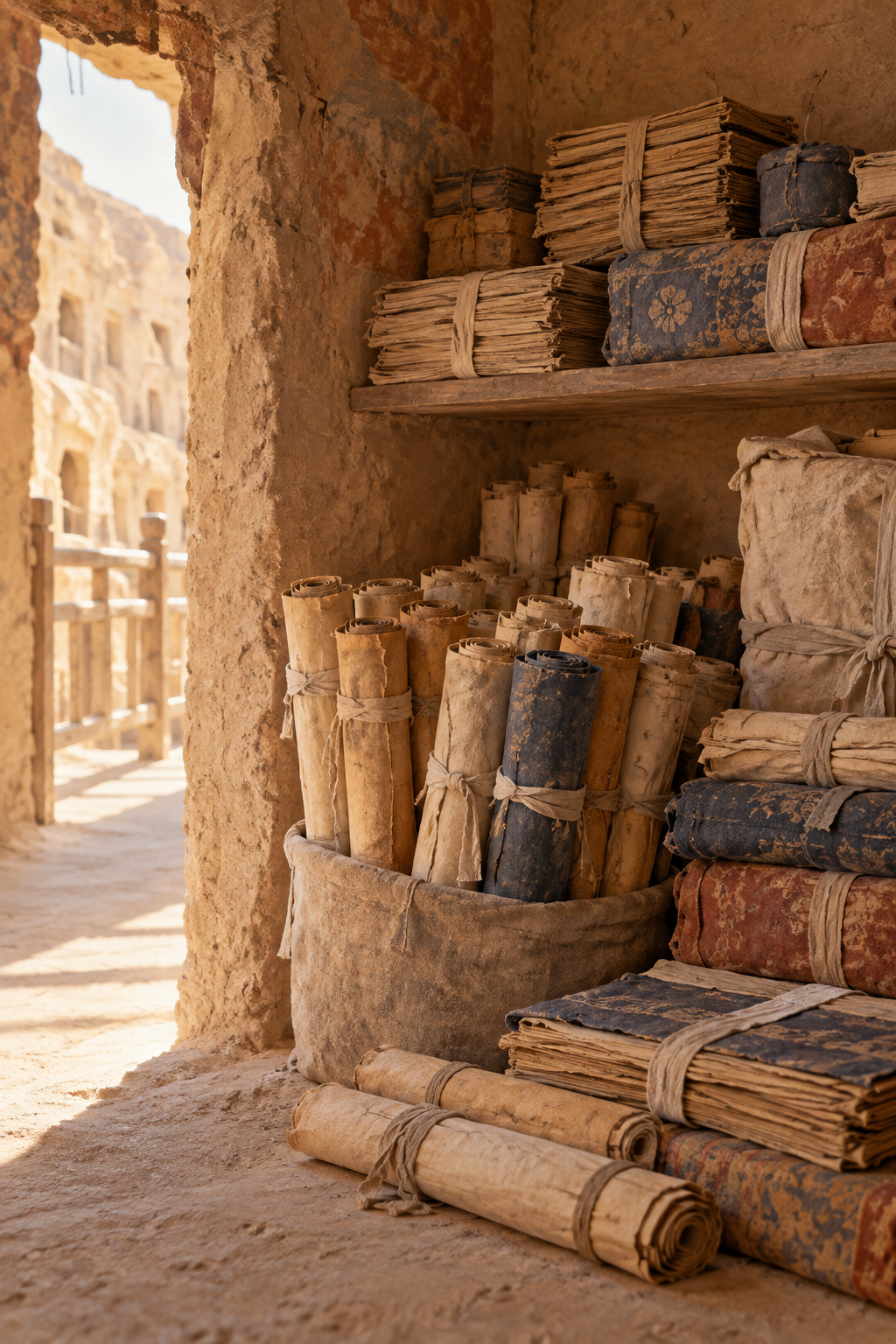
Illustration of imagined manuscript bundles in an earthen storage alcove.
This conceptual storage scene is not a reconstruction of Cave 17 as first found; the original arrangement is uncertain.

A collection of activities, not just titles

The International Dunhuang Programme introduces a collection in which Chinese and Tibetan materials stand alongside smaller groups in Khotanese, Turkic, Sanskrit and Sogdian. The presence of several languages reflects connections among people who did not all write, read or worship in the same way.

Buddhist texts form a major part of the archive, while legal, official and other practical records reveal further uses of writing. Scrolls, booklets, concertinas and loose-leaf forms ask different things of a reader's hands. The format of an object can tell us something before its language becomes accessible.

A scroll presents information by unrolling a length. A booklet allows pages to be turned. A folded format makes other kinds of opening and sequence possible. Thinking about those actions helps restore reading as an activity. A digitised rectangle is the surface of something that was handled.

Follow the Diamond Sutra beyond its famous date

Among the best-known objects is the printed Chinese Diamond Sutra dated to 868. IDP's introduction explains its importance as a Buddhist text and identifies this copy as the earliest dated printed book. The distinction is about a surviving, dated object; it does not mean printing began on that day.

The scroll offers more than a timeline landmark. Its opening illustration, extended text and concluding information invite different kinds of looking. IDP explains that seven printed sheets were joined into the scroll and describes the dedication associated with Wang Jie and his parents.

That dedication connects reproduction to religious intention. Printing was a way to make and circulate a meaningful text, not simply an early attempt to invent the modern publishing industry. Ask what the object was for before asking which later technology it resembles.

The date of the surviving copy is also distinct from the age of the teaching it transmits, the date of a translation and the later history of its storage. A single scroll can hold several chronological layers. Keeping them separate makes the object more informative rather than less impressive.

Discovery changed the archive

Wang Yuanlu had taken responsibility for restoration at the caves before finding the chamber. IDP's discovery account describes his custodianship and the acquisition of large groups of objects by visiting foreign scholars. Aurel Stein obtained materials in 1907; Paul Pelliot followed in 1908.

The subsequent dispersal is part of the history readers need. Present-day collections reflect decisions about selection, acquisition, transport and cataloguing as well as the activities of the people who originally made the objects. A library record is therefore also a record of how an item entered a modern institution.

Nor can a dramatic storage image recover an untouched arrangement at discovery. The contents were disturbed before later documentation. The illustration here suggests density and variety, but should not be used to infer the exact location of a bundle inside the chamber.

A three-object visit you can make online

Open the IDP manuscript introduction, then follow its collection links. Choose three objects for different reasons: one for its format, one for its language and one for its subject or use. They need not be famous.

Questions for a miniature reading room
Your objectBegin withThen consult
A striking formatHow would someone open or hold it?Dimensions and material description.
An unfamiliar scriptHow are lines and spaces arranged?Language identification and scholarly description.
A practical documentWhat action might the record support?Translation, date and provenance.

For each, write down one observation available from the image and one fact that depends on the catalogue. This small separation helps avoid treating a visual impression as a translation. It also shows why digital access works best when photographs and records stay connected.

If a scan contains several sheets or views, follow their order. A frontispiece alone can make a religious scroll seem like an independent picture. A fragment alone can conceal the scale of a larger work. Digital interfaces are useful tools, but the reader still has to reconstruct the relationship among parts.

The people behind the paper

The British Library's 2024–2025 exhibition “A Silk Road Oasis” used roles including scribes, printers, merchants and religious practitioners to explore Dunhuang. That approach remains useful after the exhibition's closing date. Documents are traces of people doing things, not simply specimens of scripts.

A copied teaching, a legal record and an image might have circulated within overlapping communities while serving very different purposes. Their differences make the archive rich. “Silk Roads” names a field of connections; the object gives those connections a particular material form.

By the end of a short digital visit, the chamber can seem larger than it did at the beginning. Its significance lies partly in celebrated treasures, but also in the ability to set unlike records beside one another. The best next question is often modest and specific: who needed this object, and what did its format allow them to do?

Sources and further reading

Explore more art, stories and discoveries at Incoprea.

Famous Last Meals is now in paperback — stories, history and 25 recipes

Famous Last Meals: Stories, History, and Recipes is now available in paperback on Amazon. The illustrated collection brings together 23 his...