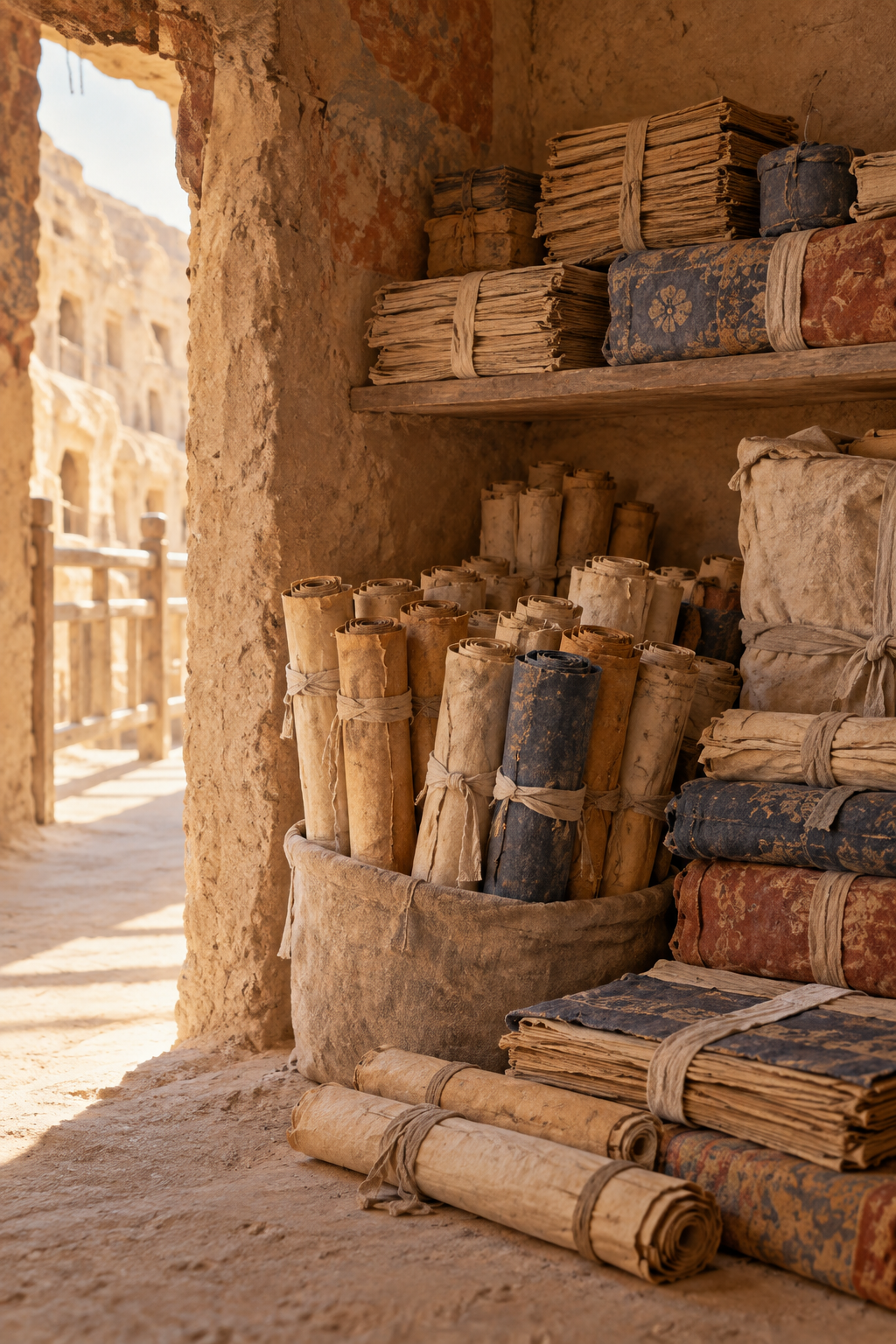
A small sealed chamber can change the scale of history. In 1900, Wang Yuanlu discovered the room now called Cave 17 at the Mogao Caves near Dunhuang in northwestern China. Inside were bundles of manuscripts and other materials that had remained closed away for centuries.
The name Library Cave is convenient, but can suggest a modern room of organized books. The surviving collection includes manuscripts, printed documents, paintings and textiles. Its significance lies in that variety, and in the many people and activities those materials represent.
Many languages, many kinds of work
The International Dunhuang Programme describes Chinese and Tibetan manuscripts alongside smaller groups in languages including Khotanese, Turkic, Sanskrit and Sogdian. A single-language picture of the Silk Roads cannot do justice to such an archive.
Buddhist texts form a major part of the collections, but religious writing is not the entire story. Legal contracts, official records and other practical documents can illuminate daily life. Different manuscript forms—scrolls, folded books and loose sheets—also show that a text's physical format was a choice.
The British Library's 2024 exhibition account approached Dunhuang through roles such as scribe, printer, artist, merchant and Buddhist nun. That is a useful way to imagine the archive: materials produced and used by people doing particular things.
A prayer, a contract and a copied teaching can belong to the same community without performing the same job. Studying their language, handwriting and material form helps recover those differences.
The discovery is part of the evidence
Wang Yuanlu had taken responsibility for restoring the caves. Following the discovery, foreign scholars and expeditions obtained substantial groups of objects. Aurel Stein visited in 1907; Paul Pelliot followed in 1908. Materials subsequently went to collections in several countries, while many others remained in China.
The history of this dispersal should accompany the celebration of a remarkable find. An item's present location reflects more than its ancient use. Acquisition, selection, transport and later conservation all affect what researchers can examine together.
The IDP also cautions that the exact arrangement at rediscovery is unknown. By the time later visitors documented the chamber, its contents had already been disturbed. An evocative modern illustration therefore cannot be treated as an image of the untouched archive.
Reading across a dispersed collection
Digital documentation makes it easier to compare material that is now separated geographically. The International Dunhuang Programme's manuscript portal introduces formats, languages and links into the collections. It offers a useful starting point for looking beyond the famous individual treasures.
A digital image is evidence of a surface. Catalog descriptions, provenance, dimensions and scholarly interpretation provide additional layers. Searchable access is most valuable when those layers stay connected, rather than when an image circulates without its context.
The Library Cave's appeal is consequently broader than the idea of a secret cache. It preserves traces of learning, worship, commerce and administration, then adds a modern history of discovery and movement. Every manuscript can be approached with several questions: who made it, who used it, how did it survive and how did it reach the place where we now encounter it?
Sources: International Dunhuang Programme: discovery and dispersal of Cave 17 · International Dunhuang Programme: manuscript collections · British Library: life in ancient Dunhuang
Explore more creative curiosities at Incoprea.




