Stand in front of a shelf and imagine choosing a book by its page edges. The spines face away from you. A chain runs from each cover to a metal rod, and the desk is close enough for a volume to reach it. The arrangement looks unfamiliar until you follow the movement of a reader’s hands.
A chained library was a physical answer to a practical question: how could a valuable, portable book remain available for consultation without leaving the collection? The chain joined the object to a place. Furniture, book orientation and rules of admission determined what reading in that place could mean.
Read the mechanism from the cover to the desk
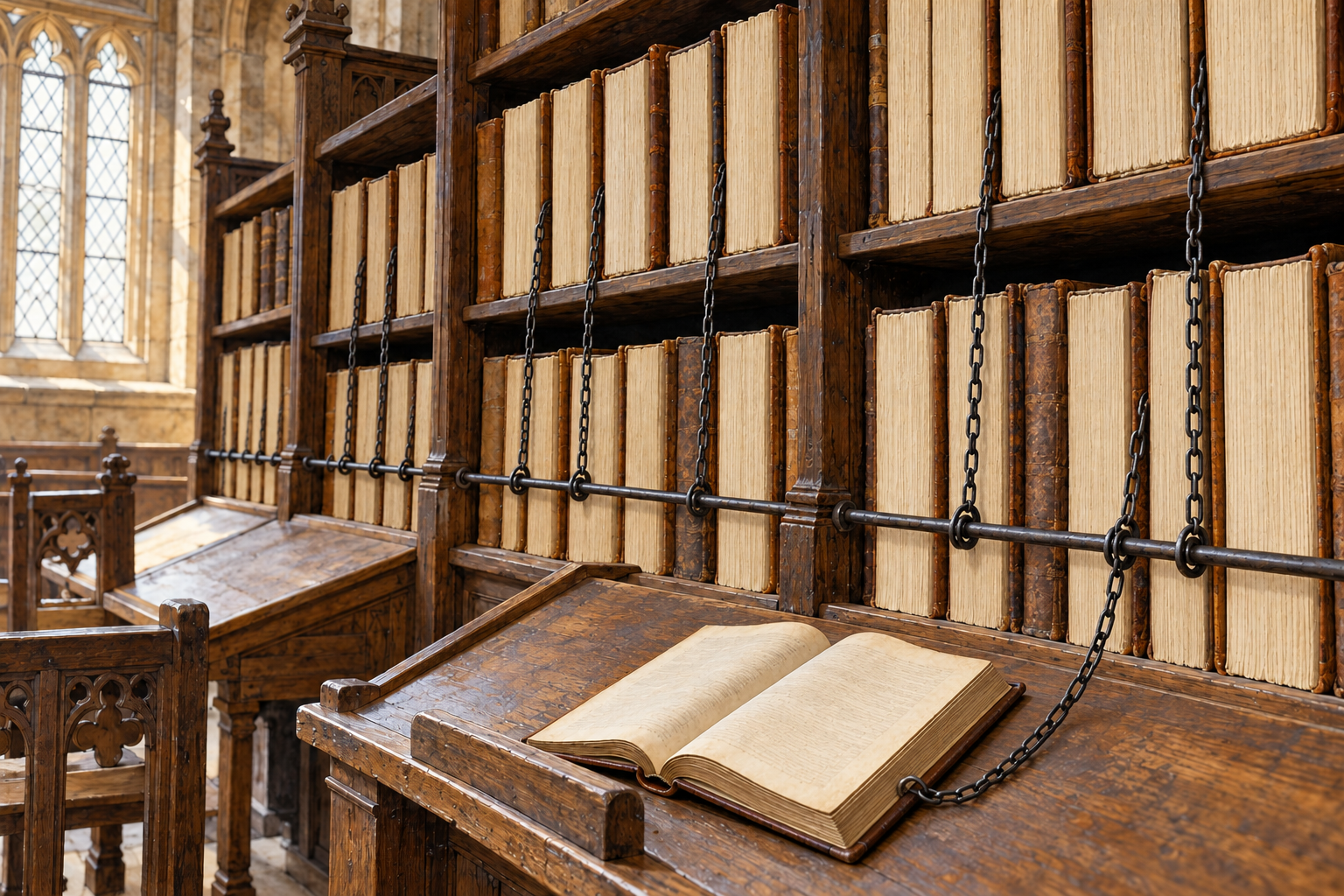
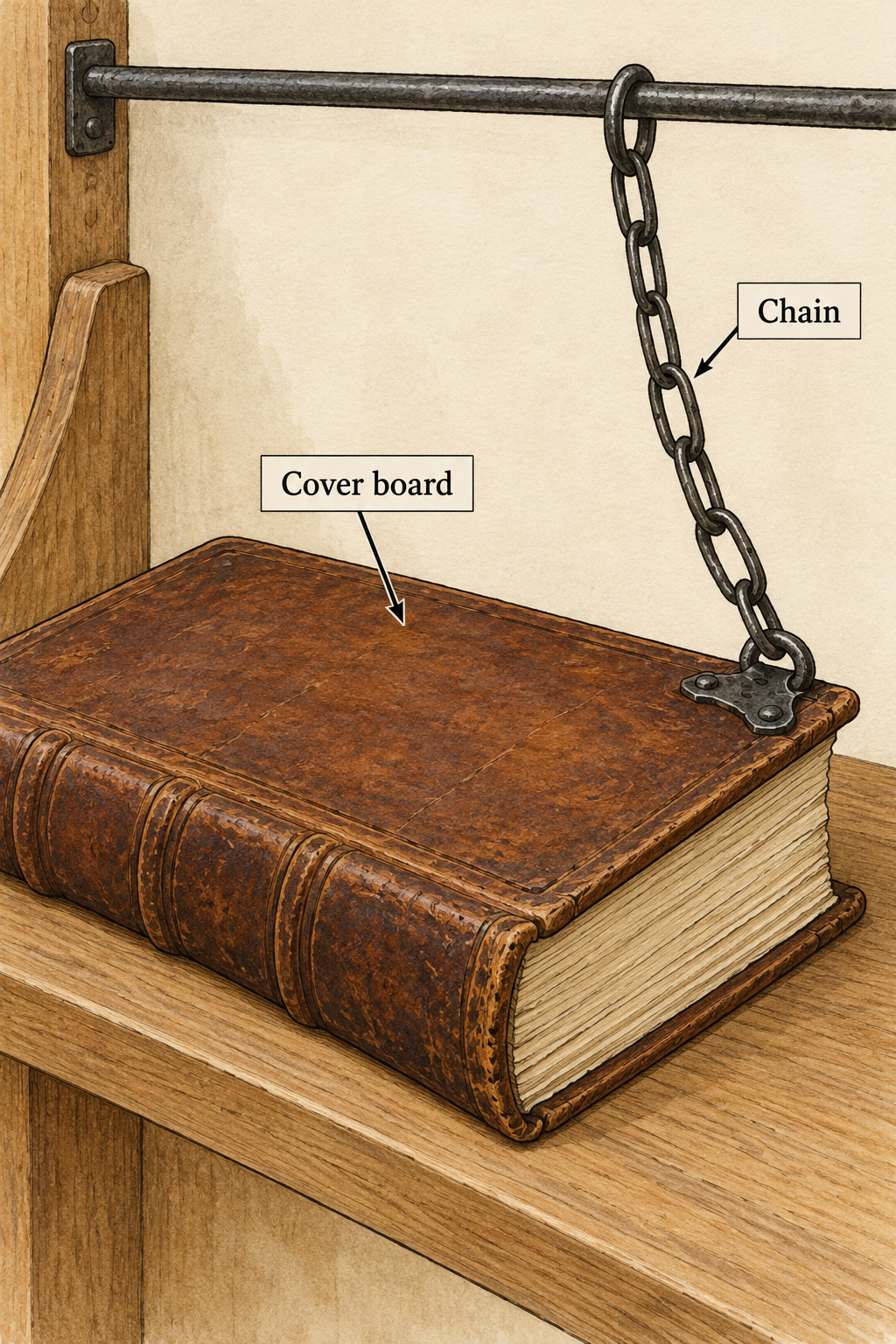
Hereford Cathedral’s account describes a chain attached to a book’s front cover, with its other end slotted onto a rod along the bottom of the shelf. A reader could lift the volume down and open it at the desk while the tether remained attached. The pages were available to turn; the hardware did not have to fasten the text shut.
The fore-edge is the edge opposite the spine. At Hereford it faces the reader, which avoids turning the volume around before opening it and tangling the chain. This is a small detail with a large explanatory role. A shelf arranged for untethered books is not automatically convenient for books that remain connected to a rail.
Try the movement with an ordinary modern book on your own table, without attaching anything to it. First place its spine toward you, lift it, and turn it into a comfortable reading position. Then place the page edge toward you and repeat. Imagine a tether fixed to the front cover throughout. The orientation that felt merely odd becomes a response to a sequence of movements.
A room can preserve several different historical times
Hereford’s surviving seventeenth-century library retains its chains, rods and locks. The cathedral describes the displayed arrangement as the one used from 1611 to 1841. Its collection also includes much older material, among it the eighth-century Hereford Gospels. The date of a book, the date of its furniture and the date of its current protective room need not match.
That distinction prevents a common visual shortcut. A medieval manuscript sitting in an early-modern chained bookcase does not make every visible component medieval. A surviving library can bring together objects acquired, arranged and conserved over many generations. Looking carefully means keeping those layers in view rather than assigning the whole room a single birthday.
Consider what a photograph cannot settle. It may show a cover fitting and a chain very clearly. It cannot, by itself, tell you when the fitting was added, whether it was moved or repaired, or which regulations applied to a particular reader. The physical clue is valuable precisely because it gives you a focused question to take to a catalogue or institutional history.
Some books traveled while others stayed
Oriel College’s library history records both a lending collection and a chained collection. Its statutes envisaged books being returned each year on 2 November, when fellows made new selections. References to the chained library appear by 1409, and Oriel’s books remained chained until 1755.
Oriel also distinguishes probable arrangements from firmly dated records. Marks on manuscripts suggest that some volumes lay flat at lecterns, while a later shelf-based system changed the room’s organization. This is useful evidence of reading practice. The surviving object can retain traces of how people once approached it, even when the furniture or routine has changed.
The two collections complicate the idea that a chain expresses a blanket hostility to readers. An institution could lend some material and retain other material for consultation in place. That did not make admission universal. It means that the question “Could someone take this book away?” needs to be kept separate from “Who was allowed to read here?”
A promise of access could include a social boundary
The history supplied by Wimborne Minster makes that boundary unusually visible. The library was founded in 1686. An initial gift of theological works was not chained. When Roger Gillingham added ninety books in 1695, he required the new gift to be chained and the library to open free to townspeople of a specified social standing.
The donor’s wording included “shopkeepers or the better class of person.” That restriction matters. The same arrangement could increase access beyond a private owner’s shelves while still drawing a line around the intended public. Calling it open without discussing that line would lose part of its history.
Wimborne’s recorded subject range includes gardening, medicine, law and building as well as theology. Imagine the different questions those books could bring into the room. The chain tells us where consultation occurred. The collection’s subjects and the admission rules help reveal whose practical or scholarly questions the institution expected to serve.
Look at a library photograph as evidence
Find a page edge, a spine, a cover attachment, a rod and a reading surface. Trace a possible route from shelf to desk. Then make two lists: things the image shows directly, and things you would need a catalogue or rule book to establish. A visible tether belongs on the first list. A claim that everyone in the town could read the collection belongs on the second.
A chain cannot keep the climate out
Keeping a book in the building addresses only one kind of loss. In its 2023 account of environmental-system works, Hereford described separate temperature and humidity needs in the Chained Library, archives, reading room and Mappa Mundi chamber. The modern protective system has to care for materials and spaces with different requirements.
The Library of Congress guide to storing books likewise emphasizes the environment and good storage as ways to extend a book’s useful life. Restricting movement does not prevent deterioration caused by unsuitable conditions. A dramatic security fitting and a quiet environmental system protect against different threats.
Return to the first imagined movement: lifting a volume down, opening it, and reading while its chain rests nearby. The library is more than a row of restricted objects. It is a set of decisions about keeping knowledge available, managing scarce copies, admitting readers and preserving the material long enough for the next generation to ask its own questions.
Sources and further exploration: Hereford Cathedral: mechanism and surviving arrangement; Oriel College: lending and chained collections; Wimborne Minster: donors and access; Hereford’s 2023 environmental works; Library of Congress: storing books.




