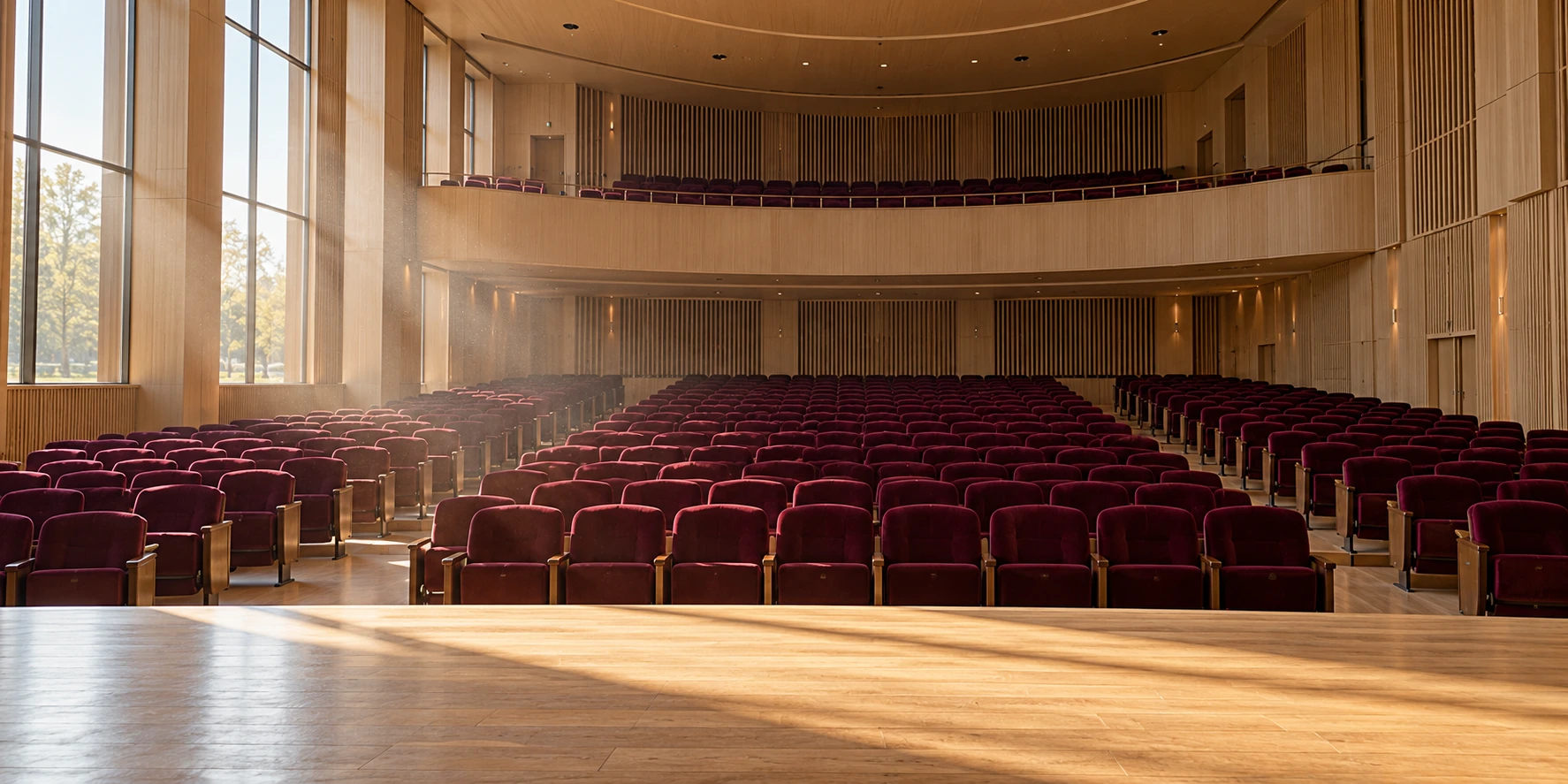
The book appears to have a perfectly ordinary gold fore-edge. Then its pages are gently fanned. A house, trees and a stretch of landscape appear across the sloping edges. Close the book, and much of the scene retreats again. The picture has not been switched on. A different part of the paper is facing you.
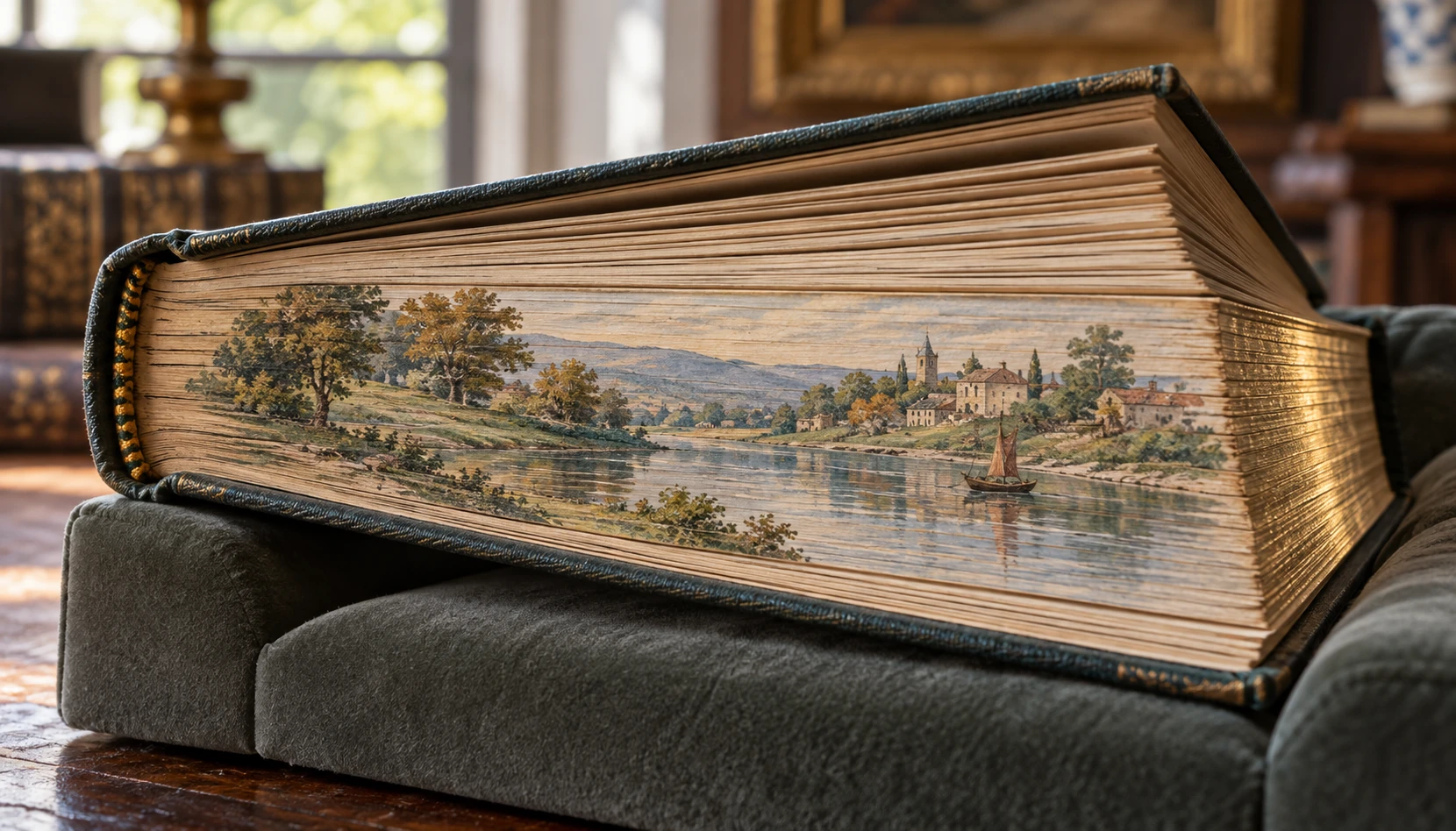
A hidden fore-edge painting is an image distributed across a stack of leaves. Its trick depends on the geometry of many narrow surfaces. The book is both the support for a picture and the mechanism that changes its visibility.
Begin with a particular house
The Folger Shakespeare Library shows a view of Wilton House on a volume of a 1797 Shakespeare edition. The painting is associated with Edwards of Halifax and dated around 1812. Its photographs show the fanned image and the same book closed, when gilding almost conceals it.
Compare those two views before reading further. Where does the landscape go? Look at the slant of the page block. When leaves are displaced slightly from one another, small painted strips become available together. When they return to a compact stack, the visible edge changes.
The book's publication date and the painting's date are consequently separate pieces of information. A volume can receive new decoration long after it was printed. That is not a suspicious exception; it is part of the material life of a book.
The image is divided into narrow contributions
Imagine a picture sliced into many thin horizontal bands. Each page contributes a little to the view, and a small collective shift exposes the bands in a useful arrangement. This comparison explains the principle without pretending that a book is a mechanically perfect stack of identical sheets.
Paper thickness, trimming, binding and the amount of fanning all affect the result. The skill lies in preparing and painting a surface that will return to a recognizable relationship when the book is handled appropriately.

The two illustrations here are conceptual companions, not before-and-after documentary photographs of one historic volume. For an actual demonstration, watch Cornell University Library's video of a 1925 copy of Kipling's Kim. The library identifies it as a work associated with Miss C.B. Currie and notes a photograph kept with the book of the scene depicted.
A still photograph hides half the event
Pause the Cornell demonstration before the pages move. Predict where a painted area will become visible. Then continue only far enough to see the reveal. The motion connects the closed edge to the open image in a way that two separate stills cannot fully explain.
The accompanying photograph mentioned by Cornell adds another layer of interest. An image in a book's edge can have a visual source outside the book's text. The subject of the painting does not have to illustrate the story printed on the pages.
The Boston Public Library's own fore-edge painting album offers a wider selection of documented scenes. Browse several examples and compare the long, narrow composition with a conventional painting. The page block imposes a strong shape, and artists work within it.
Some edges show more than one picture
The Folger's examples also include double fore-edge paintings. Fanning one way exposes one scene; fanning the opposite way exposes another. The surprise grows from the same basic principle: different small surfaces become visible under different arrangements.
It is tempting to describe this as an old version of a screen. A more useful comparison is a louvered surface, where angle changes which parts face the viewer. There is no electronic replacement of the image. The material already contains the information, waiting for a change of view.
A safe geometry exercise
Fan a few blank index cards gently in your hands and look at the stepped edge. Do not paint them or use a valuable book. Notice how one narrow strip on each card becomes visible. Then bring the stack back together. You have isolated the moving support without attempting a binding technique.
Historic volumes need knowledgeable handling. A video gives the pleasure of the reveal without asking you to force an old binding into a dramatic pose. The care is part of the experience: the hidden picture is worth seeing, and the book is worth preserving.
Fore-edge painting makes an ordinary action—changing the angle of pages—feel like discovery. Its best surprise arrives when the mechanism becomes understandable and the effect remains delightful. A landscape has been waiting in the tiny surfaces that reading usually lets us overlook.
Sources and further exploration: Folger: fore-edge paintings; Cornell: painting hidden in gilt edges; Boston Public Library: fore-edge paintings album.
Explore all 50 new articles · Browse the complete illustrated collection
Explore more art, ideas, and independent projects at Incoprea.