A carved wooden object sits inside a transparent enclosure. From outside, little seems to happen. There is no visible spray, no dramatic repair, and no freshly polished surface. The important work is occurring in the atmosphere around it—and in the records showing that atmosphere stayed within its intended conditions.
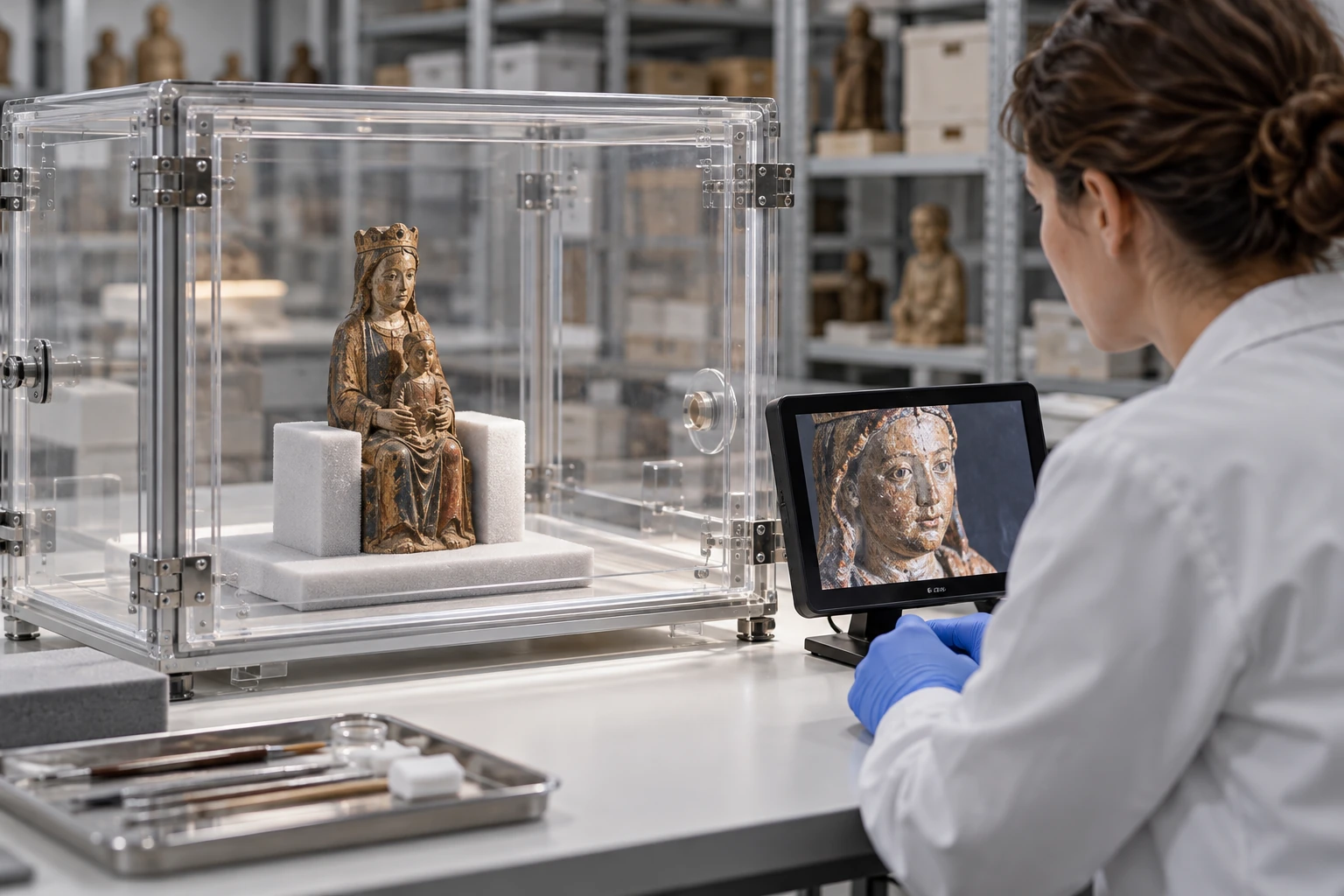
Museum anoxia uses a very low-oxygen environment as one tool against insect infestation. Its appeal is easy to understand: treat the living threat while preserving the object that contains it. Its success depends on much more than putting something in a bag.
Start with the collection, not the enclosure
The Canadian Conservation Institute's pest guidance places treatment within a wider program of prevention, detection, identification, and response. A damaged hole alone does not reveal whether an insect is currently active. Records of fresh debris, traps, location, and the kind of organism help establish what problem exists.
Imagine receiving an old chair with small exit holes. One possible story is active infestation; another is historical damage that has been inactive for decades. The visible object can fit both stories. A careful institution collects additional evidence before choosing a response.
For a visitor's close-looking exercise, inspect only a museum label or published conservation account. Does it distinguish old damage from an identified active pest? Does it describe prevention after treatment? Those details show the reasoning that a before-and-after photograph cannot carry.
The environment has to stay changed
CCI's treatment comparison explains that low-oxygen treatment depends on conditions including temperature, duration, and insect tolerance. Enclosures can be compromised by small leaks or poor seals. Some object colorants also require consideration. The method is therefore a controlled conservation procedure, not a universal safe treatment for every material.
Separate three states: the environment you intend, the environment a sensor reports at one moment, and the environment the object actually experiences over the whole treatment. A single favorable reading cannot establish the third. The record across time is part of the evidence.
This is a professional conservation account, not a household pest-control recipe. Gas handling, low-oxygen environments, object compatibility, and verified efficacy require appropriate expertise and facilities. We can understand the decision process without providing an operating schedule.
An invisible process needs visible records
The Getty Conservation Institute's monograph brings together experiments, treatment experience, enclosure materials, and monitoring methods. Its detailed attention to containment and measurement is the substance of the procedure, rather than administrative decoration around it.
Consider a fictional log containing only two entries: “enclosure closed” and “object removed.” What questions remain? You cannot tell whether oxygen stayed low, whether temperature and humidity were suitable, whether a leak occurred, or what criterion defined completion. Adding a beautiful photograph does not fill those gaps.
Now imagine a log that preserves readings, interruptions, object description, pest identification, and the reason for the selected method. Even without seeing the treatment occur, another professional can assess what was done and what uncertainty remains. Documentation lets the invisible process become reviewable.
The object has an environment after treatment, too
The National Park Service's monitoring guidance emphasizes trap placement, inspection, and records as part of integrated pest management. A successful intervention does not prevent a new pest from arriving later. Building conditions, storage, housekeeping, and incoming objects remain part of the system.
Think of treatment as one bounded event inside a longer collection history. Before it, staff need evidence and a plan. During it, they need controlled conditions and records. After it, they need prevention and monitoring. The enclosure occupies only the middle of that sequence.
Read a conservation story in four questions
What was the evidence of a current problem? Why was this method compatible with the object? How were conditions and completion checked? What changed afterward to reduce recurrence? If a short exhibition label answers only one, treat the others as questions for the fuller project record.
When reading an example treatment record, look for a stated completion criterion before the results. A criterion chosen only after the event can be too easy to satisfy. Recording what would count as success in advance makes the later judgment clearer, especially when the most important conditions were invisible throughout the procedure.
The quiet enclosure becomes much more interesting once you know what to look for. Its visible stillness conceals an active experiment in environmental control. The conservator is not merely removing an insect. They are building a defensible chain of evidence that a vulnerable object passed through a treatment—and can return to a collection whose care continues.
Sources and further exploration: CCI: pests and preventive conservation; CCI: comparison of treatment methods; Getty: inert gases in museum pest control; NPS: insect monitoring with sticky traps.
Explore all 50 new articles · Browse the complete illustrated collection
Explore more art, ideas, and independent projects at Incoprea.


