Showing posts with label Animals. Show all posts

Wednesday, October 14, 2026

The Gopher Tortoise Builds Shelter for a Whole Community

The pale sand outside a gopher tortoise burrow is a clue to work you did not see. An animal has carried soil out of the ground, leaving a sloping passage behind it. The entrance may look modest beneath open pine woodland, but it leads to shelter whose importance reaches beyond its builder.
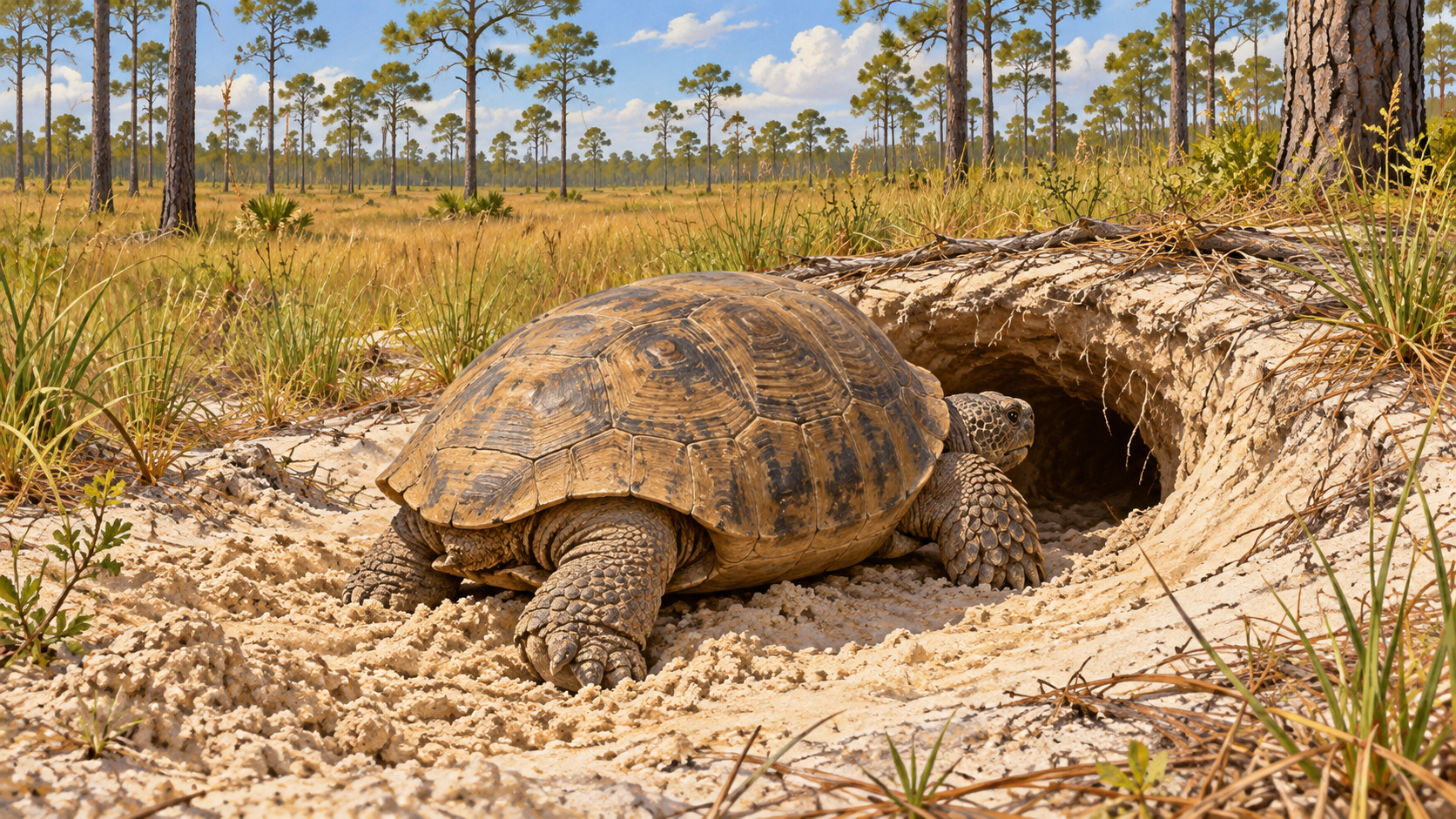
A gopher tortoise entering a sandy burrow in open longleaf-pine woodland.
An artistic view of a gopher tortoise and its burrow entrance in open pine habitat.

The gopher tortoise, Gopherus polyphemus, lives in the southeastern United States. Its digging forelimbs help excavate a refuge where above-ground conditions become less extreme. Other animals use these spaces too. Florida's wildlife agency records more than 350 species benefiting from the burrows across the system, a tally of ecological diversity rather than a head count inside one tunnel.

A different climate within reach

For a tortoise, temperature is part of the daily schedule. As an ectotherm, it relies on environmental conditions to regulate its body temperature. Basking, feeding and retreating change the conditions it experiences. A burrow expands that range of choices: an exposed surface and an underground refuge need not be equally hot, cold or dry at the same moment.

The US Forest Service review describes protection from temperature extremes, predators and fire among the burrow's functions. Its dimensions vary with the tortoise, soil and water table. The familiar cutaway of a descending tunnel with space at the end is a useful orientation, but individual burrows do not follow an identical architectural blueprint.

Imagine following a tortoise through a warm day using only the air temperature from a weather report. You would miss differences between open sun, shade, the entrance and the tunnel below. The animal's environment is a set of available places, not one regional number. By excavating a passage, it changes which of those places it can use.

The sand outside is part of the engineering

The apron at the entrance consists of excavated soil brought to the surface. It makes a physical record of digging and changes the local patch of ground. The burrow therefore creates both an underground space and a surface disturbance. Ecological engineering does not always require a dam or a towering nest; shifting soil can be enough.

The term ecosystem engineer describes this alteration of surroundings in ways that affect other organisms. The tortoise need not intend to help its neighbors. A space built for its own survival can become a resource for animals with different needs. This makes an ordinary behavior consequential at the level of a community.
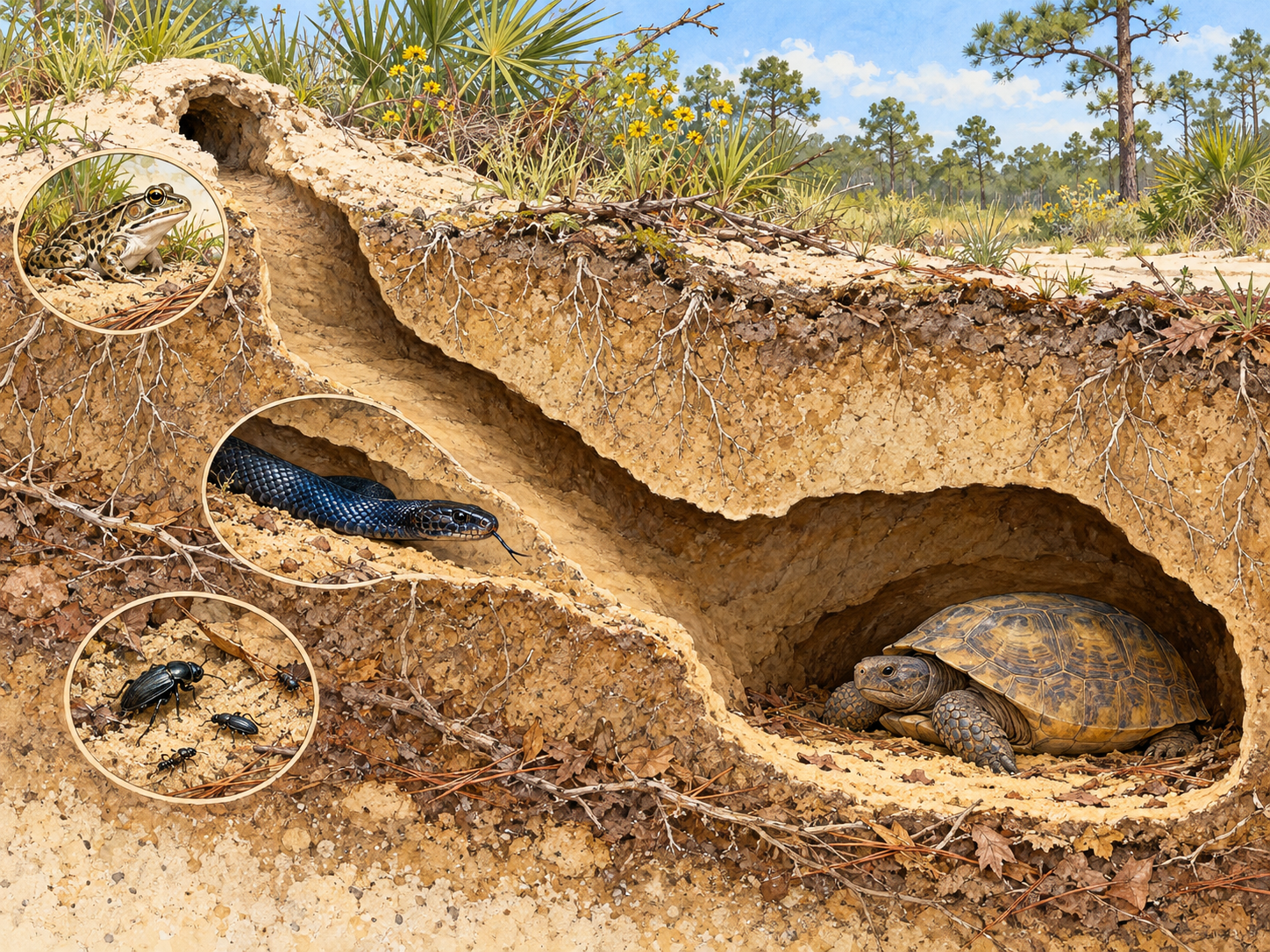
Conceptual cutaway of a tortoise burrow, with separate vignettes of a frog, indigo snake and insects.
Composite cutaway showing examples of burrow users. It does not depict simultaneous occupancy or measured tunnel geometry.

Many users, many kinds of use

Gopher frogs, eastern indigo snakes and numerous invertebrates are among animals associated with tortoise burrows. Some visitors use shelter temporarily; others have closer associations with the underground conditions. Food, refuge and other opportunities can draw different species at different times. A list of users is therefore the beginning of an ecological description, rather than a picture of one crowded household.

The supporting cutaway gathers examples to make that diversity visible. It does not show a measured tunnel or simultaneous occupants. Real animals may avoid one another, arrive in different seasons or occupy different parts of a burrow. A predator and potential prey appearing in the same species list need not be resting side by side.

Try a simple interpretation puzzle. Suppose a camera records a frog entering on Monday and a snake passing the entrance on Thursday. You have evidence of two events. You do not yet know how long the frog remained, whether the snake entered, or whether they met. Keeping those unknowns in the record makes the observation more useful, not less interesting.

The architect needs a landscape

A burrow is valuable only within a habitat where the tortoise can also feed, bask and reproduce. Open vegetation allows sunlight to reach low-growing forage. Suitable ground permits excavation. A protected hole surrounded by deteriorating feeding habitat does not supply everything its builder needs, even if its entrance remains visible for a while.

USDA describes landowners' work restoring and managing longleaf-pine habitat, including carefully planned prescribed fire. Such management helps maintain open conditions in fire-adapted landscapes. This is not a claim that any fire is harmless: effects depend on conditions, timing and the animals' exposure. Habitat restoration involves decisions about the entire site rather than simply burning around a burrow.

What returning seventeen years later revealed

A study in Alabama's Conecuh National Forest compared observations from 1999 and 2016 after stand thinning and repeated prescribed fire. Researchers examined vegetation around burrows that remained active and those later classified as abandoned. Persistent activity was associated with more open canopy conditions and differences in nearby trees.

Burrows increased in abundance, and their size distribution suggested increased juvenile recruitment. Yet not every vegetation goal was achieved: opening the canopy did not produce all the hoped-for changes in shrubs and ground plants. That mixed outcome is valuable. It shows that a restoration can alter habitat and tortoise patterns while still leaving important work unresolved.

The comparison also suggests a better question for an entrance photograph. Instead of asking only whether a burrow exists, ask whether the surrounding habitat remains suitable and whether young tortoises are appearing. Counting structures, following their use and tracking recruitment reveal different aspects of the population. The same patch of sand can mean more when placed within a longer record.

If you encounter a tortoise or burrow, observe from a distance without touching, probing or blocking the entrance. A quiet observation can focus on the apron, surrounding plants and visible animal behavior. The hidden occupants do not need to be exposed for the burrow's importance to become clear. Protecting this small piece of infrastructure begins with leaving its working parts intact.

Explore more creative curiosity at Incoprea.

The Hoatzin: A Leaf-Eating Bird With a Fermentation Chamber

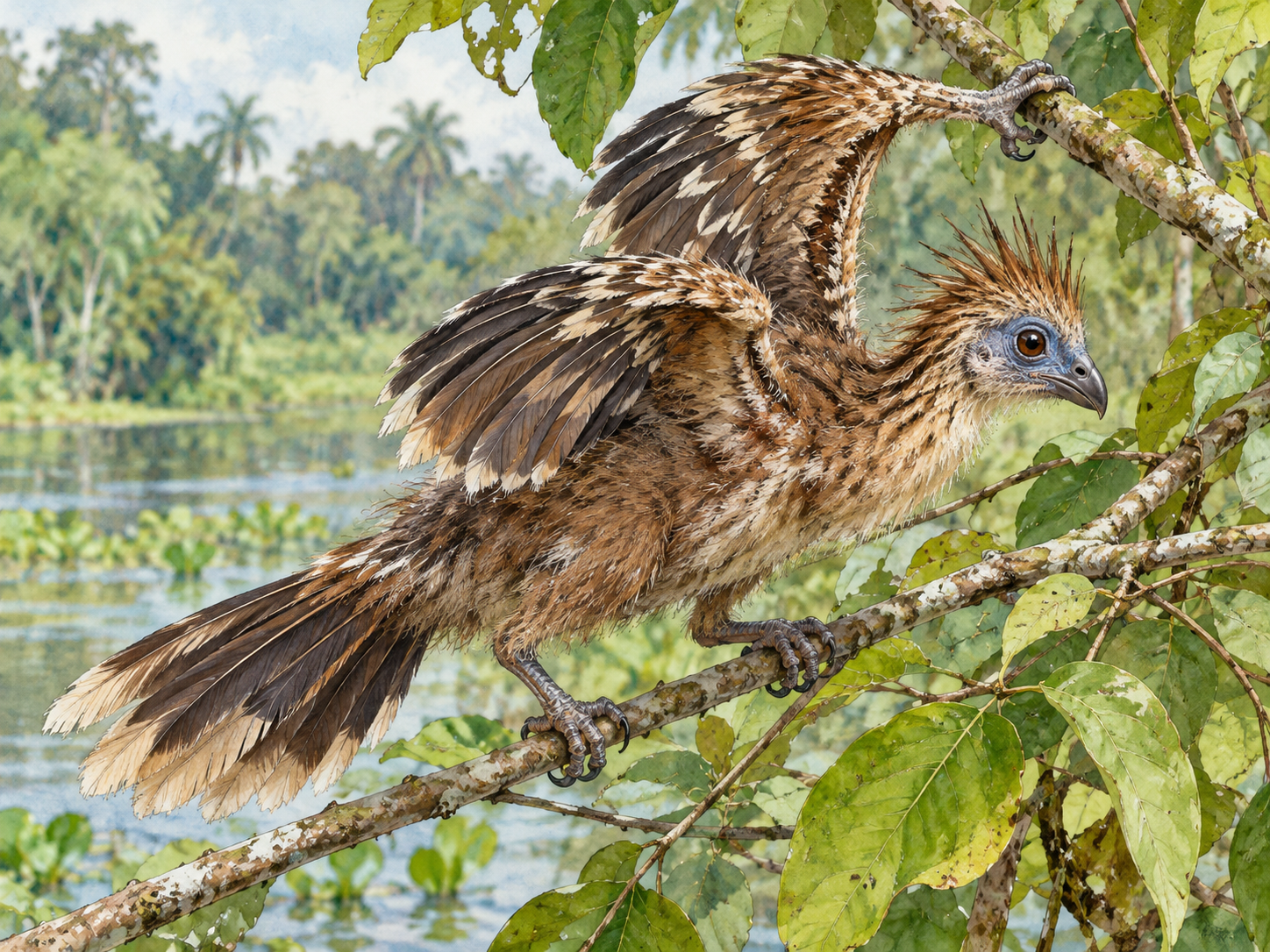
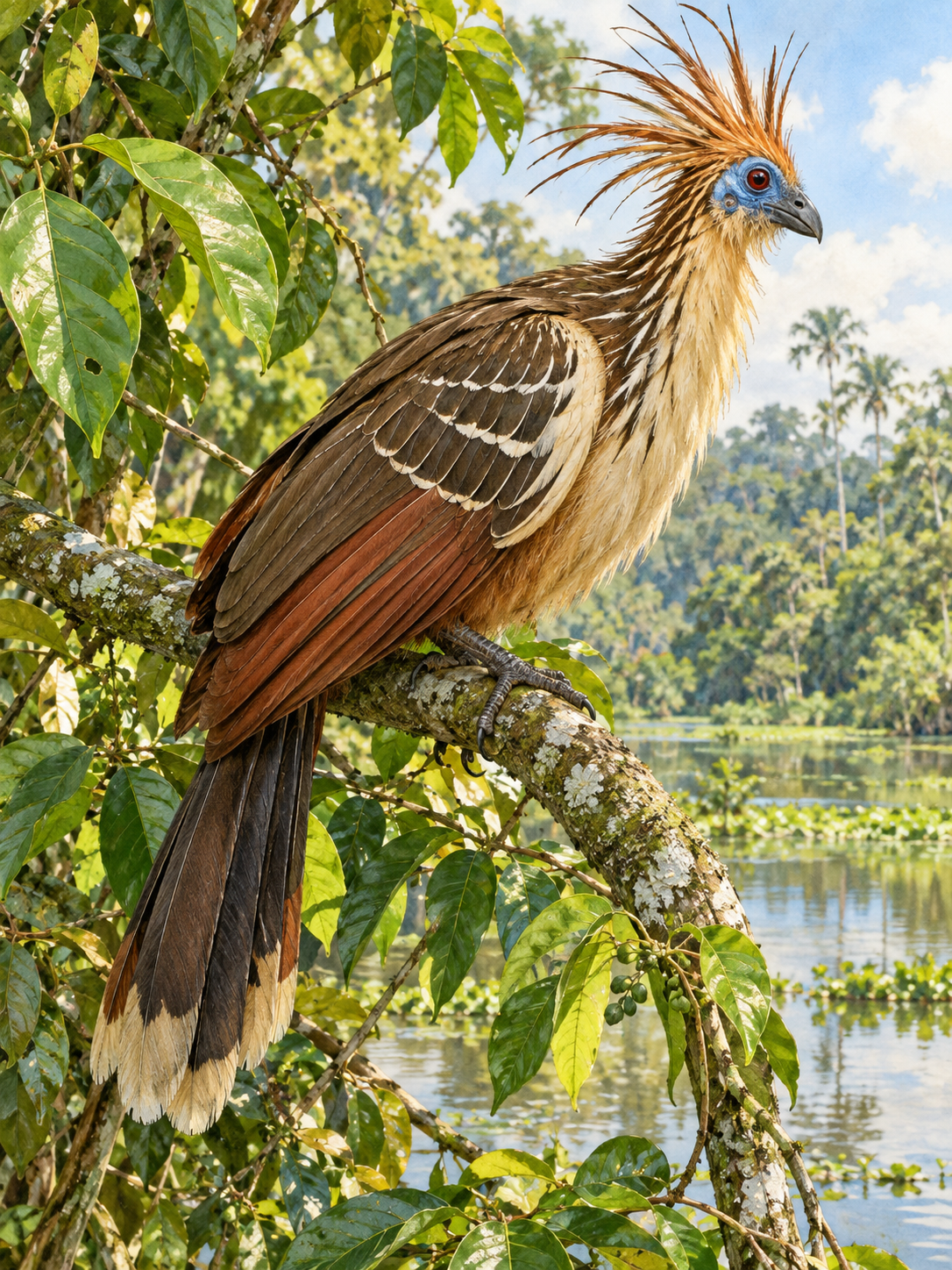
A hoatzin sits above a South American waterway with a loose crest, blue facial skin and red eyes. Its extravagant appearance is easy to notice. The more unusual feature is the processing system beneath those feathers. A leafy bite enters a digestive partnership in which microbes help make difficult plant material useful to a bird.

An adult hoatzin with blue facial skin and a reddish crest perched above a tropical wetland.
An artistic habitat view of an adult hoatzin.

Leaves seem like plentiful food until you consider their construction. Their contents are enclosed by cell walls, and eating the material does not automatically release all its potential nutrients. The hoatzin retains leafy food in an enlarged foregut where microbial fermentation can work on it. Swallowing is the start of a process that takes space and time.

Follow the meal by its jobs

The main fermentation spaces are the enlarged crop and lower esophagus, before the meal reaches the stomach. A crop in another bird can store food temporarily. In the hoatzin, this part of the digestive tract supports an extensive microbial processing system. The location of fermentation makes it a foregut fermenter.

The useful comparison with a cow is the sequence of retaining plant material for microbes before later digestion. It does not make the two animals anatomically interchangeable. The hoatzin has a bird's body and its own arrangement of chambers. Similar biological problems can be approached with comparable principles through different structures.

For a small mental exercise, divide a leafy meal into jobs: collecting food, retaining it, breaking down components, absorbing useful products and passing along the remainder. Now ask which job merely watching a bird eat would reveal. The visible bite tells you relatively little about retention or chemical processing. Those require a different kind of evidence.

Digestion can be measured

Alejandro Grajal tested captive hoatzins with two experimental diets differing in composition and fiber content. The study measured intake and digestibility instead of inferring success from the fact that the birds swallowed leaves. It documented effective digestion of fibrous material, including cellulose and other components. That result puts the feeding specialization on a measurable footing.

A balance trial compares what enters with what leaves, but interpretation still depends on the question and measurements. The presence of food in a gut shows consumption; the amount retained or digested tells a different story. Neither measurement alone identifies every microbe or enzyme responsible. Physiology and microbial ecology supply complementary pieces of the explanation.

This is one reason a familiar phrase such as “the bird eats leaves” can hide so much biology. Diet is a description of material consumed. Feeding success also depends on processing that material and obtaining enough useful resources. The hoatzin's enlarged foregut makes the invisible portion of that story a substantial part of its anatomy.

The chamber is an ecosystem

In a 2008 study, Filipa Godoy-Vitorino and colleagues examined crop bacteria from six wild adult hoatzins using DNA-based methods. They found a diverse community, with many sequences poorly matched to organisms then classified at species level. The results revealed how much microbial diversity could be present within a familiar-looking vertebrate organ.

A sequence survey is not a list of fully understood workers with individually assigned jobs. Relatedness can suggest possibilities, but finding a bacterium does not by itself establish exactly which plant compounds it processes in the bird. The authors emphasized questions about microbial function that remained open. Diversity and demonstrated metabolic activity are related research topics, not equivalent measurements.

The anatomy also imposes tradeoffs. A substantial chamber and its contents must fit within the body of a bird that moves among branches and can fly. Anatomical work describes skeletal modifications associated with accommodating the enlarged crop. The hoatzin makes a good reminder that a specialization is built into a whole animal rather than added without consequences.

The chick solves a different problem

A young hoatzin using its legs and small wing claws while climbing leafy branches.
Conceptual scene of a young hoatzin using wing claws to help climb. The pose and proportions are artistic.

A young hoatzin above water has another immediate challenge: moving to safety before it is an accomplished flyer. Its wing fingers bear functional claws that can grip vegetation. Chicks can escape into water and work their way back toward branches. These claws are useful early-life equipment, rather than the normal climbing tools of the adult.

Anick Abourachid and colleagues investigated nestling movement in a 2019 study. They filmed four chicks climbing an inclined, grippable surface and moving in water. During climbing, the limbs could act in an alternating sequence, with wing claws anchoring and helping pull the body upward. Swimming showed a flexible repertoire of limb coordination.

The small sample and experimental setting are part of the result. They document how the filmed chicks moved under those conditions. They do not describe every escape in the wild or turn a modern nestling into an unchanged prehistoric bird. The practical finding is compelling on its own: wings can participate in a mode of movement very different from synchronized flight.

Watch for a grip, then a pull

The locomotion paper and its supplementary materials let you inspect the movement behind the description. Focus on one wing at a time. Look for contact with the surface, the moment a claw takes hold, and the motion that follows. Then compare that pattern with both wings beating together during ordinary flight.

If a grip fails, do not dismiss the irregularity as an uninteresting interruption. Finding a usable contact point is part of locomotion on a complex surface. A branch-filled world does not supply an evenly spaced ladder. Watching the transition from searching for purchase to pulling upward makes the movement more legible than simply labeling the chick “clawed.”

The adult's fermentation chamber and the chick's climbing behavior belong to different problems and life stages. One concerns extracting resources from foliage; the other concerns moving through a risky waterside nursery. Together they reveal an animal through processes, rather than through nicknames: a leaf meal unfolding inside, and a developing bird negotiating the branches outside.

Explore more creative curiosity at Incoprea.

The Four-Eyed Fish Has Two Eyes With Divided Jobs

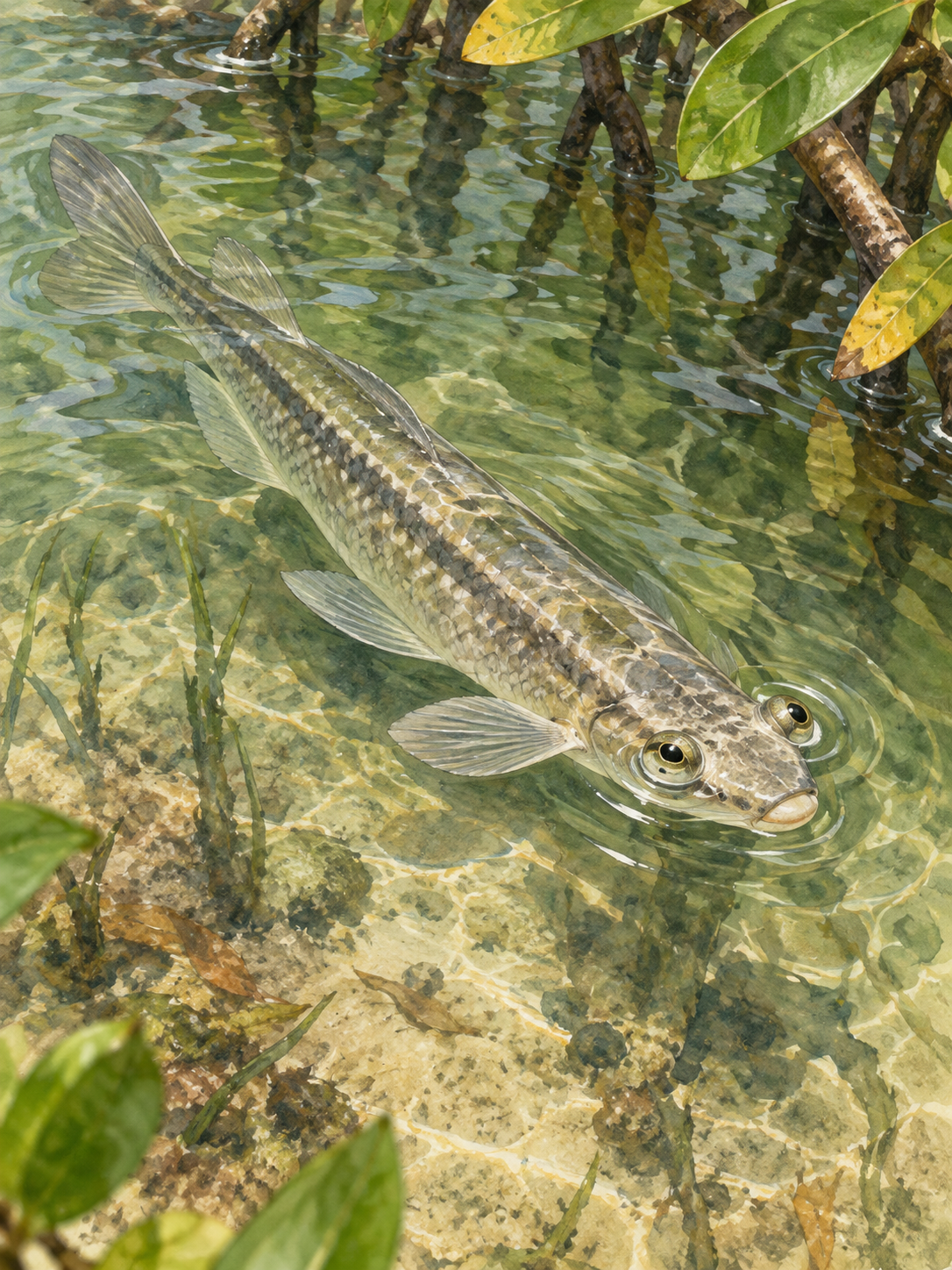
Imagine keeping watch through a window that is half in air and half under water. The two halves would not simply show different scenery. Light would reach them through different surroundings, and the same optical surface would not behave identically in both. The four-eyed fish lives at just such a boundary, with its eyes riding high at the waterline.

An Anableps fish seen from above, with two eyes protruding at a shallow mangrove water surface.
An overhead artistic view of Anableps at the water surface; the lower parts of its eyes are hidden by water.

Anableps anableps has two eyes. Each contains divided openings and specialized regions for simultaneous aerial and aquatic vision. The name “four-eyed” draws attention to the split view, but the biological solution is more interesting than adding another pair of eyeballs. Several parts of an existing eye have become regionally different.

Begin at the surface the light meets

The cornea is the transparent front surface of the eye. Above the waterline it encounters air; below it encounters water. A boundary between materials can change the direction of light, and the optical contribution of a curved surface depends on the materials on either side. The fish's two corneal regions therefore face different optical demands.

Shivalingappa Swamynathan and colleagues compared the upper and lower corneas of Anableps with those of aquatic zebrafish. They found that the air-facing region was flatter and had a thicker epithelium, the surface cell layer. The regions also differed in molecular composition. This is a difference in living tissue, not simply a dark line drawn across an otherwise uniform eye.

Their study considered both refraction and the extra challenges of exposure to air, including drying and ultraviolet radiation. A surface used for vision must remain a functioning biological surface too. An optical description tells part of the story; cells and their chemical contents tell another part. Different methods are needed to inspect each.

Try noticing that distinction in a pair of glasses. Lens shape helps determine how light is redirected, while a surface coating can change other properties. The comparison is limited: a fish's cornea is living tissue and its regional differences are not manufactured coatings. It simply reminds us that geometry and material composition can both matter to the same transparent structure.

Follow the light to the receiving tissue

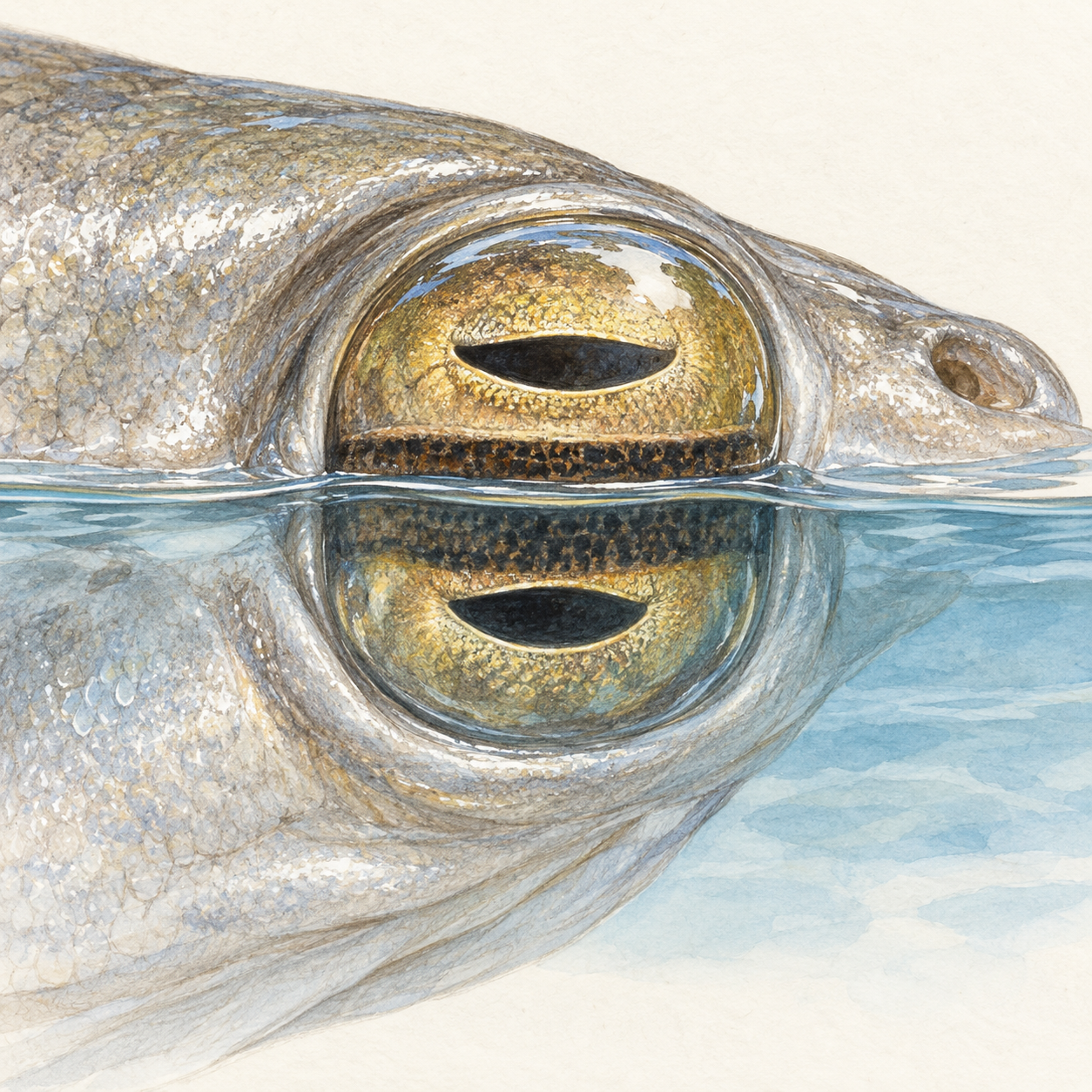
Conceptual close view of one Anableps eye with upper and lower pupil openings separated by a pigmented band.
Conceptual view of one divided pupil spanning the waterline. The proportions are illustrative, not anatomical measurements.

A pigmented division separates the aerial and aquatic openings. Light passing through the eye reaches the retina, the light-sensitive tissue at the back. The path crosses within the optical system, so the upper and lower positions at the front do not translate into the same upper and lower positions on the retina. Anatomical labels need that orientation.

This is a useful pause before reading a figure. Find the front of the eye, the lens and the retina. Then locate the diagram's dorsal and ventral labels rather than treating “top half” as a universal description. A clear view of one divided pupil is not yet a map of which retinal cells receive its light.

Gregory Owens and colleagues studied regional expression of opsin genes, which contribute to visual pigments in photoreceptors. They found several types across the retina and others distributed differently between regions associated with the two views. The result supports regional specialization without implying that each region detects only a single color.

The researchers used probes to map gene expression in tissue sections. Their published figures show where particular signals occurred. Those colors are labels chosen to display laboratory results; they are not an image of the colors the fish experiences. Reading a biological map requires knowing what has been measured, as well as where a marker appears.

A gene map leaves an important question open

Different visual pigments can differ in wavelength sensitivity. Their distribution is consequently relevant to the light a fish encounters. Water can alter the spectrum available below the surface, while the aerial view presents a different mixture. The study's interpretation links the regional organization to these contrasting optical environments.

Yet detecting a visual pigment and demonstrating color discrimination are different achievements. The latter also involves how signals are combined and used. The authors identified behavioral tests as a way to investigate how the expression differences affect vision. It is possible to learn a great deal about a visual system without claiming to reconstruct its subjective world.

Consider three statements: a region expresses a gene; its photoreceptors respond to certain wavelengths; the animal distinguishes two colored targets. Each asks for an additional kind of evidence. A tissue study, physiological measurement and behavioral experiment can complement one another. Moving between them carefully makes the eye's capabilities more concrete than assigning it a human-style display.

The split system has to develop

The adult arrangement is not merely an ordinary eye exposed to a waterline. Louise Perez and colleagues examined eye and skull development through six larval stages. Their 2017 study described the emergence of divided structures and differences in retinal growth and organization. They also found regional differences in photoreceptor gene expression beginning during development.

The findings suggest that the pattern has a developmental basis rather than being created only by later exposure to aerial light. Building the specialized eye involves the surrounding skull as well as its transparent surfaces and receiving tissue. An unusual adult feature can require coordinated changes in several structures as the animal grows.

Return to the imagined half-submerged window. You can now replace the simple pane with several connected questions: which medium meets the cornea, where the light travels, which cells receive it, and how the arrangement is built. The four-eyed fish inhabits a narrow boundary, but understanding its two eyes requires following a surprisingly broad chain of biological events.

Explore more creative curiosity at Incoprea.

publications

New this week Two novels in six stories each, from The Night Shift . New — a novel in six documents Small Print A Novel in Six Do...