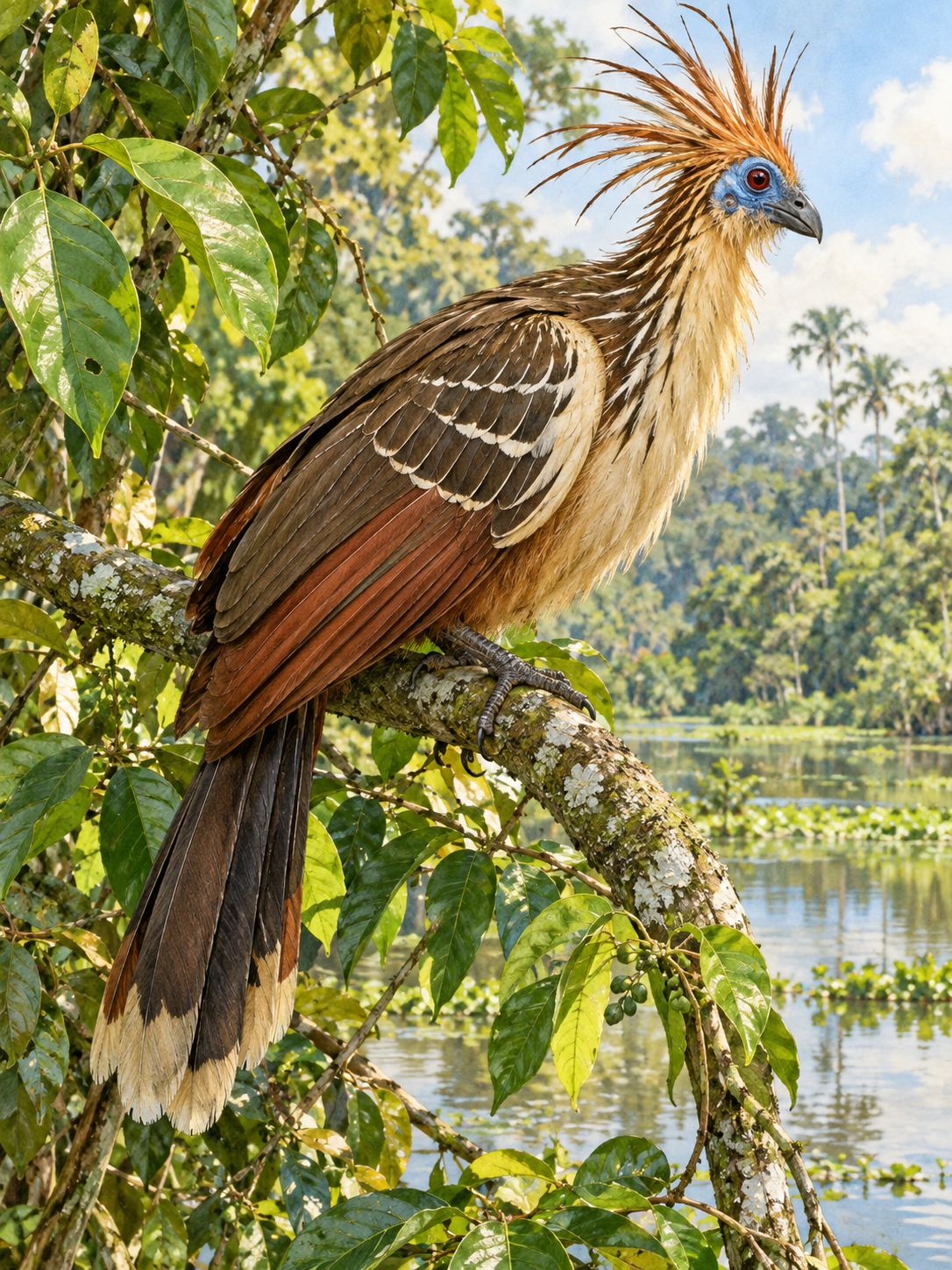
Along South American waterways, a bird with blue facial skin, red eyes and a loose reddish crest sits among branches. The hoatzin looks extravagant before it does anything unusual. Its less visible distinction is a digestive system that turns a leafy meal into a collaboration with microbes.
Leaves are abundant, but their tough cell walls make them demanding food. A bird cannot simply treat them as easy packets of energy. The hoatzin's enlarged foregut provides space and time for a different approach: fermentation before the meal reaches the main stomach.
A bird with a microbial workshop
Research on the hoatzin's digestive tract describes a large crop and lower esophagus functioning as fermentation chambers. Microorganisms help break down plant material there. The result is a foregut strategy often associated with herbivorous mammals, appearing in a remarkably different body.
A cow's anatomy and a hoatzin's anatomy are not interchangeable. The useful comparison is the principle: retain plant material in a chamber where microbes can work on it, then use the products of that activity. The bird has its own arrangement for doing so.
Studies of digestive efficiency examined how the hoatzin handles fibrous food and how long material is retained. Its leafy diet is therefore supported by an actual processing system, rather than by an unexplained ability to swallow difficult vegetation. What looks like a simple bite begins a longer sequence of mechanical and microbial work.
Space inside the body has consequences
A substantial fermentation chamber must fit somewhere. Anatomical research links the unusually enlarged foregut with changes in the bird's internal layout. This is a useful way to think about specialization: a successful feeding system occupies space, has weight and interacts with the rest of the animal.
The hoatzin is often nicknamed the stinkbird, a reference associated with its fermentation and odor. That label is memorable, but a less cartoonish description is more revealing. It is a living partnership between a leaf-eating bird and the microbial community that helps process its food.
The chicks have another surprise
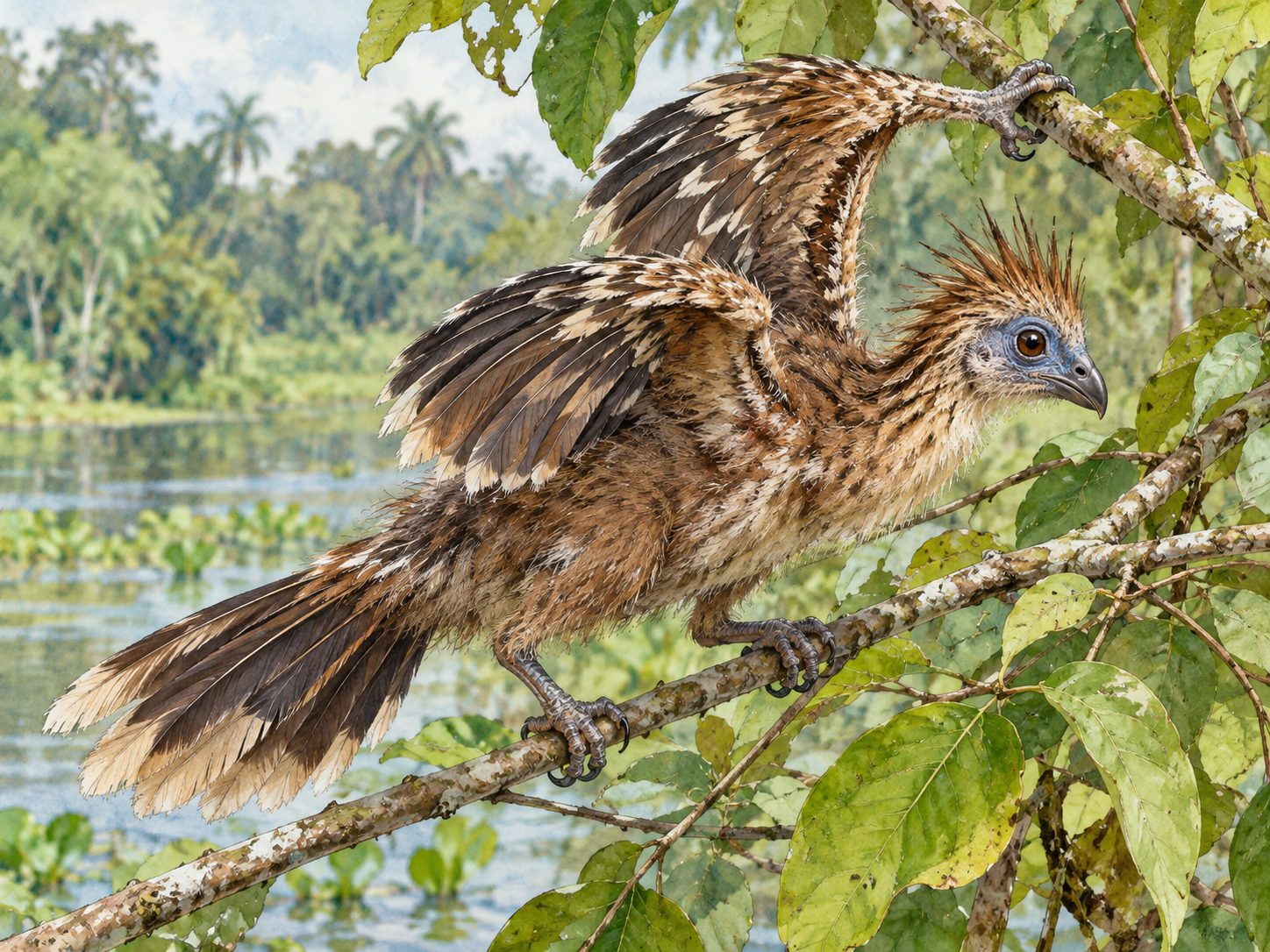
Young hoatzins possess small functional claws on wing fingers. These help them climb through vegetation near nests built over water. If threatened, chicks can drop into the water and later work their way back through branches. The wing claws are a temporary part of this early life, rather than the normal adult climbing equipment.
Clawed wings can make a chick look like an illustration from a dinosaur book. Appearance alone, however, cannot establish a special evolutionary relationship or make a living bird an unchanged ancient survivor. Here the immediate explanation is practical: a youngster that cannot yet fly well has another way to move.
The adult's digestive chamber and the chick's climbing tools solve different problems at different stages. Together they make the hoatzin interesting beyond its startling face: a bird whose biology is fitted closely to a leafy, branch-filled world above the water.
Sources and further reading: University of Michigan hoatzin account; Primary study of digestive efficiency; Primary research on digestive structure and function.
Explore more creative work at Incoprea.




