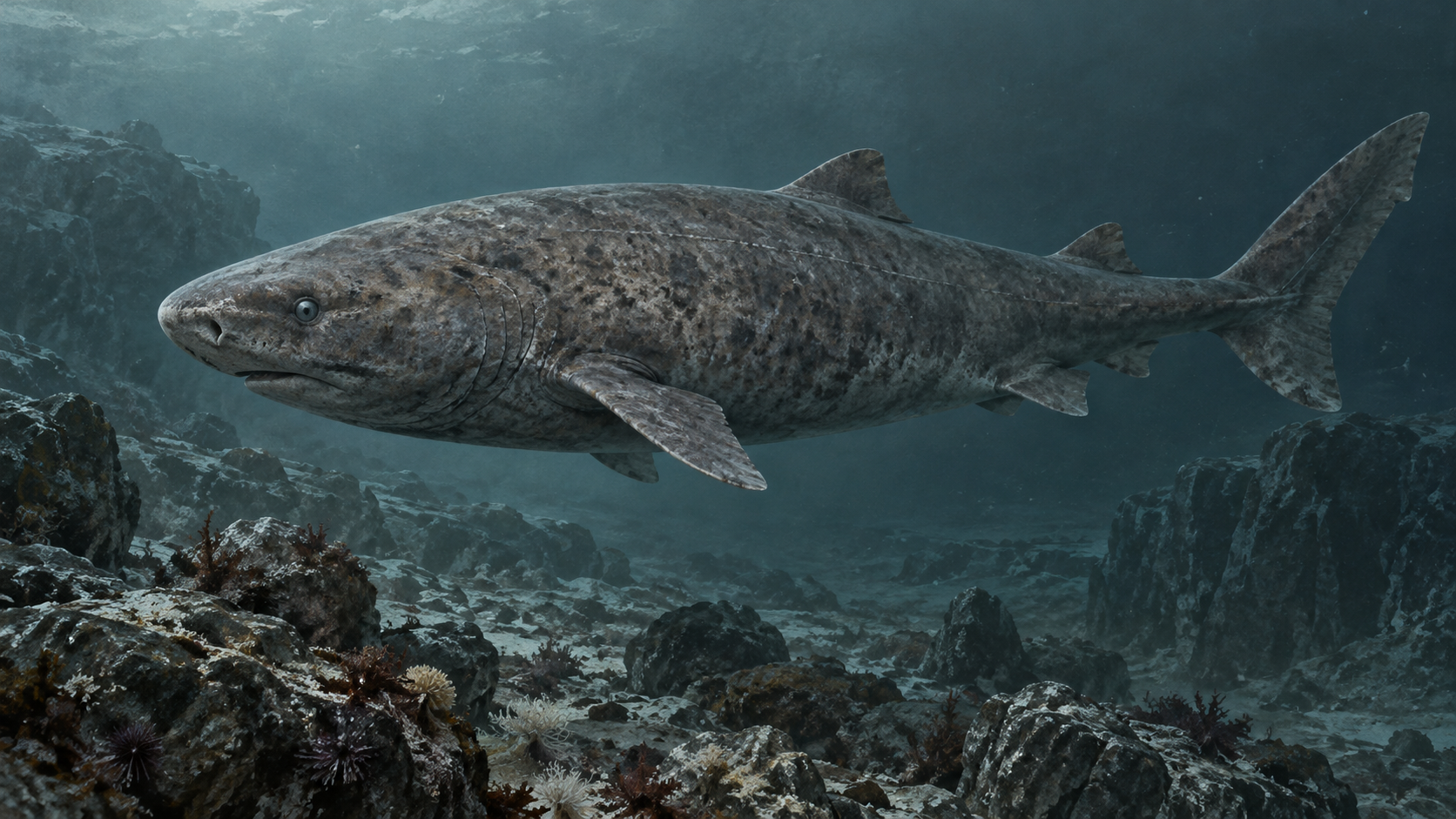
A large Greenland shark may have been alive long before anyone now living was born. The striking possibility became much firmer in 2016, when researchers used radiocarbon dating to investigate proteins in the centers of sharks' eye lenses.
The discovery depends on a good question and a suitable biological archive. An animal does not need a visible annual birthday mark if some tissue preserves information from its earliest life.
A lens holds an old carbon record
The eye lens contains proteins formed early in development that remain unusually stable. Dating carbon in the lens nucleus therefore offers a route toward estimating when that material was made.
Radiocarbon methods use the radioactive isotope carbon-14 and the history of its abundance in the environment. Food-web and marine-carbon effects complicate the translation from a laboratory measurement to a calendar date. Researchers have to model and calibrate the relationship.
Atmospheric nuclear testing also produced a distinctive mid-twentieth-century carbon signal. Its presence or absence helps constrain ages, particularly for younger animals whose tissues formed around that period. The technique reads a historical chemical signal, rather than counting visible rings in the lens.
A remarkable estimate, with a range
The 2016 study examined eye lenses from 28 female Greenland sharks. Its results supported a lifespan of at least 272 years for the sampled animals and an age estimate of about 392 years for the largest shark, accompanied by substantial uncertainty.
The often-repeated “400-year-old shark” is thus a rounded summary of a modeled estimate. It is not a known birth date attached to an individually observed animal. The study's uncertainty is part of the result, rather than a reason to discard the evidence of exceptional longevity.
| What researchers have | What it supports |
|---|---|
| Lens-nucleus carbon measurements | Evidence about when stable tissue formed |
| Calibration and biological modeling | An estimated age range |
| A large, slow-growing shark | Context for interpreting longevity |
Long life changes the ecological timescale
Greenland sharks inhabit cold northern waters and can occur at substantial depth. Their slow growth and late maturation make their life history very different from that of a fast-growing animal that replaces generations quickly.
NOAA notes that removing mature animals can therefore affect the population and ecosystem for many decades. A long lifespan is impressive for an individual, but it does not necessarily give a species rapid recovery from losses.
There is more to learn about how these sharks maintain their bodies over such long periods. Establishing age is one step; explaining every mechanism behind longevity is another.
The memorable part of the story is a quiet one. Inside a dim-eyed shark, a small region of protein can preserve a chemical connection with the distant past. Careful measurement turns that connection into an age estimate, and an ordinary-looking eye becomes a window onto centuries.
Sources and further reading: Nielsen and colleagues: Eye-lens radiocarbon and Greenland sharks; University of Copenhagen: Sharks living for hundreds of years; NOAA: How long do Greenland sharks live?.
Explore more creative work at Incoprea.




