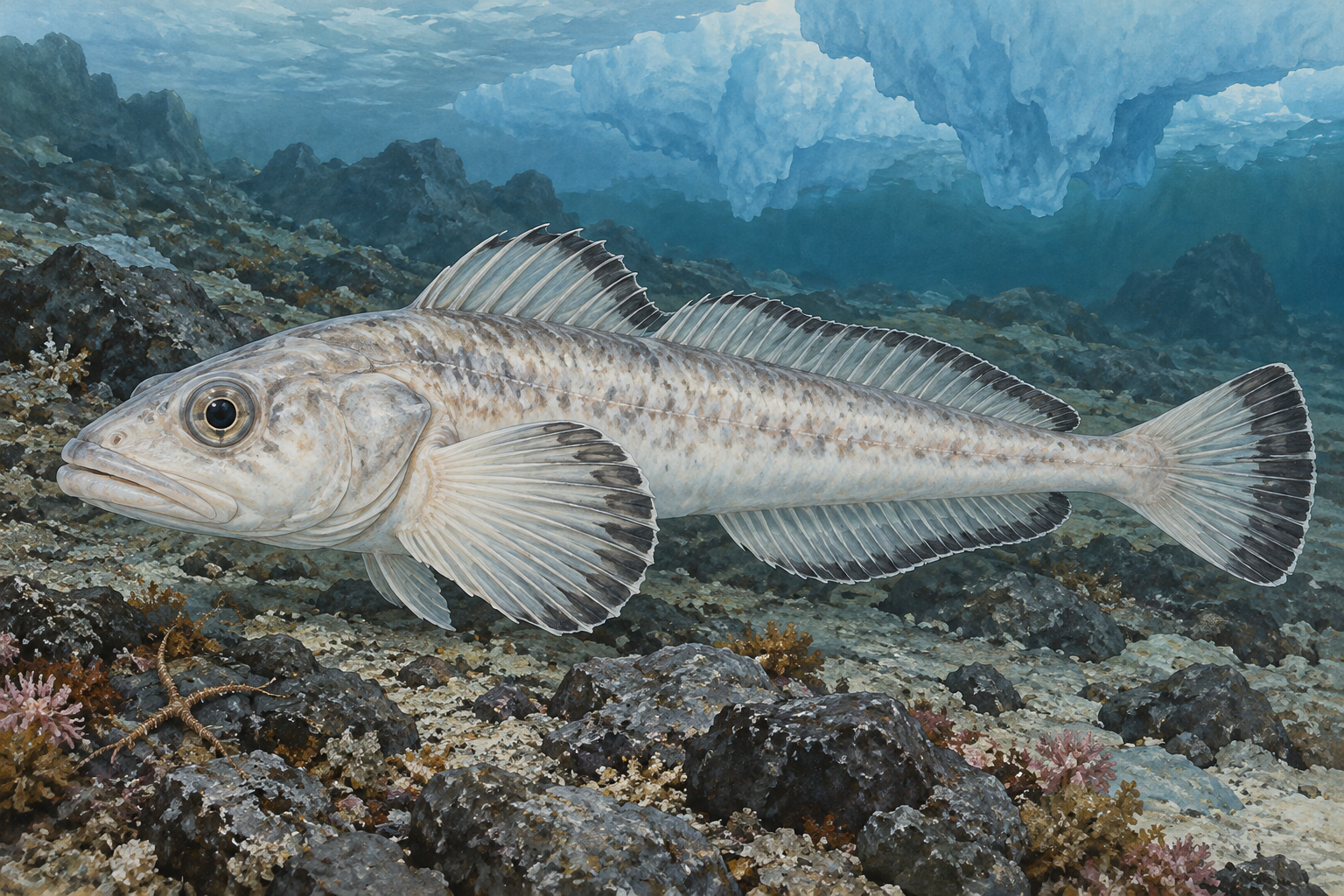
For most vertebrates, red blood seems as fundamental as bones. Antarctic icefish provide an extraordinary exception. Members of the family Channichthyidae have no functional hemoglobin, the iron-containing protein that normally gives blood its red color and carries oxygen.
Their blood is pale because an essential-looking tool has disappeared. The surprise is not that the fish no longer need oxygen. They still do. The question is how their bodies deliver enough of it without the usual carrier.
Cold water makes an unusual life possible
Oxygen can dissolve directly in blood plasma, but hemoglobin greatly increases a typical vertebrate's oxygen-carrying capacity. Icefish rely on oxygen carried in physical solution. A study of the blackfin icefish described blood oxygen capacity as less than a tenth that of related red-blooded Antarctic fishes, measured per unit of blood volume.
The Southern Ocean helps make this workable. Cold water holds more dissolved oxygen than warm water, and Antarctic fish have evolved in an unusually cold environment. That favorable starting condition does not eliminate the cost of losing hemoglobin. It creates circumstances in which compensating changes can keep the animal alive.
Icefish are part of a larger group called notothenioids. Many of their Antarctic relatives retain red blood. It is therefore important not to call every fish living around Antarctic ice a hemoglobin-free icefish.
A body built around the missing carrier
Compared with red-blooded relatives, icefish have cardiovascular features including larger hearts, greater blood volumes, and wider blood vessels. Moving more blood through an accommodating circulation helps offset the limited oxygen in each volume of plasma.
The adjustments also extend into tissues. Researchers studying Chionodraco myersi found distinctive patterns involving mitochondria, the cellular structures central to energy metabolism. Icefish muscles have unusually abundant mitochondria, and their membranes may contribute to oxygen movement within cells. Some details of that contribution remain under investigation.
This is a coordinated physiological system, rather than a single magical mutation. The missing protein is only the most visible part of a network of evolutionary changes.
Oxygen delivery has several bottlenecks
Think of oxygen transport as a route rather than one ingredient. Oxygen must move from the surrounding water into the animal, travel in its circulation, leave that circulation and reach the cellular machinery that uses it. Improving one part of the route does not automatically remove a limitation elsewhere.
A simple delivery ledger helps: how much oxygen can a volume of blood carry, and how much blood passes through the relevant tissues over time? Those quantities interact. Moving a larger volume can partly compensate for a smaller oxygen content per volume, but it requires an appropriate pump and vessels. Actual delivery also depends on extraction by the tissues, so this is a way to organize the problem rather than a formula for predicting a particular fish's performance.
Compare the reported features with that ledger. A larger heart belongs to circulation. Wider vessels affect the routes through which blood moves. Changes in the density and arrangement of mitochondria concern what happens farther along, inside tissues. The adaptations are interesting because they address several steps of the same transport problem.
The mitochondria should not be treated as substitute red blood cells. They participate in cellular metabolism; hemoglobin's familiar job is oxygen carriage in blood. Distinguishing those locations prevents a tempting but misleading story in which one extra organelle simply replaces the missing protein.
An exception with real costs
The distinction matters when conditions change. Warmer water holds less oxygen, while warming can increase a fish's metabolic demand. A system strongly dependent on dissolved oxygen has constraints that researchers consider when studying the future of Antarctic ecosystems.
A useful comparison starts with a red-blooded relative
Comparing an icefish only with a human exaggerates the novelty while obscuring which differences matter. Related Antarctic fishes share much of the cold environment yet retain hemoglobin. They provide a more informative starting point for investigating what is associated specifically with the icefish loss and its compensations.
The genome studies also add a timescale that a photograph cannot supply. The present animal is the result of an evolutionary history. Differences in genes and gene regulation can identify promising explanations, but a sequence difference alone does not measure oxygen movement through a living muscle. Genomic comparisons, physiological measurements and tissue observations contribute different kinds of evidence.
This is why “adapted” does not necessarily mean that losing the original trait was an advantage from the beginning. A loss can become survivable in a permissive environment, followed by changes that offset its consequences. Establishing the sequence and the selective circumstances is a historical question, distinct from demonstrating that the modern animal functions.
For a final thought experiment, change both sides of the oxygen ledger. Warmer water may supply less dissolved oxygen while the animal's demand can rise. Increasing demand while reducing availability is different from changing temperature as an isolated label. The fish's unusual circulation makes a broad ecological issue concrete: a working physiological system can depend on a particular balance between an organism and its environment.
Sources and further reading: Antarctic blackfin icefish genome reveals adaptations to extreme environments · Icefish genome and mitochondrial adaptations · Genomics of cold adaptations in Antarctic notothenioids




