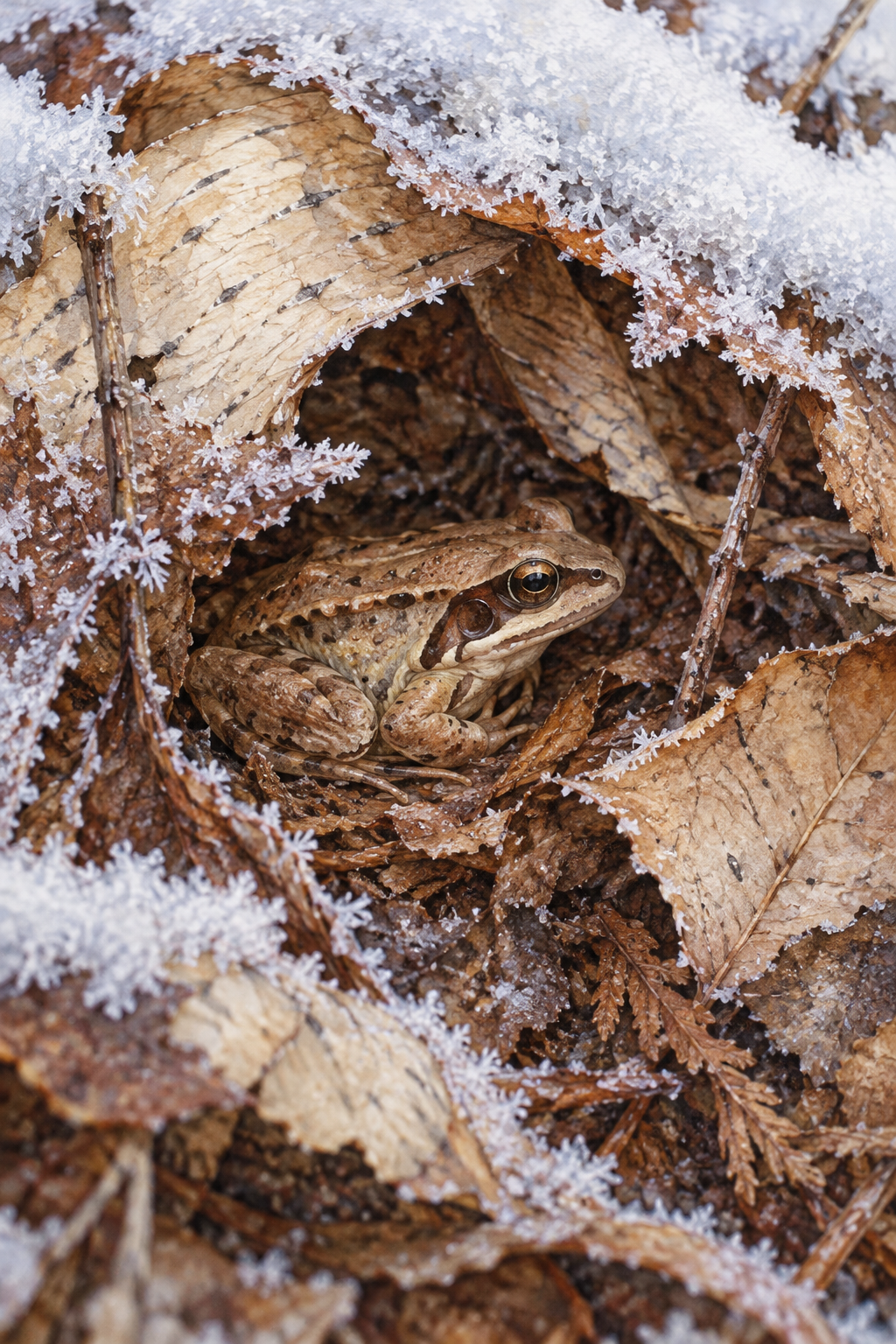
In a northern forest, a wood frog can spend winter looking like a small, motionless piece of the leaf litter. Ice forms in its body. Breathing stops, and its heart no longer beats. When spring warms its shelter, the frog can thaw and resume its active life.
This is not an animal recovering from being dead. It is an animal that has evolved to survive a dangerous, temporary physiological state. The impressive part is how carefully its biology limits the damage that freezing would normally cause.
The place where ice forms matters
Ice crystals inside a living cell can disrupt its delicate machinery. Wood frogs survive substantial ice formation outside cells while protecting the contents within them. Water shifts as ice forms, creating another hazard: cells can become severely dehydrated and salts can become concentrated.
One important defense is glucose. As freezing begins, the frog mobilizes sugar from stored glycogen in its liver. Glucose reaches tissues and acts as a cryoprotectant, helping stabilize cells and limit harmful water loss. The word “antifreeze” can be misleading here, because the frog does not prevent its whole body from freezing.
Researchers have identified additional protective chemistry as well. The animal's winter preparation is a coordinated system, not simply blood sweet enough to remain liquid at every temperature.
Freezing tolerance is not ordinary refrigeration
The location of ice changes the problem. Ice forming outside cells draws water into the growing frozen fraction and concentrates what remains in solution. A cell can therefore face a dehydration problem even while surrounded by abundant water in solid form. Protecting it requires more than keeping its outline intact.
Glucose helps modify that chemical and physical setting. It is misleading to imagine a frog protected by one unfreezable inner reservoir while everything else is irrelevant. The organism has to manage several tissues, changing water distribution and the transitions into and out of the frozen state.
To compare two studies, list the whole temperature history rather than only the coldest value. Was the animal cooled steadily or exposed to several freeze–thaw episodes? How long did it remain frozen? What preparation occurred before the test? These variables can affect the response even when the final minimum temperature is the same.
The Alaska observations are especially useful because they exposed a difference between a convenient laboratory treatment and the animals' natural autumn. The proposed role of repeated early freezing was an explanation to test, not permission to treat every freeze–thaw cycle in every frog as beneficial. The details of population, preparation and timing stay attached to the claim.
A long winter, measured outdoors
Much of what makes the wood frog remarkable depends on where it lives. A 2014 study tracked frogs in natural winter shelters in Interior Alaska. Eighteen monitored frogs survived, after remaining frozen for an average of about 193 consecutive days. Their shelters experienced much colder conditions than those used in many earlier laboratory studies.
The researchers found much higher glucose concentrations in naturally freezing frogs than in frogs frozen under a particular laboratory treatment. They suggested that repeated autumn freezing and thawing could help build up cryoprotectant levels before the long winter.
That suggestion is a hypothesis about the observed differences, rather than a complete explanation of every population's cold tolerance. Geography, inherited differences, preparation, and the temperature pattern all deserve attention.
The forest floor is part of the strategy
Wood frogs shelter in leaf litter and forest debris. Snow and surrounding material influence the temperatures they actually experience. An outdoor air-temperature reading does not necessarily tell you the temperature in the frog's small winter refuge.
According to the National Park Service, important organs such as the heart and liver freeze late and thaw early, allowing vital functions to continue as long as possible during the transitions. In spring, the frogs emerge and head for breeding ponds. Their conspicuous calls belong to a very different season of the same life.
Listen to the season on the other side of the freeze
The chorus is a useful counterpoint to the motionless winter animal. It records an active breeding setting, not sound made by a frozen frog. The same life cycle includes both states, and survival matters because activity can resume when conditions permit it.
While listening, notice how many overlapping callers turn individual pulses into a dense background. The recording does not reveal how cold any particular frog became during winter or establish that all callers shared the same freezing history. It supplies the sound of a different phase of the story, rather than a physiological measurement.
On paper, draw three seasonal boxes: preparation, frozen interval and recovery. Put glucose mobilization near entry into freezing, the insulated leaf-litter refuge around the winter interval, and renewed circulation and breeding activity after thaw. The sequence helps expose what a headline about “coming back to life” leaves out.
A future field observation should leave the frog and its refuge undisturbed. You can learn from the published temperature histories and spring recordings without reproducing freezing in an animal. The intriguing question is how seasonal chemistry and a small sheltered place cooperate across time, not whether an unprepared frog can survive a household freezer.
Sources and further reading: Larson and colleagues: Wood frog adaptations to overwintering in Alaska · UAF: Alaska frogs stock up on glucose · National Park Service: Denali's wood frogs




