Showing posts with label Material Culture. Show all posts

Friday, October 23, 2026

A Message Stick Is More Than the Marks a Camera Can See

A small carved object appears in a museum photograph. You can enlarge its surface until every line seems available for inspection. Yet the most important part of its message may never have been a mark that the photograph could capture.
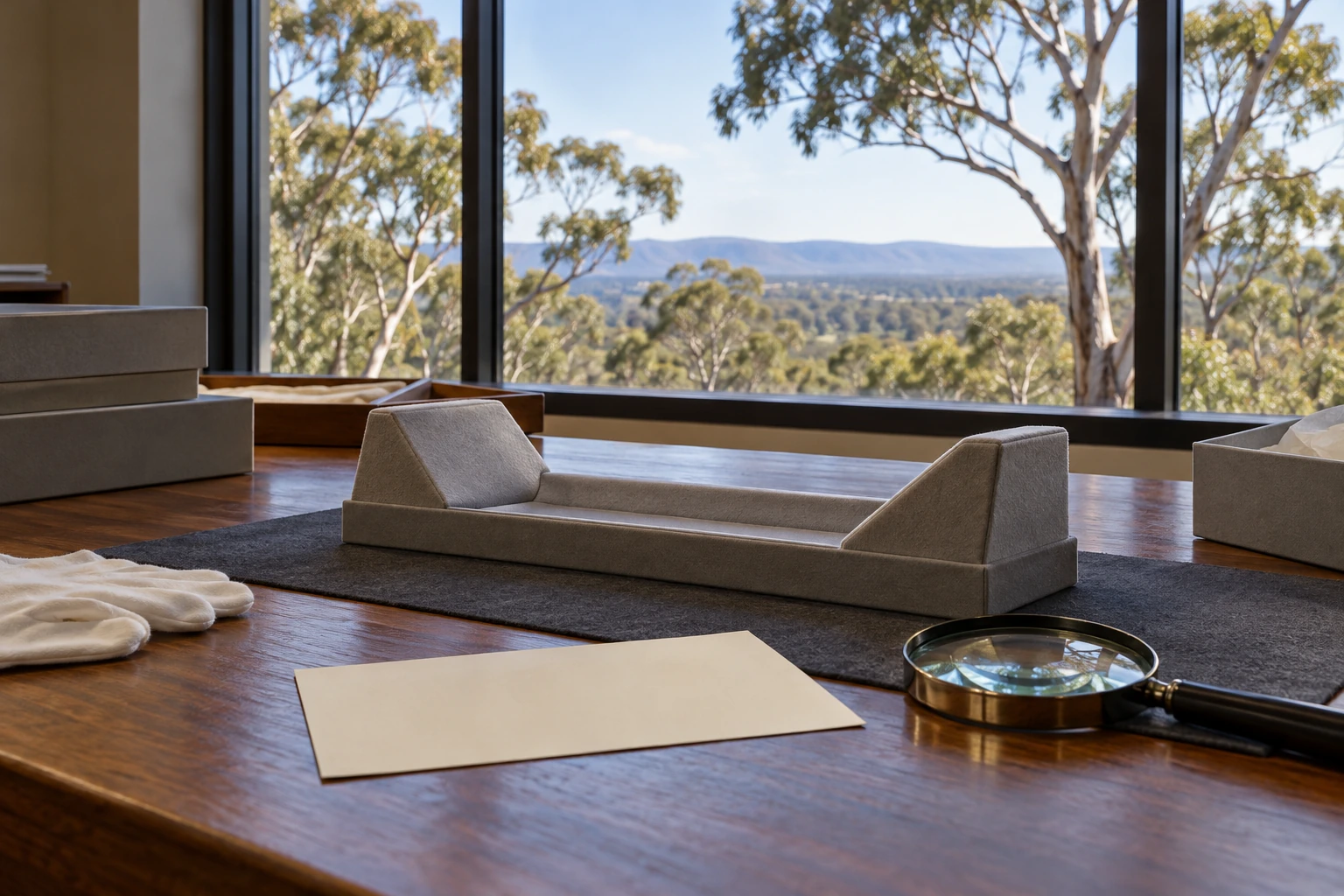
An empty museum study cradle and magnifying glass sit before a window overlooking eucalyptus trees.
The study setting leaves the object to its documented museum record, where image, provenance and description remain connected.

Aboriginal Australian message sticks belong to particular people, places and communicative practices. They should not be treated as a single continent-wide alphabet waiting for an outsider to decode. A careful encounter begins with the specific record, including what the record does not know.

Follow one documented object

The National Museum of Australia's Kimberley community story discusses objects collected during Governor Frederick Napier Broome's journey along the north-west coast in 1884. A message stick appears within that collection history. The date describes a documented collecting event, not a universal origin date for a practice.

Read that page with two columns on a piece of paper. In one, record statements about the object and its collection. In the other, record the names and roles of people whose accounts are being presented. This simple separation helps stop a collector's description from silently becoming the sole voice of the object.

Now add a third column headed “not established here.” You might need more information about a maker, the intended recipient, an oral explanation or the circumstances of acquisition. A blank in that column is useful. It keeps an unanswered question visible.

The messenger belongs inside the communication

The research project Australian Message Stick Database brings dispersed object records and associated documentation together. Its record for a Queensland object held in the British Museum describes red wood with incised lines containing red and white pigment. The object is 154 millimeters long. Its 1885 date is explicitly an upper bound, associated with acquisition rather than a documented day of manufacture. Those small fields distinguish the physical item from the layers of information attached to it.

That distinction is crucial. A message-bearing object may work with a messenger's spoken explanation, authority and relationship to the recipient. An observer who records only the carved surface has not necessarily recorded the whole communication. We should not assume that every object used the same division between visible marks and spoken knowledge.

Consider a mundane comparison from your own life. A house key handed to a neighbor can convey permission because of a prior conversation. A photograph of the key preserves its shape but not the terms of that permission. This is not an explanation of message sticks through a modern analogy. It is a reminder that communication can depend on context that an object alone does not contain.

A database can preserve uncertainty well

The researchers' published account of the database describes a project built from material and archival evidence. Bringing records together enables comparison, but comparison is not the same as proving that a motif carried an identical meaning everywhere.

When you browse a record, look for the distinction between a transcription of an older description and the researchers' own analysis. Check whether a place is specific or approximate. Notice whether a message interpretation comes from a named participant, a collector or a later inference. A good database makes those differences traceable.

Also watch for historical language in archival quotations. A preserved document can be important evidence while carrying assumptions that present-day scholarship rejects. Repeating its classifications without identifying their source would turn an object of study into an unquestioned explanation.

What to do instead of inventing a code

For a useful reader activity, choose one public record and produce a short object biography using only supported facts. Give the object a location in a collection, record the documented collecting history and name the source of any interpretation. Finish with one question that could guide further research.

A test for your object biography

Can another reader locate each factual claim in the linked record? Have you separated “the archive says” from “the maker intended”? Did you accidentally change “this object” into “all Aboriginal people”? If so, narrow the sentence until it fits the evidence.

The illustration here intentionally shows a study setting rather than inventing a culturally specific message-stick design. For the object itself, use the linked museum and research records, where the image can stay connected to its provenance and description.

Close looking remains valuable. So does recognizing the point at which looking is insufficient. The most interesting message may lie in the relationship among an object, a person carrying it and people who already knew how to receive it. A responsible reader follows those relationships as far as the evidence permits and leaves the remaining questions open.

Sources and further exploration: National Museum of Australia: Kimberley Aboriginal country; Australian Message Stick Database: BM_Oc2462; AMSD research paper.

Explore all 50 new articles · Browse the complete illustrated collection

Explore more art, ideas, and independent projects at Incoprea.

Before European Porcelain Settled Down: The Soft-Paste Experiment

Imagine trying to copy a material by looking at its finished surface. You can see whiteness, translucency, a fine edge, and perhaps an elegant painted decoration. You cannot see the quarry, the washed clay, the kiln atmosphere, or all the failed pieces that came before it.

The European history of porcelain is partly a history of that gap between appearance and production. The labels “soft-paste” and “hard-paste” preserve different solutions to a demanding materials problem. They are not judgments about the artistic worth of the finished object.

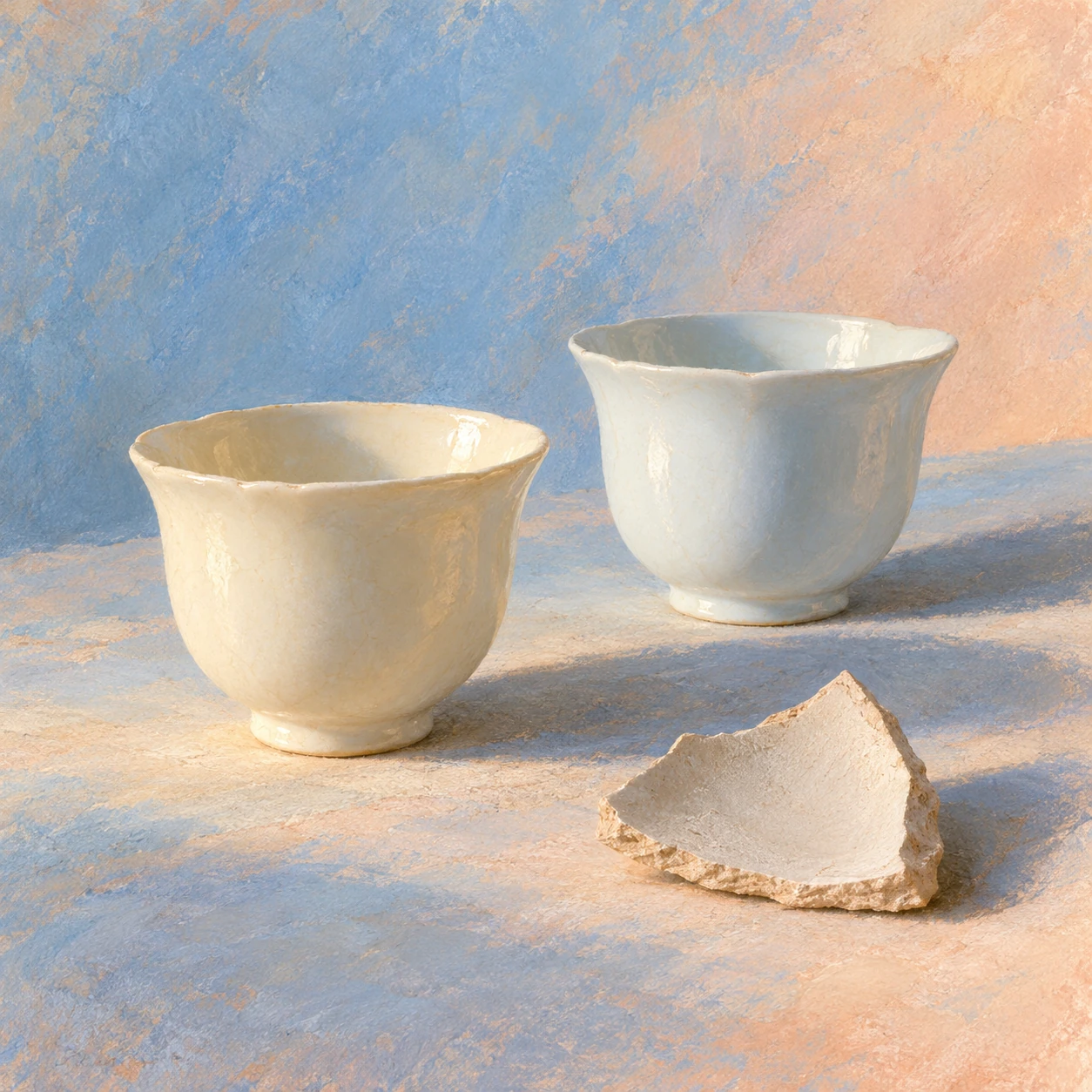
Two small undecorated eighteenth-century French porcelain-inspired cups, one creamy white and one cool white, plus a separate unglazed ceramic shard.
Two invented cups invite a materials comparison. Color alone cannot reliably distinguish soft-paste from hard-paste porcelain.

A name for a body, not just a glaze

The V&A's ceramics guide connects hard-paste porcelain with its raw materials and high firing temperatures. Kaolin, or china clay, belongs to that story, along with a material that helps the body fuse. The fired ceramic can combine whiteness, translucency, strength, and low porosity.

Soft-paste bodies developed through other formulations as European makers sought effects associated with imported Asian porcelain. “Soft” does not mean a cup remains flexible after firing. It identifies a different ceramic family, with different behavior in manufacture. A material can require extraordinary care in the kiln and still become a highly finished luxury object.

There is a useful lesson here for reading any technical label: find out what the adjective modifies. The name may concern the unfired mixture, a manufacturing difficulty, the fired body, or a later classification. Familiar everyday meanings can take you in the wrong direction.

Sèvres did not change materials in a single clean leap

The Met's factory history places the start of the enterprise at Vincennes in 1740 and its move to Sèvres in 1756. Soft-paste production continued during the eighteenth century even after hard-paste porcelain entered the story. A new formulation did not instantly make an established repertoire disappear.

Calling a ceramic “porcelain” does not tell us which production problem its makers were solving. Compare the body with the decoration rather than assuming that either explains the other. Ask what kind of evidence would connect a particular formulation to a particular artistic result.

That history complicates a simple progress story. Makers were not only asking which body was strongest. They also needed forms, surfaces, colors, and decorative effects to work together. A formulation that suits one object or palette may create difficulties for another. Technical development and artistic intention were entangled.

The clay deposit was a beginning

A Metropolitan Museum Journal study of Sèvres plates describes the importance of kaolin discovered near Saint-Yrieix around 1768 and Pierre Joseph Macquer's hard-paste production in 1769. It also follows processing, shaping, and firing problems. Locating a necessary raw material did not supply a complete working factory.

Washing and preparing a material changes what reaches the potter. Shaping it into a plate presents another set of problems. Firing requires the body and surface to behave together. The study is especially useful where it admits that exact records of a forming method are absent. A plausible account based on object appearance remains an interpretation, not a recovered workshop instruction sheet.

Three questions that should stay separate
QuestionUseful evidence
What does the object look like?Color, translucency, surface, thickness, and decoration.
What is the body made from?Documented recipes, material analysis, and production records.
How was this particular piece made?Marks, joins, molds, archival evidence, and comparison with related objects.

Try this distinction with two collection records rather than two cups at home. Compare the museum's named medium, date, factory, and dimensions. Then look at the photographs. Which differences can you actually see? Which depend on the record? Avoid scratch tests or heating experiments: the point is to learn from documentation, not to turn an object into a sample.

Porcelain becomes more interesting when “the secret” expands into a network of deposits, preparation, skills, equipment, and aesthetic choices. The finished white surface is not an absence of history. It is a place where much of that history has become difficult to see.

When reading a catalog, keep the material, maker, place, and date in separate columns. A factory attribution and a description of the ceramic body answer different questions. One may be revised without changing the other. That small habit prevents a label from becoming a single indivisible verdict.

Sources and further exploration

Explore all 80 new articles · Browse the complete illustrated collection

Continue exploring art, ideas, and unexpected connections at Incoprea.

The Mold That Must Be Broken: Brass Casting in Benin

A cast metal object can preserve a shape whose first version no longer exists. In lost-wax casting, wax gives the maker a workable surface. Heat removes it. Metal takes its place. The mold then has to be broken so that the object inside can emerge.

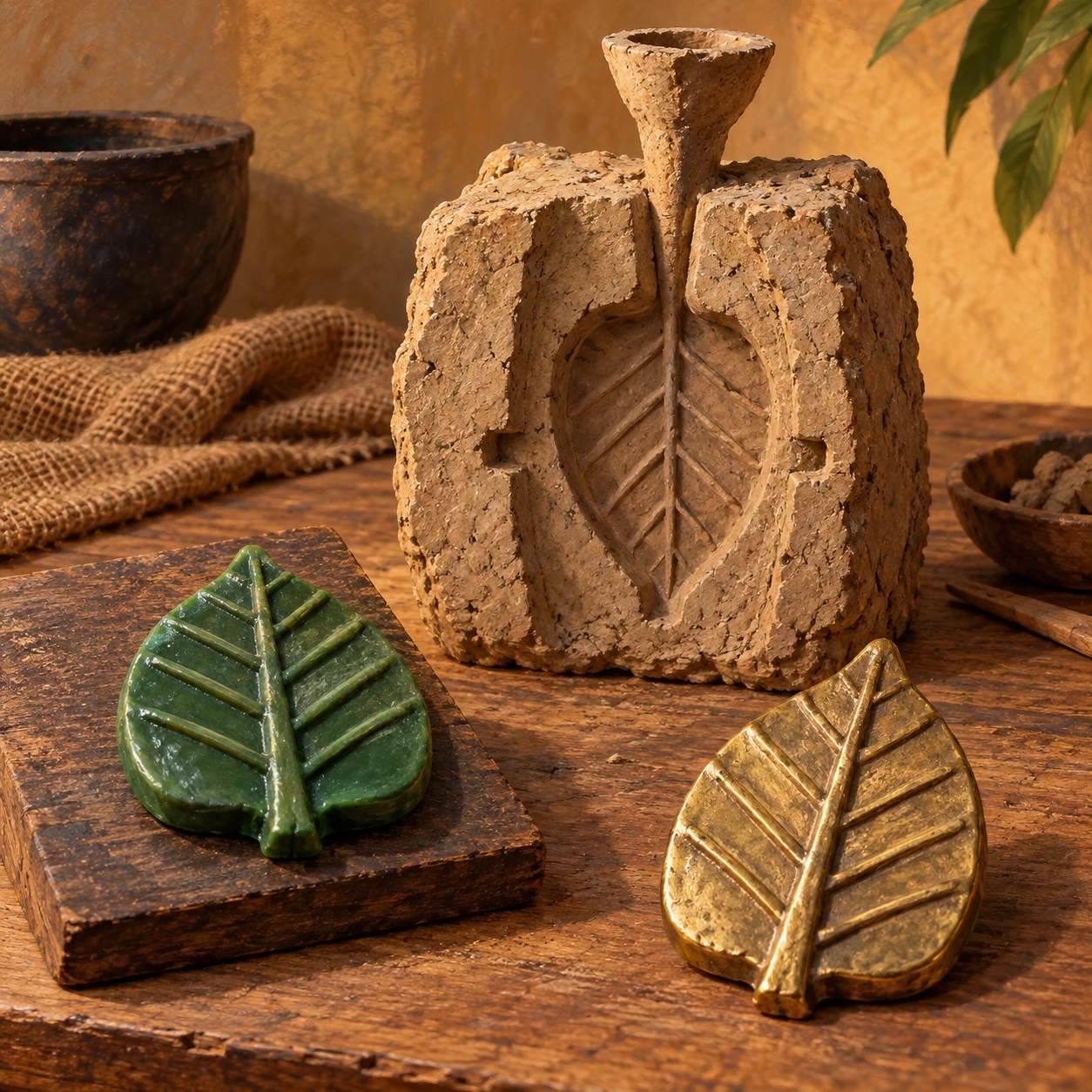
An illustrative Benin brass-casting material study: one small original abstract wax relief, a rough clay investment mold with a modest pouring channel, and a finished brass relief of the same simple leaf geometry.
Wax, an investment mold, and a finished brass surface suggest distinct stages. The invented motif is not a historical Benin court object.

That sequence is easy to summarize and difficult to carry out well. In Benin City, in present-day Nigeria, brass casting belongs to a living tradition of skilled makers, court institutions, and inherited knowledge. Treating it as a mysterious ancient trick misses the people who understand the work.

Watch the changes of material

The Art Institute of Chicago's museum archive presents a film of casting in Benin City, documented in 2003 and 2006. Its explanation follows a wax model built over a clay core, an enclosing clay investment, heating to remove the wax, and the introduction of molten metal. Breaking away the cooled mold reveals the cast form.

As you follow the sequence, notice the reversals. A positive wax surface becomes the boundary of a negative space. That space then shapes metal. The outer mold must withstand a process that is meant to destroy its usefulness as a mold. A successful casting depends on coordinating these temporary roles, not simply on pouring a liquid into a hole.

A concise description cannot supply the judgment involved in preparing materials, arranging channels, or responding to local working conditions. The museum film is valuable because it returns the explanation to makers and movements. It also gives a date and place: it documents a particular instance of practice, rather than providing an unchanging picture of every Benin workshop across centuries.

The surface can retain part of the process

Conservation research sometimes changes what a viewer thinks the surface is. In Ellen G. Howe's account of the Horn Player at the Met, reddish material in recesses proved more interesting than loose dirt. Analysis identified iron-rich clay with evidence of heating, supporting the interpretation that it was surviving investment from casting.

That does not settle every question about why the material remained. Howe distinguishes the material evidence from possible reasons for retaining it. A technological identification is not automatically an explanation of intention. The possibility that a residue contributed to appearance or significance deserves attention without being promoted into a proven rule for all objects.

This is a good habit to bring to any museum surface. Ask whether you are seeing the original material, a working trace, corrosion, a later repair, a coating, or a mixture. “Clean metal” is not a neutral goal if removing something would erase historical information. Surface treatment can change the questions an object remains able to answer.

Technique does not explain the whole object

A cast head, a palace plaque, and a figure need not have the same role because they share a manufacturing method. The Met's record for a head of an oba connects that form with royal ancestral commemoration and palace altars. The depicted head is therefore more than an opportunity to admire casting skill. Its meaning belongs to an institution and a relationship between rulers and ancestors.

Likewise, the familiar collective term “Benin Bronzes” should not make us careless about materials. Museum records often identify particular objects as brass or use the broader term copper alloy. Read the actual material field. A conventional group name is not a laboratory result.

A close-reading route for one object record
  1. Identify the named maker or guild, where recorded.
  2. Separate the object's date from the date it entered a collection.
  3. Find the material description rather than relying on the title.
  4. Look for an account of use, not only an account of appearance.
  5. Read the provenance as part of the object's history.

Follow the later journey too

The British colonial military attack of 1897 resulted in extensive looting of Benin City and its palace. Digital Benin connects dispersed objects with provenance records, including military participants, dealers, collectors, and institutions. Those records help reconstruct how objects were separated from the settings in which they mattered.

An account that ends at the moment of casting stops too early. So does an account that begins when a museum acquired the work. Looking at both histories lets us appreciate technical accomplishment without detaching it from authority, violence, continuity, and the knowledge of living makers.

Sources and further exploration

Explore all 80 new articles · Browse the complete illustrated collection

Continue exploring art, ideas, and unexpected connections at Incoprea.

Thursday, October 22, 2026

When Two Pieces of Wood Had to Agree: Reading a Medieval Tally

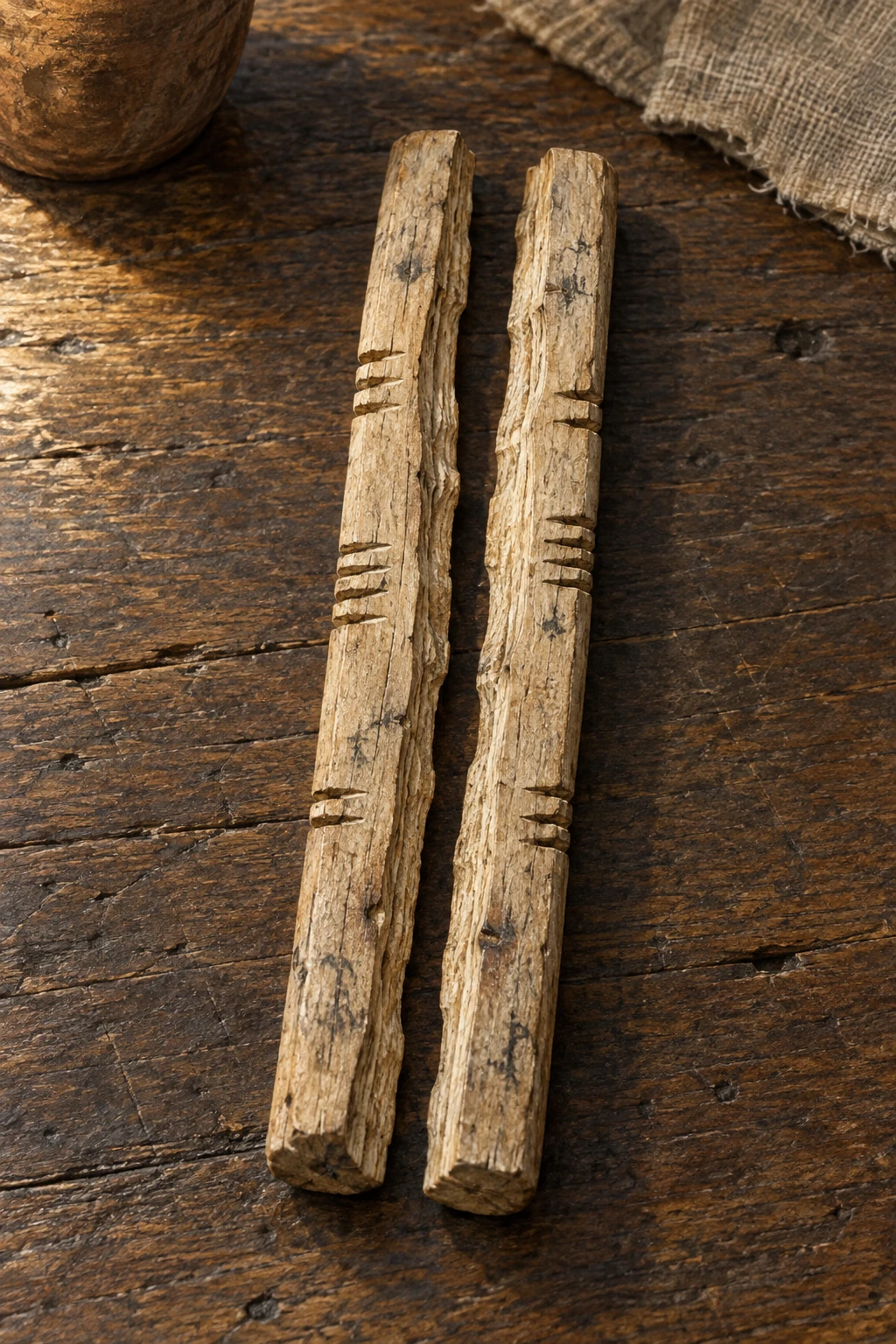
Two slender notched wooden tally halves lie side by side on a worn table, with their grain and split edges visible.
Conceptual illustration of split tallies. It is not a photograph or an exact replica of a surviving record.

Imagine being asked to prove that a payment had been made, with neither a screen to consult nor a paper receipt in your pocket. You bring out a thin piece of notched wood. Someone else retrieves its partner. The two pieces meet along a split, and the record becomes a physical comparison.

A split tally is wonderfully direct, but it is more interesting than the familiar claim that medieval people “used sticks as money.” It combines a number, a material, a procedure, and an institution willing to recognize the result. Look at those four things separately and an apparently primitive object becomes a sophisticated answer to a specific administrative problem.

One record, two custodians

The National Archives’ financial-record glossary defines a tally as a notched stick split in two, with one half retained at the Exchequer and another given to a collector receiving credit for payment. The Exchequer was the government’s financial department. Wood was therefore participating in a system that also involved officials, accounts, and written records.

The important move was to mark one object before separating it. In a modern explanation of a surviving example, the Bank of England Museum points out why the sequence mattered: extra notches cut later in one half would fail to appear on the other. A comparison could reveal an alteration.

This does not make the tally a magic fraud-proof machine. It protects a particular relationship between two physical records. It cannot independently tell you whether an official entered the right sum at the start, whether a transaction was legitimate, or whether the institution later treated the holder fairly. Those are different questions, requiring different evidence.

The wood is only part of the document

A tally was not necessarily an anonymous row of cuts. A British Museum specimen preserves one full-length half, 25 large notches, and an ink label; it is 117.5 centimetres long. Its length alone is a useful antidote to imagining every tally as a little pocket token. Surviving objects need to be examined individually.

The label and the notches perform different jobs. A notch can register a value without expressing a person’s name, a place, a date, or the circumstances of the entry. Writing can supply information that the cut pattern does not. A split surface supplies another sort of information again: a possible relationship between this half and another object.

When a museum photograph shows only one face, it may conceal precisely the surfaces you most want to compare. That is a practical reading lesson. Ask which face is being shown, whether a partner survives, whether the catalog transcribes an inscription, and whether damage has removed part of the original record. An attractive photograph is an invitation to read the catalog, not a substitute for it.

A real audit could still go wrong

The National Archives’ account of fourteenth-century Irish Exchequer records describes payments made without the expected tally authorization and other tallies made incorrectly. The records concern the troubled accounts of Alexander Bicknor’s period as treasurer. Surviving rolls allowed officials, and now historians, to examine administrative failure.

That example changes the story. The interesting historical question is not simply whether a clever device existed. It is whether people followed the procedure, checked the result, preserved the evidence, and could challenge a discrepancy. A tally gains meaning from the work around it.

The Archives’ guide to pipe rolls explains that these written records preserve the audit of the monarchy’s accounts for a financial year. The wooden objects and the written audit should be thought about together. They are different components of the same broad effort to make obligations visible and accountable.

Try the matching principle, without a knife

This simple paper exercise models one feature of the tally. It is an analogy, not a reconstruction of medieval accounting practice.

  1. Draw an uneven line across a strip of scrap paper. Place several marks across the line so that each mark has a portion on either side.
  2. Tear the strip along that line and give one half to a partner. Keep the other.
  3. On your half alone, add another mark that ends at the torn edge.
  4. Bring the halves back together. Compare both the torn contour and the marks crossing it.

The unmatched mark is easy to spot. Now consider a harder problem: what if the two of you wrote the wrong number before tearing the paper? The fit would still be excellent. Physical agreement proves agreement between the records; it does not prove the truth of every claim recorded on them.

That distinction travels well beyond medieval history. Whenever a system advertises a strong check, ask what the check actually checks. Matching, identity, authorization, and correctness are related tasks, but they are not interchangeable.

Size changes the question

Two collection records make a revealing pair. A Science Museum Group medieval stock measures 174 millimetres along its longest dimension. Its 1822 stock-and-foil set includes a stock 580 millimetres long and a foil 465 millimetres long. These are separate objects from different dates. The comparison is useful because it stops the mental picture of “a tally” from settling into one standard size or two perfectly equal halves.

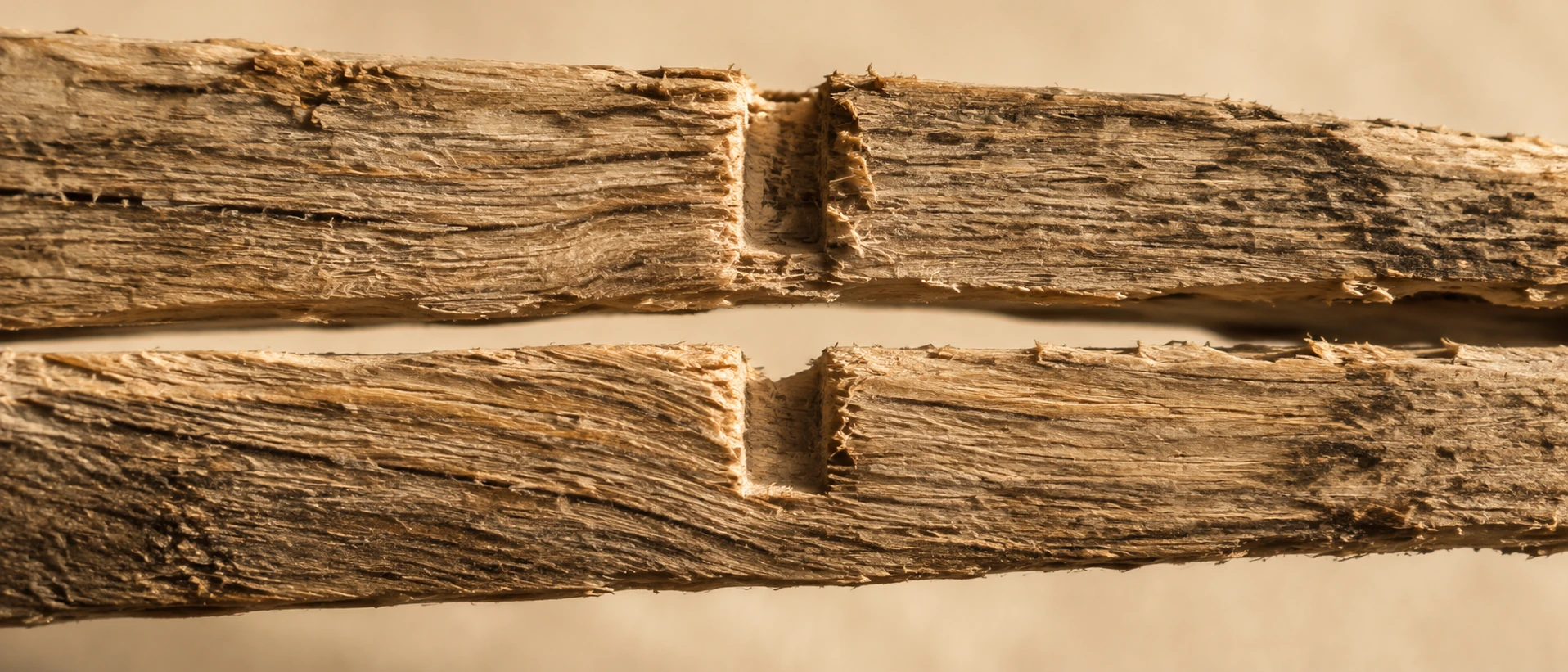
Close study of matching wood grain and notches along two split tally edges.
Conceptual edge study. The notches do not encode a historical amount.

Try giving the objects a physical scale without copying their marks. Lay an ordinary measuring tape on a table and locate 17.4, 46.5, and 58 centimetres. Then close the catalog photographs and imagine storing twenty records of each length. A record is something an institution must put somewhere, retrieve, carry to a comparison, and keep associated with the right account. Those practical questions become harder to ignore once the wood occupies real space.

The stock-and-foil terminology also makes the two custodians visible. The catalog identifies the stock as the longer portion and the foil as the shorter one. Length is not a substitute for knowing the procedure, however. A detached object in a case cannot tell us who most recently presented it, whether its partner survived, or whether anyone actually performed the check when a dispute arose.

The short exercise below tests three different kinds of agreement. Its descriptions are invented examples, with no medieval denomination code. First ask whether two records match. Then ask whether the recorded event is supported. Finally ask whether the person presenting the record has an established claim. A strong answer to one question leaves the others open.

What does a match establish?

Three fictional evidence cases distinguish agreement, truth, and entitlement.

Open this activity in its own window.

Notice the asymmetry between a successful comparison and a failed one. A mismatch gives a specific reason to investigate; a match removes that particular objection. It does not close every possible investigation. This is the intellectually interesting part of the stick: it turns one large, vague question about trust into a smaller question that two people can actually inspect together.

On returning to an authentic specimen, check whether its record supplies a partner, dimensions, inscription, date, and collection history. Missing information is not a defect in your visit. It tells you which of those questions the surviving object can presently help answer.

A long life, followed by a disastrous disposal

The Bank of England’s collection includes a tally recording one of its first loans to government in 1694. Tallies therefore belong to a history that extends well beyond the medieval period. Their use in recording obligations does not mean every example circulated in the same way as a coin.

On 16 October 1834, old Exchequer tallies were burned in underfloor stoves at the Palace of Westminster. According to Parliament’s historical account, the stoves ignited panelling in the Lords Chamber and the fire destroyed much of the palace. The famous ending can overwhelm the objects’ working lives. It is worth returning from the flames to the quiet act of comparison: two halves, an entry, and a person asking whether the account agrees.

One final question to keep beside the object is who could demand the comparison. A matching technology only helps a holder if there is somewhere to present it and some recognized process for considering it. That question is a prompt for further historical research, rather than a claim that every tally holder enjoyed equal power.

Sources and a closer look

The National Archives: financial glossary; Bank of England Museum: The Future of Money guide; British Museum: tally OA.9453; The National Archives: Bicknor and the Irish accounts; The National Archives: pipe rolls research guide; Bank of England: payments through time; UK Parliament: destruction by fire, 1834.

Find more art, ideas, and unexpected connections at Incoprea.

A Glass Bowl in Nara: Following Connections Without Inventing a Journey

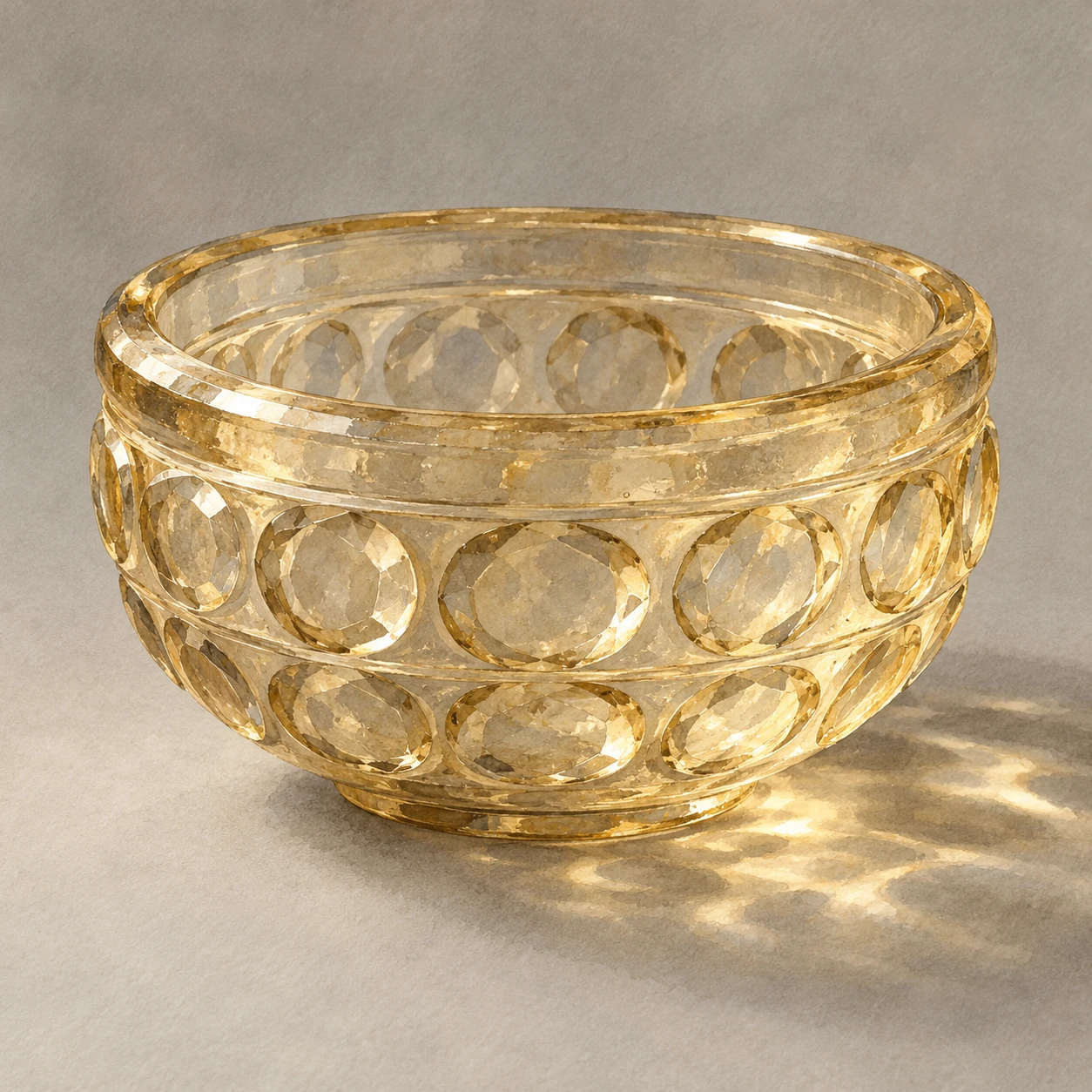
A pale amber glass bowl with repeating shallow circular facets casts a soft shadow on a neutral surface.
Conceptual cut-glass study, not a facsimile or photograph of the Shōsōin White Glass Bowl.

A small glass bowl can make a continent feel connected. Its shallow circular facets catch the light, repeating around a surface that has survived for centuries in Japan. It is easy to imagine a single adventurous traveler carrying it all the way from a western workshop to Nara. The bowl does not tell us that story so neatly.

The White Glass Bowl in the Shōsōin collection is more rewarding when we resist inventing its itinerary. Its material, shape, decorative technique, and custodial history provide different kinds of evidence. Together they reveal wide connections. They do not necessarily reveal every hand through which the vessel passed.

Start with the object that is actually cataloged

The Imperial Household Agency’s object entry describes a nearly colorless alkali-lime glass bowl with a faint brown tint, its exterior covered in circular cut facets. It gives a mouth diameter of 12 centimetres and height of 8.5 centimetres. The entry attributes its manufacture to Sasanian Persia as a received scholarly identification, rather than supplying the name of a particular maker.

Those modest dimensions matter. This is an intimate object, not a monumental vessel. To picture the scale, mark a 12-centimetre circle on ordinary paper. Then compare that small opening with the geographic breadth of the connections people discuss around it. The contrast is part of the bowl’s power.

A circular facet is a change in the glass surface. It can alter reflected and transmitted light without requiring a painted design. Look at a good museum photograph for the relationship between repeated cuts, the uninterrupted rim, and the thickness of the wall. The decoration depends on material being removed, while enough glass remains to preserve the vessel.

Why this treasury is an unusual archive

The Agency’s history of the Shōsōin explains that much of the collection derives from Emperor Shōmu’s belongings donated by Empress Kōmyō to Tōdaiji in 756. Dedicatory records, inscriptions, and controlled access help scholars understand objects passed down in custody rather than recovered from the ground. The treasures are now housed in modern repositories; the famous timber storehouse is not simply an unchanged room full of exposed artifacts.

This is a different preservation history from a burial find. A treasury may retain surfaces and materials that soil would have altered. It can also favor objects that powerful institutions chose to keep. “Well preserved” and “representative of everybody’s life” are separate judgments.

The collection includes goods and designs connected with multiple regions. That does not make it a bag of foreign curiosities. An imported thing acquires new uses and meanings where it is received, displayed, donated, or preserved. Its life in Japan is part of its history, rather than an epilogue to the place of manufacture.

Similar is useful; identical needs proof

The Nara National Museum catalogs another cut-glass bowl, dated to the fifth–sixth century, as comparable to the Shōsōin example. Its label links the cutting technique with Sasanian Persia and describes its weathered yellowish-white surface following burial. This is a separate object, with a different preservation history. Comparing them is useful precisely because comparison does not require pretending they are the same bowl.

A further comparison comes from the Metropolitan Museum’s Sasanian glass bowl, cataloged broadly to the third–seventh century and associated with Ctesiphon in Mesopotamia. A museum’s period and geographic labels help place an object within a scholarly framework. They are not a passport listing all of its movements.

What chemistry can add—and what it cannot

A SPring-8 research report discusses scientific analysis of fragments believed to come from different glassware excavated at Niizawa Senzuka Tumulus 126 in Nara Prefecture. The analyzed facet-cut bowl fragment had a composition matching a Sasanian glass group. That research concerns the tumulus material, not a direct analysis of the White Glass Bowl discussed here.

The distinction is essential. An analytical result from a comparable artifact can strengthen a wider picture of connections. It should not be silently transferred to another object. Even when a glass composition points toward a production region, it does not automatically name the person who carried the finished vessel, the route taken, or the occasion of its arrival.

Consider two possible journeys for the same vessel: one long passage with a single owner, or several shorter exchanges among people who never met its maker. Both can connect the same endpoints on a map. The surviving object needs additional evidence to distinguish them. Distance alone cannot choose the more dramatic story.

One collection, two very different glass objects

The nearly colorless bowl becomes easier to understand beside the Shōsōin’s blue Glass Cup, Middle Section 70. The official record describes cobalt-colored alkali-lime glass with applied rings, joined to a silver-gilt stem; it also identifies a newly supplied lotus-shaped receiving element. This is a different artifact, with a different construction. Its metal and glass should not be quietly added to the White Glass Bowl’s description.

Light passing through a close section of round-faceted pale glass and its rim.
Interpretive light study, not a facsimile of the White Glass Bowl.

The Imperial Household Agency’s introductory treasury guide attributes the cup’s glass to ancient Persia and its dragon-patterned stem to China. That attribution gives a visitor a striking material comparison within one object. It does not identify the carrier of the separate White Glass Bowl, or make the two vessels traveling companions. Shared preservation in a treasury is a later relationship, not evidence of a shared route.

Use the two official object views as a short comparison game. Make four headings: color, surface decoration, supporting structure, and documented later intervention. Fill each column for the blue cup and then for the pale bowl. Where the record is silent, leave a blank. Do not turn an absent statement into evidence that no repair ever occurred.

Now cover the historical attributions and read only your material descriptions. The objects already differ in several useful ways. One has decoration formed by removing material at the exterior; the other includes applied glass rings and an attached metal support. The contrast helps explain why a common category such as “imported glass” can hide quite different working sequences.

Finally, restore the attributions and choose one claim that would require evidence beyond a photograph. The origin of cobalt color, the place where a stem was made, or the identification of a later replacement are good candidates. Ask which institution or analytical record supplies that information. The exercise gives invisible scholarship a visible place beside the object.

It is possible to enjoy broad connections while keeping these distinctions intact. A treasury collects materials, techniques, and later acts of care as well as things. Comparing two objects makes that richness clearer when neither is forced to stand as a miniature map of every exchange across Asia.

Build an evidence map with three kinds of line

Try making a simple sketch rather than a confident trade-route graphic. Put the bowl at one end and the proposed production region at the other. Use a solid line only for a documented relationship, a dashed line for a reasoned attribution, and a question mark for a missing part of the journey.

  • Documented custody: what does the treasury’s history establish about preservation and records?
  • Material and stylistic comparison: what features connect the bowl with other vessels?
  • Unrecorded movement: which carriers, ports, exchanges, or gifts have not been demonstrated for this particular object?

You may end with fewer arrows than an exhibition’s sweeping map. That is a useful outcome. The exercise reveals which claims come directly from the object and which are interpretations of a network around it.

For a second pass, write two captions: one saying only what a photograph shows, and another adding the catalog’s historical attribution. Notice how much invisible knowledge the second caption introduces. Good interpretation makes that knowledge available while allowing the reader to see where it comes from.

The bowl remains extraordinary with its gaps intact. Someone formed the glass, someone cut the facets, and a succession of people kept the vessel from disappearing. We do not need to supply their missing conversations to recognize how much human work a little surviving surface contains.

Sources and a closer look

Shōsōin: White Glass Bowl object record; Imperial Household Agency: Shōsōin repository history; Nara National Museum: comparable cut-glass bowl; The Met: Sasanian bowl 32.150.244; SPring-8: Ancient glassware that traveled the Silk Road.

Find more art, ideas, and unexpected connections at Incoprea.

A Face Made From Clay: Asking Better Questions of Vinča Figurines

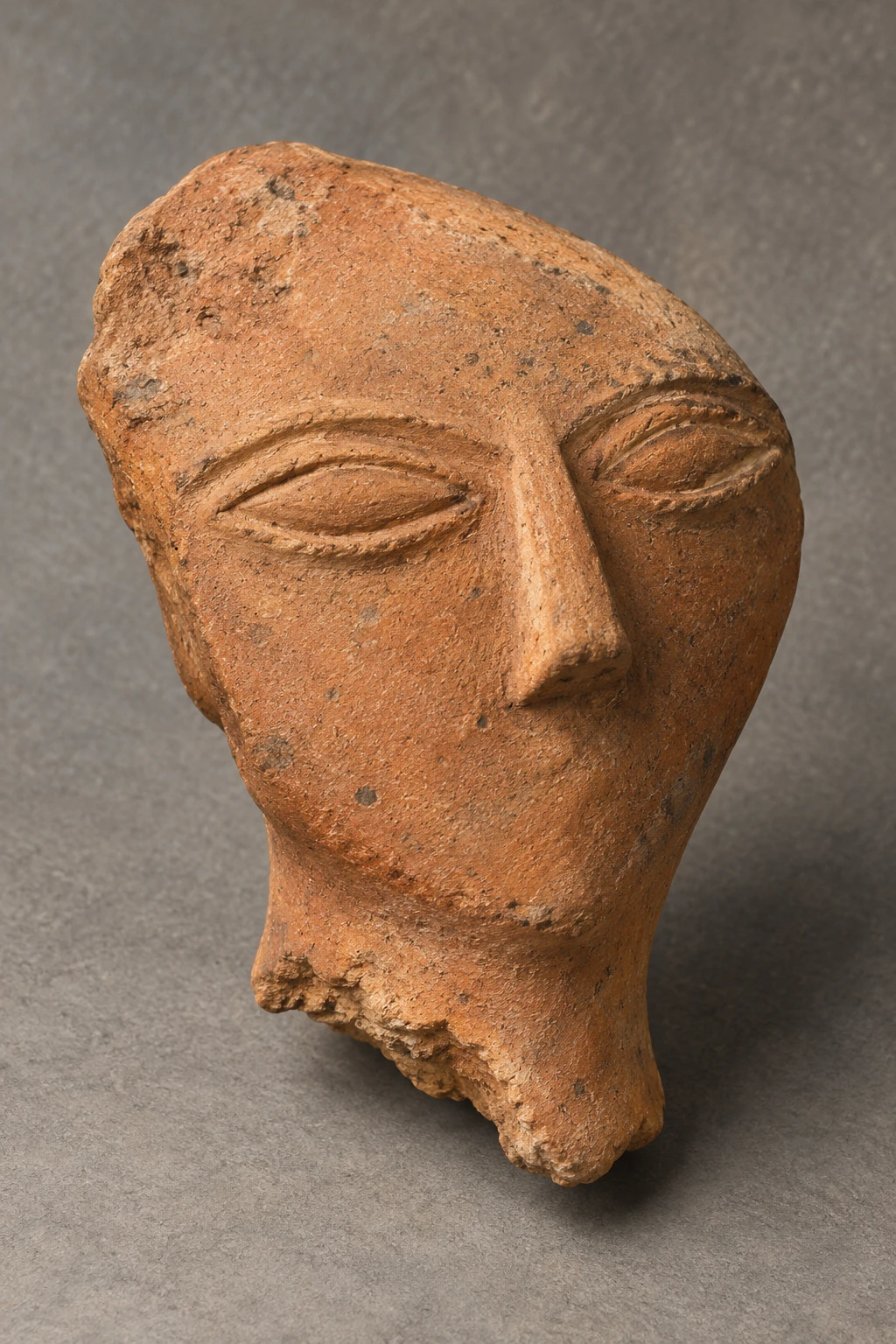
A stylized terracotta head fragment with incised eyes and a simple raised nose against a neutral background.
Original conceptual Neolithic head study, not an excavated Vinča artifact or a claim about a deity’s appearance.

The face is small, angular, and deliberate. A few incisions can make eyes, a raised ridge can suggest a nose, and clay can turn a human form into something that feels both familiar and strange. A Neolithic figurine asks us to recognize a body while admitting that recognition is not the same as understanding its purpose.

Vinča figurines from southeastern Europe attract confident labels: deity, mother, priestess, toy, portrait. Some may be plausible for particular finds, but a name can race far ahead of the evidence. The objects become more interesting when we ask what would let us distinguish among those possibilities.

A culture name is not an ancient person’s name

The National Museum of Serbia’s late Neolithic collection includes material from Vinča-Belo Brdo, Pločnik, Belovode, and other sites. It places its collection broadly between the middle of the sixth and middle of the fifth millennium BCE and describes pottery, figurines, stone objects, and early copper artifacts.

That wider setting matters. A figurine did not emerge from a world containing nothing but mysterious sculptures. It belonged among settlements, agriculture, animal husbandry, material production, and the ordinary work of living. A museum’s archaeological culture label groups evidence through scholarly comparison; it does not recover every ancient person’s self-description.

The museum’s wording about figurine use remains open: decoration or ritual are possibilities. This is a good model for public writing. Uncertainty can identify a real research question without becoming an excuse to supply a fantasy.

Describe the clay before naming the being

A British Museum figurine from Vinča is cataloged as a stylized terracotta figure, with a question mark attached to the possible category of religious or ritual equipment. The question mark is not a failure of expertise. It distinguishes the surviving form from an interpretation of its use.

Try a description that uses only visible attributes: material color, surface finish, preserved parts, incised lines, proportions, holes, breaks. “Large eyes” describes form. “All-seeing goddess” introduces an identity and a theology. The second statement needs more evidence than the first.

Surface marks present a similar challenge. A line might be a construction trace, a body feature, an ornament, a garment detail, a repeated sign, or something else. Its placement and comparison with other objects matter. The mere presence of an incision does not make a text, and recognizing a repeated shape does not by itself decipher one.

Context is more than a dot on a map

An object’s findspot can include the building or deposit in which it lay, the other materials nearby, its position, and the history of how the layer formed. A broken head in disturbed soil and an intact figure in a carefully recorded deposit offer different opportunities for interpretation.

When details of excavation are missing, the object does not become worthless. Its form and material remain available for study. The missing context does limit which questions can be answered confidently. A visually striking piece in an old collection should not be given an invented ritual scene simply because the scene would make a good illustration.

A study of symbols on southeastern European figurines analyzes decoration in relation to other attributes and argues for patterned rules of making. Such an approach is richer than selecting one spectacular figure and asking it to explain an entire belief system.

A body is not a simple gender label

The archaeological discussion in Becoming Gendered in European Prehistory addresses the varied and sometimes ambiguous treatment of bodies in Neolithic imagery. It warns against importing an easy modern binary or assuming that one anatomical emphasis explains every figure’s social meaning.

The broader methodological question is explored in Can We Interpret Figurines?: figurines can carry several dimensions of meaning, and simple labels such as mother goddess or sex object can conceal the questions that need investigation.

That does not require pretending bodies have no visible features. It requires separating the observed feature, the assigned category, and the proposed social meaning. Each step adds an argument.

Use a second photograph of the same figurine if one is available. Compare how the eyes and nose read under another angle or light. A shallow incision may look like a heavy dark line in one view and almost vanish in another. Sketch only the marks that both photographs support, leaving uncertain features dotted. You are not restoring the ancient face; you are recording the limits of the images you have. The little drawing can expose how much a modern impression of expression depends on shadows, cropping, or the direction from which the object was photographed.

A break is evidence, but intention takes an argument

Recent work outside the Vinča group shows what a stronger argument about breakage can involve. A study of 378 figurine fragments from Těšetice-Kyjovice–Sutny combined microscopic and three-dimensional fracture analysis, internal structure, experimental breakage, and spatial information. Its authors argue for deliberate fragmentation in that Lengyel-culture assemblage. This is a finding about a different site and archaeological culture, not a result that can be pasted onto every broken Vinča head.

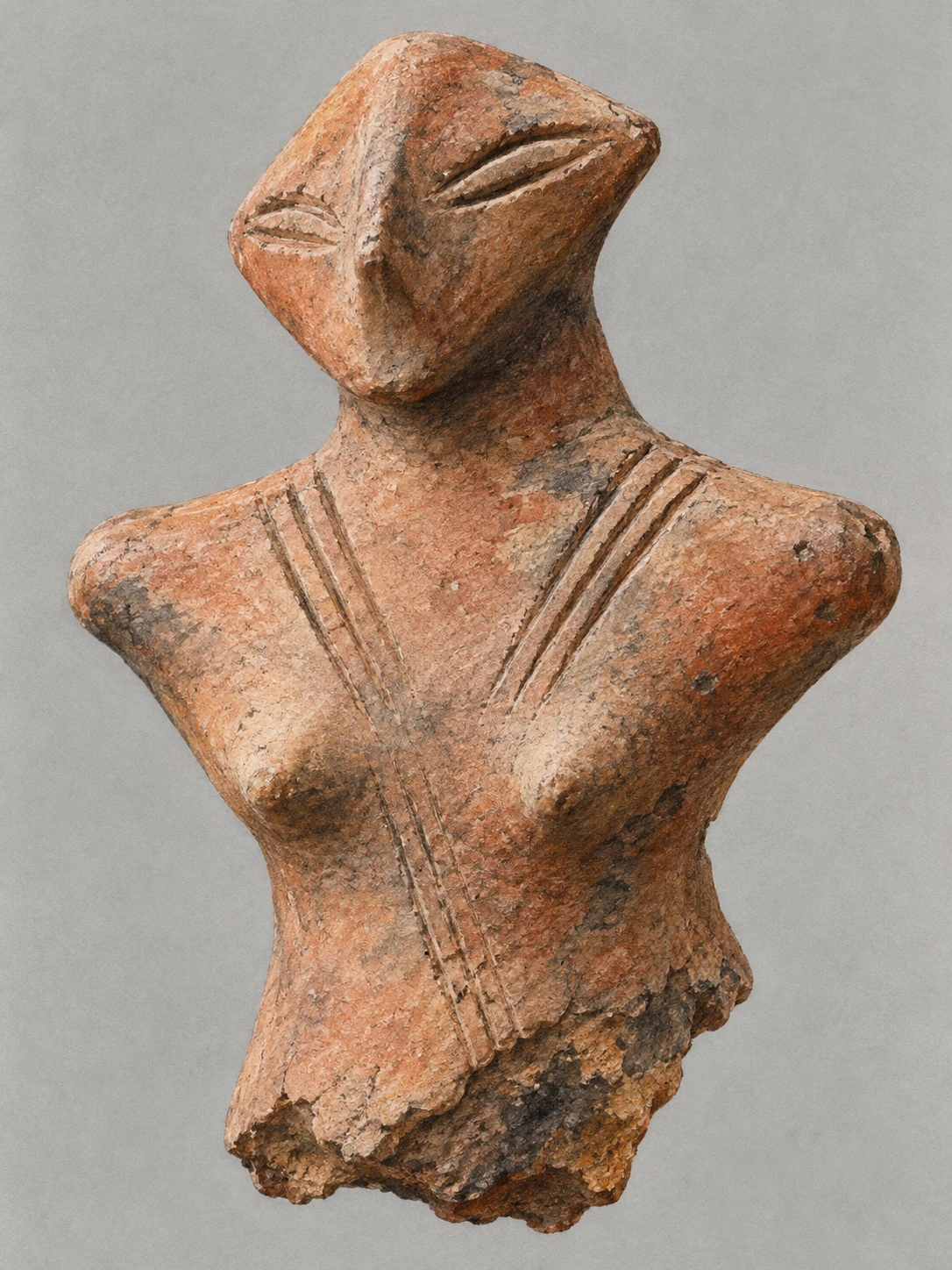
Generic modeled clay head and torso with incisions and a broken lower edge.
Original clay-form study, not an excavated figurine or identification of a deity.

A separate Vinča pottery investigation at Belovode and Pločnik studied ceramic technology through well-dated sherds. It concerns pottery production rather than the identity of a figurine. Read together, these studies show why the object’s physical history and an explanation of its cultural meaning need several kinds of evidence, carefully attached to the material actually studied.

Consider a fictional fragment with a break at the neck. Four possibilities are available before investigation: breakage during manufacture, damage during use, deliberate separation, and change after burial. Listing them does not make them equally likely, and it does not decide among them. It creates a fairer question than beginning with the most dramatic story and searching only for details that fit.

Now ask what would distinguish the possibilities. Does the break follow a weak construction join? Are similar breaks repeated across a well-recorded assemblage? Do matching pieces occur together or in different contexts? What do experiments reproduce, and what conditions do they leave out? These are research prompts, not a home authentication method.

For a reader activity, take a museum description and highlight every word that concerns the object’s present condition. Use a second color for words about the event that produced that condition. “Broken” belongs to the first group. “Intentionally broken in a ceremony” belongs to the second. Mark which evidence supports the move from one group to the other.

Do not break an object to perform the exercise. A paper outline with a missing section is enough to test the language of inference. Its purpose is to slow the sentence down at the point where a visible condition becomes an account of somebody’s action.

The fragile face remains compelling through that slower reading. A fracture can disclose construction, use, and later history without immediately disclosing motive. Knowing what an additional study would need to test is itself a substantial step toward understanding the object.

Give three hypotheses a fair test

Choose one official museum photograph and write three possible functions on a sheet: display, play, and ritual. These are thinking prompts, not a claim that they exhaust ancient possibilities. For each, ask what additional evidence would make it stronger.

  • Would wear or handling traces be relevant?
  • Would repeated placement in similar contexts help?
  • Would a set of related objects change the interpretation?
  • Would scale, fragility, or means of attachment matter?

Now cross out any “evidence” that comes only from how strange the face looks to you. Strangeness is a relationship between object and viewer, not an archaeological context.

For a final exercise, write a museum label in two sentences. The first describes what survives. The second presents a carefully qualified interpretation and says what remains unknown. This compact form is harder than a dramatic declaration, but it offers a reader something they can evaluate.

The Vinča face does not need a solved identity to hold our attention. Someone made choices about what a body should look like in clay, and those choices entered a material world we can investigate. The wonder lies in the encounter and in the work of asking better questions, without pretending the missing answers are already ours.

Sources and a closer look

National Museum of Serbia: late Neolithic collection; British Museum: Vinča terracotta figurine; Journal of European Archaeology: figurine decoration and context; American Antiquity: gender in European prehistory; Cambridge Archaeological Journal: Can We Interpret Figurines?.

Find more art, ideas, and unexpected connections at Incoprea.

A Mandala Made to Be Dismantled: Looking at a Public Sand-Painting Tradition

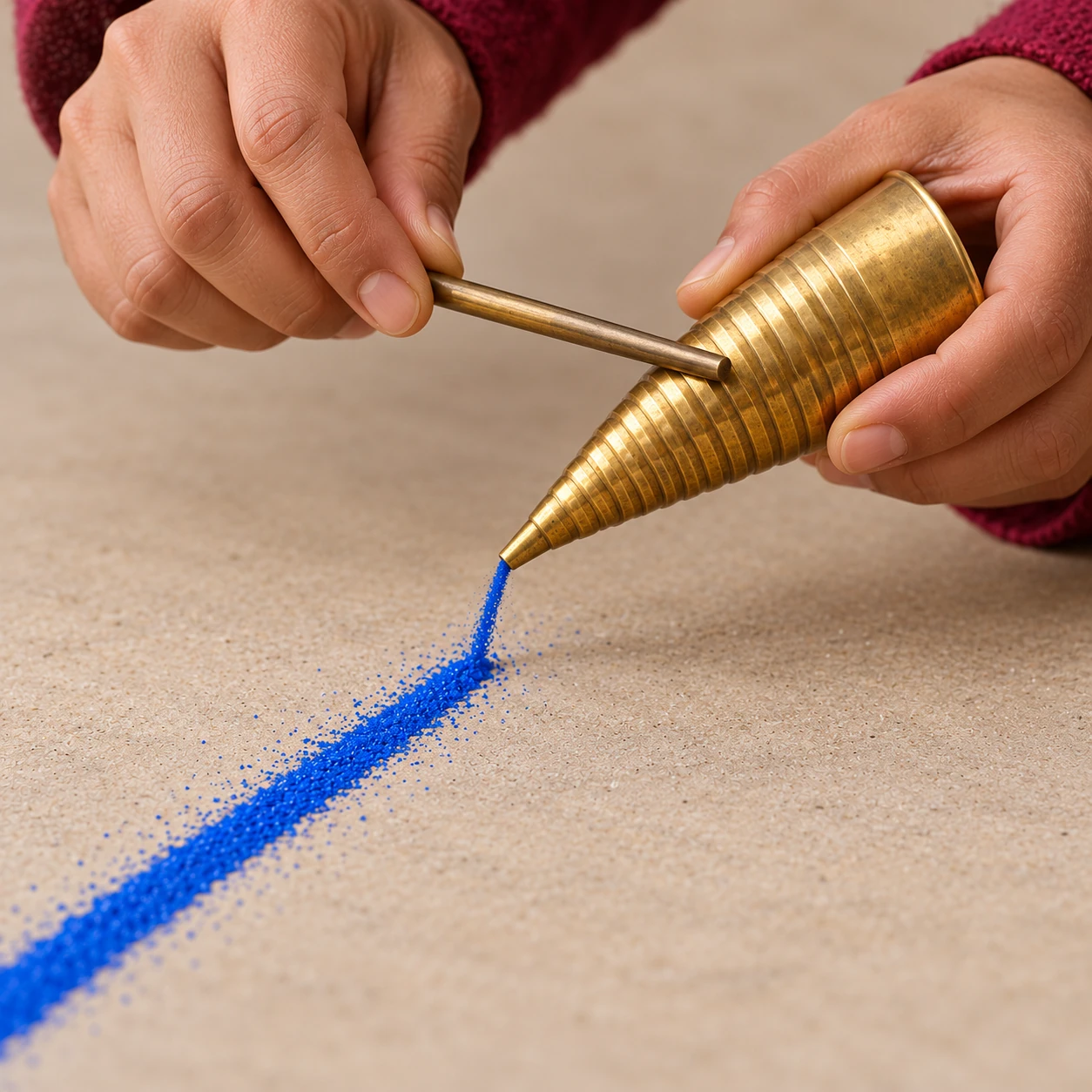
Conceptual close view of a metal funnel laying a thin line of blue grains.
Tool study; the abstract lines are not a sacred mandala or a record of a ceremony.

The difficult moment in a public sand-mandala ceremony may come after the difficult work is finished. Lines have become fields of color. Small adjustments have accumulated into a coherent whole. Then the makers begin to dismantle it. If we assume that painstaking craft must end in a permanent collectible, this conclusion can feel like a contradiction. The contradiction belongs to that assumption.

A Tibetan Buddhist mandala is not simply a decorative circle. The Rubin Museum explains that it can be a cosmological diagram and a sacred dwelling organized around a central deity. Mandalas may be made as paintings, sand constructions, or three-dimensional structures. Their meaning depends on a religious setting and practice that a pattern alone cannot reproduce.

Begin with a documented event

The Smithsonian’s Tibetan Healing Mandala archive documents a public construction following the September 11 attacks in 2001. It identifies monks from Drepung Loseling Monastery, a seven-foot-square work, and twenty monks working in shifts over two weeks. Those numbers describe that event; they are not rules for all mandalas.

The archive describes a sequence of preparation, drawing, filling, consecration, and eventual sweeping and dispersal into flowing water. Its explanation links dismantling to impermanence. It also presents healing energies as a Buddhist religious understanding. That is the practitioners’ framework, not evidence of a medical treatment.

Keeping those distinctions visible improves the experience. A visitor can take a belief seriously as part of what people are doing without converting it into a scientific claim or stripping it out as an embarrassment. Both the labor and its purpose deserve to be heard.

The precision is in the delivery

For the Smithsonian example, the colored material was powdered marble. The archive identifies a cone-shaped metal funnel called a chak-pur: rubbing a rod along its ridged surface produces vibration that releases a controlled stream. The construction begins with drawn guidelines rather than incised grooves.

That short description gives you something concrete to watch. Look for the relationship between tool position and the emerging line. Is the tip moving while the flow continues? Does the maker stop before changing direction? How does one filled area meet another? You need not know the entire iconographic program to notice disciplined handling of a granular material.

Do not infer a maker’s internal state from a still photograph. A lowered face is not proof of serenity, nor is a steady hand proof that a task is effortless. Public viewing shows actions and results. Training, attention, fatigue, devotion, and personal experience are larger matters than a camera can settle.

Watch time without losing the people

The National Museum of Asian Art offers a time-lapse recording of a mandala begun in March 2010 by Venerable Ngawang Chojor. A time-lapse is especially good at making cumulative structure legible. It is less good at communicating the duration of a pause or the physical repetition of a working session.

Use it twice. First watch the whole sequence for large changes. Then replay a short portion and concentrate on one boundary between colors. Ask what the compressed recording has removed. Speed can reveal organization while making work appear to arrive almost by itself.

A public account from UNC Pembroke in September 2026 describes another Drepung Loseling visit, this time a four-and-a-half-foot work made by six monks. The report includes a maker’s explanation of kindness and the intentional dismantling. Comparing the two institutional records shows continuity without pretending their scale, occasion, or audience was identical.

Three things a finished photograph leaves out

Order. A completed design makes adjacent elements look simultaneous. A process record can show which decisions came before others. Without that record, avoid inventing a construction sequence from appearance alone.

Sound. A silent picture cannot convey a tool being worked, spoken explanation, chanting, or the room’s ordinary movement. If a recording includes sound, listen to what it actually preserves. Do not add an imagined soundtrack and mistake it for observation.

The ending. An image of the completed surface can circulate indefinitely after the sand has been dispersed. That photograph is a durable record of an intentionally temporary work. It is not the same kind of object as the work it records.

This last distinction can change the way you share a picture. Naming the makers and occasion, linking their explanation, and including the documented conclusion gives viewers more than visual spectacle. It preserves something of the event’s own account of itself.

A respectful looking guide for a public visit

Read the host’s guidance before approaching. Viewing, photography, questions, and participation can have different arrangements at different events. A public invitation to observe does not mean every tool, symbol, or ritual action is available for casual imitation.

Choose one question that the setting can actually answer. “What material is used here?” is more useful than assuming it is beach sand. “Who selected this mandala?” respects a decision-making structure. “Where can I read the makers’ explanation?” keeps the account connected to its practitioners.

If you want a personal exercise afterward, arrange a few plain paper squares into an original temporary composition and then put them away. Use no sacred diagram or borrowed ritual. Observe your response to undoing your own arrangement. The exercise can help you notice attachment to a result; it does not reproduce Buddhist training or grant insight into somebody else’s religious experience.

Whose account accompanies the picture?

The practitioners’ own Mystical Arts of Tibet explanation describes an outlined platform, colored material delivered through vibrating metal funnels, and the eventual dismantling. It also explains consecration and blessing within its religious framework. Those statements should be attributed as the practitioners’ account, rather than turned into a universal description of every Buddhist mandala or a measured health outcome.

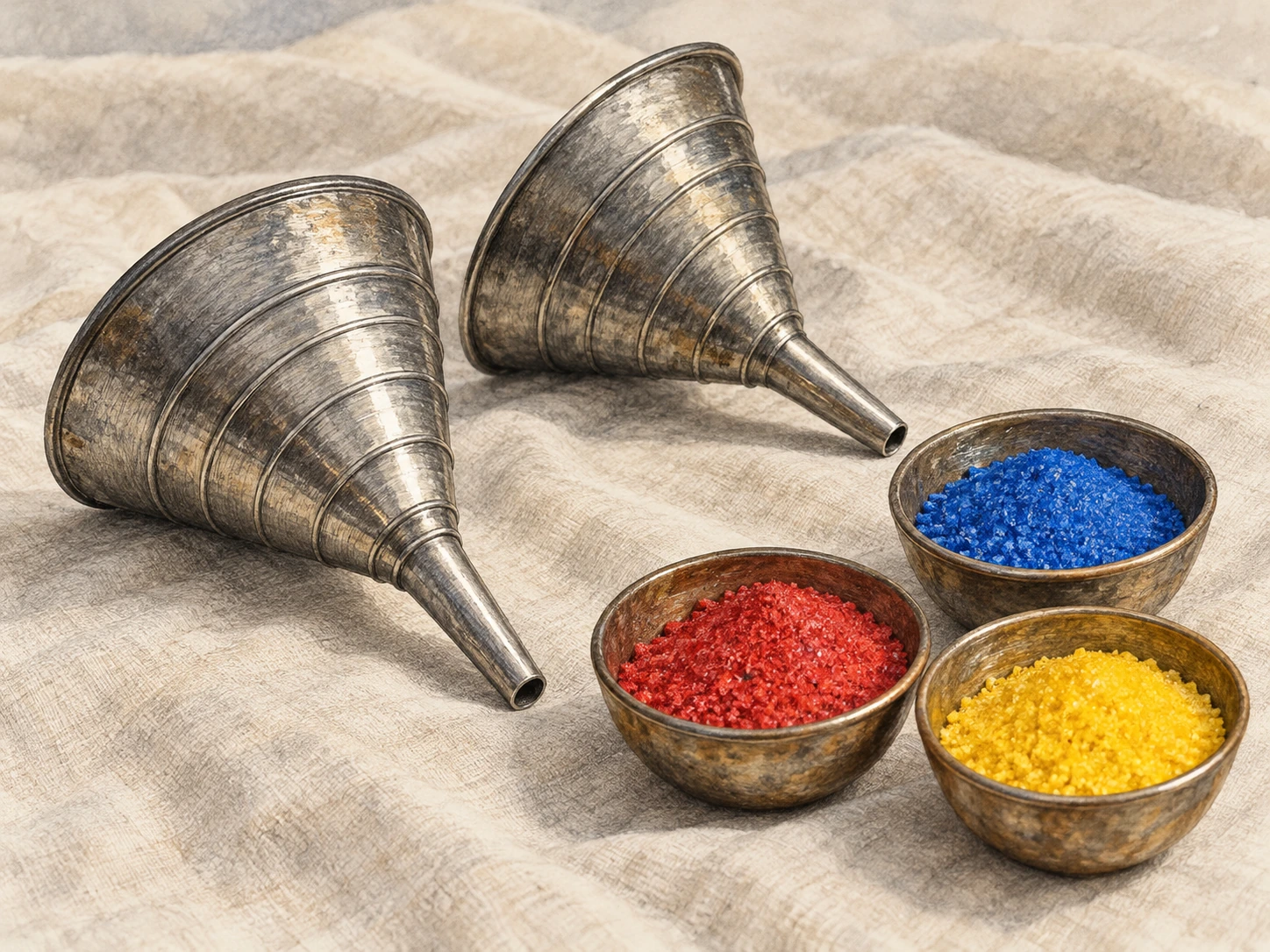
Unused ridged metal funnels rest beside small bowls of colored granular material.
Interpretive tool study. No sacred diagram or ceremony is reproduced.

A Drepung Loseling event announcement from August 2019 identifies a White Tara mandala, opening and closing ceremonies, and separate days for construction and viewing. This dated program is useful because it distinguishes an unfolding public event from one isolated photograph. Its schedule documents that event’s planned sequence; it does not establish a fixed duration for all such work.

Try making a listening-and-label card before visiting a public program or its documented recording. Leave four spaces: the makers’ names or monastery, the selected work, the occasion, and the makers’ explanation of the ending. If a host supplies only the first three, the fourth is a question to research, not an invitation to invent a poetic meaning.

Next compare three possible captions for the same finished surface. One gives only color and geometry. Another adds the makers and occasion. A third explains the documented dismantling. What kind of encounter does each caption invite? The first may be visually accurate while leaving out the event’s stated purpose. Adding context changes the reader’s access without altering a grain of the image.

For an accessible alternative to a long film, read the event program and trace the order in words: preparation, construction, public encounter, conclusion. Identify which parts a still image could document and which require a sequence or explanation. Someone unable to attend every session can still understand that the finished surface was one stage rather than the whole event.

This exercise requires no copying of a sacred design. Its subject is how an account is presented and whose voice remains attached to it. A respectful record can preserve the visual achievement while allowing the makers’ own explanation to guide the interpretation.

The final act becomes easier to understand when it is not cropped out of the story. A photograph may continue circulating after the work has been dismantled. Naming that difference lets the lasting image serve as a record of an intentional process, instead of quietly converting the process into a permanent decorative object.

Completion can include release

There are many reasons people make things: exchange, use, remembrance, devotion, learning, pleasure. Permanence is only one possible goal. The public sand-mandala events described here ask viewers to attend to a process whose final action changes the visible work entirely.

The useful question is not how anyone could bear to “waste” so much effort. It is what that judgment assumes effort is for. Looking carefully, listening to the makers, and staying with the ending allows the event to challenge that assumption on its own terms.

Sources and a closer look

Smithsonian: Tibetan Healing Mandala archive; Rubin Museum: Circle in the Square; National Museum of Asian Art: Encountering the Buddha and time-lapse; UNC Pembroke: September 2026 mandala visit.

Find more art, ideas, and unexpected connections at Incoprea.

Wednesday, October 14, 2026

Inuit Snow Goggles: A Clever Design for an Overwhelmingly Bright World

Imagine a landscape bright from almost every direction. Snow lies underfoot, ice stretches ahead, and light reflected from those surfaces reaches the face from below as well as above. A brim offers only a partial answer. Arctic makers developed another: a close-fitting frame with narrow openings that admits a useful view while excluding much of the surrounding glare.

Snow goggles make a rewarding design study because the cleverness is visible. There is no glass to search for. The aperture, the material and the fit do the work together. Yet the familiar photograph of a two-slit frame is only one version of a much more varied tradition.

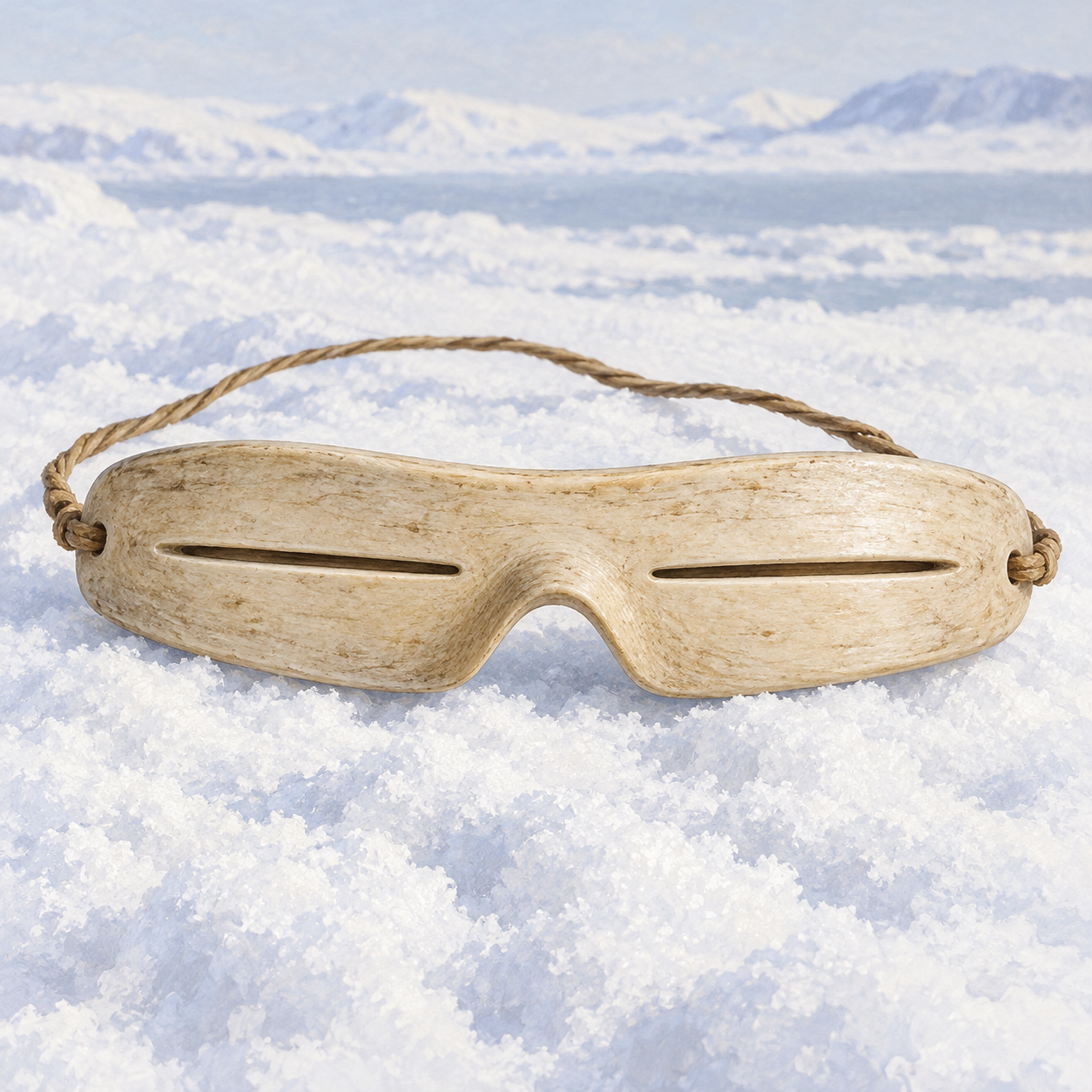
An interpretive pale carved frame has two narrow horizontal slits and a cord against snow.
Explanatory illustration of a general snow-goggle design. It is not an authentic artifact, exact replica or attribution to a particular maker or community.

Start with three particular objects

The Metropolitan Museum of Art holds a pair of walrus-ivory goggles catalogued as Thule, made in Alaska around 800–1200. Its narrow openings sit within a carefully decorated border. The museum describes engraved double lines, spikes and projecting linear forms. A useful object could also carry designs meaningful to its maker or owner; its appearance deserves attention alongside its practical operation.

A second Met record describes a child's pair from the Hudson Bay region, dated around 1900. These are antler, pigment and sinew, rather than walrus ivory. The smaller scale matters. Equipment has to meet a particular face, and a child's object reminds us that everyday expertise extends beyond the adult hunter who often dominates popular illustrations of Arctic life.

Now compare a Smithsonian example from St. Lawrence Island. Its record identifies it as Yupik and describes nine horizontal slits across a bow-shaped frame. The accompanying community knowledge explains the broad field of view afforded by these multiple openings. Two slits are therefore not a rule from which every other pair deviates. They are one solution among several.

Keep those cultural and geographic descriptions attached to the objects. Inuit, St. Lawrence Island Yupik and the archaeological designation Thule do not name one interchangeable community. Comparing designs is valuable precisely because it leaves room for differences in makers, materials, places and periods.

What the opening changes

A narrow slit reduces the area through which light can enter. It also limits the vertical view. That is a tradeoff a designer can work with: enough information to travel and carry out tasks, less exposure to a field of dazzling brightness. The width, length and arrangement of the openings all affect that balance.

The Smithsonian's nine-slit example makes the tradeoff especially easy to notice. Multiple openings can distribute access to the scene across the face. A familiar shape has been reconsidered in response to the experience of seeing. Calling the object simple can hide this sort of judgment.

Fit changes the result too. A front view reveals the aperture, but an inner view raises different questions. How does the frame sit at the bridge of the nose? Where might light enter around an edge? How is the cord attached? Which surfaces need to be smooth? Those are questions about prolonged use, rather than an isolated optical principle.

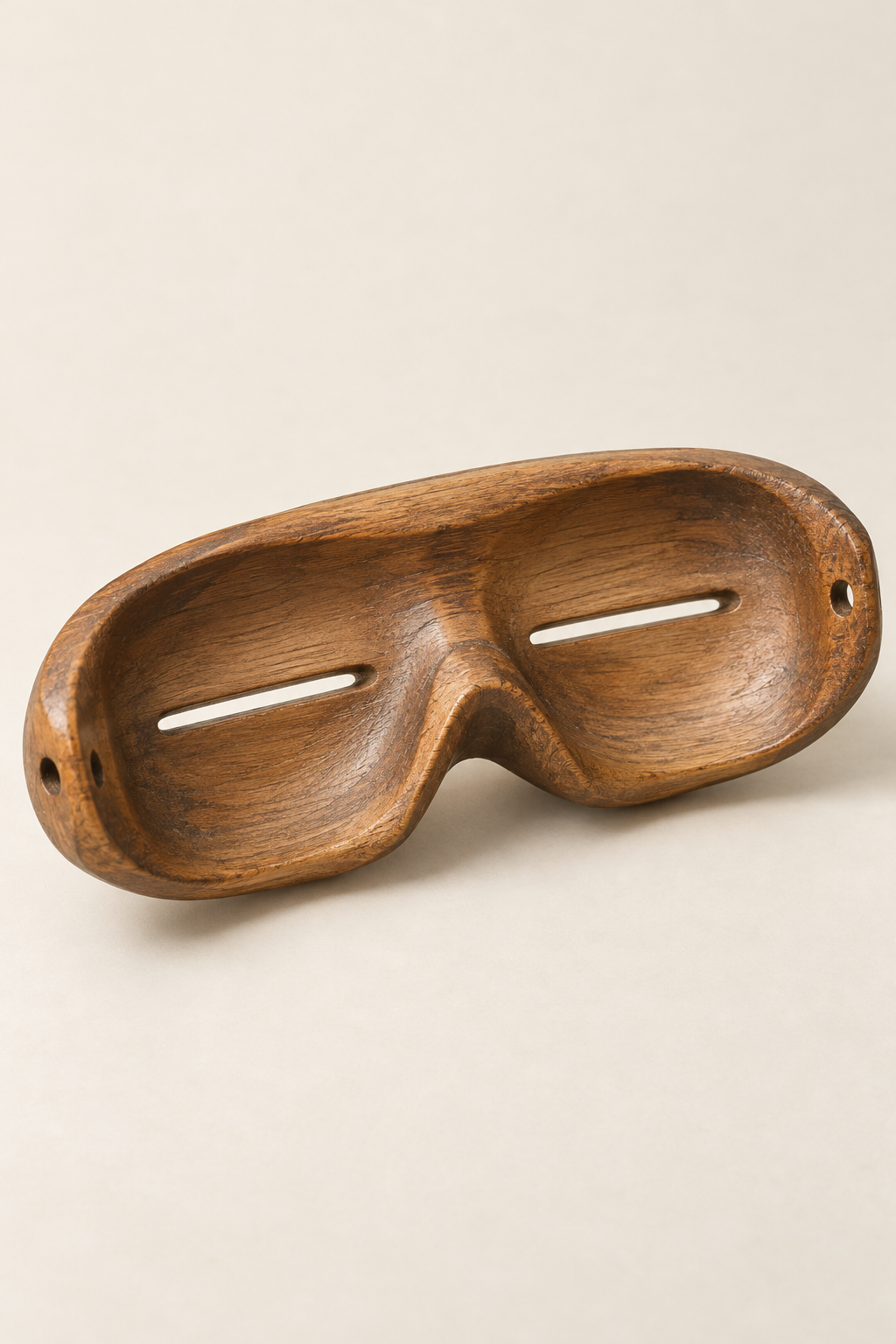
An interpretive inner view of plain wooden slit goggles shows their concave carved surfaces.
Explanatory illustration of a wooden snow-goggle design and its carved fit. It is not an actual artifact or a replica attributed to a particular community.

The illustrations here help separate the front opening from the inner shape. For the details of a particular historical object, use the museum photographs linked below. A general illustration cannot tell us the exact carving, wear or fastening of an individual pair.

A five-minute object comparison

Open the three collection records and examine their photographs before reading the descriptions closely. You do not need to identify a maker's intention to make useful observations. Begin with what the image actually shows, then use the catalogue to refine it.

Three ways to look at the same design problem
Look forQuestion to ask
OpeningsHow many are there, and how much of the frame do they occupy?
Inner contourCan you see a nose notch, a hollowed surface or an edge that meets the face?
Material and fasteningWhich details can you see, and which are known only from the record?
DecorationDoes the design follow the opening, the outer border, or another part of the surface?

Write one observation for each object without using the words clever or primitive. This forces the description to do more work. “Nine narrow openings extend across a broad frame” communicates something a reader can test. “An ingenious ancient gadget” offers praise while leaving the object almost invisible.

Next choose a question the photographs cannot answer. Weight on the face, the feel of the cord, and the precise circumstances of use are all possibilities. Recognising an unanswered question is part of close looking. It prevents a compelling image from becoming a complete story by itself.

Listen to knowledge as well as looking at form

The Smithsonian record includes knowledge shared through the Arctic Studies Center's Alaska Native Collections project. It connects bright spring conditions with the usefulness and variety of goggles. That account adds something a material label cannot: a description grounded in lived experience of the environment.

The Met's older Thule record also includes an audio feature, “Snow Goggles, Thule.” Open the museum page if you would like to follow that additional interpretation. The audio and the photographs offer different routes into the object; neither needs to be reduced to a caption beside a novelty image.

After the comparison, the most interesting question changes. Instead of asking how anyone managed without modern sunglasses, ask how particular people shaped local materials to meet a demanding visual environment. The goggles become evidence of design decisions: what to admit, what to exclude, what to fit, and what to make meaningful.

Sources and further reading

Explore more art, stories and discoveries at Incoprea.

Famous Last Meals is now in paperback — stories, history and 25 recipes

Famous Last Meals: Stories, History, and Recipes is now available in paperback on Amazon. The illustrated collection brings together 23 his...