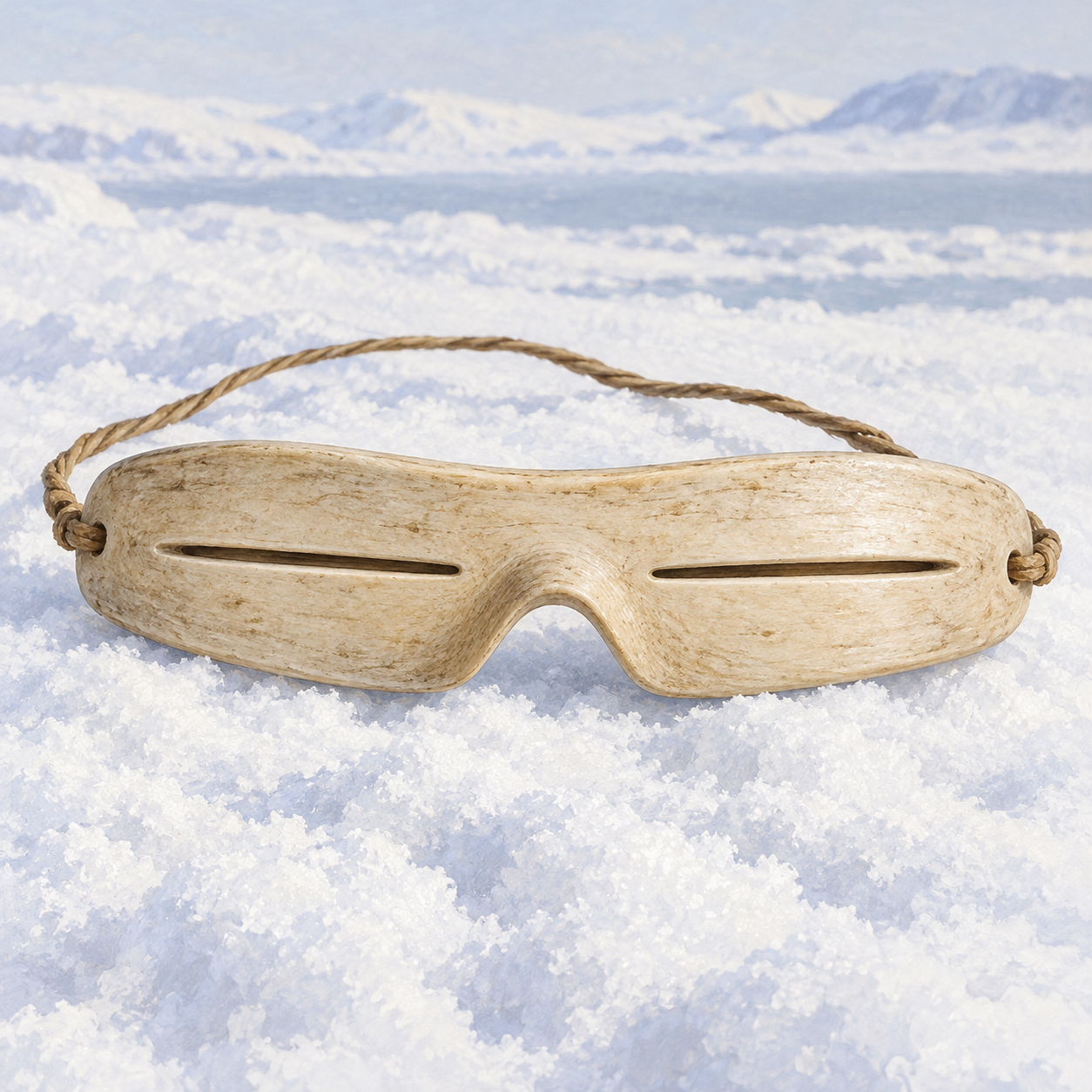
Some of the most striking Arctic eyewear has no glass at all. A carved frame fits close to the face, with narrow slits admitting a restricted view of the landscape. Snow goggles made by Inuit and other Arctic peoples demonstrate how a practical design can emerge from close knowledge of a demanding environment.
Snow and ice can reflect intense light, while wind carries ice particles toward the face. Effective equipment has to work in those conditions using materials, craftsmanship and forms suited to the people who wear it.
Let in a useful view, reduce the glare
The narrow openings restrict the light entering the eyes while allowing the wearer to see ahead. The solid frame shields surrounding parts of the face and helps keep windblown material away. A contoured shape and a cord secure the object in position.
The design does not depend on dark tinted lenses. It reduces exposure through the size and placement of the openings. This makes the silhouette immediately recognizable: a long pale or wooden frame divided by a nose bridge, with openings that look almost impossibly slender.
Actual examples vary. A Smithsonian record describes St. Lawrence Island Yupik goggles with nine narrow horizontal slits, arranged somewhat like blinds to provide a broad field of view. It is a useful reminder that one familiar two-slit image cannot represent every Arctic maker's solution.
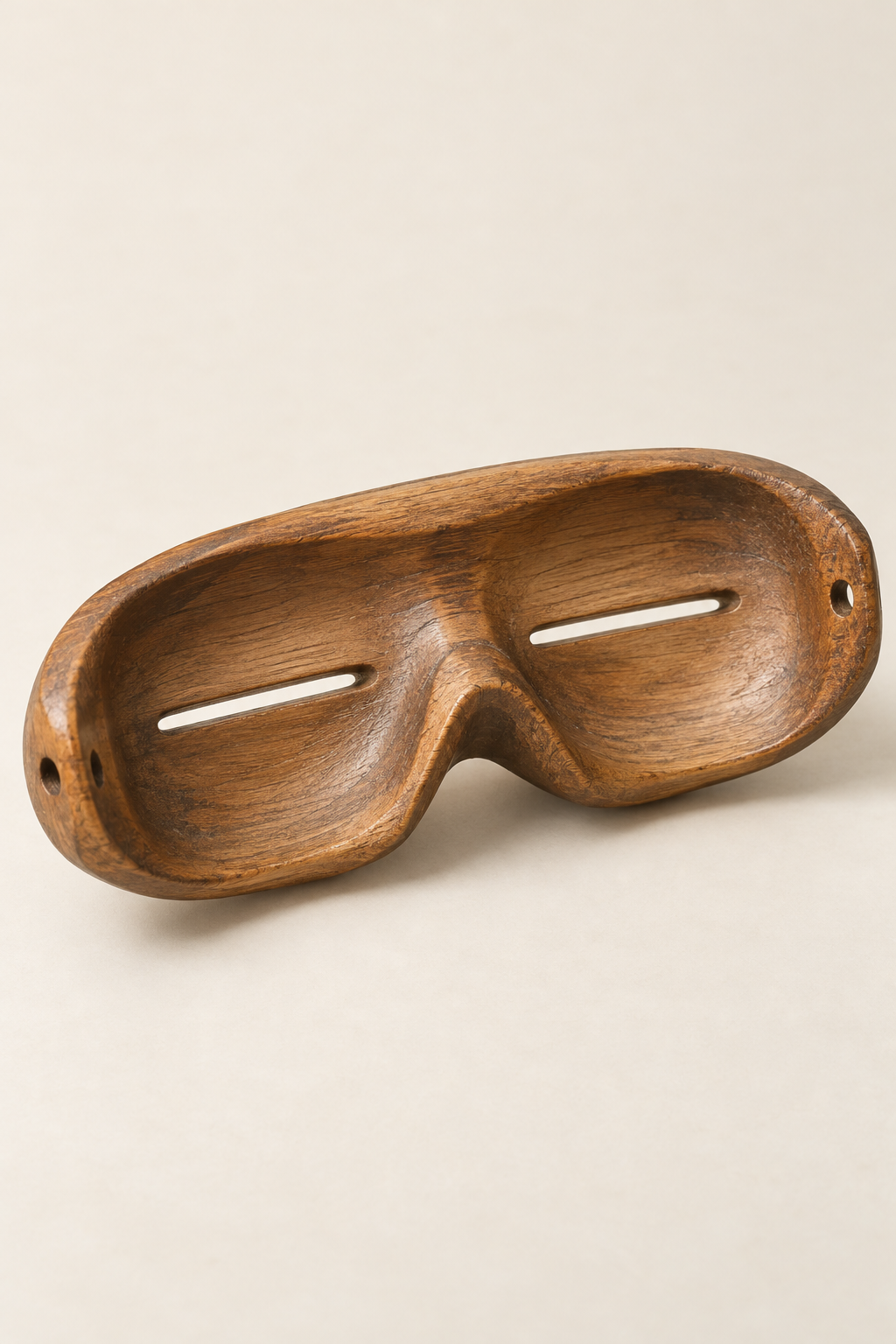
Materials and individual choices
Museums preserve goggles made from different materials. The Metropolitan Museum of Art holds an Inuit child's pair from the Hudson Bay region, dated around 1900, made from antler, pigment and sinew. Its scale shows that such equipment was also adapted for children.
The same museum records an older pair from Alaska, attributed to Thule culture and dated approximately 800–1200, carved from walrus ivory. Engraved details give it a distinctive appearance. The museum explains that these designs were significant to its owner or maker; reducing the object to a generic optical gadget would overlook that aspect.
Inuit, Yupik and the historical Thule attribution should not be treated as interchangeable labels. These examples come from particular regions, communities and periods. Their similarities are interesting, and their differences deserve attention.
A sophisticated object can look simple
A pair of goggles contains choices about opening width, the field of view, fit, strength and material. Those choices are informed by use, not merely by abstract geometry. An object with few parts can still embody considerable expertise.
The Met's older goggles record includes detailed images and an audio feature. Comparing it with the Inuit child's pair makes the variation concrete.
The generated illustration here is a general explanatory design, not a replica of either artifact. The museum records provide the actual objects and their provenance. Together, they encourage a better kind of looking: notice both the ingenious response to glare and the people whose craftsmanship made that response usable.
Sources and further reading: Smithsonian: St. Lawrence Island Yupik snow goggles; The Met: Thule snow goggles from Alaska; The Met: Inuit child’s snow goggles.
Explore more creative discoveries at Incoprea.




