A barren desert surface can look like a simple answer: nothing grows here. In the hyperarid parts of Chile's Atacama Desert, that conclusion is too quick. Some habitats contain microbial communities, while other samples preserve remnants of past life or organisms surviving with little opportunity to reproduce.
The distinction makes this landscape an unusually valuable natural laboratory. The question is not merely whether scientists can detect something biological. It is what that evidence says about activity, growth and the conditions required for a community to persist.
Small habitats change the picture
The Atacama is not uniformly dry. Conditions vary across the region, and tiny differences within a site can matter. A shaded pore, a salt crust or a protected space inside a rock may offer conditions unlike those on an exposed soil surface.
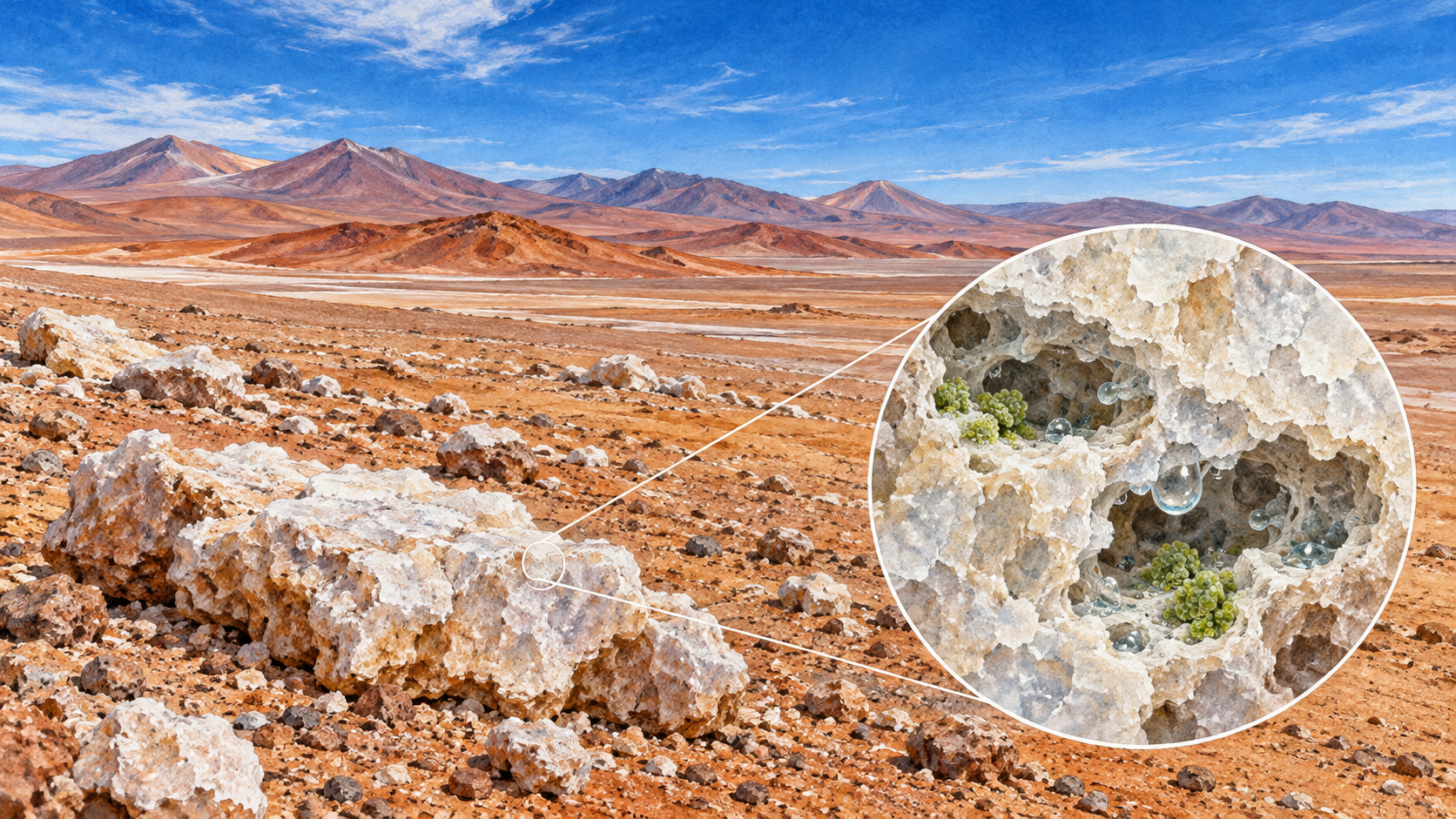
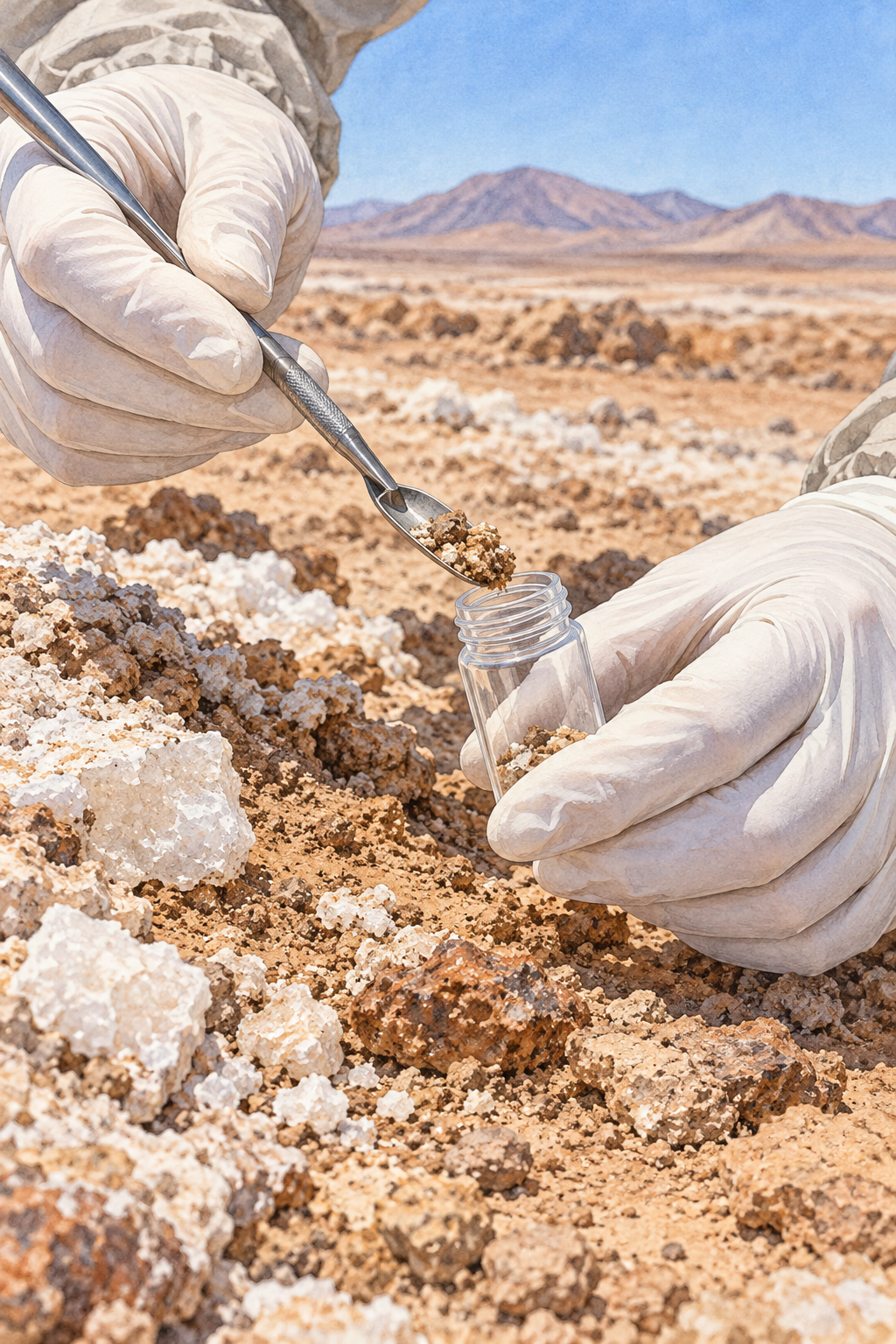
Studies of halite, the mineral form of common salt, have found microbial communities within salt nodules. The salt can absorb atmospheric moisture under suitable conditions, creating highly saline liquid in its pores. Researchers have measured activity in such communities, including photosynthetic processes where enough light and water are available.
Living inside rock is not the same as finding a universal way to ignore dryness. The mineral, humidity, light and chemistry together create a particular microhabitat. A successful refuge in one location need not work in another.
A salt nodule is more than a tiny roof
A crack or overhang can shelter organisms physically. Halite offers an additional possibility: under suitable humidity, the salt takes up moisture and forms brine. The habitat therefore changes the local availability of liquid rather than merely hiding cells from view. The amount of exposed desert visible around the nodule is a poor measure of conditions inside it.
The 2015 field study placed a humidity and temperature sensor within a colonized salt nodule and monitored photosynthetic activity. This pairing matters. A moisture record describes an environmental opportunity; a physiological measurement tests whether a community actually uses it. Combining the two makes the claim more specific than finding a green layer in a broken rock.
Liquid alone is not the entire requirement. The resulting brine is saline, light must reach photosynthetic organisms, and cells must function within the chemical setting. A refuge can solve one problem while imposing another. Life in salt does not demonstrate that any microbe can grow wherever a little water is found.
Imagine three samples collected a few steps apart: exposed soil, material beneath a rock and the interior of a salt nodule. Even if they share the same regional weather, they need not share humidity, illumination or the duration of accessible water. Labeling all three simply “Atacama” can hide the very differences that explain the results.
Surviving is different from growing
A 2018 study described temporarily active communities in hyperarid soils following rare rain. Other research on the driest surface soils found evidence consistent with severe limits on growth, even when biological material remained detectable.
These findings need not be contradictory. Sampling time, location, depth and habitat differ, as do the measurements used to infer activity. A brief wet period may open a window that is closed for most of the surrounding years.
DNA or other organic molecules can be informative without proving that a population is currently flourishing. Scientists therefore combine methods and examine whether cells are maintaining themselves, reproducing or simply leaving chemical traces behind.
Four biological claims that need different evidence
“Biological molecules are present” is the broadest statement. Molecules can remain after the cells that made them have died, and sampling must also consider contamination. “Cells are present” narrows the observation but still leaves their condition open. Neither statement, by itself, establishes a growing community.
“Metabolism is occurring” requires evidence about ongoing processes. “The population is growing” adds another requirement concerning reproduction or increasing biomass over time. Maintenance during a difficult interval and sustained growth are different achievements. A community may survive a long dry period and become active during a shorter favorable window.
Use those distinctions to compare the linked studies. Note the habitat, collection time and measurement in each one before deciding whether their conclusions disagree. A soil sample taken long after rain and a salt community monitored during a moisture event are asking related but different questions of different material.
That comparison is useful beyond desert microbiology. A life-detection instrument must be designed around what its signal can actually establish. A trace suggesting past biology, a measurement of current activity and a test of habitability answer different questions. The Atacama helps researchers practice keeping those questions separate in a place where the signals are faint enough that an attractive interpretation can otherwise arrive too quickly.
A careful rehearsal for another planet
The Atacama helps researchers test ideas and instruments for investigating dry planetary environments, especially Mars. It supplies difficult samples in which faint biological signals must be distinguished from preservation, contamination and nonbiological chemistry.
The analogy has limits. Mars differs in temperature, radiation, atmospheric pressure and chemical conditions. Discovering an earthly refuge does not establish that an equivalent Martian refuge contains life. It helps refine questions about where to look and what a convincing signal might require.
Sources and further reading: NASA: Transitory activity in hyperarid soils · NASA Ames: Growth and survival at the dry limit · Davila et al.: In-situ metabolism within halite · Davila and colleagues: Field measurements inside halite