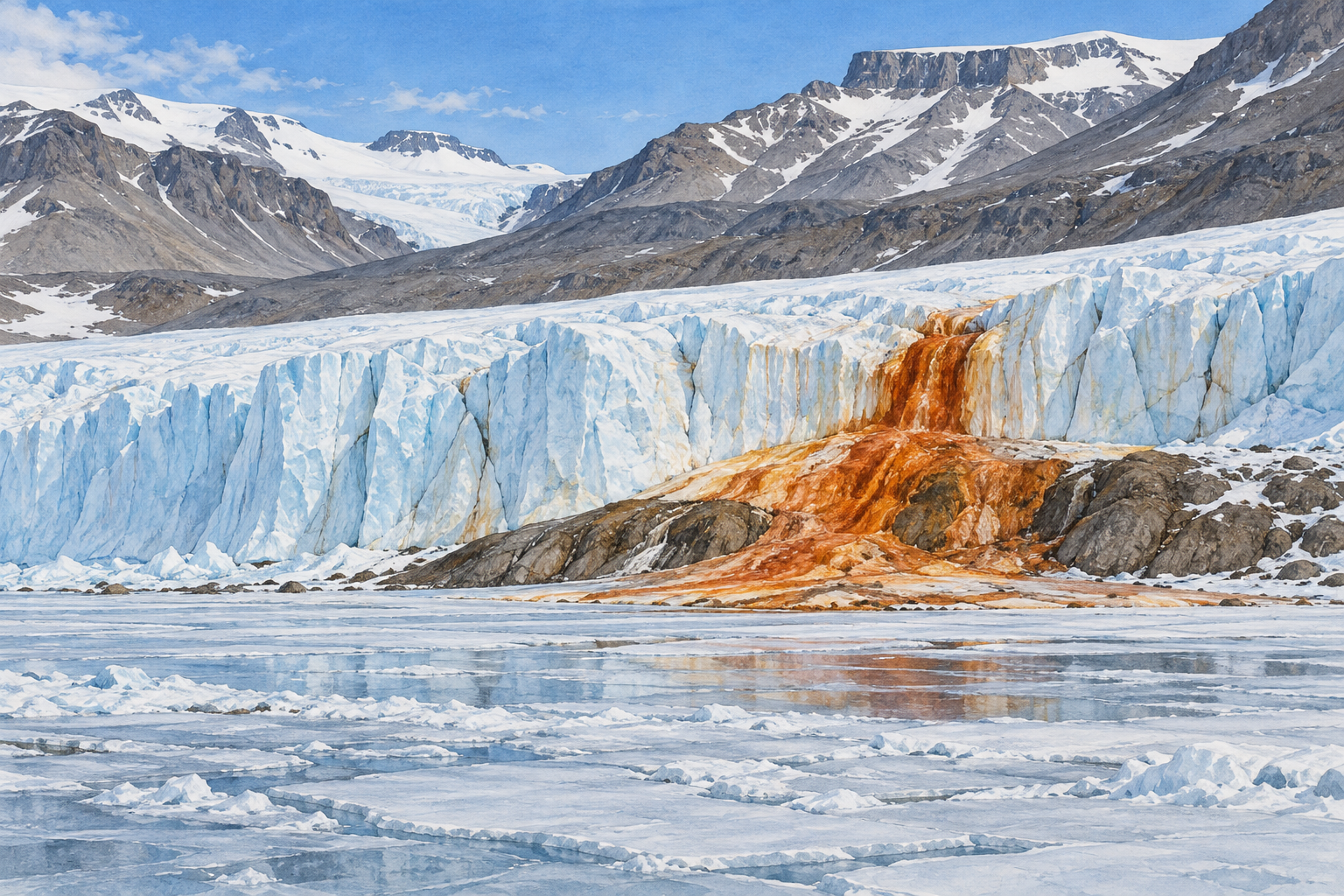
A rust-red stain across Antarctic ice is startling enough to earn a dramatic name. Blood Falls emerges near the end of Taylor Glacier, in the McMurdo Dry Valleys. Its color comes from iron-rich salty water and the changes that occur as that water reaches the surface.
The spectacle raises two distinct questions. Why is the outflow red? And how can liquid water travel through such a cold glacier? Solving one does not automatically solve the other.
Salt changes the freezing problem
A 2017 research team used radio-echo sounding to investigate the brine pathway connecting an underground water source with the outlet. Salt made the liquid easier to distinguish from surrounding fresh glacier ice in the radar measurements.
The University of Alaska Fairbanks account describes a route extending about 300 feet through the glacier toward the falls. The releases at the surface are sporadic, rather than a permanently flowing waterfall behaving like a familiar stream in a warm landscape.
Brine has a lower freezing temperature than fresh water. There is another contribution as well: water releases heat when it freezes, warming the adjacent environment. The researchers explained that the combination helps liquid movement remain possible inside very cold ice.
The glacier is therefore not a simple solid block with nothing happening within it. Its internal plumbing depends on water chemistry, temperature, pressure, and changing pathways.
The red material gets a closer look
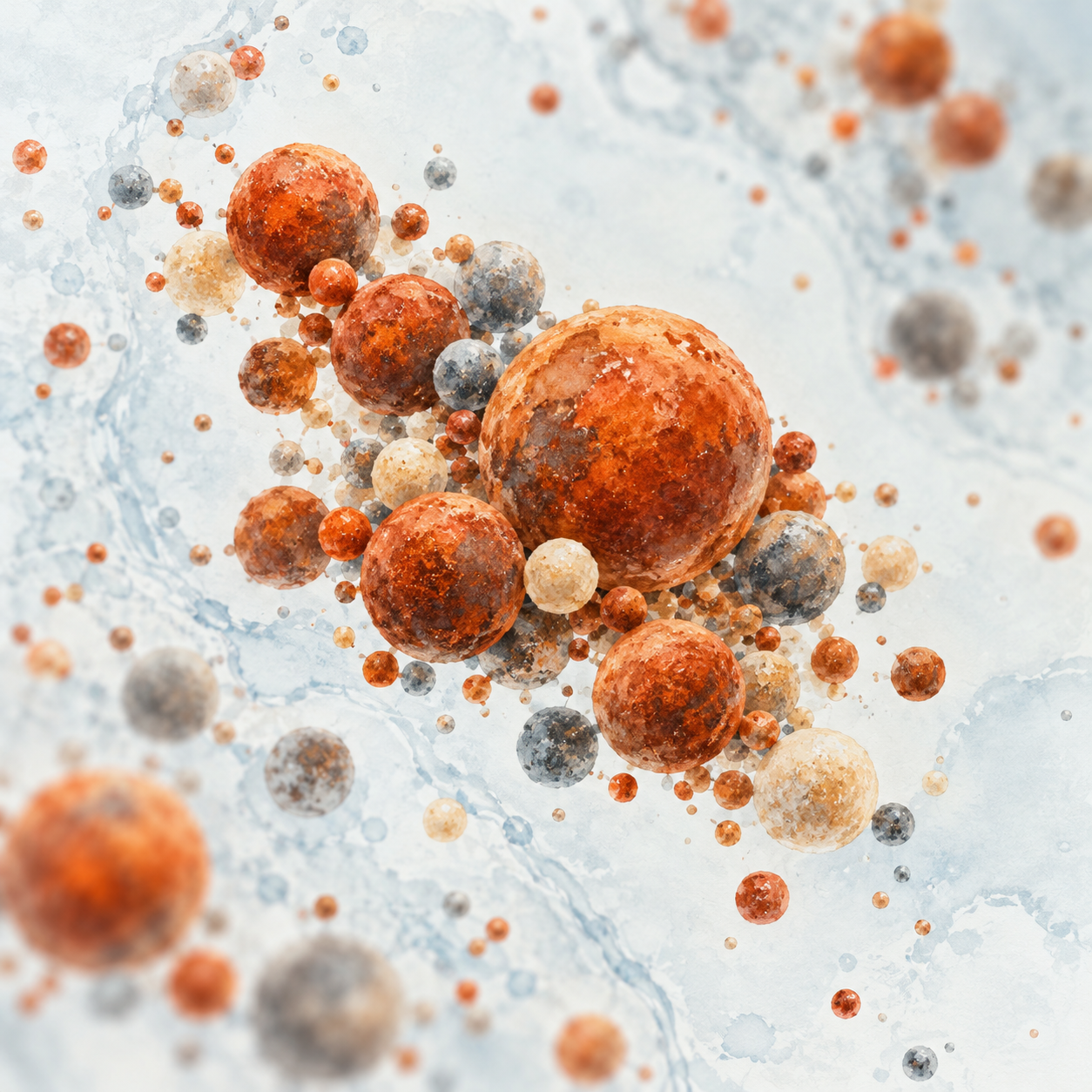
Iron-rich outflow changes color after contact with air. A 2023 investigation added a finer-scale explanation by examining solids from Blood Falls with transmission electron microscopy.
Johns Hopkins researcher Ken Livi identified abundant tiny, iron-rich spheres containing other elements as well. These nanospheres were non-crystalline: their atoms were not arranged in the regular structure expected of a conventional mineral crystal.
That distinction helped explain why earlier methods focused on identifying minerals could miss part of the material responsible for the color. “It looks like rust” remains a useful visual comparison, but detailed analysis reveals a more specific mixture and structure.
A landscape that tests our instruments
The brine also interests scientists studying life in difficult environments. Microorganisms have been investigated in the system beneath Taylor Glacier. Cold, darkness, and salty water create an unusual setting for examining the conditions under which life can persist.
Researchers have used Blood Falls as a place to think about planetary exploration, including how instruments might identify materials on a cold world such as Mars. The nanosphere work highlights a practical issue: a method excellent at recognizing crystalline minerals may leave other important material unresolved.
That is an analogy for instrument design, not evidence that the same organisms or deposits exist elsewhere. The Antarctic site gives researchers something real to measure when evaluating what a tool can and cannot reveal.
Blood Falls rewards looking beneath the name and beneath the ice. The red surface feature is the visible meeting point of hidden brine flow, freezing physics, iron chemistry, and the methods scientists bring to an unfamiliar landscape.
Sources and further reading: UAF: Researchers solve the Blood Falls flow mystery; Johns Hopkins: Seeing red at Blood Falls; An englacial hydrologic system of brine within a cold glacier.
Explore more creative work at Incoprea.