Remove the glasses from a red-cyan picture and its doubled outlines look like a printing error. Put the glasses back on and a foreground ledge may separate from a distant wall. The colored fringes were carrying two different instructions to the two eyes.
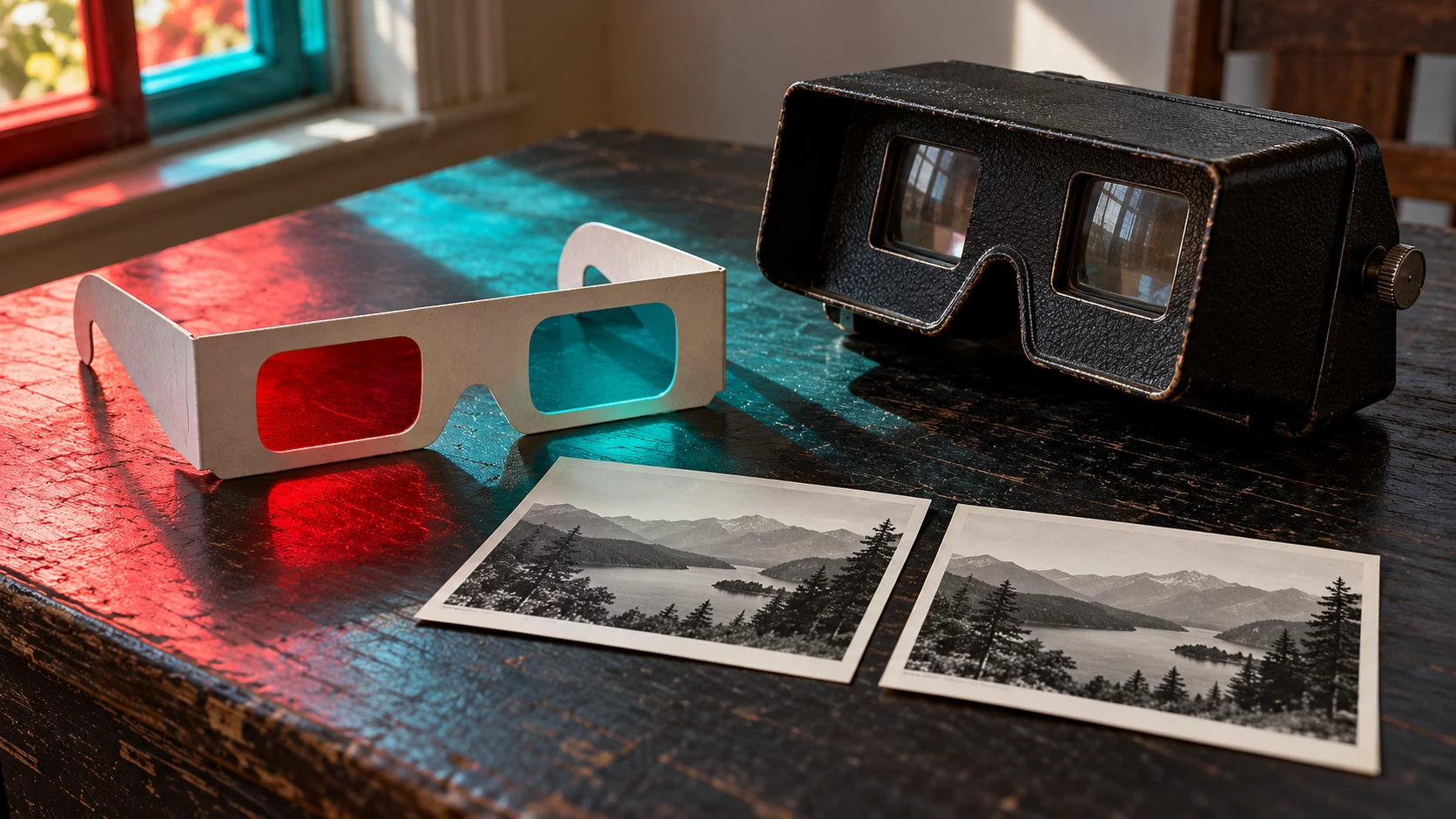
An anaglyph is a practical answer to a delivery problem. A flat page or ordinary display has to present two views at once, then help each eye receive mostly its intended view. Color filters provide a relatively simple way to separate the channels. The sensation of depth depends on the relationship between the views, not on red and cyan being inherently three-dimensional.
Begin with a nearby finger
Hold a finger comfortably in front of you against a distant background. Close one eye, then the other. The finger changes position relative to the background because the eyes occupy different viewpoints. Keep the task brief and stop if it feels uncomfortable. You have observed parallax without making a picture.
Now imagine photographing the scene from those two positions. Objects at different distances do not all shift by the same amount. A stereo pair preserves some of those relative differences. If you accidentally use the same view twice, adding colored filters cannot invent the missing viewpoint information.
Color becomes an address
NASA's InSight camera data specification describes an anaglyph product that places the left-eye view in the red channel and the right-eye view in the green and blue channels. That makes cyan the combined partner to red. Matching glasses help route those channels to the appropriate eyes.
Through a red filter, the red-channel contribution remains comparatively visible while much of the cyan contribution is reduced. The cyan filter performs the complementary separation. Real filters and displays are imperfect, so a faint unwanted outline can leak into the other eye. A ghost is a channel-separation problem, not necessarily an error in the scene's depth.
If you have suitable glasses, look at an ordinary red-cyan anaglyph with only one eye at a time. Notice which outlines remain prominent through each filter. Then open both eyes and compare the combined impression. Do not swap glasses indefinitely or strain to force depth; some viewers do not fuse a particular image comfortably.
Use a real image as evidence
Open NASA's anaglyph gallery and choose one documented rover landscape. Read its caption before interpreting it. The gallery includes views assembled from rover camera pairs and other spacecraft observations; their image geometry is not interchangeable.
Choose three features: a foreground stone, a middle-distance slope, and a distant ridge. Predict their order from ordinary clues such as overlap and size. Now inspect the stereo view. Does the depth impression reinforce your prediction? If it seems reversed or uncomfortable, check the stated glasses convention and the caption rather than deciding the terrain has an impossible shape.
The linked gallery is the actual image resource for this exercise. The generated hero still life introduces the glasses and paired-view idea, but it contains no calibrated stereo scene. Separating illustration from evidence lets the artwork set the mood while the mission record supplies the observation.
One picture can contain several kinds of depth clue
A flat photograph already offers perspective, shading, overlap, and familiar-size clues. Stereo adds a relationship between two views. To appreciate that addition, compare a feature with one eye closed and with both eyes open through the glasses. Ask what became clearer, rather than assuming every part must suddenly leap toward you.
The Library of Congress guide to viewing stereographs places anaglyphs alongside other ways of presenting stereo pairs. A stereoscope separates the views optically instead of assigning them complementary colors. The underlying two-view problem can be solved with different delivery systems.
Keep a short stereo-image record
Record the image title, mission or archive, date if supplied, glasses convention, and three feature positions. Describe any ghosting separately from depth. If you cannot see the stereo effect, note what the ordinary image and caption still reveal. A useful observation does not require every viewer to have an identical visual experience.
Compare a feature that already looks deep from overlap with one whose distance is ambiguous in a single view. Stereo may add more useful information to the second. A good viewing task therefore looks for a specific uncertainty, rather than asking the entire landscape to behave like a theatrical pop-out effect.
The glasses' colored lenses are easy to remember, but the remarkable work happens before they reach your face. Two viewpoints are selected, aligned, and encoded so that differences can become spatial information. The messy-looking fringe is not the end of the picture. It is the part waiting to be delivered to the other eye.
Sources and further exploration: NASA InSight camera data specification; NASA Photojournal: anaglyph gallery; Library of Congress: viewing stereographs.
Explore all 50 new articles · Browse the complete illustrated collection
Explore more art, ideas, and independent projects at Incoprea.


