Showing posts with label Communication. Show all posts

Sunday, October 25, 2026

A Courtship Written in Blue Sparks

Imagine seeing a short ladder of blue lights appear above a seagrass bed. The ladder climbs, fades, and begins again nearby. Its maker is a crustacean smaller than a grain of rice. Certain Caribbean ostracods turn courtship into a pattern written outside their own bodies: they release luminous material into seawater while swimming. To understand the display, follow the dark spaces between the sparks as carefully as the sparks themselves.

Several blue pulse trails rise above a dark seagrass bed.
Blue pulse trails rise above the seagrass in this imagined night scene.

The animal leaves the light behind

An ostracod lives inside a small, hinged shell, which can make it resemble a mobile seed. The shell does not make it a clam; ostracods are crustaceans. Many species never perform these displays. In the luminous courtship species discussed here, the male expels light-producing substances from a specialized organ near the upper lip. The result is an extracellular signal: a glowing packet remains in the water as its maker moves on. The Smithsonian’s introduction provides a useful view of the tiny animals behind the spectacle.

That separation creates a small navigational problem for a female. A bright spot marks where the male was, not necessarily where he is now. A single flash could supply a location but little information about his direction. A sequence supplies both timing and a route. Seen this way, the display resembles a succession of signposts whose meaning depends on their order. This is an interpretation of the geometry, rather than a suggestion that the animals deliberately design signs.

Researchers studied one species now called Photeros annecohenae, named Vargula annecohenae in the earlier paper. Its display had two distinguishable phases: several relatively bright pulses near one place, then a rising sequence of shorter, dimmer pulses as the male swam along a helical path. Field and laboratory recordings established those patterns; they were not inferred from a single attractive photograph. The 2008 study is particularly good at showing how a moving animal and its fading light can form different shapes.

A miniature playback experiment

Watching males display is not enough to establish what a female does with the signal. Rivers and Morin addressed that problem with an array of blue light-emitting diodes. They reproduced the species’ pulse pattern in the laboratory and filmed virgin females under infrared illumination. Females approached the artificial signals along routes that would bring them above the path of an upward-displaying male. The 2013 experiment therefore tested a receiver’s response, not merely the signal’s appearance to humans.

The distinction matters. An observer could reasonably guess that a sparkling display attracts mates, but the guess leaves several questions open. Does the female approach any blue light? Does she chase the last pulse? Does she move toward a place the male is likely to reach next? A controlled playback gives researchers a way to hold some features constant while examining movement. It also has limits: an LED array is not an entire male, with his swimming, chemistry, and eventual physical contact.

One chemistry, two very different messages

Light is also used in defense. Both sexes of this species can release luminescence when attacked, whereas the courtship display is male-produced. A study of light budgets found that an average defensive display released about fifty times the light of an average courtship display under the study’s conditions. The work also found different rates of fading. A defensive burst and a delicate courtship sequence draw on related chemistry without being interchangeable behaviors.

Those measurements invite a careful distinction between light output and total biological cost. Measuring emitted light and available luminous stores does not automatically measure every cost of finding a display site, avoiding a predator, or producing a mate. The study answers a narrower, useful question about how the animals allocate luminescence. A number such as “fifty times” belongs with its comparison and experimental context; it is not a universal conversion between romance and survival.

The evolutionary history is broader still. A phylogenetic study reconstructed luminous courtship as an ancient co-option of an existing defensive system in a particular cypridinid lineage. Its dates are estimates from evolutionary models and molecular evidence. They do not mean that a modern species has remained unchanged for that entire interval. The striking connection is that an old biochemical capacity can acquire a new social use while continuing to serve its earlier job.

Try reading a trail

On paper, draw five dots rising diagonally, then cover all except the first. Where would you search for the animal? Reveal the second and third dots. Now draw a route that meets a moving source rather than visiting its previous positions. Change the intervals between the dots and ask how your prediction changes. This simple exercise models a problem of interception; it does not reproduce an ostracod’s nervous system or measure its choices.

Then return to the seagrass scene. The darkness is part of the display’s working conditions, the gaps carry temporal information, and the fading dots belong to the water rather than to a permanently glowing body. What first looked like decoration becomes a meeting problem solved through a repeated, species-associated signal. The memorable sight is the blue ladder. The deeper fascination is the invisible animal moving just ahead of it.

Sources and further exploration

Two more connections

Visit Incoprea

Friday, October 23, 2026

A Message Stick Is More Than the Marks a Camera Can See

A small carved object appears in a museum photograph. You can enlarge its surface until every line seems available for inspection. Yet the most important part of its message may never have been a mark that the photograph could capture.

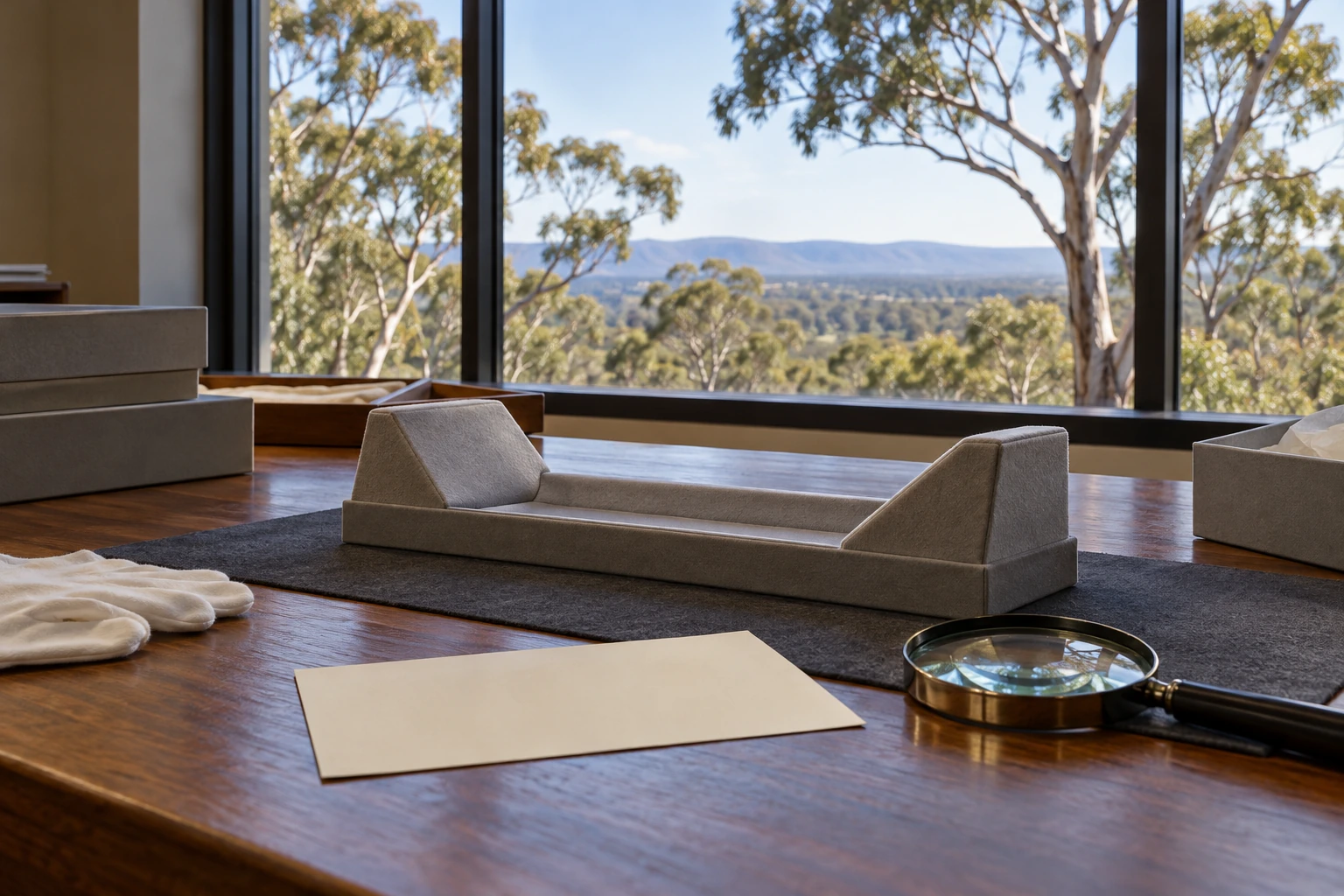
An empty museum study cradle and magnifying glass sit before a window overlooking eucalyptus trees.
The study setting leaves the object to its documented museum record, where image, provenance and description remain connected.

Aboriginal Australian message sticks belong to particular people, places and communicative practices. They should not be treated as a single continent-wide alphabet waiting for an outsider to decode. A careful encounter begins with the specific record, including what the record does not know.

Follow one documented object

The National Museum of Australia's Kimberley community story discusses objects collected during Governor Frederick Napier Broome's journey along the north-west coast in 1884. A message stick appears within that collection history. The date describes a documented collecting event, not a universal origin date for a practice.

Read that page with two columns on a piece of paper. In one, record statements about the object and its collection. In the other, record the names and roles of people whose accounts are being presented. This simple separation helps stop a collector's description from silently becoming the sole voice of the object.

Now add a third column headed “not established here.” You might need more information about a maker, the intended recipient, an oral explanation or the circumstances of acquisition. A blank in that column is useful. It keeps an unanswered question visible.

The messenger belongs inside the communication

The research project Australian Message Stick Database brings dispersed object records and associated documentation together. Its record for a Queensland object held in the British Museum describes red wood with incised lines containing red and white pigment. The object is 154 millimeters long. Its 1885 date is explicitly an upper bound, associated with acquisition rather than a documented day of manufacture. Those small fields distinguish the physical item from the layers of information attached to it.

That distinction is crucial. A message-bearing object may work with a messenger's spoken explanation, authority and relationship to the recipient. An observer who records only the carved surface has not necessarily recorded the whole communication. We should not assume that every object used the same division between visible marks and spoken knowledge.

Consider a mundane comparison from your own life. A house key handed to a neighbor can convey permission because of a prior conversation. A photograph of the key preserves its shape but not the terms of that permission. This is not an explanation of message sticks through a modern analogy. It is a reminder that communication can depend on context that an object alone does not contain.

A database can preserve uncertainty well

The researchers' published account of the database describes a project built from material and archival evidence. Bringing records together enables comparison, but comparison is not the same as proving that a motif carried an identical meaning everywhere.

When you browse a record, look for the distinction between a transcription of an older description and the researchers' own analysis. Check whether a place is specific or approximate. Notice whether a message interpretation comes from a named participant, a collector or a later inference. A good database makes those differences traceable.

Also watch for historical language in archival quotations. A preserved document can be important evidence while carrying assumptions that present-day scholarship rejects. Repeating its classifications without identifying their source would turn an object of study into an unquestioned explanation.

What to do instead of inventing a code

For a useful reader activity, choose one public record and produce a short object biography using only supported facts. Give the object a location in a collection, record the documented collecting history and name the source of any interpretation. Finish with one question that could guide further research.

A test for your object biography

Can another reader locate each factual claim in the linked record? Have you separated “the archive says” from “the maker intended”? Did you accidentally change “this object” into “all Aboriginal people”? If so, narrow the sentence until it fits the evidence.

The illustration here intentionally shows a study setting rather than inventing a culturally specific message-stick design. For the object itself, use the linked museum and research records, where the image can stay connected to its provenance and description.

Close looking remains valuable. So does recognizing the point at which looking is insufficient. The most interesting message may lie in the relationship among an object, a person carrying it and people who already knew how to receive it. A responsible reader follows those relationships as far as the evidence permits and leaves the remaining questions open.

Sources and further exploration: National Museum of Australia: Kimberley Aboriginal country; Australian Message Stick Database: BM_Oc2462; AMSD research paper.

Explore all 50 new articles · Browse the complete illustrated collection

Explore more art, ideas, and independent projects at Incoprea.

Thursday, October 22, 2026

The Honeybee Waggle Dance Has an Apprenticeship

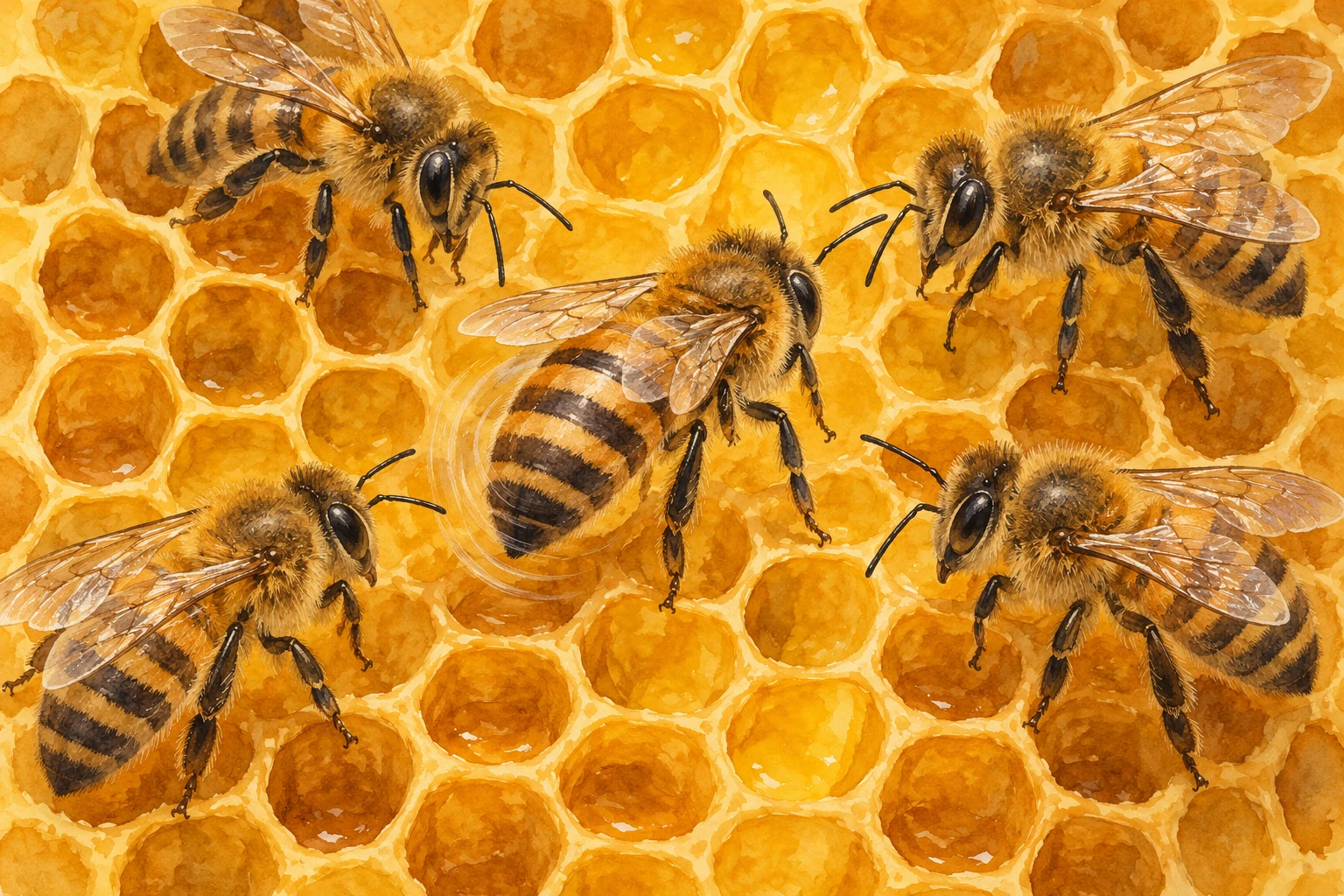
Worker honeybees cluster around a central dancer on golden vertical honeycomb.
Conceptual honeybee scene; motion is suggested artistically and is not a diagram of measured dance trajectories.

A foraging honeybee returns to a dark hive with information about a place the surrounding bees have not visited. She cannot point at a flower across the field. Instead, she moves across the comb in a repeating pattern whose central waggle runs contain information about direction and distance. The hive turns a journey through space into a signal made of motion.

The familiar figure-eight outline is only the beginning. If we watch the looping returns and miss the straight central runs, we miss much of what the signal communicates. And if we imagine a perfectly calibrated message produced without experience, recent research gives us a more interesting picture.

Read the central run, not just the loop

The Sussex guide to dance decoding explains how researchers translate waggle-run orientation and duration into estimates of resource location. On a vertical comb, direction is encoded relative to gravity and relates to the sun's direction outside. Waggle-run duration supplies information used to estimate distance. Repeated runs provide a set of measurements rather than one infallible coordinate.

For a simple directional example, imagine the sun's direction outside as a reference line. A run straight upward represents a direction toward that reference; a run tilted to one side represents a corresponding angle from it. The comb is not a miniature overhead map with north permanently at the top. It is a coordinate translation between an internal vertical surface and the outside world.

The distinction matters because the sun's position changes. A meaningful description must specify the reference system rather than attach a permanent compass direction to one tilt. Likewise, a duration-to-distance conversion is a calibrated biological relationship, not a universal rule that any one-second motion means the same distance for every bee in every circumstance.

The distance message begins with the trip's visual texture

Before a bee communicates distance, it must acquire information about the journey. A ruler on our map and the movement seen by a flying animal are not the same thing. Nearby vegetation can sweep across the eye rapidly, while distant scenery changes more slowly.

A 2000 tunnel experiment tested visual motion against an energy-based explanation of the bee's odometer. Short flights through a narrow, textured tunnel led to dances indicating substantially greater travel than the physical distance alone suggested. Changing the visual arrangement helped identify the information behind the signal.

Honeybee flies low beside richly textured meadow vegetation toward a distant field
A journey offers moving visual information. This landscape is an interpretation, not one of the measured experimental routes.

A 2004 outdoor study compared two 580-meter routes, one entirely over land and one passing over water. Waggle duration changed differently with distance over the two terrains. The authors connected this difference with the scenes' visual properties. The odometer did not behave like a fixed-rate wheel counter independent of its surroundings.

That does not make the dance useless. It makes calibration part of a biological communication system operating in real terrain. A signal can narrow another bee's search while still carrying the conditions under which its information was acquired.

Separate geometric motion from a complete odometer

The calculator below considers a much smaller question. A point feature lies beside a straight path. At the instant of closest passage, angular speed is forward speed divided by perpendicular distance. At 1 meter per second, a feature 1 meter away sweeps at about 57.3 degrees per second; one 10 meters away sweeps at about 5.73. These are geometric examples, not recordings from a bee's eye.

Near and far features move differently

Labeled sliders calculate instantaneous angular motion at closest passage, with explicit geometric assumptions.

Open this activity in its own window.

Double both distances while keeping speed fixed. Both angular speeds halve. Double forward speed instead and both increase. This helps explain why distance traveled and visual motion accumulated need not have one universal relationship. The model deliberately omits contrast, flight height, eye movements and how a nervous system integrates information.

For a more revealing reading of a dance paper, ask two questions in sequence: what was the bee allowed to experience en route, and how was its later signal decoded? The journey and the message are connected experimental stages. Learning to produce an orderly dance is part of the story; measuring the world that dance describes is another.

The signal has an apprenticeship

A 2023 study in Science tested the role of early social experience. Researchers created colonies in which young bees lacked older, experienced dancers to follow before making their own first dances. They compared those bees with others that had the normal opportunity to observe experienced nestmates.

The socially deprived first dancers made less orderly and less accurate signals, including errors in the distance component. Experience later improved aspects of performance, but some differences persisted. The University of California account describes the result as evidence that social learning contributes to this communication system.

This does not mean a young bee starts with no biological predisposition to dance. Nor does it mean an older bee deliberately conducts a lesson. It means that the developmental environment—including the opportunity to follow experienced signals—changes subsequent performance. A behavior can have an evolved foundation and still be refined through learning.

Noise can carry a message without being an exact address

Individual waggle runs vary. A researcher decoding a dance therefore asks how many runs were measured, how their angles were summarized, and which calibration converted duration into distance. The result is better understood as evidence about a likely foraging area than as the equivalent of a consumer navigation pin accurate to a doorway.

The same issue appears whenever an animal communicates about a variable world. Flowers differ in reward, conditions change, and the receiver still has to search. A useful message can narrow a problem without solving every part of it. Precision is not all-or-nothing.

The colony also needs brakes

A dance can recruit other foragers, producing positive feedback around a resource. But useful collective behavior requires ways to limit recruitment too. The Nieh Lab's research overview includes honeybee stop signals that counteract dance-related positive feedback. A colony is not simply a room of advertisers trying to make every discovered patch sound irresistible.

That balance gives the communication system a wider meaning. An individual has partial information. Another bee can use it, check the world, and contribute a further signal. Recruitment and inhibition help turn many local experiences into a changing pattern of collective effort. No bee needs an overview of every field for the colony to distribute foraging activity.

When watching the research video linked in the university account, follow one dancer rather than the crowd. Identify the central run, the returns, and the nearby followers. Then watch a second sequence and notice variation. The real behavior is more useful to see than a perfectly repeated animated figure eight.

The waggle dance is remarkable because it refers to something beyond the immediate hive. Its richness increases when learning, calibration, and noise are included. The returning bee has converted a lived trip into a signal others can use. What looks like a few inches of busy motion contains a relationship between bodies, sunlight, experience, and a landscape outside the comb.

Follow the evidence: Dong and colleagues: social signal learning in honeybees; University of California: learning improves waggle dance; Ratnieks: decoding waggle dances; Nieh Lab: communication, learning and stop signals.

More curious connections, art and independent projects at Incoprea.

Wednesday, October 14, 2026

Quorum Sensing: How Bacteria Respond to a Chemical Crowd

Sparse and dense groups of illustrated bacteria are surrounded by different concentrations of gold signal dots.
Conceptual illustration of quorum sensing. Signal molecules are enlarged and color-coded; this is not a measured concentration image.

A lone bacterium and a dense bacterial community can behave differently even when they have the same genes. One reason is quorum sensing: cells release chemical signals, detect them and change gene activity in response. Under suitable conditions, many cells can shift behavior together.

Calling this a bacterial “conversation” makes the idea memorable, but there are no tiny voices or conscious decisions. Production, transport, receptors and gene regulation turn a local chemical environment into a biological response.

Signals accumulate

Quorum-sensing molecules are often called autoinducers. When only a few cells occupy a large volume, their signals may remain dilute. As more cells produce them, the concentration can rise enough to activate a response. Feedback in a signaling network can help make the transition coordinated.

Different bacteria have different signals and regulatory systems. Some use more than one signaling pathway, allowing responses to information about their own population and other organisms nearby. The effects include changes in light production, biofilm-related behavior and production of extracellular substances.

A useful example is the luminous bacterium Vibrio fischeri. Its light production is regulated by quorum sensing. In its association with the Hawaiian bobtail squid, a dense population inhabits a light organ, where the bacterial glow contributes to camouflage against illumination from above. A single weakly glowing cell would not provide the same effect.

A concentration is not a head count

Try a deliberately simple model on paper. Ten imaginary cells each add one unit of signal to their surroundings during a time step. In a closed space with no loss, ten steps would accumulate 100 units. In a space where half the accumulated signal is removed after every step, the amount would stay much lower. The cells have not become less numerous; the rules for accumulation have changed.

The numbers are invented to isolate an idea, not to describe a real bacterial species. Actual systems include signal production, degradation, transport, receptor behaviour, and feedback. Nevertheless, the model shows why the same population size can produce different local concentrations. A chemical measurement needs an environmental explanation before it becomes a claim about a crowd.

Work through the first three removal steps

If production happens first and half is removed second, the retained amounts are 5 units after the first step, 7.5 after the second, and 8.75 after the third. The sequence approaches 10 under these particular assumptions. If the order of operations changes, the numbers change too. State the rule before comparing results.

This exercise is useful precisely because it is incomplete. It asks you to identify an assumption rather than remember a striking number. A strong explanation of quorum sensing has to connect what cells produce with what their surroundings retain.

The surroundings can rewrite the message

The name suggests a straightforward head count, but concentration also depends on the surroundings. Signals diffuse, break down and can be carried away by flowing fluid. A crowded population in a strong current may encounter a different signal concentration from the same population in still water.

Princeton researchers tested such effects in controlled flow experiments. Fluid could wash away signals locally while transporting them downstream. The arrangement of cells and the geometry of their environment changed how communication worked.

ConditionPossible effect on a signal
More producing cellsGreater local production
Strong fluid flowRemoval and downstream transport
Restricted spaceSignals may accumulate locally

This table describes influences, not a universal rulebook. A real response depends on the organism's network and the combination of conditions. Quorum sensing is better understood as chemical information processing within an environment than as a perfect census.

Read the films as an experiment

Red marks the bacterial cells; yellow shows the reported quorum-sensing response. Compare the no-flow and flow conditions. Source and viewing fallback: Princeton University.

The Princeton page linked below shows cells in red and a quorum-sensing response in yellow. Those colours are part of the experimental visualization. Before watching the film, decide which observation would support the idea that flow changes signalling: fewer cells, a different location of the response, or a different response among cells that remain present? These possibilities should not be collapsed into one impression of a brighter or darker picture.

Watch the comparison without flow and with flow first. Then inspect the downstream experiment and the pocket-like spaces. The interesting result is not merely that flow turns communication off. In these experiments, flow can remove signals from one place while helping carry them to another, and sheltered geometry can preserve local conditions. The environment shapes where a response occurs.

A useful set of notes has three columns: location, flow condition, and visible response. You can make those notes from the institutional films without growing any organisms yourself. The format encourages you to compare like with like rather than treating a single vivid frame as the whole experiment.

Many local responses can make a collective pattern

The glowing squid example also helps separate mechanism from metaphor. Bacterial light contributes to a host’s camouflage, but no central bacterium has to inspect the squid’s silhouette and assign its neighbours a job. Local regulation and the host environment support an outcome that is meaningful at a larger scale. Woods Hole’s account of bacterial signals and light provides that ecological context.

Nor should a useful collective pattern imply that all bacteria are cooperating in the same way. Signals, responses, and relationships vary. A molecule that changes one organism’s behaviour need not produce the same outcome in another species. The term quorum sensing names a broad class of chemical regulation, not a universal command shared throughout the microbial world.

The strongest questions therefore remain concrete: which molecule, which cells, which response, and which environment? Those questions make a bacterial community more interesting than an imagined miniature parliament. They reveal how physical transport and molecular regulation can combine to produce coordinated effects without an observer counting the participants.

Explore more creative curiosity at Incoprea.

publications

New this week Two novels in six stories each, from The Night Shift . New — a novel in six documents Small Print A Novel in Six Do...