A small carved object appears in a museum photograph. You can enlarge its surface until every line seems available for inspection. Yet the most important part of its message may never have been a mark that the photograph could capture.
Aboriginal Australian message sticks belong to particular people, places and communicative practices. They should not be treated as a single continent-wide alphabet waiting for an outsider to decode. A careful encounter begins with the specific record, including what the record does not know.
Follow one documented object
The National Museum of Australia's Kimberley community story discusses objects collected during Governor Frederick Napier Broome's journey along the north-west coast in 1884. A message stick appears within that collection history. The date describes a documented collecting event, not a universal origin date for a practice.
Read that page with two columns on a piece of paper. In one, record statements about the object and its collection. In the other, record the names and roles of people whose accounts are being presented. This simple separation helps stop a collector's description from silently becoming the sole voice of the object.
Now add a third column headed “not established here.” You might need more information about a maker, the intended recipient, an oral explanation or the circumstances of acquisition. A blank in that column is useful. It keeps an unanswered question visible.
The messenger belongs inside the communication
The research project Australian Message Stick Database brings dispersed object records and associated documentation together. Its record for a Queensland object held in the British Museum describes red wood with incised lines containing red and white pigment. The object is 154 millimeters long. Its 1885 date is explicitly an upper bound, associated with acquisition rather than a documented day of manufacture. Those small fields distinguish the physical item from the layers of information attached to it.
That distinction is crucial. A message-bearing object may work with a messenger's spoken explanation, authority and relationship to the recipient. An observer who records only the carved surface has not necessarily recorded the whole communication. We should not assume that every object used the same division between visible marks and spoken knowledge.
Consider a mundane comparison from your own life. A house key handed to a neighbor can convey permission because of a prior conversation. A photograph of the key preserves its shape but not the terms of that permission. This is not an explanation of message sticks through a modern analogy. It is a reminder that communication can depend on context that an object alone does not contain.
A database can preserve uncertainty well
The researchers' published account of the database describes a project built from material and archival evidence. Bringing records together enables comparison, but comparison is not the same as proving that a motif carried an identical meaning everywhere.
When you browse a record, look for the distinction between a transcription of an older description and the researchers' own analysis. Check whether a place is specific or approximate. Notice whether a message interpretation comes from a named participant, a collector or a later inference. A good database makes those differences traceable.
Also watch for historical language in archival quotations. A preserved document can be important evidence while carrying assumptions that present-day scholarship rejects. Repeating its classifications without identifying their source would turn an object of study into an unquestioned explanation.
What to do instead of inventing a code
For a useful reader activity, choose one public record and produce a short object biography using only supported facts. Give the object a location in a collection, record the documented collecting history and name the source of any interpretation. Finish with one question that could guide further research.
A test for your object biography
Can another reader locate each factual claim in the linked record? Have you separated “the archive says” from “the maker intended”? Did you accidentally change “this object” into “all Aboriginal people”? If so, narrow the sentence until it fits the evidence.
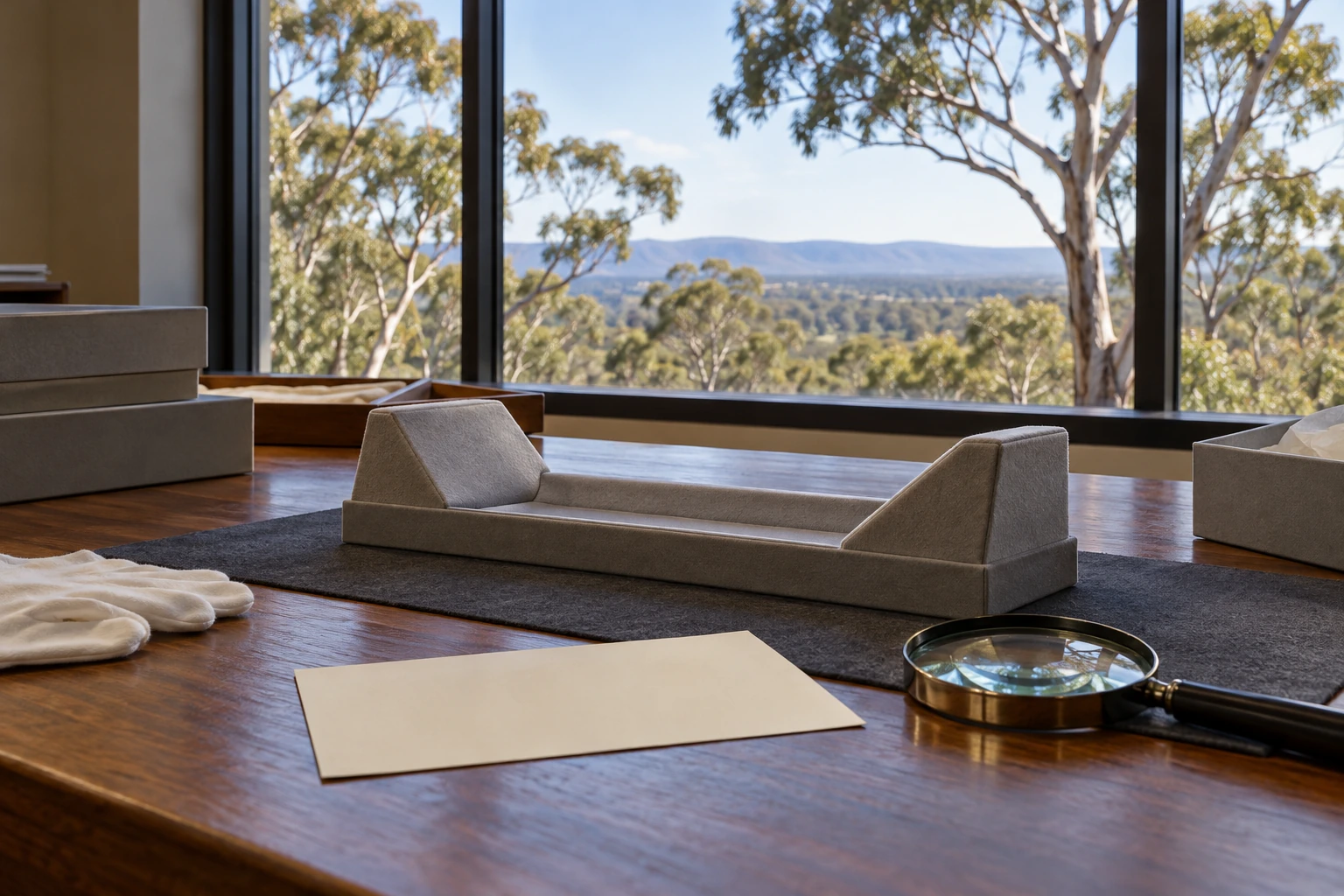
The illustration here intentionally shows a study setting rather than inventing a culturally specific message-stick design. For the object itself, use the linked museum and research records, where the image can stay connected to its provenance and description.
Close looking remains valuable. So does recognizing the point at which looking is insufficient. The most interesting message may lie in the relationship among an object, a person carrying it and people who already knew how to receive it. A responsible reader follows those relationships as far as the evidence permits and leaves the remaining questions open.
Sources and further exploration: National Museum of Australia: Kimberley Aboriginal country; Australian Message Stick Database: BM_Oc2462; AMSD research paper.
Explore all 50 new articles · Browse the complete illustrated collection
Explore more art, ideas, and independent projects at Incoprea.