Showing posts with label Motion. Show all posts

Sunday, October 25, 2026

The Geneva Drive Gives a Turning Wheel Time to Wait

Imagine a machine that must turn a part, hold it still, then turn it again. A motor can supply steady rotation, but steady rotation is precisely what the task does not want. The Geneva drive solves the mismatch through geometry. A moving pin visits a slot, escorts a wheel to its next position, and leaves it waiting while the driver continues around.

A conceptual Geneva mechanism with a blue driver disc, an offset pin, and a four-slotted brass wheel.
A conceptual arrangement of the driver and four-slotted wheel in a Geneva mechanism.

The familiar external version has two neighboring axes. One wheel carries an offset pin. The other has radial slots, often arranged in a cross. As the driver turns, its pin enters one slot and makes the slotted wheel rotate. The pin then withdraws. During the remainder of the driver's revolution, the output wheel stays in the new position. Its pause has a technical name: dwell.

The pause needs its own part

A slot alone would provide intermittent pushing, but it would not reliably hold the output still between pushes. A typical Geneva mechanism therefore includes a circular locking surface on the driver. This fits the concave arcs between the slots. During dwell, the mating surfaces prevent unintended rotation of the driven wheel. Near the period of engagement, a relief in the driver allows the slotted wheel to move. The Digital Mechanism and Gear Library's four-slot example shows these relationships explicitly.

That distinction matters. “No longer being driven” and “being held in place” are different mechanical conditions. A loose wheel could drift because of load, vibration, or its own momentum. A locked wheel can present a part or picture at a repeatable orientation. The device manufactures a useful interval of stillness, rather than merely failing to produce motion.

One turn is not one turn

For a standard four-slot external Geneva drive, each full driver revolution advances the output by one quarter-turn. Four driver revolutions complete one output revolution. The same library example assigns 90 degrees of driver rotation to the movement and 270 degrees to dwell. With a driver turning uniformly once per second, the ideal output moves for one quarter of a second and rests for three quarters. This is a calculation for that geometry, not a general rule for all intermittent mechanisms.

The output does not move at constant speed during its quarter-turn. The pin's changing position within the slot changes the mechanical relationship between the two wheels. The driven wheel begins its step, speeds up, then slows before it stops. An ordinary reduction gear can also turn one wheel more slowly than another, but it generally keeps both turning. The Geneva drive changes the pattern of motion as well as the average rate.

The NPTEL teaching material on manufacturing automation identifies this mechanism as a way to convert continuous rotation into intermittent rotary motion. The alternate name “Maltese cross” reflects the appearance of a common slotted wheel. A shape that resembles an ornament is actually a schedule encoded in metal.

The film frame that had to wait

Traditional film projection offers a particularly clear reason to want dwell. A frame must rest in the gate while light passes through it. Then the film must move to the next frame. If the illuminated picture slid continuously across the gate, the projected image would smear. The intermittent movement and the shutter therefore have different jobs: one positions the film, while the other hides its travel from the screen.

The Independent Cinema Office's projection guide explains how a Geneva unit drives an intermittent sprocket. A rotating shutter closes while frames advance and opens while they rest. It also distinguishes the frame rate from repeated shutter interruptions used to reduce flicker. A film running at 24 frames per second need not show only 24 flashes of light per second. Motion transport and light timing are cooperating systems.

This history should not be flattened into “all projectors use a Geneva drive.” Intermittent transports take other forms, and individual film systems have different mechanisms. Even among Geneva-based designs, engineers have changed the input motion and timing. A Kodak patent for an intermittent film pull-down describes a driver, star wheel, and changes intended to shorten the pull-down period. Its claims concern a particular design; they are not evidence that every projector has that performance.

A Science Museum Group 1896 Photo-rotoscope record documents a different solution: an eccentric roller periodically struck and dragged the film below the gate. The catalog calls this “dog” motion. Its purpose was intermittent transport too, but its contacting parts and film path differed. The comparison keeps the useful general idea of dwell separate from the particular pin-and-slot mechanism that creates it here.

What faster operation costs

The useful pause comes with repeated acceleration and deceleration. Loads must move and stop, while the pin and slot transmit force through limited contact regions. Increasing the rate can increase dynamic demands, noise, wear, and the difficulty of controlling impact. Real mechanisms require suitable materials, clearances, lubrication, and allowable loads. A neat animation conceals these engineering questions because its pieces have no flexibility or damage.

For a simple reading exercise, draw a circle divided into four equal sectors. Label one “move” and the other three “wait.” Then compare this timing sketch with the library illustration or its linked mechanism media. Follow the pin, but also follow the locking surface. The two observations explain why the output can move decisively and then remain still. The Geneva drive is a reminder that a machine's most valuable output may sometimes be a well-timed pause.

Sources and further reading

Continue exploring: The Slits in a Zoetrope Are Doing Half the Work; The Gearbox That Lets Two Wheels Disagree.

Explore more at Incoprea.

A Salp Chain Has Many Engines and No Captain

A transparent chain hangs in the blue water, each link a living barrel with bands of muscle around it. This is a salp colony. Its members remain attached while moving and feeding, so the chain has many pumping units. The surprising feature is that smooth travel need not require every unit to fire at once. Differences in their timing can help the whole chain move more steadily.

Transparent salps form an imagined chain, with dark gut masses and schematic trails from individual jets.
An imagined salp chain, with schematic trails representing the separate jets of its connected zooids.

Look for the individual inside the chain

A salp draws water in through one opening and expels it through another as its muscle bands contract. The expelled water contributes to forward thrust. Salps are tunicates, and their transparent bodies should not be confused with jellyfish merely because both appear gelatinous. A study of swimming and feeding performance describes how differences in body form and movement influence this water-pumping system.

Each unit in an aggregate is called a zooid. It has its own body and contributes a jet, but its attachments constrain where it can move relative to its neighbors. That makes a chain different from a school of unattached fish. The members do not simply happen to travel in the same direction. Their physical arrangement is part of the structure that transmits their combined forces.

The chain also belongs to a life cycle. A solitary, asexually reproducing stage buds an aggregate of genetically identical zooids; the aggregate stage reproduces sexually and gives rise to the solitary stage. A 2024 study of colonial architecture follows how connected units develop into different arrangements. Some salp colonies form streamlined chains, while others have quite different shapes. “Salp chain” is a useful image, but it is not the only possible architecture.

Why imperfect synchrony can help

Consider a single pumping body. Its forward speed can rise during a jet and fall while it refills. If many attached units pulse together, the colony may experience pronounced surges. If their pulses occur at different times, the contributions overlap: one zooid can provide thrust while another is between pulses. That is a simple reason to suspect that a collection of intermittent engines could produce a steadier total push.

Sutherland and Weihs tested that idea with theory, high-speed laboratory recordings, and flow observations in the sea. Their 2017 study focused on the linear colonies of Salpa fusiformis and Weelia cylindrica. Asynchronous pulsing produced smoother swimming, and the measured timing was consistent with individual zooids operating without a common cruising beat. Steadier speed can reduce the hydrodynamic penalty associated with repeated acceleration and deceleration.

The result is narrower and more interesting than “salps always cooperate perfectly.” A beneficial group-level pattern can emerge from differences among the members’ pulse timing. It does not require a central individual to order each contraction. Nor does it mean the zooids are unable to communicate. The research distinguishes routine asynchronous swimming from coordinated responses possible through connections between the units.

“No captain” is therefore a metaphor for the absence of a single cruising conductor, not a claim that the colony lacks sensing or physiological integration. A good account needs both levels: each zooid is a functioning animal, and attachment creates a larger moving system. Treating the chain as one giant salp loses the contributions of its members; treating it as unrelated passengers loses the mechanics of their connection.

The same water carries food

Pumping also moves food toward an internal mucus filter. The animal’s travel and feeding are coupled, rather than requiring entirely separate machinery. In Woods Hole research on salp filters, experiments with particles helped explain how these animals capture extremely small food. The mesh and its interaction with flowing water matter, not just the intuitive idea of a net with fixed holes.

That coupling creates a useful question: when the body form or pumping pattern changes, what happens to feeding as well as speed? A movement that looks efficient for travel might change the flow through a filter. Examining both tasks keeps us from evaluating a living animal as if it were a vehicle carrying an unrelated lunchbox. Its propulsion system and its means of obtaining food share the same stream of water.

To see the forms in motion, the CNRS Plankton Chronicles salp episode offers underwater footage and still images. If the film is unavailable, the accompanying photographs show chains, pumping bodies, and developing forms. Use the sequence to locate one zooid first, then follow its neighbors. An image of a long colony becomes easier to read when you know what one complete unit looks like.

A tabletop timing exercise

Draw eight columns on a page and give each five short marks representing pulses. First align all the marks into the same rows. Next shift the marks in each column by a different amount. Count how many occur in each row across the page. Which arrangement has the larger gaps? This is a conceptual comparison of overlapping inputs, not a numerical model of salp forces or swimming efficiency.

Now add a second question: what if the units are turned at different angles? Timing alone no longer tells you the direction of the combined push. That is why colony architecture, individual anatomy, and pulse phase all belong in the explanation. A chain of nearly invisible animals becomes an elegant example of collective mechanics: the motion of the whole depends both on what each member does and on how the members are joined.

Sources and further exploration

Two more connections

Visit Incoprea

Wednesday, October 14, 2026

The Moon Keeps One Face Toward Us—Yet We See Around Its Edges

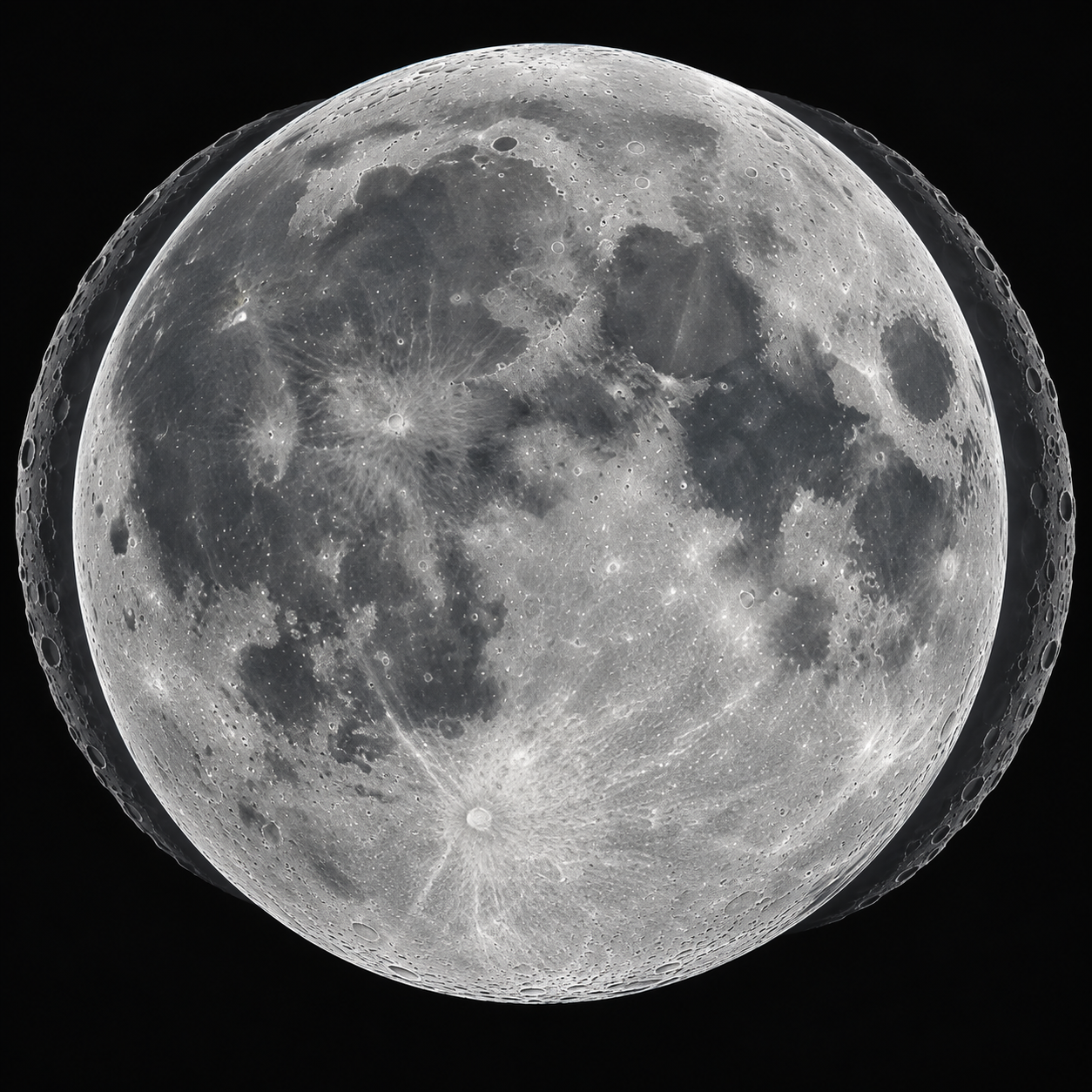
An illustrated near-side Moon has faint offset outlines around its rim to suggest a changing viewpoint.
Conceptual illustration of lunar libration. The ghosted rims suggest changing views; they are not measured lunar outlines.

Put a month's Moon images into a fast animation and something surprising happens. The familiar face seems to rock, nod and turn. Dark plains shift slightly toward the edge, and craters near the rim alternately become easier and harder to see. The Moon still keeps broadly the same hemisphere facing Earth. Our changing view is called libration.

This is why observers can eventually see about 59 percent of the lunar surface, rather than precisely half. That extra area is revealed gradually around the edges. It is not all visible at once, and most of the far side remains beyond an Earthbound observer's view.

A steady spin and an uneven journey

The Moon rotates once on its axis in approximately the same time that it completes an orbit around Earth. This synchronous rotation is the reason it presents one familiar face. It does rotate: a Moon that did not turn as it orbited would show us every side.

But its orbit is elliptical, so its orbital motion speeds up and slows down. Its rotation is much more uniform. For part of an orbit, the orbital movement runs slightly ahead of the rotation; during another part, it falls slightly behind. From Earth, this mismatch lets us peek a little around the eastern and western limbs. This effect is libration in longitude.

The chair exercise that settles the rotation question

Place a chair in the center of a clear space and walk slowly around it while keeping your face toward the chair. By the time you return to your starting point, you have turned once relative to the room. Keeping one face inward requires rotation. Now repeat only a small part of the walk while keeping your face toward the same wall. Your side begins to face the chair instead.

The exercise is a model of orientation, not a scale model of gravity or speed. It is useful because “always facing Earth” can sound like the absence of turning when it actually describes a relationship between two motions. The Moon's synchronized spin does not mean that it stands still relative to distant stars.

To imagine longitude libration, let your walking pace vary while your turning remains steadier. You cannot reproduce the full celestial geometry perfectly by walking, but you can feel the mismatch. A little extra orbital progress changes which edge of your face points inward. The important ingredient is the difference between orbital angle and rotation angle, not an unexplained monthly shaking.

Looking over the poles

A second ingredient is tilt. The Moon's rotational axis is inclined relative to its orbital plane. As it travels, our viewpoint alternates between looking slightly over the north pole and slightly under the south pole. This is libration in latitude.

Earth itself also matters. An observer on the turning Earth's surface changes position relative to the Moon between moonrise and moonset. This smaller perspective change contributes another kind of apparent libration. There are also small real variations in lunar rotation, called physical librations. The conspicuous monthly rocking seen in a time-lapse is primarily a result of viewing geometry, rather than a dramatic physical tumble.

These shifts should be distinguished from the lunar phases. A crescent or full Moon describes how much of the Earth-facing disk is illuminated by the Sun. Libration describes which terrain is presented to us. Two images with similar phases can show subtly different views of a feature near the rim.

Make three passes through the animation

On the first pass, watch only the boundary between lunar day and night. It sweeps across the terrain as the phase changes. Notice how long shadows emphasize craters close to that boundary. A feature becoming more dramatic under low sunlight does not necessarily mean that libration has brought it newly into view.

On the second pass, follow the center of one dark plain near the edge of the disk. Its position relative to the rim changes with viewing angle. Pause at two frames with broadly similar illumination and compare the amount of surrounding terrain visible. This is closer to the question of libration than comparing a narrow crescent with a full Moon.

On the third pass, watch the disk's size without following individual markings. NASA includes the changing Earth–Moon distance in the visualization. Growing larger and peeking around an edge can occur together, yet one is a distance effect and the other an orientation effect. Separating them makes the apparent motion much easier to read.

For your own photographs, note the date, time and image orientation. A telescope, camera or viewing program can rotate or mirror a picture, which complicates a comparison based on “left” and “right.” NASA's linked page labels its orientation and uses a geocentric view. Your position on Earth's surface adds another perspective difference, so matching two pictures requires more care than matching their apparent phase.

Watch the same crater move

The Moon also appears larger when it is closer to Earth and smaller when farther away. That changing size adds another movement to the animation, but it does not explain the sideways peek. The useful habit is to separate illumination, distance and viewing angle: three different causes can change the appearance of the same familiar world.

NASA Scientific Visualization Studio: simulated Moon phase and libration for 2026, built with lunar terrain data. Explore the interactive view and full credits.

Sources and further reading: NASA: What is lunar libration? · NASA: Moon Wobble · NASA: Moon Phase and Libration, 2026

publications

New this week Two novels in six stories each, from The Night Shift . New — a novel in six documents Small Print A Novel in Six Do...