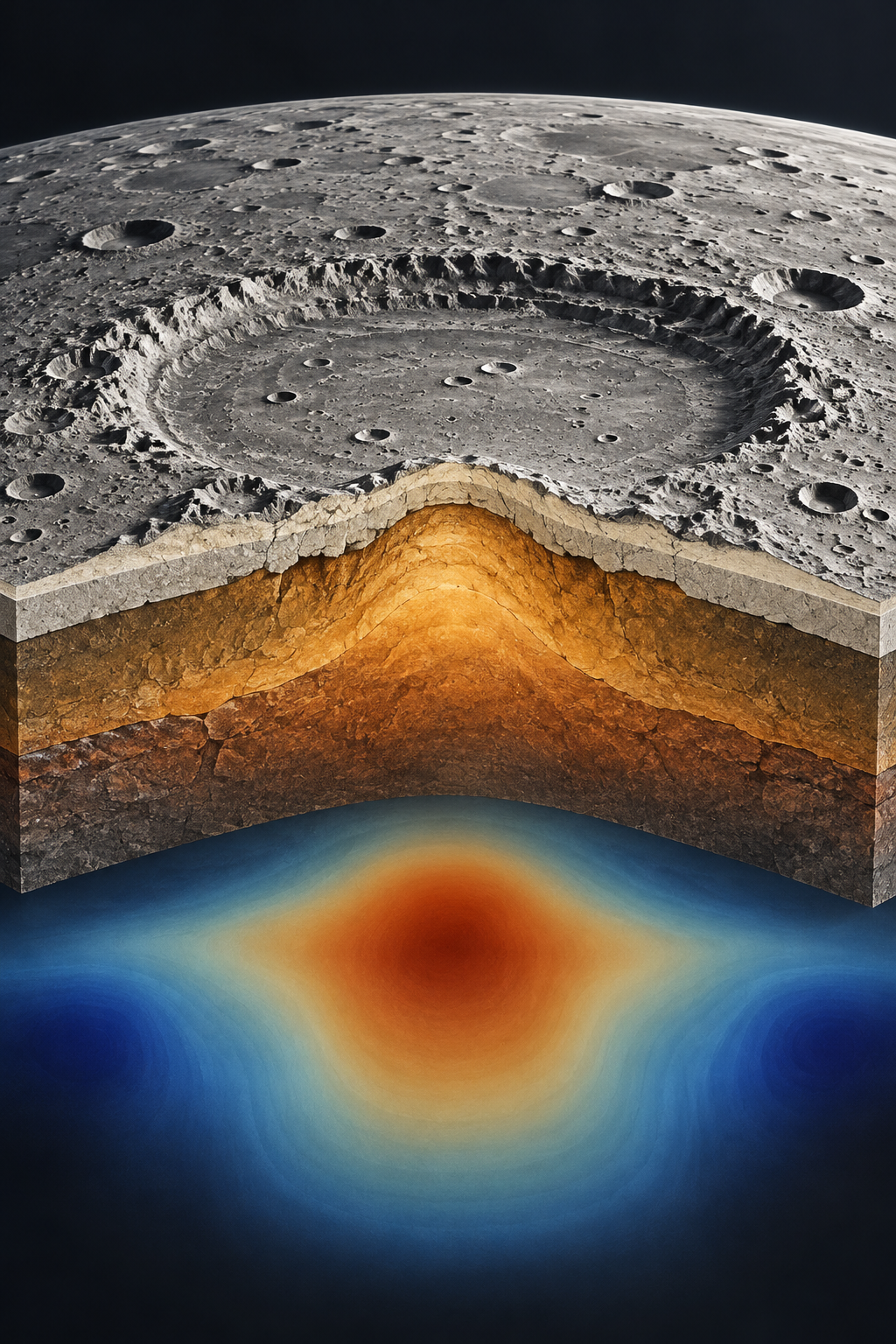
The Moon looks solid and still, but its gravity is not perfectly smooth. A spacecraft passing over one region can be pulled a little more strongly than over another. Some of the strongest patches lie beneath enormous ancient impact basins. They are called mascons, short for mass concentrations.
A mascon is not a hidden ball of exotic metal. It is an excess of mass compared with what a simple reference model would predict, produced by the arrangement and density of lunar rock. These invisible differences matter to spacecraft navigation and preserve clues to a violent geological past.
Reading gravity with two spacecraft
NASA's GRAIL mission used two spacecraft, Ebb and Flow, following one another around the Moon. Instruments measured tiny changes in the distance between them. When the leading spacecraft encountered a stronger gravitational pull, it moved slightly differently from its companion. As the second followed, the separation changed again.
Combining these measurements across many orbits produced exceptionally detailed gravity maps. Such maps do not show the same thing as photographs. A striking surface crater and a strong gravity anomaly can correspond, but gravity also responds to material below the visible ground.
Colors on a gravity map encode departures from a chosen reference. They do not mean the lunar surface is physically red or blue. Nor does a red patch mean gravity there rivals Earth's: the Moon's overall gravity remains much weaker.
An impact leaves more than a hole
Large impacts excavated crust, deformed the interior and brought denser mantle material upward beneath their basins. The resulting structure then cooled and evolved. In some basins, later volcanic lava added additional dense material. Together, these processes can leave a mass surplus that a passing spacecraft detects.
GRAIL data and computer models helped researchers explain the characteristic gravity patterns around major basins. Some have a central positive anomaly surrounded by rings with different gravitational signatures. The details depend on the impact, the thickness and properties of the crust, and subsequent geological history.
This makes a mascon useful evidence, not simply a nuisance. Surface imagery records the top of an impact structure; gravity adds information about its buried architecture. The two kinds of measurement constrain each other when scientists reconstruct what happened billions of years ago.
A practical map of an uneven world
For mission planners, an uneven gravitational field means an orbit must be calculated with more care than if the Moon were a perfectly uniform sphere. The same precision can turn an old navigation difficulty into a powerful scientific tool. Changing spacecraft motion is a measurement of the world beneath it.
Compare the conceptual cutaway here with NASA's actual GRAIL gravity map. The illustration simplifies a basin to communicate the idea; the map records observations and their mathematical interpretation. Seeing both reveals a remarkable connection: slight motions of two distant spacecraft can help expose the hidden structure of an ancient impact.
Sources and further reading: NASA/JPL: GRAIL solves the mascon mystery; NASA: GRAIL gravity map; NASA Gravity Assist: The Moon’s Holy GRAIL.
Explore more creative discoveries at Incoprea.




