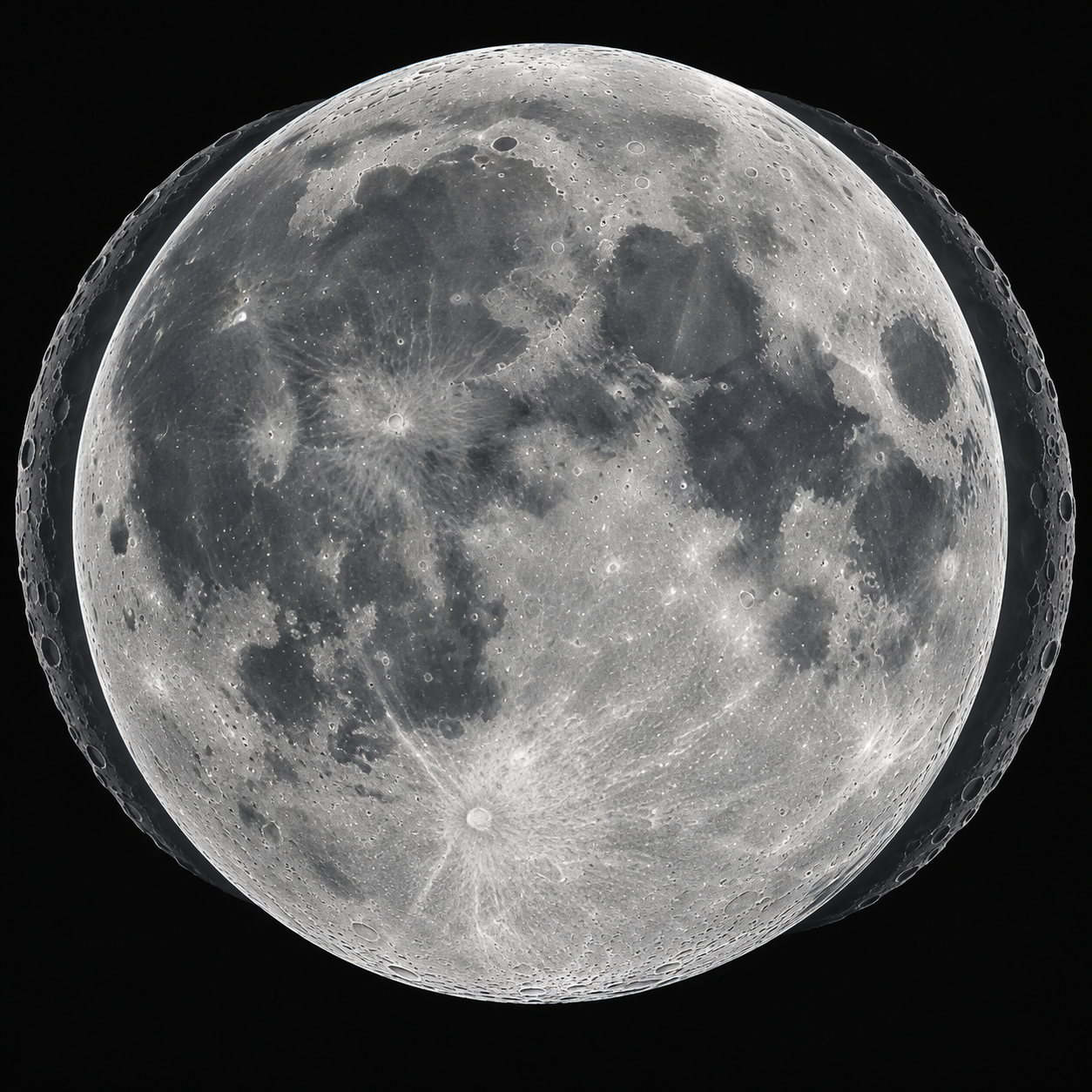
Put a month's Moon images into a fast animation and something surprising happens. The familiar face seems to rock, nod and turn. Dark plains shift slightly toward the edge, and craters near the rim alternately become easier and harder to see. The Moon still keeps broadly the same hemisphere facing Earth. Our changing view is called libration.
This is why observers can eventually see about 59 percent of the lunar surface, rather than precisely half. That extra area is revealed gradually around the edges. It is not all visible at once, and most of the far side remains beyond an Earthbound observer's view.
A steady spin and an uneven journey
The Moon rotates once on its axis in approximately the same time that it completes an orbit around Earth. This synchronous rotation is the reason it presents one familiar face. It does rotate: a Moon that did not turn as it orbited would show us every side.
But its orbit is elliptical, so its orbital motion speeds up and slows down. Its rotation is much more uniform. For part of an orbit, the orbital movement runs slightly ahead of the rotation; during another part, it falls slightly behind. From Earth, this mismatch lets us peek a little around the eastern and western limbs. This effect is libration in longitude.
Looking over the poles
A second ingredient is tilt. The Moon's rotational axis is inclined relative to its orbital plane. As it travels, our viewpoint alternates between looking slightly over the north pole and slightly under the south pole. This is libration in latitude.
Earth itself also matters. An observer on the turning Earth's surface changes position relative to the Moon between moonrise and moonset. This smaller perspective change contributes another kind of apparent libration. There are also small real variations in lunar rotation, called physical librations. The conspicuous monthly rocking seen in a time-lapse is primarily a result of viewing geometry, rather than a dramatic physical tumble.
These shifts should be distinguished from the lunar phases. A crescent or full Moon describes how much of the Earth-facing disk is illuminated by the Sun. Libration describes which terrain is presented to us. Two images with similar phases can show subtly different views of a feature near the rim.
Watch the same crater move
NASA's animation below compresses the 2026 changes in phase, orientation, distance and libration. Try watching one recognizable dark plain instead of the changing crescent. Then follow the rim. Its apparent movement makes the extra glimpses much easier to understand than a single still image does.
The Moon also appears larger when it is closer to Earth and smaller when farther away. That changing size adds another movement to the animation, but it does not explain the sideways peek. The useful habit is to separate illumination, distance and viewing angle: three different causes can change the appearance of the same familiar world.
Sources and further reading: NASA: What is lunar libration?; NASA: Moon Wobble; NASA: Moon Phase and Libration, 2026.
Explore more creative discoveries at Incoprea.




