Showing posts with label Insects. Show all posts

Sunday, October 25, 2026

The Trap-Jaw Ant Loads a Spring Before It Bites

An open pair of ant mandibles can be a sign of stored energy. In trap-jaw ants of the genus Odontomachus, the jaws may remain spread while muscles load elastic structures. A release then turns that preparation into a strike too fast to follow with unaided eyes. The dramatic motion is brief; much of the work happens before anything seems to move.

A brown trap-jaw ant with long, nearly straight mandibles partly open above leaf litter.
The mandibles are partly open here; in the fully cocked trap-jaw position they spread much farther apart.

Three moments hidden inside one snap

  1. Load: muscle contraction stores elastic energy while the jaws are held in position.
  2. Release: the latch ceases to restrain the system.
  3. Recoil: elastic structures drive the mandibles through their rapid rotation.

This sequence is called latch-mediated spring actuation. Its advantage is about timing. A muscle can do work over a comparatively long loading period, then the system can deliver that stored energy over a very short interval. The spring does not create free energy. It changes the rate at which the energy becomes available, much as a slowly drawn bow can launch an arrow in a moment.

That analogy is useful only if we keep looking at the ant’s actual parts. In a 2022 study of Odontomachus brunneus, researchers found two elastic components working together. Recoil of the head capsule supplied a push, while recoil of the muscle–apodeme system supplied a pull. An apodeme is a structure through which muscle force is transmitted inside the exoskeleton. Calling the mechanism “a spring” should not make us imagine one hidden metal coil.

The two contributions create torque around the jaw joint. This matters because a useful fast strike needs controlled rotation, not merely a large force somewhere in the head. The study combined movement measurements, elastic recoil measurements, and modeling. Its detailed mechanical interpretation belongs to the species it tested; it should not be silently substituted for the anatomy of every ant carrying the common name “trap-jaw.”

A striking number needs a species name

The much-cited 2006 study concerned Odontomachus bauri. It recorded jaw speeds of roughly 35 to 64 metres per second and an average closure duration of about 0.13 milliseconds under its experimental conditions. Those are jaw measurements, not the ant’s running speed. They describe a sampled behavior in a named species, not a fixed speed for all strikes or all trap-jaw lineages.

The same study showed that where a strike lands can change its outcome. A jaw strike can hit prey, an intruder, or the ground. Against a surface, the reaction can propel the ant’s body into the air. Changing head orientation and the struck surface therefore allows one apparatus to participate in feeding and escape. The jaw has acquired a locomotor role without becoming a leg.

This is an unusually clear example of why a body part’s name does not define all its functions. A mandible is associated with eating, but the relevant mechanical question is where it delivers an impulse. Pressing a spring-driven object against a fixed surface can move the object itself. The ant’s jump makes that change of reference visible. The same moving structure can produce a very different event when its surroundings change.

The latch and the trigger are not the whole machine

Sensory hairs help connect contact near the jaws to rapid release. Early work on Odontomachus neurons and trap jaws examined the neural arrangements associated with the behavior. The trigger is worth distinguishing from the energy source: sensing an object can initiate release without supplying most of the mechanical energy of the strike. The muscles loaded that energy beforehand.

A 2023 study of O. kuroiwae investigated the physical latch in another species, using anatomical and mechanical evidence. It illustrates how even a familiar general explanation can leave an important detail unresolved. Saying “there is a latch” identifies a function. Showing which structures hold, disengage, and transmit force explains how that function is embodied in an animal.

Comparative research also prevents a spectacular result from turning into a universal record. A 2008 study across trap-jaw ants examined variation in form and performance. Body size, jaw geometry, and evolutionary history provide reasons to compare species carefully. “Faster” is incomplete until we specify whether we mean tip speed, angular speed, acceleration, closure time, or the time between a stimulus and the completed response.

A useful question for any speed headline

What exactly moved, how far did it travel, and when did the measurement begin? An ant can spend time loading and waiting before its brief jaw closure. If one experiment times only recoil and another includes sensing and preparation, their results answer different questions. A precise comparison starts by drawing the interval that each measurement covers.

Try that interval drawing with an everyday spring clip. Sketch preparation, holding, and release as separate blocks on a page; there is no need to snap it near your skin. Then imagine comparing it with a hand closing directly around an object. Both movements use muscle energy, yet one allows storage before release. The exercise helps explain power amplification without implying that an ant is simply a tiny version of a household mechanism.

The fascination of the trap jaw is therefore larger than a record-breaking bite. It reveals how an animal organizes time: gather energy, hold it, detect an opportunity, then release it through a carefully arranged geometry. High-speed cameras make the final instant visible. Anatomy and experiments recover the longer preparation that makes that instant possible.

Sources and further exploration

Two more connections

Visit Incoprea

The Cicada Wing With a Microscopic Mechanical Defense

A cicada wing looks like a transparent sheet reinforced with veins. Enlarge its surface far beyond a normal close-up, and another landscape appears: tiny protrusions arranged across the membrane.

Under experimental conditions, some of these surfaces can damage and kill certain bacteria that contact them. The surprise is that surface architecture can contribute to the damage. The challenge is understanding exactly which architecture, which bacterium, and which conditions make it happen.

Cicada resting on a leaf with its transparent veined wing catching the light.
The visible wing is a starting point. Its much smaller surface structures require microscopy to study.

The result began with a particular encounter

In a 2012 study of the clanger cicada, Psaltoda claripennis, researchers investigated the interaction between its wing surface and Pseudomonas aeruginosa. Bacterial cells contacting the nanostructured surface became damaged. The paper connected the effect to the physical surface and mechanical rupture.

The species names matter. They tell us what was actually tested. A discovery involving this cicada and this bacterium does not immediately establish that every cicada wing kills every microorganism. Keeping the original encounter in view makes the result testable.

It also distinguishes two very different outcomes. A surface might discourage attachment, or it might damage cells after they attach. Both can affect contamination, but they call for different explanations. A bacterium absent from a surface may have failed to stick; absence alone does not prove it died.

More subtle than a bed of needles

“Nanopillars puncture bacteria” is an irresistible mental picture. It can also conceal the most interesting mechanics.

A 2013 biophysical model considered a bacterial outer layer adhering to a patterned wing. As parts of that layer contact the pillars, the material suspended between them can become stretched. The model predicts rupture when deformation becomes too great. In this account, damage need not begin as a sharp point simply drilling through the cell.

The researchers also investigated the importance of cell rigidity. Altering resistant cells so that they became less rigid made them susceptible to the wing's effects. That experiment supported a role for mechanical properties, alongside the model.

A model is a deliberately simplified account of forces and materials. Its value lies in explaining observations and generating predictions. It should not be mistaken for a microscopic film of every event occurring on every natural wing.

The material is part of the surface

Topography is only one property a bacterium encounters. A wing has a chemical composition, interacts with water, and varies among species.

A 2020 comparison of Neotibicen pruinosus and Magicicada cassinii examined both molecular composition and surface structure. Researchers extracted surface compounds, examined changes with microscopy, and measured properties including wettability, bacterial fouling, and bactericidal effects.

The work pointed to chemistry acting directly and indirectly together with geometry. Extraction also altered nanoscale features, which makes the experiment richer than a simple “chemicals off, shape unchanged” switch.

This does not erase the earlier physical finding. It widens the question. To reproduce a biological surface successfully, engineers may need to understand what it is made of as well as how its small features are arranged.

Three claims that need three kinds of evidence

ClaimWhat would help demonstrate it?
The surface sheds water.Measurements of droplet behavior and wetting under stated conditions.
Fewer bacteria remain attached.Attachment or retention measurements with an appropriate comparison surface.
The surface kills bacteria.Evidence about cell survival or damage, rather than attachment counts alone.

These are useful questions to take to a research paper or a product claim. A striking droplet photograph can support an argument about wetting. It cannot, by itself, demonstrate a reduction in viable bacteria.

Likewise, an electron micrograph can reveal small structures and deformed cells. To assess killing, look for the additional biological measurements. The best evidence connects the structure to what happened to the living cells.

Copying the idea takes more than making bumps

A review of natural and bioinspired bactericidal surfaces examines variables such as feature dimensions, density, flexibility, chemistry, and the properties of the bacteria. It describes a research field working out how these factors interact, rather than a universal texture with one guaranteed effect.

A manufactured surface has further questions to answer. Will its structure survive wear? What happens when material accumulates between the features? Does performance persist in the relevant environment? Is the surface compatible with other cells that may contact it? Those are separate tests, not details that a natural example can settle in advance.

The wing is therefore most useful as an invitation to investigate. It shows that a surface can influence a cell through forces at a very small scale. Turning that principle into a reliable material requires the careful comparisons that made the biological finding interesting in the first place.

Next time a cicada lands nearby, the transparent wing offers two views at once. One is visible: a light, veined flight surface. The other belongs to microscopy and experiment, where contact between a cell and a patterned material can become a mechanical event.

Read the research

Keep exploring

Discover more art, ideas, and curious things at Incoprea.

Why a Caddisfly Carries the Streambed Around

A little tube of sand on a streambed begins to walk. A head appears at one end. Six jointed legs get to work, and what looked like a piece of bottom debris becomes an animal carrying its own small building.

This is a case-making caddisfly larva. Its shelter is easy to admire as miniature architecture. The more interesting question is how that architecture works while the occupant eats, grows, moves, and breathes underwater.

Caddisfly larva emerging from a sand-and-stone case on a streambed.
A portable case puts locally available material around a vulnerable larva.

The builder is not the building

Caddisflies belong to the insect order Trichoptera, relatives of butterflies and moths. Most spend their larval lives in water before emerging as winged adults. The Natural History Museum's account of the group includes both mobile cases and fixed retreats. A portable stone tube is one successful way to be a caddisfly, rather than the definition of the whole order.

The Riverfly Partnership describes cases made with materials such as sand, small stones, shells, and vegetation. Silk holds the assembly together. Some other caddisfly larvae occupy attached shelters or spin feeding nets. Still others live without these conspicuous constructions.

That variety changes how to read the scene. A case suggests a larva's building strategy, but its appearance alone may not establish a species. Nearby plant fragments and grains also provide a local material supply. The stream is both habitat and building yard.

A shelter has to let water through

Imagine protecting a soft-bodied animal by enclosing it, then remembering that the animal must obtain oxygen from the surrounding water. A sealed capsule would solve one problem by creating another.

As Maine's environmental monitoring program explains, caddisfly larvae obtain dissolved oxygen across soft body surfaces. Larvae inside cases can undulate their abdomens to move water past themselves. Their tiny houses therefore participate in a flow system. Shelter, the openings, the occupant's movements, and the surrounding current work together.

A case is consequently more than a heavy disguise. Its usefulness depends on what the larva can still do inside it. More material is not automatically better. Any protective structure must remain compatible with movement and water exchange.

The expensive part is easy to overlook

Suppose a larva loses its case and builds another. It may survive the immediate disturbance, yet that does not mean rebuilding was free.

A study of Limnephilus rhombicus examined this question experimentally. Larvae forced to reconstruct cases used more oxygen during construction and suffered protein losses. Effects also appeared later, including delayed adult emergence. The experiment concerned a particular species and set of conditions; it does not supply one universal price for every caddisfly case.

It does show why an outcome measured today can miss a cost paid tomorrow. Energy and material spent rebuilding are unavailable for something else. Seeing a larva produce a replacement shelter is evidence of impressive ability, while measuring its later development reveals more of the transaction.

Underwater glue has its own chemistry

The stones get attention because we can see them. The silk deserves equal billing. It must be produced, drawn into fibers, and attached in a wet environment.

In research on the silk of Hesperophylax occidentalis, scientists distinguished a fiber core from an adhesive coating. They investigated a peroxidase enzyme associated with that coating and chemical cross-links that help establish attachment. Their work also examined interactions with environmentally conditioned surfaces.

This is a more specific achievement than “sticky silk.” It brings together the fiber, a coating, chemical reactions, and the surface encountered by the animal. The findings should not be treated as a complete recipe for every caddisfly's adhesive. They are a detailed window into one biological material system.

A small animal is a clue, not a certificate

Caddisflies are useful in freshwater monitoring, but one sighting does not certify pristine water. Maine's account emphasizes that sensitivities differ among groups. Habitat, oxygen, food, and the wider invertebrate community matter when interpreting a sample.

The rewarding discovery is more modest and more tangible. Something that looked like loose streambed material is a living arrangement of protection, water flow, and construction effort. Watch long enough, and the streambed gets up and takes its house along.

Read the research

Keep exploring

Discover more art, ideas, and curious things at Incoprea.

Thursday, October 22, 2026

Desert Locusts: How a Solitary Insect Becomes Part of a Swarm

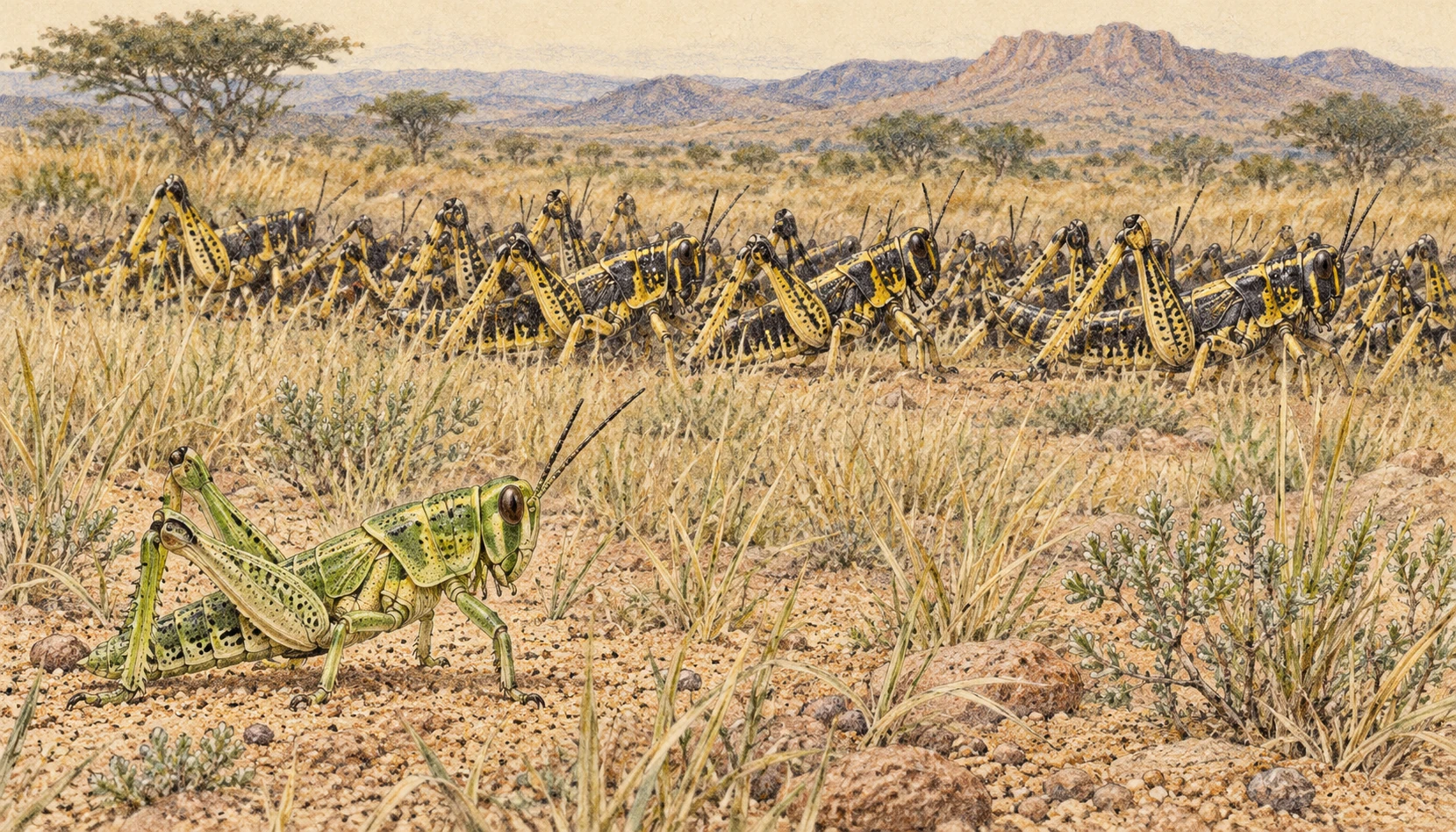
A solitary greenish locust hopper separated from a band of dark yellow-and-black hoppers in dry grass.
Conceptual field-guide comparison of locust social phases; illustrative coloration and setting, not a diagnostic field photograph.

Two young desert locusts can belong to the same species yet behave as if the presence of another insect means opposite things. One avoids company. The other moves toward it. Once attraction begins to reinforce crowding, a scattered population can start becoming a coordinated band. A swarm is not merely a large number of unchanged solitary insects accidentally sharing the sky.

Locusts are particular grasshoppers capable of a density-dependent transformation called phase change. In the desert locust, Schistocerca gregaria, that transformation can alter behavior, appearance, physiology, and body proportions. The FAO's biological overview distinguishes wingless hopper bands from flying adult swarms. “More insects” describes abundance; “different responses to one another” describes an important part of what makes the abundance dangerous.

The change begins with an insect-sized world

A broad environmental sequence can create the opportunity. Suitable rainfall and vegetation allow breeding and survival; population growth and later concentration bring individuals together. But the insect does not experience a regional population estimate. It experiences contacts, sights, smells, and its own changing internal state. Connecting those local inputs to large collective behavior is the scientific problem.

Research described by the University of Cambridge in 2009 identified a role for serotonin in the behavioral transition. Under the study's experimental conditions, changes in this signaling chemical helped initiate gregarious behavior. Sensory stimulation associated with crowding could therefore be linked to a measurable nervous-system response, rather than merely correlated with the final sight of a swarm.

It is tempting to turn that into “serotonin makes locusts swarm.” That sentence hides several scales. A behavioral shift in a test arena, a gradual change in body coloration, synchronized breeding, and a flying swarm crossing a landscape are not one event. Nor does a chemical's familiar name tell us what it does in every species or tissue. The useful question is which response was measured, where the chemical acted, and what else the experiment held constant.

A disagreement that improves the story

Not every experiment produced the same result. A 2013 study by Tanaka and Nishide reported that significant changes in attraction or avoidance took at least three days in their tests, and serotonin injection did not alter those behaviors or body color as it had been expected to. That is a substantive qualification, not a reason to erase the earlier work.

A 2014 study of rapid gregarization examined activity and attraction together and addressed how experimental design and behavioral measurement affect interpretation. A locust that moves more may encounter a stimulus more often even if attraction has not changed in the same way. Combining several measures into a behavioral score can be useful, but it also makes the score's construction matter.

For a reader, this is the best part of the research story. The uncertainty has a shape. It concerns protocols, rearing conditions, timescales, and the behaviors used to define transition. “Scientists disagree” would be too vague; “everything is settled by one chemical” would be too strong. The studies show why a phenomenon can be real while particular claims about its speed or mechanism still require careful comparison.

Three measurements that answer different questions
ObservationWhat it can showWhat remains open
Distance moved in an arenaActivity under the test conditionsWhether the insect is attracted to other locusts
Time near a group behind a barrierAttraction or avoidance in that setupHow it will behave in a complex landscape
Color and body proportionsPhysical features associated with phaseWhether every behavioral change happened at the same time

A coordinated band can contain many small pauses

From far away, a marching band seems to flow. Following one hopper reveals another rhythm: walk, pause, change direction, walk again. A collective can move coherently while its members remain intermittent. This is a different question from how a solitary-phase insect becomes gregarious.

2014 experiments on desert locust nymphs examined that pause-and-go pattern and its relation to interactions in a crowd. The work connected individual movement rules with the persistence of ordered marching. It did not require every animal to move at one constant speed or receive a command from a leader.

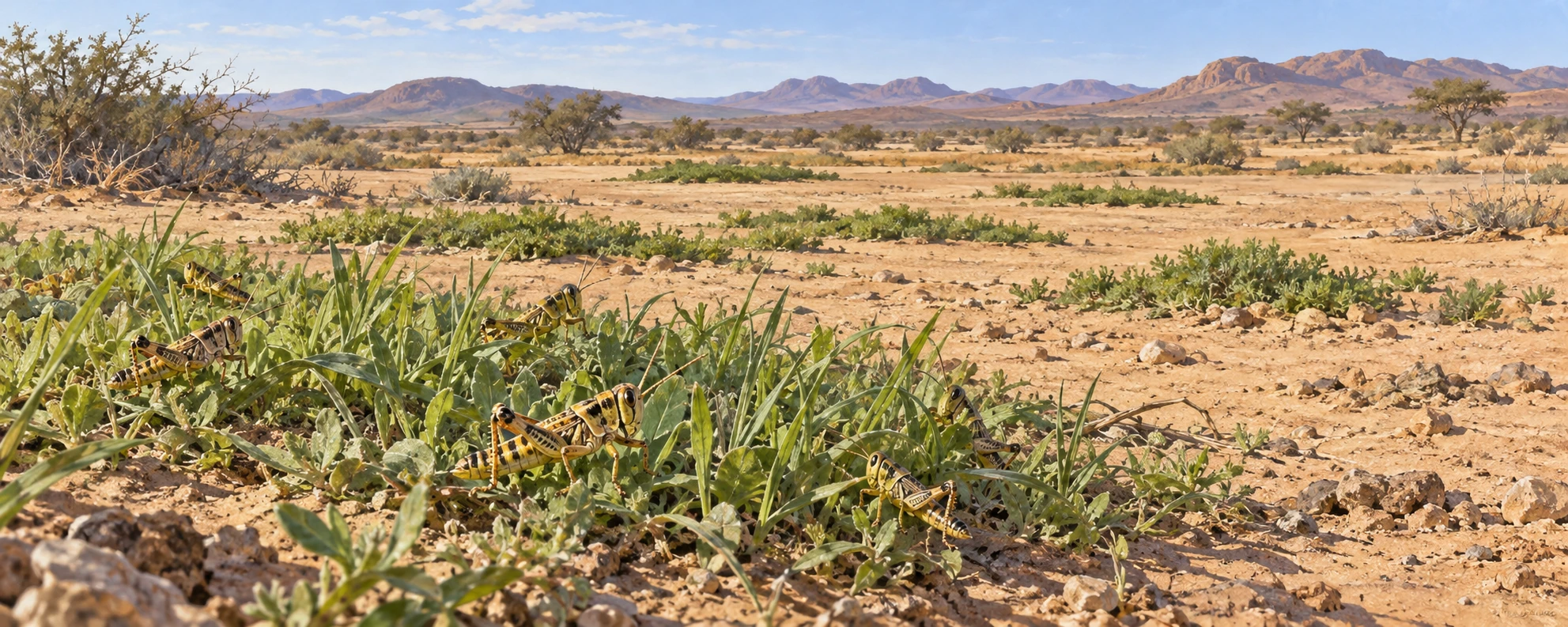
Remaining green patches concentrate locust hoppers in a broad drying landscape
Habitat can concentrate encounters. The later order of a marching band still depends on how individuals move and respond.

A 2023 visual experiment separated parts of the scene further. Tethered locusts saw moving dots whose direction, speed and coherence could be changed. Responses depended on those features, and the animals showed a tendency to maintain or join a heading. The researchers restricted comparisons to a responsive interval because the open-loop display did not change as a real scene would when the animal turned.

That methodological detail matters. A screen can isolate a cue while also removing the consequences of acting on it. A result from that arrangement supports a specific sensory-behavioral relationship. It is not a forecast of the speed or direction of a wild band.

Count movement and agreement separately

Imagine eight fictional hoppers on a straight track. Five walk right and three walk left at equal speeds. Eight animals moving vigorously would not tell you how coordinated the group is; you need the headings. A simple illustrative agreement score is the absolute difference between the two counts divided by eight: 2/8, or 0.25. Seven right and one left give 0.75. Eight walking right give 1.

What happens if half the animals stop?

The answer depends on the definition. A score calculated only among moving animals can remain high, while the fraction of the entire group that is walking falls. Report both. These fictional calculations illustrate why activity and directional agreement need separate measures; they are not a reproduction of the studies' tracking analysis.

In a research video, try following one individual for a short interval instead of following the front of the band. Mark its pauses, then look back at the group. The individual and collective views are complementary. The apparently smooth stream is made from many histories that do not look smooth at all.

From a behavioral switch to a food-security problem

A simple thought experiment clarifies the feedback. Put ten imagined insects among many scattered food patches. If each tends to move away from others, encounters help maintain separation. Change only that tendency so that encounters encourage proximity. The same starting abundance can now yield denser clusters. This is an illustration of feedback, not a simulation of real swarm prediction; food, development, weather, and many other influences would have to be added.

The distinction matters to monitoring. Waiting for an enormous flying cloud means waiting until several earlier processes have already unfolded. The FAO desert-locust guide describes surveillance, weather and habitat information, and coordinated early response. The biological story helps explain why prevention depends on dispersed field observations as well as dramatic satellite-scale events.

It also puts responsibility in the right place. A farmer facing a band is dealing with a material threat to food and livelihoods, not an entertaining behavioral puzzle. Understanding the transition can improve how we interpret reports without turning affected communities into scenery. Population stage, location, date, and the conditions for further breeding are more useful information than an isolated photograph captioned “plague.”

The generated artwork accompanying this article separates a solitary-looking hopper from a band to make the contrast readable. It is an interpretive comparison, not evidence that a particular green individual is about to transform, and not a diagnostic guide to every age and phase. Color is one part of a changing system, not an infallible label.

The deepest transformation is relational. An insect's response to neighbors changes; those changed responses alter the density of neighbors it encounters; the emerging group creates new conditions for its members. The swarm has no single commander, but it is also no accident of identical isolated individuals. It is a population whose members have become different through their experience of one another.

Follow the evidence: FAO: locust phase change; Cambridge: serotonin and behavioral change; Tanaka and Nishide: a different experimental result; Rogers and colleagues: activity and attraction in rapid gregarization; FAO: desert locust questions and monitoring.

More curious connections, art and independent projects at Incoprea.

The Milky Way Helps a Dung Beetle Keep Its Course

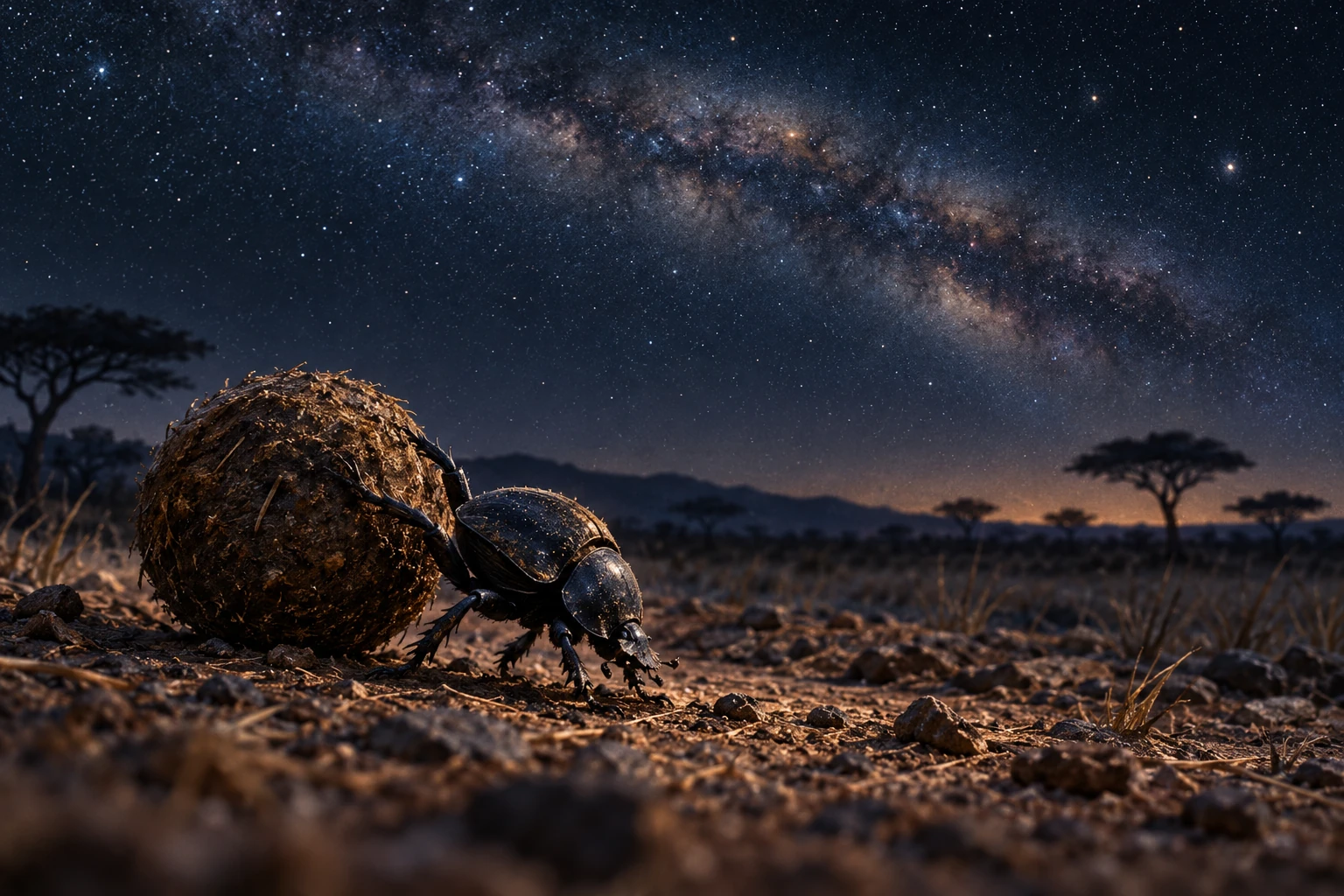
A dark scarab beetle rolls a dung ball across savanna ground under a diffuse Milky Way.
Conceptual nocturnal scene; sky brightness and beetle visibility are artistic interpretation, not a field measurement.

A dung beetle rolling a ball away from a crowded dung pile has a practical problem: get clear without circling back into competitors. A straight route is useful even when there is no fixed destination to find. For some night-active beetles, the broad light of the Milky Way can help maintain that route.

The surprising connection between a small insect and the galaxy is real, but “navigates by stars” can suggest the wrong kind of journey. The beetle is not necessarily identifying a constellation or plotting a route to a remembered address. In the experiments that made the story famous, the central issue was keeping a bearing while rolling away.

A compass can work without a map

A 2013 Current Biology study tested the nocturnal dung beetle Scarabaeus satyrus under different sky conditions. A planetarium allowed researchers to change celestial information while preserving the general task. Beetles oriented effectively when the Milky Way was visible, including conditions in which that broad band was presented without the full field of individual stars.

The Lund publication record summarizes the key comparison: the Milky Way could supply sufficient information for orientation. A diffuse brightness pattern is a very different visual cue from a human astronomer's named star chart. The result is remarkable precisely because a relatively coarse feature can solve the insect's immediate problem.

Imagine leaving the center of an open room while keeping a long bright window at the same angle to your body. You could preserve a heading without knowing the room's compass orientation. The analogy is about the distinction between a bearing and a destination, not a claim that a beetle sees the sky as a person sees a window.

Why the little dance matters

Beetles sometimes climb onto the ball and turn before moving away. Research described by Lund in 2016 investigated this behavior as a way of acquiring a celestial snapshot. Subsequent movement could be guided by maintaining the relationship to the stored pattern. “Snapshot” here names a functional comparison with a visual memory, not a literal camera image inside the insect.

A useful experiment changes the cue and asks whether the route changes with it. Simply filming a beetle beneath stars would establish coexistence, not celestial guidance. A controlled sky, an altered cue, or an obstruction can distinguish the proposed mechanism from alternatives such as following the ground or a nearby landmark.

The scale of the task also helps explain why the sky is useful. A landmark near the ground changes apparent position rapidly as an insect moves past it. Very distant celestial features remain comparatively stable over a short journey. A broad, distant pattern can therefore be a practical reference even for an animal that never needs a detailed picture of the galaxy.

The brightest object is not always the compass

A moonlit sky supplies more than a bright lunar disc. Scattering also produces a polarization pattern: light differs in the orientation of its electric field across the sky. An animal sensitive to that property can obtain information that an ordinary night photograph does not show.

2003 experiments with Scarabaeus zambesianus demonstrated orientation using polarized moonlight. Keep that name beside the result. It is a different species from S. satyrus in the famous Milky Way experiment. Related beetles can solve similar departure problems with celestial information, without every experiment establishing the same cue hierarchy for all of them.

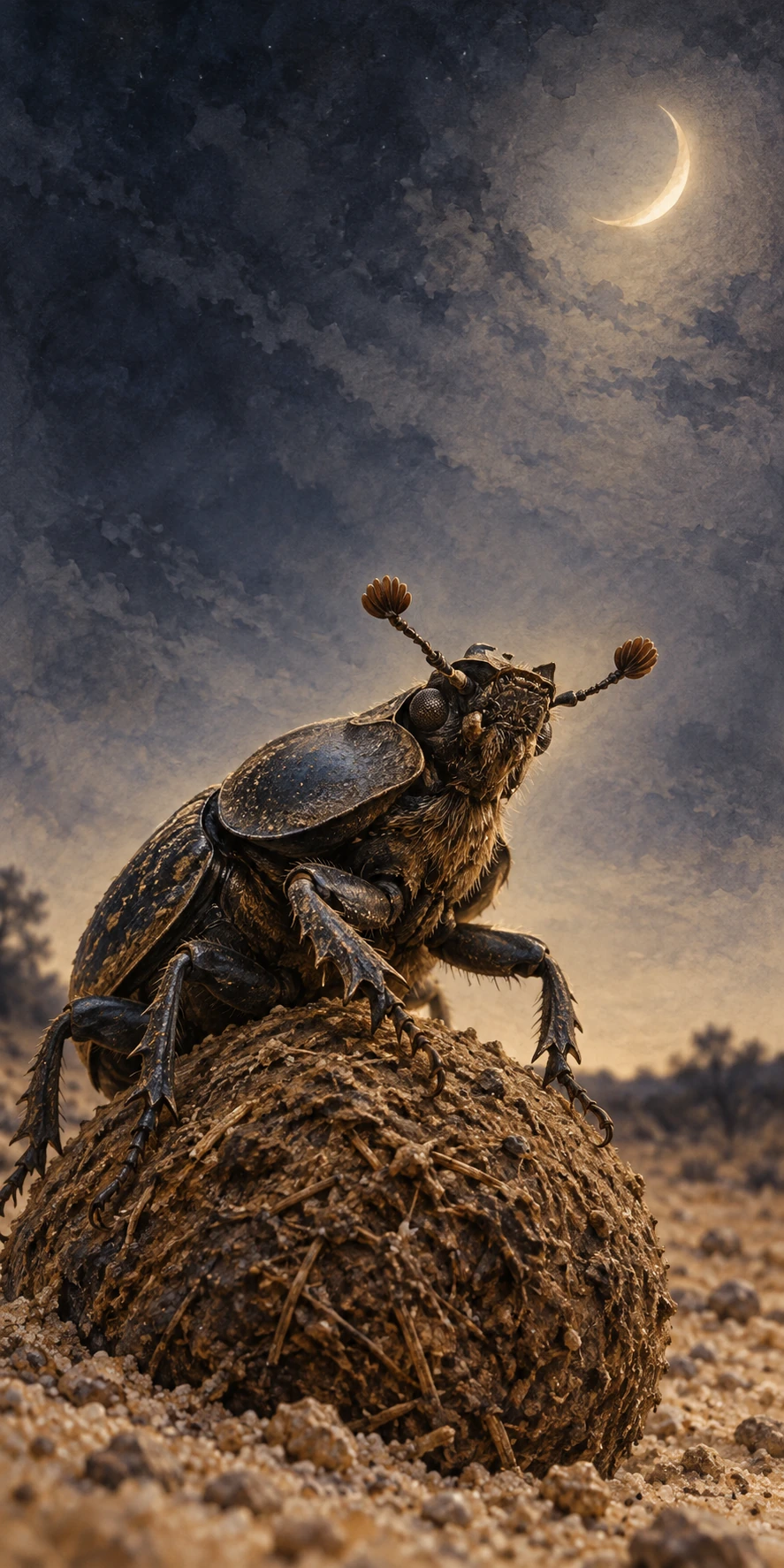
Nocturnal dung beetle raises its head above a ball beneath a pale moonlit sky
The sky contains information beyond the visible moon. This scene does not depict polarization as a human-visible pattern.

A 2004 follow-up separated the moon's visible position from the surrounding polarization pattern. Moving the apparent moon or obscuring its disc generally did not change orientation performance in the tested comparisons. The researchers concluded that the disc was not the primary cue; the polarized-light pattern was more important.

The distinction is subtle and rewarding. Hiding an object can leave information produced by its light available elsewhere. “The beetle could not see the moon” is therefore not equivalent to “all moon-related information had been removed.” The experimental manipulation has to match the proposed mechanism.

Make a cue ledger before drawing a sky map

The worksheet separates three categories: an object such as the moon, a broad brightness pattern such as the Milky Way and a property such as polarization. For each experiment, record the species, the changed cue and the measured response. This keeps the shared word “sky” from making unlike treatments sound identical.

One sky, several kinds of information

Research-reading cue ledger distinguishing objects, brightness and polarization across beetle species.

Open this activity in its own window.

Then write two predictions. If the visible disc is necessary, obscuring it should impair the relevant behavior. If a distributed polarization pattern is sufficient under those conditions, the same obstruction need not have that effect. Predictions made before reading the outcome help reveal the experiment's logic.

The illustration deliberately contains no colored polarization bands. Those would be an explanatory overlay, rather than a naked-eye view of the night. A seemingly sparse sky can contain structured information that is invisible to us and still useful to a small traveler on the ground.

Artificial light changes the available information

A 2021 study examined dung-beetle orientation under light pollution. The university's account describes comparisons between urban Johannesburg and a darker rural site in Limpopo. When natural celestial information was obscured, beetles relied more on bright ground-level beacons. The altered light environment changed how they held a course.

This is more specific than saying that darkness is good and brightness is bad. The arrangement and origin of light matter. A large-scale natural reference and a nearby artificial beacon provide different information. An animal can continue responding effectively to light in one sense while the response becomes less useful for its ecological task.

For a reader looking at a night landscape, that is a different reason to notice skyglow. Losing the Milky Way is not only a loss of a human view. It can remove information that another organism uses. The ecological question is what behavior changes when the cue disappears, and what those changes mean for competition, feeding, and survival.

No disturbance of wild beetles is needed to appreciate the principle. On a safe evening walk, compare a distant skyline feature with a nearby lamp as you move a short distance. The nearby reference shifts relative to you much more strongly. That observation illustrates geometry; it does not reproduce the beetle experiment or justify handling insects.

The galaxy is enormously larger than the beetle's world, yet one of its visible patterns can become part of an ordinary trip away from dinner. The connection is neither mystical nor grandiose. A broad stripe of light supplies a stable cue, and a small nervous system uses it to solve a local problem. That is the scale at which the Milky Way becomes useful.

Follow the evidence: Dacke and colleagues: Milky Way orientation experiment; Lund University: publication record and abstract; Lund University: celestial snapshot experiments; Lund University: light pollution changes orientation; 2021 study: light pollution forces orientation changes.

More curious connections, art and independent projects at Incoprea.

The Honeybee Waggle Dance Has an Apprenticeship

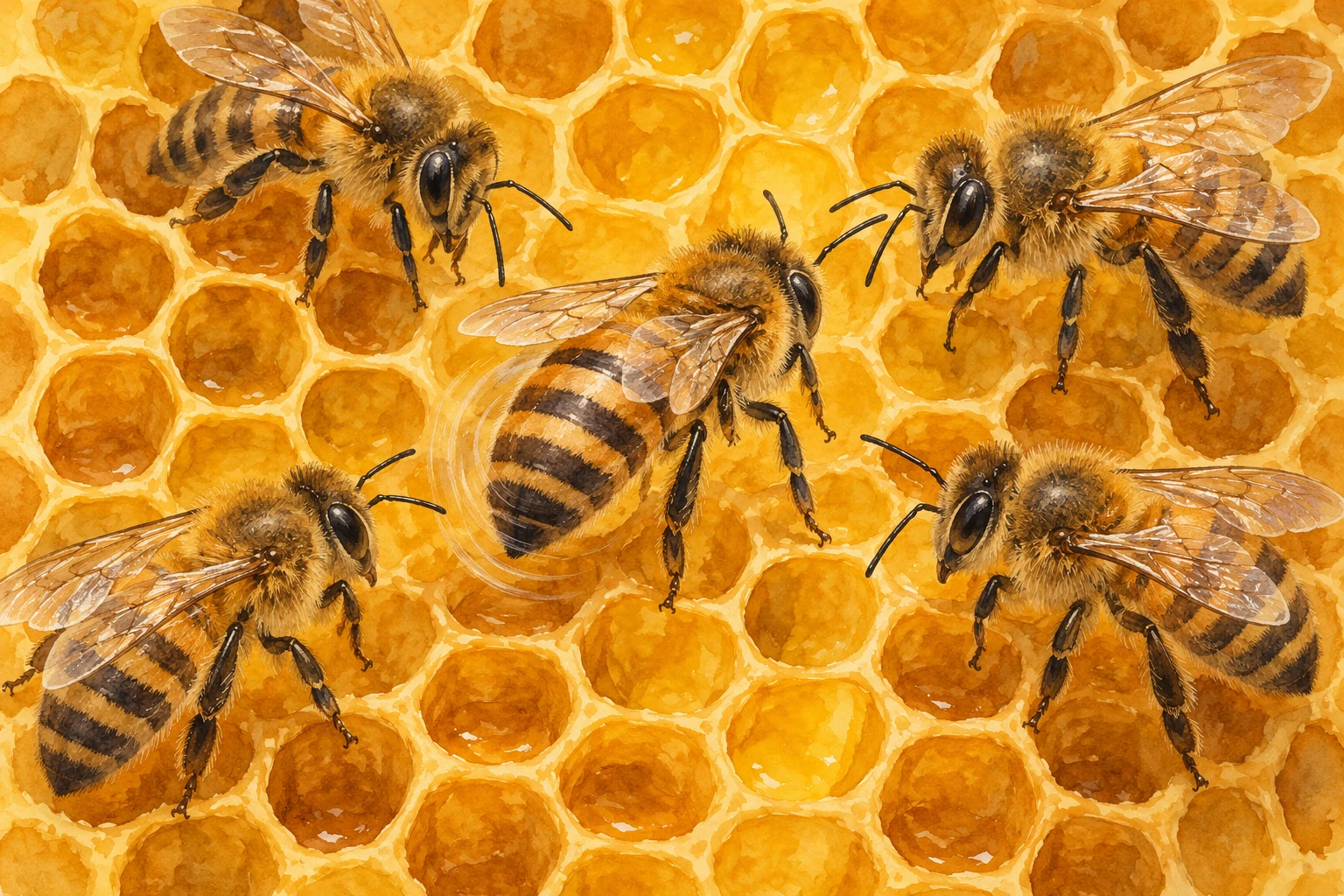
Worker honeybees cluster around a central dancer on golden vertical honeycomb.
Conceptual honeybee scene; motion is suggested artistically and is not a diagram of measured dance trajectories.

A foraging honeybee returns to a dark hive with information about a place the surrounding bees have not visited. She cannot point at a flower across the field. Instead, she moves across the comb in a repeating pattern whose central waggle runs contain information about direction and distance. The hive turns a journey through space into a signal made of motion.

The familiar figure-eight outline is only the beginning. If we watch the looping returns and miss the straight central runs, we miss much of what the signal communicates. And if we imagine a perfectly calibrated message produced without experience, recent research gives us a more interesting picture.

Read the central run, not just the loop

The Sussex guide to dance decoding explains how researchers translate waggle-run orientation and duration into estimates of resource location. On a vertical comb, direction is encoded relative to gravity and relates to the sun's direction outside. Waggle-run duration supplies information used to estimate distance. Repeated runs provide a set of measurements rather than one infallible coordinate.

For a simple directional example, imagine the sun's direction outside as a reference line. A run straight upward represents a direction toward that reference; a run tilted to one side represents a corresponding angle from it. The comb is not a miniature overhead map with north permanently at the top. It is a coordinate translation between an internal vertical surface and the outside world.

The distinction matters because the sun's position changes. A meaningful description must specify the reference system rather than attach a permanent compass direction to one tilt. Likewise, a duration-to-distance conversion is a calibrated biological relationship, not a universal rule that any one-second motion means the same distance for every bee in every circumstance.

The distance message begins with the trip's visual texture

Before a bee communicates distance, it must acquire information about the journey. A ruler on our map and the movement seen by a flying animal are not the same thing. Nearby vegetation can sweep across the eye rapidly, while distant scenery changes more slowly.

A 2000 tunnel experiment tested visual motion against an energy-based explanation of the bee's odometer. Short flights through a narrow, textured tunnel led to dances indicating substantially greater travel than the physical distance alone suggested. Changing the visual arrangement helped identify the information behind the signal.

Honeybee flies low beside richly textured meadow vegetation toward a distant field
A journey offers moving visual information. This landscape is an interpretation, not one of the measured experimental routes.

A 2004 outdoor study compared two 580-meter routes, one entirely over land and one passing over water. Waggle duration changed differently with distance over the two terrains. The authors connected this difference with the scenes' visual properties. The odometer did not behave like a fixed-rate wheel counter independent of its surroundings.

That does not make the dance useless. It makes calibration part of a biological communication system operating in real terrain. A signal can narrow another bee's search while still carrying the conditions under which its information was acquired.

Separate geometric motion from a complete odometer

The calculator below considers a much smaller question. A point feature lies beside a straight path. At the instant of closest passage, angular speed is forward speed divided by perpendicular distance. At 1 meter per second, a feature 1 meter away sweeps at about 57.3 degrees per second; one 10 meters away sweeps at about 5.73. These are geometric examples, not recordings from a bee's eye.

Near and far features move differently

Labeled sliders calculate instantaneous angular motion at closest passage, with explicit geometric assumptions.

Open this activity in its own window.

Double both distances while keeping speed fixed. Both angular speeds halve. Double forward speed instead and both increase. This helps explain why distance traveled and visual motion accumulated need not have one universal relationship. The model deliberately omits contrast, flight height, eye movements and how a nervous system integrates information.

For a more revealing reading of a dance paper, ask two questions in sequence: what was the bee allowed to experience en route, and how was its later signal decoded? The journey and the message are connected experimental stages. Learning to produce an orderly dance is part of the story; measuring the world that dance describes is another.

The signal has an apprenticeship

A 2023 study in Science tested the role of early social experience. Researchers created colonies in which young bees lacked older, experienced dancers to follow before making their own first dances. They compared those bees with others that had the normal opportunity to observe experienced nestmates.

The socially deprived first dancers made less orderly and less accurate signals, including errors in the distance component. Experience later improved aspects of performance, but some differences persisted. The University of California account describes the result as evidence that social learning contributes to this communication system.

This does not mean a young bee starts with no biological predisposition to dance. Nor does it mean an older bee deliberately conducts a lesson. It means that the developmental environment—including the opportunity to follow experienced signals—changes subsequent performance. A behavior can have an evolved foundation and still be refined through learning.

Noise can carry a message without being an exact address

Individual waggle runs vary. A researcher decoding a dance therefore asks how many runs were measured, how their angles were summarized, and which calibration converted duration into distance. The result is better understood as evidence about a likely foraging area than as the equivalent of a consumer navigation pin accurate to a doorway.

The same issue appears whenever an animal communicates about a variable world. Flowers differ in reward, conditions change, and the receiver still has to search. A useful message can narrow a problem without solving every part of it. Precision is not all-or-nothing.

The colony also needs brakes

A dance can recruit other foragers, producing positive feedback around a resource. But useful collective behavior requires ways to limit recruitment too. The Nieh Lab's research overview includes honeybee stop signals that counteract dance-related positive feedback. A colony is not simply a room of advertisers trying to make every discovered patch sound irresistible.

That balance gives the communication system a wider meaning. An individual has partial information. Another bee can use it, check the world, and contribute a further signal. Recruitment and inhibition help turn many local experiences into a changing pattern of collective effort. No bee needs an overview of every field for the colony to distribute foraging activity.

When watching the research video linked in the university account, follow one dancer rather than the crowd. Identify the central run, the returns, and the nearby followers. Then watch a second sequence and notice variation. The real behavior is more useful to see than a perfectly repeated animated figure eight.

The waggle dance is remarkable because it refers to something beyond the immediate hive. Its richness increases when learning, calibration, and noise are included. The returning bee has converted a lived trip into a signal others can use. What looks like a few inches of busy motion contains a relationship between bodies, sunlight, experience, and a landscape outside the comb.

Follow the evidence: Dong and colleagues: social signal learning in honeybees; University of California: learning improves waggle dance; Ratnieks: decoding waggle dances; Nieh Lab: communication, learning and stop signals.

More curious connections, art and independent projects at Incoprea.

Ants and Acacias: The Cost of a Living Defense

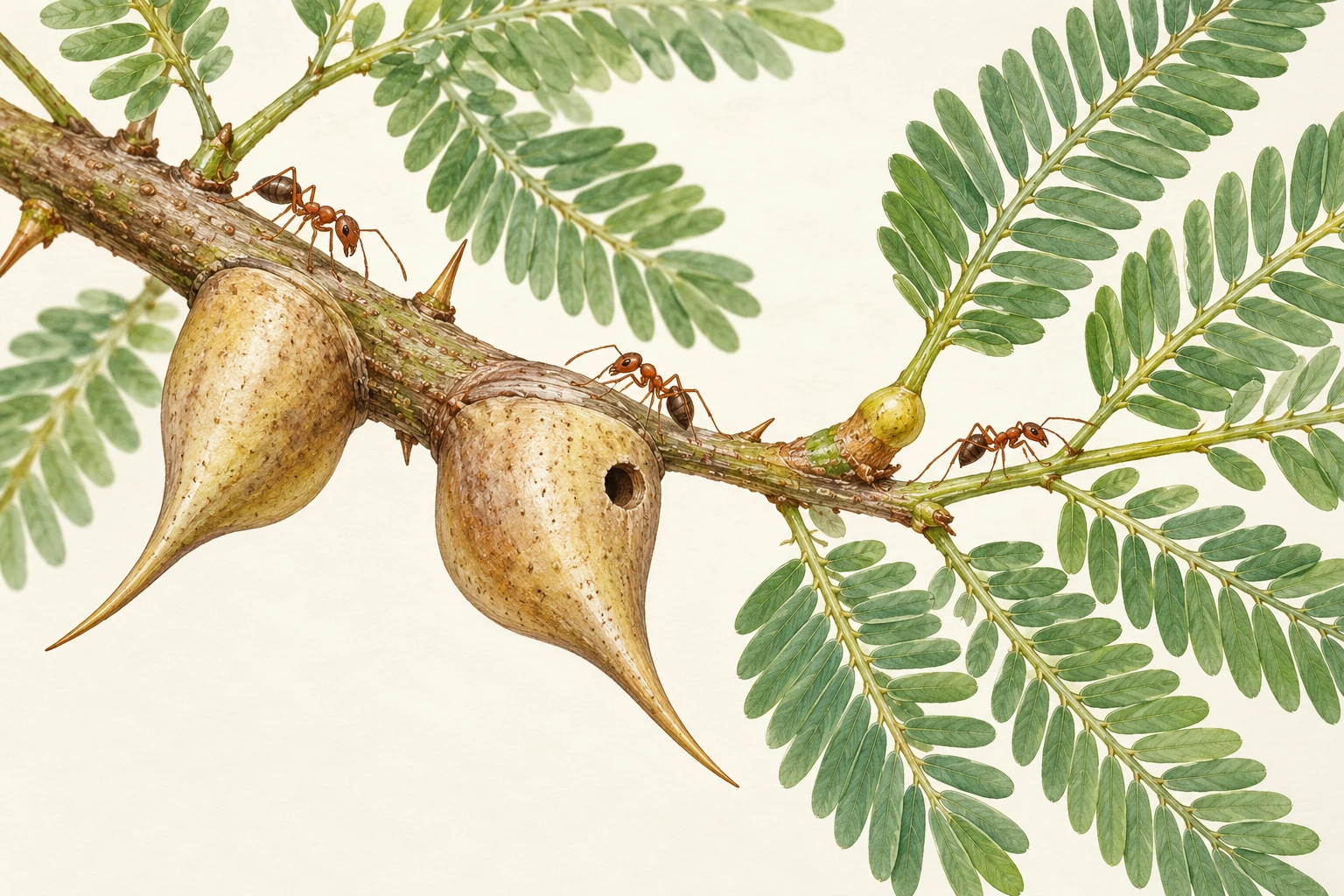
Small reddish ants patrol an acacia branch bearing swollen thorns and finely divided leaves.
Generic acacia–ant illustration; not a named specimen, species diagnosis, or representation of one study site.

A tree can grow its own thorns. It can also provide accommodation for animals that bite. In several acacia–ant partnerships, hollow thorns or other nesting spaces, nectar outside the flowers, and sometimes food bodies help sustain resident ants. The ants patrol the plant and can attack herbivores. The defense moves because the defenders are alive.

It is an elegant exchange, but calling it a perfect partnership would hide the main scientific questions. Food costs the plant resources. Ant species differ in their behavior. Other plants compete with the host, and flowers may need insect visitors that aggressive defenders could disturb. The value of the arrangement depends on circumstances.

Start with the terms of the exchange

The rewards must be distinguished. A nesting cavity is shelter. Extrafloral nectar is food produced outside a flower, so it need not function as a pollination reward. Food bodies are another investment. A study of short-term variation in acacia rewards examined how occupancy and herbivory relate to plant provisioning. The plant's contribution is a measurable biological allocation, not a free surplus with no consequences.

Likewise, an ant on a branch is not automatically a defender. Its behavior toward herbivores, its abundance, and its dependence on the host all matter. A visitor collecting nectar could provide a different service from a resident colony occupying the plant's shelter. Observing the insect is the beginning of the inference, not its end.

Different acacia systems should not be merged. Central American swollen-thorn acacias and East African whistling-thorn trees involve different plants and ant communities. Botanical names have also changed: the East African tree often studied as Acacia drepanolobium is now commonly placed in Vachellia. Following the species name across sources helps keep the evidence attached to the correct partnership.

A grass can change the relationship without attacking either partner

Field experiments in a Kenyan savanna tested a plausible prediction: grasses competing with acacia saplings for resources should make it harder to support Crematogaster mimosae, an aggressive defender that consumes substantial nectar. The lower-cost, less-protective ant Tetraponera penzigi does not consume that nectar and was expected to be less affected. Researchers manipulated grass presence and ant identity, then followed colony survival and sapling growth for 40 weeks.

The surprising result ran against the competition prediction. C. mimosae colonies survived better with grasses present. Grass-shaded soil held more moisture, and those saplings had more active nectaries; reduced water stress appeared to help the tree support its ants. Grass removal did not significantly change T. penzigi colony survival, and grass neighbors had no significant net effect on sapling growth. Neighboring vegetation can therefore facilitate an interaction as well as compete for resources. The observed result, rather than the attractive initial explanation, has to guide the story.

A comparative study of indirect plant resistance also distinguished induced nectar production from more continuous provisioning in obligate ant-associated acacias. Some defenses increase in response to damage; a resident defensive workforce may require ongoing support. Those are different allocation strategies, each with costs and conditions under which it can be useful.

A broken defense can change a lion's hunting ground

The effects of an ant–tree partnership can extend beyond the animals that eat the tree. If protected branches help maintain cover across a landscape, that cover becomes part of the setting in which other animals hunt and escape.

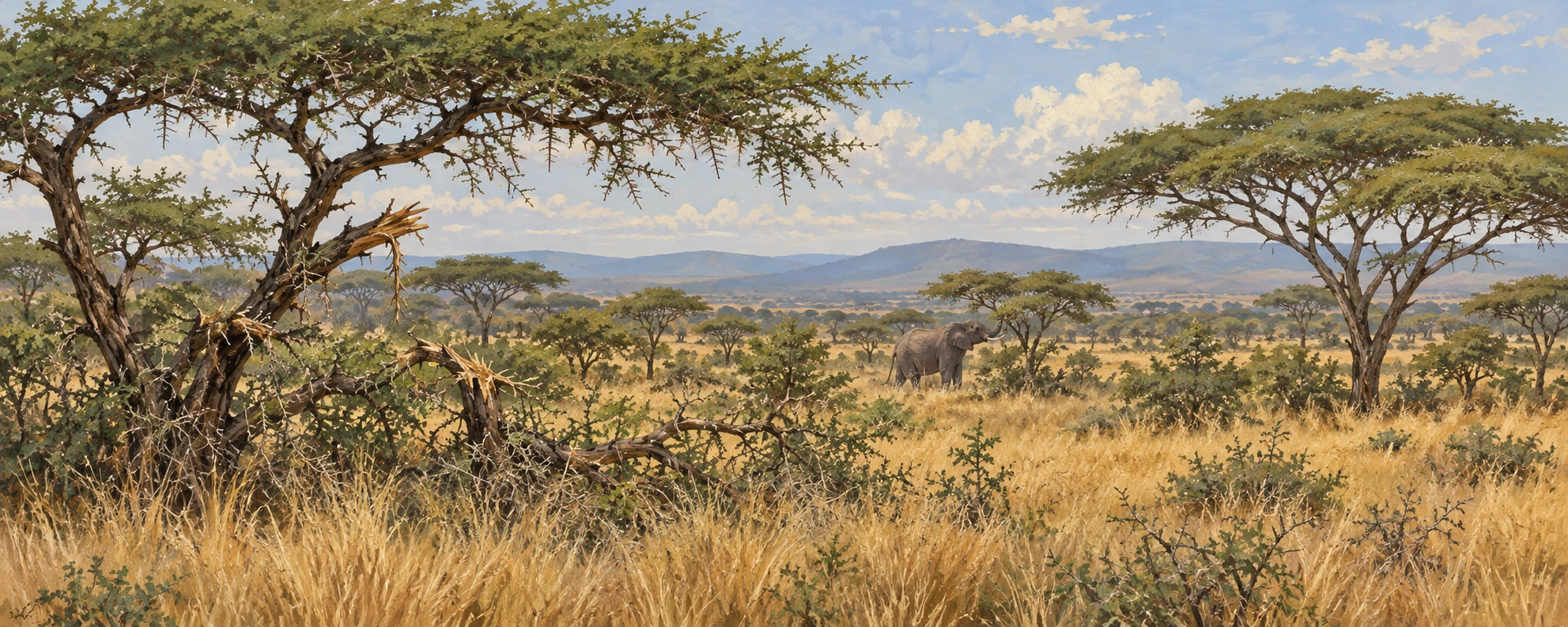
A 2024 study at Kenya's Ol Pejeta Conservancy traced such a chain after invasive big-headed ants, Pheidole megacephala, displaced native defensive ants. Whistling-thorn trees became more vulnerable to elephant browsing. More open vegetation then changed the opportunities available to ambush-hunting lions.

Whistling-thorn savanna with browsed branches and a distant elephant
Tree cover connects the ant defense to a larger landscape. This is an ecological interpretation, not a photograph of the study plots.

The researchers combined experiments, tracking and investigations of kills. Zebra kills were less likely in the more open, invaded areas. Lion numbers had not declined during the study's invasion history, with prey switching toward buffalo offered as a likely reason. This is a local, measured reorganization of interactions, rather than a prediction that invasive ants will remove lions from every savanna.

The University of Wyoming account explains how the team connected ant occupancy, tree damage, landscape visibility and predator behavior. Those links are the substantive discovery. A headline about ants defeating lions would conceal both the elephant's role and the lions' behavioral response.

Build the chain, then ask which arrow was measured

Write five items in a line: ant community, tree defense, browsing damage, cover, zebra hunting. Between each pair, write a verb. “Displaces,” “protects,” “opens” and “conceals” describe different processes. A row of nouns is much easier to mistake for a complete explanation than a row of testable relationships.

Why does stable lion abundance not settle the outcome?

A population count can remain similar while diet, hunting locations or effort change. Stability of one outcome does not establish that every interaction remained stable. The study distinguished reduced zebra predation from the subsequent question of lion population consequences.

Now imagine measuring only ant presence and lion numbers. An unchanged predator count could make the intervening changes disappear from the account. The lesson is to look for behavior and habitat structure as well as abundance.

The tree's living defense helps shape a place, not only the condition of one leaf. A small interaction on a thorn can have consequences that become visible only when the observer steps back far enough to include elephants, cover and a predator choosing its approach.

Benefits do not erase conflict

Research on different investment strategies considered the coexistence of mutualistic and more exploitative ant partners. A host that offers less reward may save resources, but can also alter the ant community it supports. The relationship is not classified adequately by saying “ants present” or “ants absent.” Which ants are present can be central.

There is another potential conflict at flowering. Aggressive guards could interfere with pollinators, yet the plant needs successful pollination as well as protection. A 1997 study examined how ant guarding and seed production interact. The broader lesson is to look for spatial or temporal ways in which a plant can accommodate two kinds of insect activity, rather than assuming all defense should be maximized everywhere.

That is a recurring evolutionary theme: the best amount of a trait is not always the largest amount. More nectar is costly. More aggression can have side effects. A flexible arrangement can be favored when circumstances change. None of those outcomes requires the plant to calculate a budget consciously; differential reproductive success can shape the allocation.

The generated branch illustration makes one part of the arrangement visible: swollen thorns, a possible entry hole, leaves, and patrolling ants. It is a generic conceptual view. A field identification or a claim about the resident species requires the photographs, descriptions, and local evidence in the research.

The compelling feature is not a tree hiring tiny soldiers. It is a defense assembled across species, with its success depending on the resource demands and behavior of both partners. A branch can support shelter, food, danger, and reproduction at once. Understanding how those uses fit together turns a charming mutualism into a much richer piece of ecology.

Follow the evidence: Short-term plasticity in acacia ant rewards; Palmer and colleagues: neighboring grasses alter a protection mutualism; Heil and colleagues: induced and constitutive indirect defenses; Divergent investment strategies and exploiter ants; How ant guards and acacia pollination can coexist.

More curious connections, art and independent projects at Incoprea.

Aphids Can Carry Daughters Already Carrying Daughters

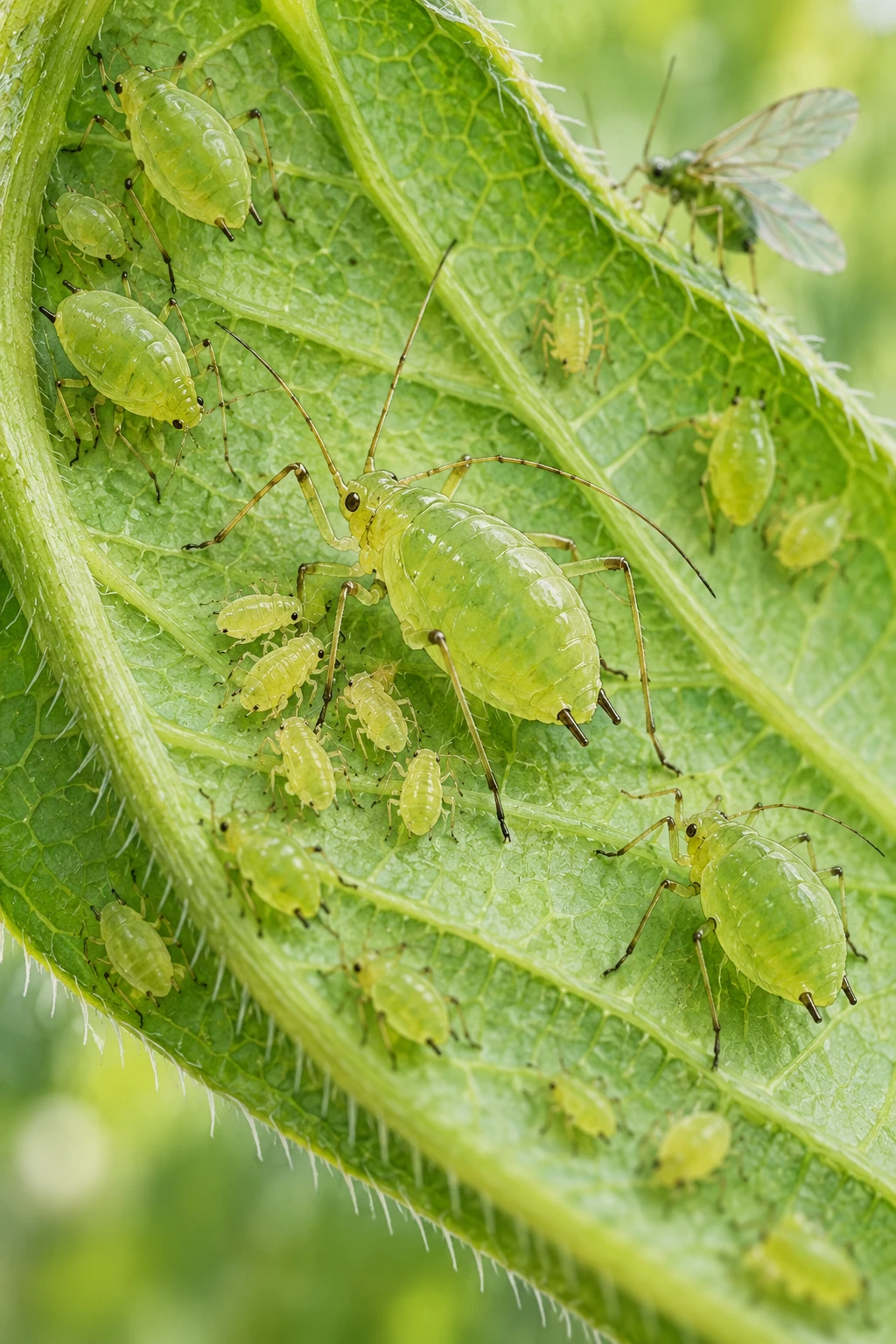
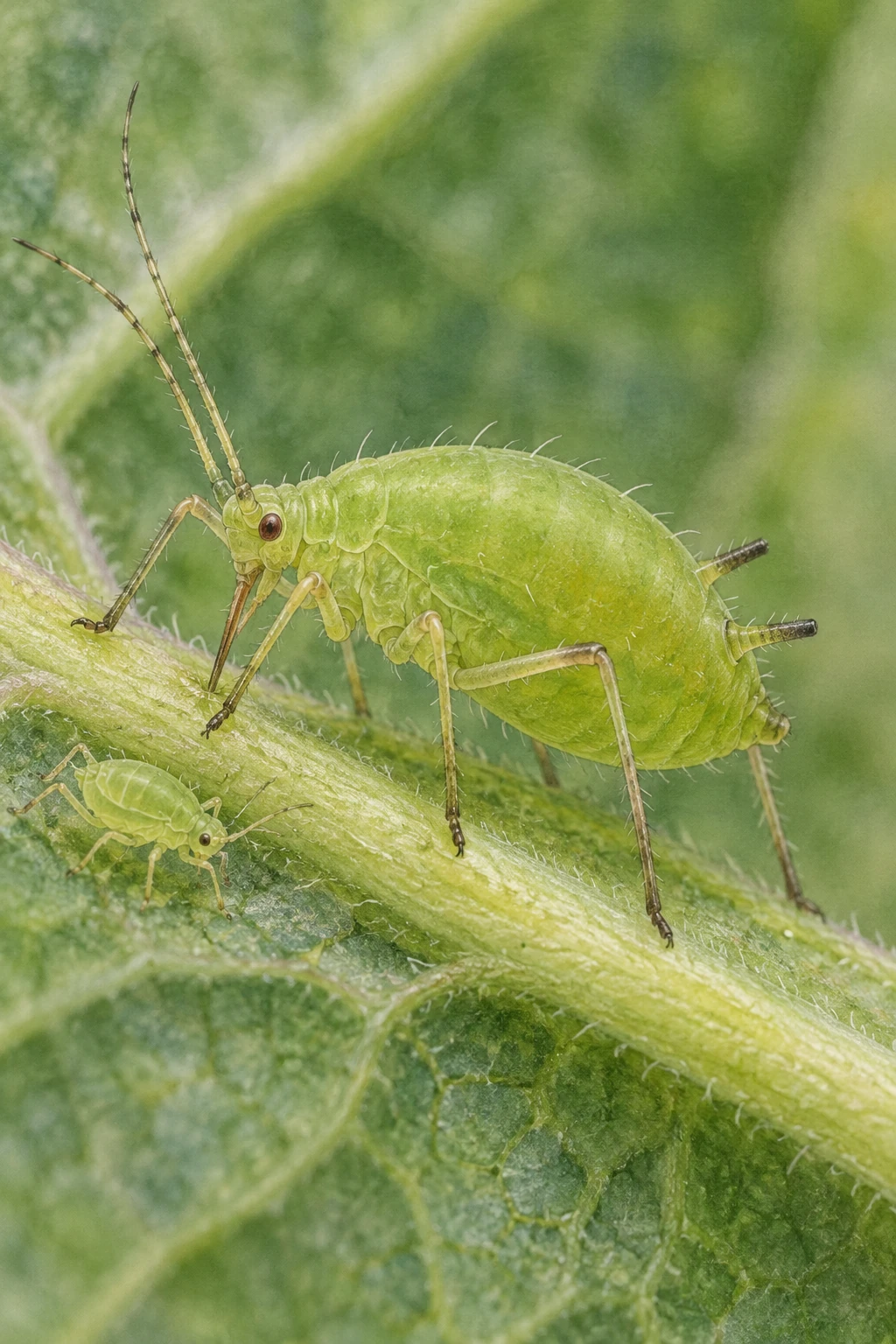
Green aphid adults and smaller nymphs cluster on the underside of a leaf, with one winged form behind them.
Conceptual aphid colony; visible sizes illustrate overlapping ages, not a census or an anatomical view of embryos.

A leaf can hold a family whose generations overlap in a way our ordinary family tree does not show. In the live-bearing, asexual phase of many aphids, daughters develop inside a mother while the beginnings of another generation can already be developing inside those daughters. A grandmother can contain parts of two succeeding generations at once.

The phenomenon is called telescoping generations. It is not an infinite sequence of fully formed insects nested like toys. Developmental stages overlap, and that overlap shortens the delay between one generation and the next. The small crowd under a leaf has a history that began before some of its visible members were born.

Two reproductive features work together

Parthenogenesis means development without fertilization. Viviparity means giving birth to live young. They are different features: an animal can have one without the other. In aphids, their combination during certain life-cycle phases makes telescoping development possible.

The University of Maryland guide explains that aphid reproduction varies with species and season. Females may give birth to live young or produce eggs, and populations can include adults and nymphs of several ages together. A sentence beginning “all aphids always” is therefore likely to need qualification.

Many temperate species alternate a series of asexual generations with a sexual phase that produces overwintering eggs. Other life histories differ. The review of aphid evolutionary and genetic biology places those cycles in a wider context. Telescoping is a specific reproductive arrangement, not a claim that mating has disappeared from the whole group.

The mother is also a developmental environment

A review of embryo nutrition examines how developing aphids receive resources through the maternal system. The ovariole sheath forms a selective interface between maternal fluids and embryo tissues. This is living provisioning, not merely a collection of eggs stored in an empty abdominal space.

That nutritional connection helps explain why maternal conditions can matter. Food quality, physiology, and the timing of development can affect more than one visible generation. The grandmother's body may be the immediate environment in which both a daughter and an early granddaughter stage are developing.

Such direct exposure is important when reading claims about inherited environmental effects. If multiple generations are physically present during an exposure, an effect in a later generation is not automatically evidence of a mysterious memory passed beyond all contact. The reproductive anatomy must be considered before deciding what “transgenerational” means in the experiment.

A daughter also receives a microbial partnership

The developing family includes more than aphid cells. In pea aphids, Acyrthosiphon pisum, the bacterial symbiont Buchnera is transmitted from the mother to her offspring. A lineage's continuity therefore includes an organized passage of microbes into the next developing body.

A 2003 microscopy study used specific labeling to follow Buchnera during transmission to parthenogenetic embryos. It showed bacteria associated with maternal specialized cells and entering developing embryos. The images suggested a possible membranous conduit, an interpretation that later work could test more closely.

Green pea aphid feeds along a leaf vein beside a smaller nymph
The surface view cannot show embryo stages or bacterial transmission. Those routes require developmental and cellular evidence.

A 2012 study of the bacteriocyte–embryo interface used electron microscopy and manipulated symbiont associations to investigate the route. It supported release of bacteria from the maternal cell, a temporary extracellular passage and uptake by the embryo. The resolved membrane structures argued against a continuous conduit at the observed transmission center.

The mechanism also had a selective component. The maternal-cell release step treated Buchnera differently from the facultative symbiont examined in the experiment. “Bacteria enter the embryo” is therefore only the beginning of the question. Which bacteria, through which cellular step, and with what evidence are the useful details.

Follow ancestry and transmission on separate lines

The worksheet puts the aphid family and the microbial route in two rows. The first records the overlapping mother, daughter and early granddaughter stages. The second records how a symbiotic population reaches an embryo. Both involve inheritance, but they should not be confused with the claim that a bacterial cell is part of the aphid's nuclear genome.

Two inheritances through one mother

A two-route reading ledger contrasts aphid ancestry with symbiont transfer and revisits a mechanism across microscopy methods.

Open this activity in its own window.

For a rewarding comparison, read the 2003 interpretation before the 2012 membrane evidence. Notice how a plausible shape at one resolution can invite a mechanism that a later method revises. That is a more precise story than declaring the earlier picture meaningless or treating every old hypothesis as settled fact.

The feeding aphid's external form conceals both kinds of continuity. One developing generation overlaps another, while a microbial partnership is passed across a cellular interface. The future on the leaf is not only a larger number of aphids. It is the repeated construction of living bodies already connected to other lives.

The environment can influence which kind of offspring develops

Ogawa and Miura's 2014 review discusses aphid polyphenisms: different forms produced from similar genetic backgrounds in response to conditions. Depending on the species and context, maternal information can contribute to developmental switches such as winged versus wingless offspring or reproductive mode.

The pathway is not simply a leaf becoming crowded and every insect instantly growing wings. The mother perceives conditions, signals are integrated and transmitted, and developing offspring respond during sensitive stages. Which generation shows the changed form and how long the effect lasts are empirical questions.

This is why researchers often rear aphid lines under stable conditions across generations before testing a cue. A colony's recent history can influence the outcome. Without that preparation, a result attributed to today's treatment might partly reflect conditions experienced by a mother or grandmother.

Rapid population growth still has limits

Overlapping development and reproduction without a search for mates can help a population build quickly when conditions are favorable. But a reproductive capacity is not a forecast of unlimited increase. Predators, parasitoids, weather, plant quality, disease, and movement alter what happens on a real leaf.

A count on one day is therefore only a snapshot. If observing a small colony on a plant you already own, photograph the same leaf without moving insects and note adults, smaller nymphs, winged forms, and empty shed skins separately. Shed skins are evidence of growth, not additional living aphids. Repeated observations can show births, disappearance, and changes in the visible age mix without revealing every cause.

For a garden-management decision, use the local extension guide's identification and plant-condition advice rather than assuming that any aphid presence requires immediate intervention. The life-history story helps explain the speed of change; it does not establish a universal action threshold.

The generated artwork shows adults and nymphs together, not a transparent anatomical cutaway. The remarkable nesting of developmental stages comes from the research, and it occurs inside bodies too small for an ordinary garden glance to resolve.

An aphid colony can look like a sudden arrival. In part, it is a release of development already underway. The next generation did not wait politely for the previous one to finish. The leaf holds a crowded present, and inside some of its inhabitants a portion of the near future is already growing.

Follow the evidence: Ogawa and Miura: aphid polyphenisms and telescoping development; Bermingham and Wilkinson: embryo nutrition in viviparous aphids; University of Maryland Extension: aphid reproduction and observation; Evolutionary and genetic aspects of aphid biology.

More curious connections, art and independent projects at Incoprea.

Famous Last Meals is now in paperback — stories, history and 25 recipes

Famous Last Meals: Stories, History, and Recipes is now available in paperback on Amazon. The illustrated collection brings together 23 his...