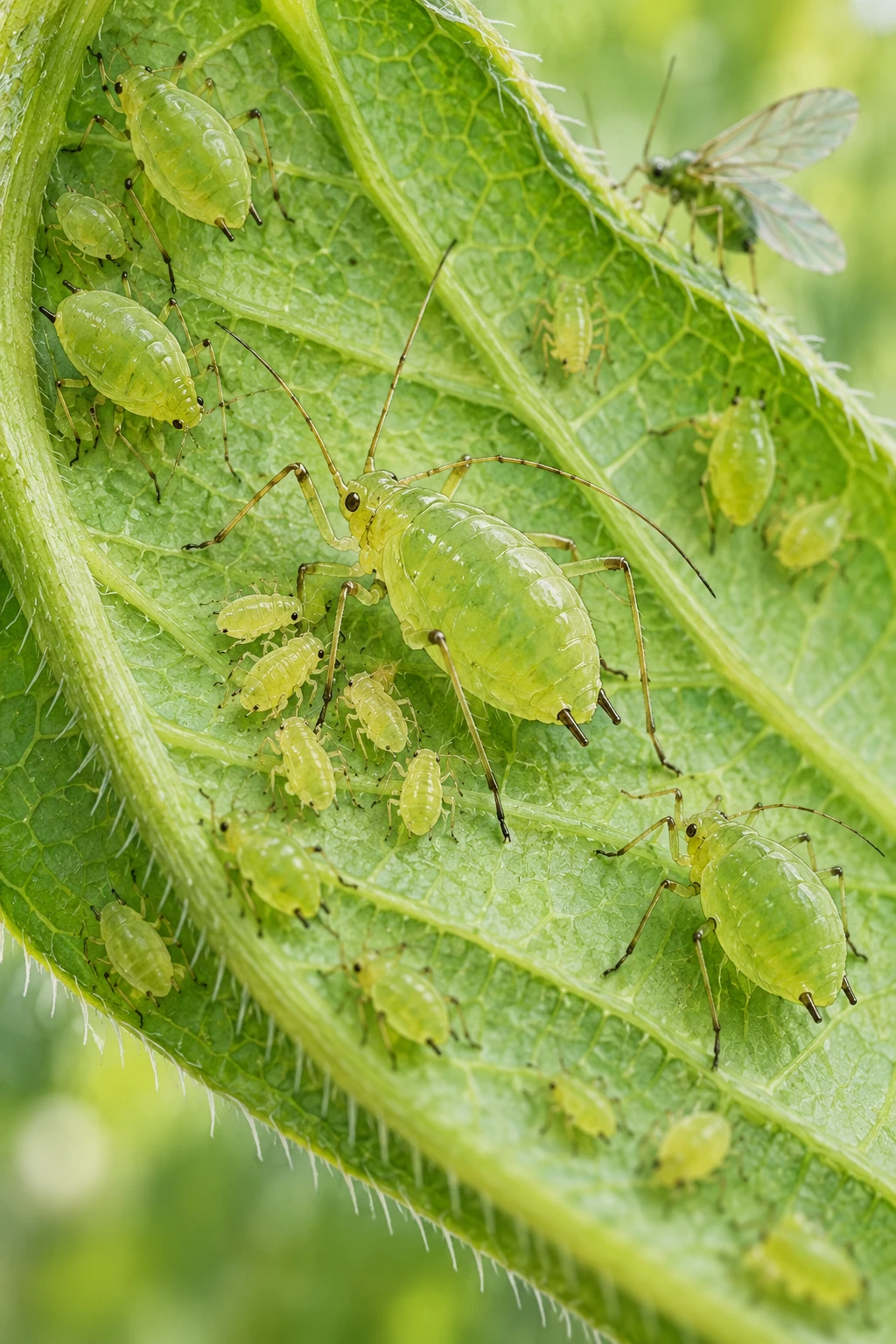
A leaf can hold a family whose generations overlap in a way our ordinary family tree does not show. In the live-bearing, asexual phase of many aphids, daughters develop inside a mother while the beginnings of another generation can already be developing inside those daughters. A grandmother can contain parts of two succeeding generations at once.
The phenomenon is called telescoping generations. It is not an infinite sequence of fully formed insects nested like toys. Developmental stages overlap, and that overlap shortens the delay between one generation and the next. The small crowd under a leaf has a history that began before some of its visible members were born.
Two reproductive features work together
Parthenogenesis means development without fertilization. Viviparity means giving birth to live young. They are different features: an animal can have one without the other. In aphids, their combination during certain life-cycle phases makes telescoping development possible.
The University of Maryland guide explains that aphid reproduction varies with species and season. Females may give birth to live young or produce eggs, and populations can include adults and nymphs of several ages together. A sentence beginning “all aphids always” is therefore likely to need qualification.
Many temperate species alternate a series of asexual generations with a sexual phase that produces overwintering eggs. Other life histories differ. The review of aphid evolutionary and genetic biology places those cycles in a wider context. Telescoping is a specific reproductive arrangement, not a claim that mating has disappeared from the whole group.
The mother is also a developmental environment
A review of embryo nutrition examines how developing aphids receive resources through the maternal system. The ovariole sheath forms a selective interface between maternal fluids and embryo tissues. This is living provisioning, not merely a collection of eggs stored in an empty abdominal space.
That nutritional connection helps explain why maternal conditions can matter. Food quality, physiology, and the timing of development can affect more than one visible generation. The grandmother's body may be the immediate environment in which both a daughter and an early granddaughter stage are developing.
Such direct exposure is important when reading claims about inherited environmental effects. If multiple generations are physically present during an exposure, an effect in a later generation is not automatically evidence of a mysterious memory passed beyond all contact. The reproductive anatomy must be considered before deciding what “transgenerational” means in the experiment.
The environment can influence which kind of offspring develops
Ogawa and Miura's 2014 review discusses aphid polyphenisms: different forms produced from similar genetic backgrounds in response to conditions. Depending on the species and context, maternal information can contribute to developmental switches such as winged versus wingless offspring or reproductive mode.
The pathway is not simply a leaf becoming crowded and every insect instantly growing wings. The mother perceives conditions, signals are integrated and transmitted, and developing offspring respond during sensitive stages. Which generation shows the changed form and how long the effect lasts are empirical questions.
This is why researchers often rear aphid lines under stable conditions across generations before testing a cue. A colony's recent history can influence the outcome. Without that preparation, a result attributed to today's treatment might partly reflect conditions experienced by a mother or grandmother.
Rapid population growth still has limits
Overlapping development and reproduction without a search for mates can help a population build quickly when conditions are favorable. But a reproductive capacity is not a forecast of unlimited increase. Predators, parasitoids, weather, plant quality, disease, and movement alter what happens on a real leaf.
A count on one day is therefore only a snapshot. If observing a small colony on a plant you already own, photograph the same leaf without moving insects and note adults, smaller nymphs, winged forms, and empty shed skins separately. Shed skins are evidence of growth, not additional living aphids. Repeated observations can show births, disappearance, and changes in the visible age mix without revealing every cause.
For a garden-management decision, use the local extension guide's identification and plant-condition advice rather than assuming that any aphid presence requires immediate intervention. The life-history story helps explain the speed of change; it does not establish a universal action threshold.
The generated artwork shows adults and nymphs together, not a transparent anatomical cutaway. The remarkable nesting of developmental stages comes from the research, and it occurs inside bodies too small for an ordinary garden glance to resolve.
An aphid colony can look like a sudden arrival. In part, it is a release of development already underway. The next generation did not wait politely for the previous one to finish. The leaf holds a crowded present, and inside some of its inhabitants a portion of the near future is already growing.
Follow the evidence: Ogawa and Miura: aphid polyphenisms and telescoping development; Bermingham and Wilkinson: embryo nutrition in viviparous aphids; University of Maryland Extension: aphid reproduction and observation; Evolutionary and genetic aspects of aphid biology.
More curious connections, art and independent projects at Incoprea.