LIGO listens for tiny changes in the relative lengths of long interferometer arms. Its laser light is part of the ruler. But quantum fluctuations in that light also contribute noise, limiting how clearly the instrument can measure passing gravitational waves.
One response is to prepare the light in a squeezed quantum state. The phrase sounds like a beam being physically narrowed. What is rearranged is the uncertainty associated with properties of the optical field.
A ruler made of interference
Light traveling through the detector’s arms recombines, and changes in the relative optical paths alter the interference signal. LIGO’s sensitivity requires extraordinary control of seismic motion, thermal noise, optical losses, alignment, and many other effects.
MIT’s LIGO instrumentation overview places quantum optics within that wider engineering effort. Squeezing is one improvement in a system whose noise sources vary with frequency. Reducing one contribution does not automatically remove the others.
This frequency dependence matters because a detector does not have one universal noise number. Its sensitivity curve describes how well it measures different gravitational-wave frequencies, and different astronomical signals occupy that curve differently.
The uncertainty trade
Two field quadratures can be pictured as components analogous to amplitude and phase. Their uncertainties obey a quantum constraint. A squeezed state reduces fluctuations in one chosen combination while increasing them in another, rather than making every property simultaneously exact.
LIGO’s explainer by Lee McCuller introduces this trade through a balloon analogy. The useful part is redistribution. The analogy should not be read as a literal pressure applied to photons or a classical object hiding inside the light beam.
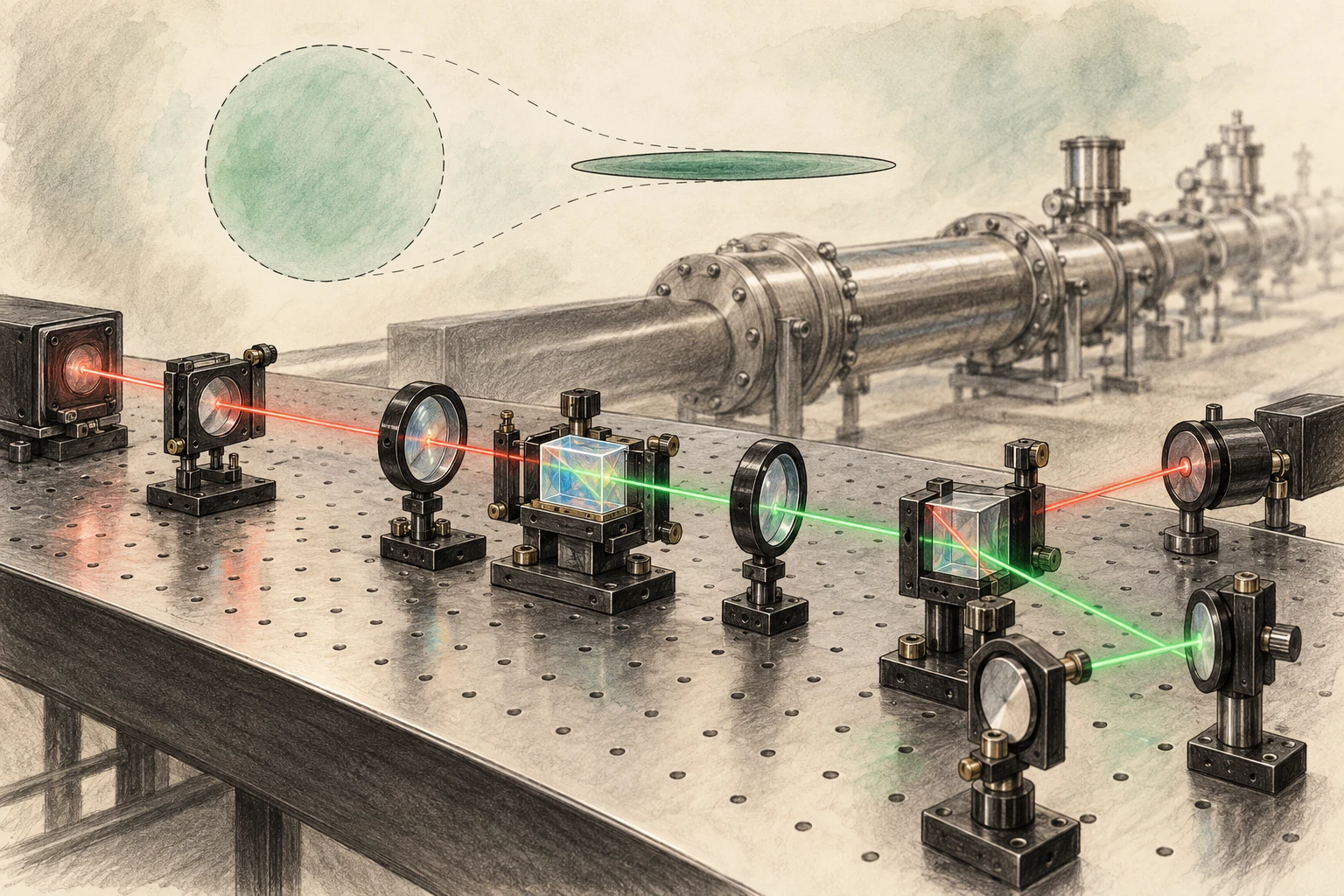
Draw a circle, then an ellipse with the same area. The ellipse is narrower along one direction and wider along the other. This is a conceptual picture of changed uncertainties, not a photograph of a quantum state or a complete statement of every experimental noise source.
Why squeezing one way is insufficient
At higher frequencies, photon-counting fluctuations contribute shot noise. At lower frequencies, fluctuations in radiation pressure can move the mirrors and create measurement back action. A squeezing choice that improves one part of the spectrum can worsen another.
McCuller and colleagues’ 2020 frequency-dependent-squeezing paper explains the need to rotate the squeezed quadrature with frequency. The goal is to match the uncertainty reduction to the part of the measurement that matters at each frequency.
Increasing laser power is not a universal alternative, because power affects shot noise and radiation-pressure effects differently and introduces practical thermal and optical challenges. Detector improvement is a balance of coupled limits.
A filter cavity changes the orientation
A carefully controlled optical cavity can rotate the squeezing angle in a frequency-dependent way. That lets the detector benefit across a broader band. The word “filter” refers to its optical action on the field, not a software operation that removes unwanted wiggles after a gravitational-wave event has been recorded.
MIT’s precision-measurement page describes the 300-meter filter cavities installed at the LIGO sites in 2023. The infrastructure is substantial because tiny optical losses, alignment errors, and phase noise can degrade the prepared quantum state’s benefit.
Loss is especially instructive: it mixes in ordinary vacuum fluctuations and reduces the observable squeezing. A remarkable state prepared at one point must survive the entire relevant optical path to improve the actual detector output.
The full detector is the test
The collaboration’s broadband-enhancement paper reports the realization of frequency-dependent squeezing in full-scale detectors, reducing both shot-noise and radiation-pressure contributions over the relevant band. That is a stronger result than demonstrating a narrow optical effect on a separate bench.
MIT’s 2023 account explains the instrument advance and its expected astronomical value. The projection concerns improved reach under stated conditions, not a promise that every observing period must detect a fixed number of mergers.
Actual detection counts depend on observing time, duty cycle, data quality, source populations, and chance. A sensitivity improvement creates the possibility of seeing more; the universe supplies the events.
A small reach change can mean a larger search volume
In an idealized nearby, uniform Euclidean population, increasing detection distance by 10 percent increases the enclosed volume by 1.1 cubed, or about 33 percent. That is an original geometric example, not LIGO’s measured gain from a particular upgrade.
The example explains why modest range improvements matter. Real astrophysical reach depends on source masses, orientation, waveform, detector network, cosmology at larger distances, and analysis thresholds. The simple cube is an intuition, not a replacement for an instrument’s published sensitivity calculation.
It also clarifies the difference between distance and event-rate language. A statement that a detector can survey a larger volume should not be rewritten as the same percentage increase in distance.
The detector comparison also needs a consistent operating state. A curve recorded on a quiet day at one laser power cannot be attributed entirely to squeezing if the reference came from different conditions. Controlled comparisons and a noise model help separate the quantum improvement from other changes. This is a general experimental lesson made unusually demanding by LIGO: the desired effect can be real while the size assigned to it is wrong unless the comparison isolates the relevant variable.
Read a noise curve as a budget
- Check the horizontal frequency axis and the vertical strain-noise units.
- Identify whether the curve shows amplitude or power, because improvements scale differently.
- Compare squeezed and unsqueezed operation over the whole band.
- Look for the classical-noise floor that limits the visible gain.
- Read whether the result is measured, modeled, or a design target.
Then revisit the circle-and-ellipse sketch. Rotate the ellipse on the page and imagine a different orientation being appropriate at different frequencies. The drawing cannot reproduce the detector’s quantum correlations, but it makes the purpose of frequency dependence easier to hold in mind.
LIGO’s squeezed light does not abolish uncertainty. It uses a deeper understanding of uncertainty to build a better ruler, turning quantum physics from a source of noise into part of the measurement strategy.
Sources and a next step
- MIT Kavli: LIGO instrumentation and quantum optics
- Caltech/MIT/LIGO: quantum squeezing explainer
- McCuller et al.2020: frequency-dependent squeezing
- MIT LIGO Lab: precision measurements and filter cavities
- Ganapathy et al.: broadband detector enhancement
- MIT News 2023: squeezing in LIGO
Continue exploring art, ideas, and unexpected connections at Incoprea.