Follow a wall at Great Zimbabwe and it can seem to move through the landscape. Granite courses curve rather than meeting at the sharp corners a visitor might expect. The surface is impressive from far away, but close looking reveals another achievement: separate blocks fitted into a controlled, continuous form without mortar.
Then step back further. These walls belonged to a city with households, earthen buildings, crafts, food production and exchange. The stone is the most conspicuous survivor. Understanding the place means restoring the relationships around it, rather than allowing the monument to stand for the whole society.
Start with three areas, not one famous view
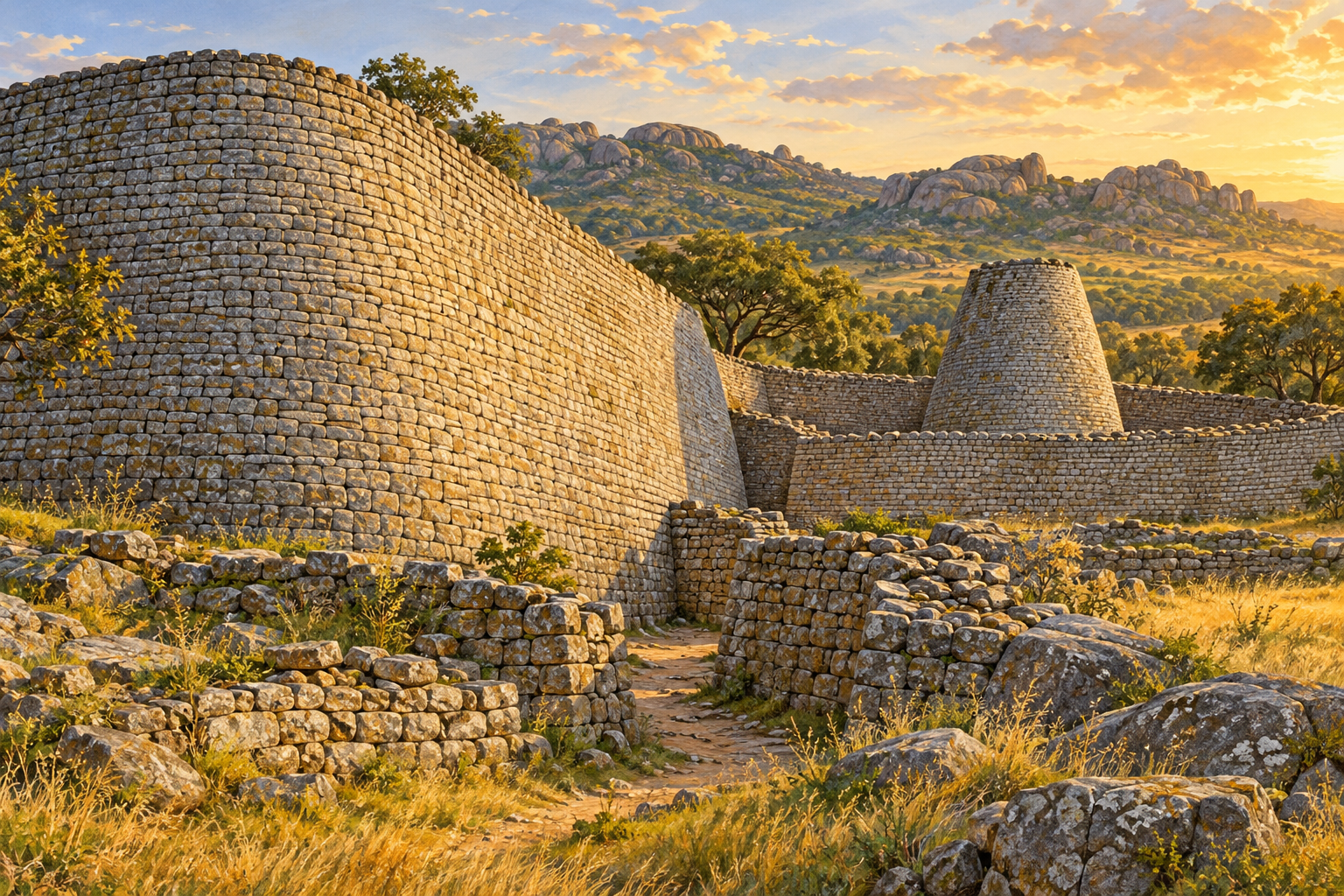
The Hill Complex, Great Enclosure and Valley Enclosures form three principal areas. Archaeologist Tawanda Mukwende's 2025 account describes Great Zimbabwe as the capital of a state influential across the Zimbabwean plateau. Its occupation and development extended over centuries.
The layout includes dhaka, or earthen, structures as well as stone walls. This difference matters for the mental image we build. Durable masonry dominates photographs, while less durable buildings require closer archaeological attention. The occupied city contained more than the forms most easily seen today.
The site also belongs to a broader regional tradition of stone-walled settlements. Its scale is exceptional, but its architecture does not appear from nowhere. Comparing it with that wider landscape helps situate local skill, political relationships and changes over time.
How granite becomes a flowing wall
The surrounding hills supplied granite that could split into slabs and be worked into portable blocks. Builders laid the stones without mortar, developing closely fitted courses and walls that taper inward. Material properties and construction choices worked together.
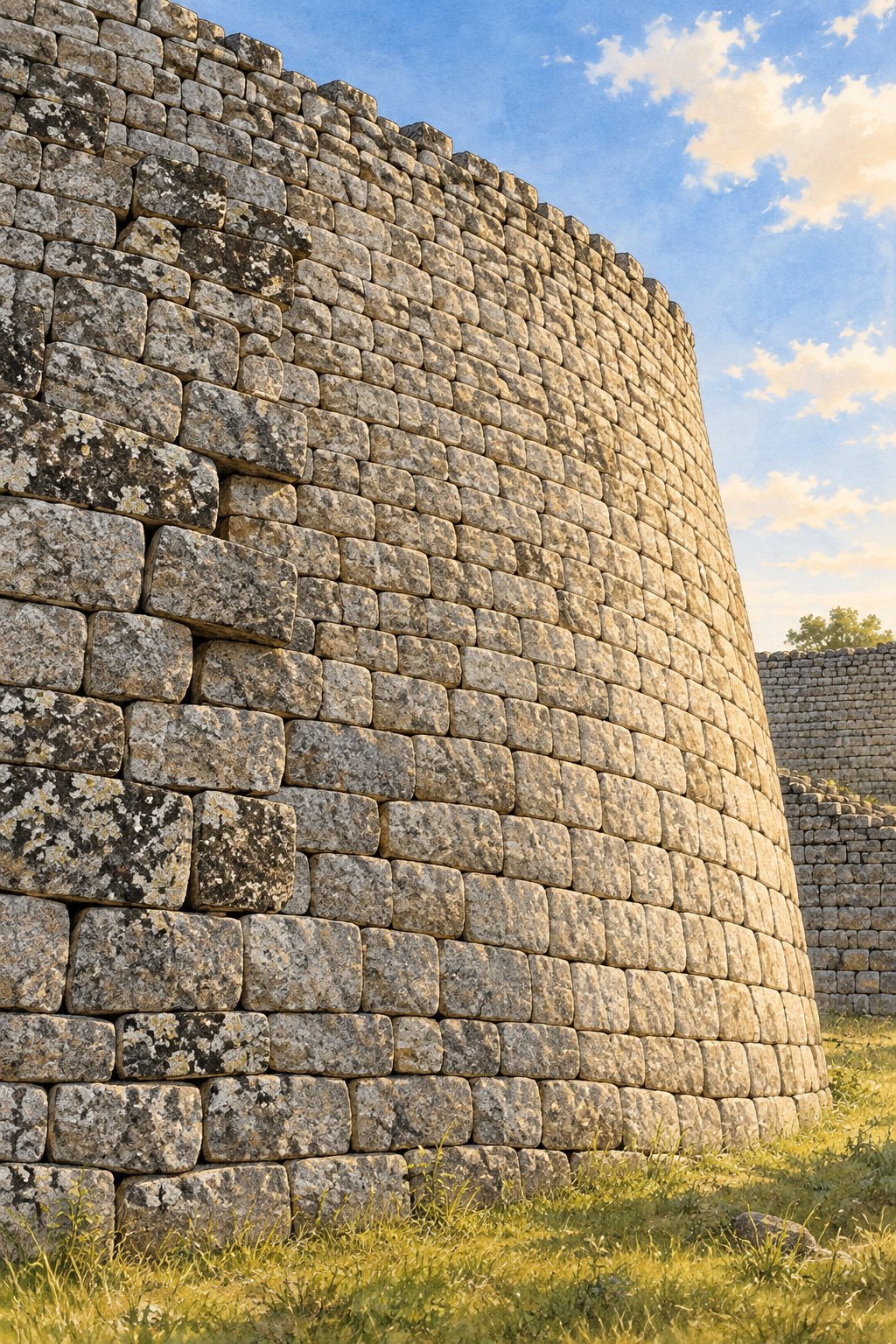
The illustration isolates fitting and wall profile as ideas; it is not a measured construction drawing. Use site photographs to follow an actual course. Notice how a line of blocks continues through a curve, and how the pattern changes around an opening or the end of a wall.
There are several scales of precision here. One block has to sit well with its neighbours. A course has to continue. The overall surface has to follow the intended form. Calling the wall a heap of stones misses the relationships that make it architecture.
Different masonry styles also belong to a developing history. The Met's architectural account describes refinement from rougher fits to more regular and closely joined surfaces. A city expanded over generations should not be imagined as the work of one anonymous building event.
The work that sustained the monument
Mukwende's account includes animal husbandry, crop cultivation, weaving, metalworking and exchange. Great Zimbabwe's links with Indian Ocean networks are reflected in imported materials and objects. These connections belong to the city's economy rather than replacing its local history.
A monumental wall requires labour and resources, but that labour also needs food, tools and organisation. Looking for the workshops and households around the enclosure changes the questions. How did craft activities relate to residence? How did goods move? What relationships connected the centre with surrounding settlements?
A traded object can illuminate those networks without identifying a city's builders as foreign. Material can travel while construction remains grounded in local knowledge. The same distinction applies at many connected places: exchange is evidence of relationships, not the disappearance of local agency.
A false origin story should not organise the visit
European claims that the architecture must have been built by outsiders reflected colonial prejudice. Archaeological investigation established its African origins and its relationship to the ancestors of Shona communities. That is a foundation for study, not an unresolved puzzle needing an exotic answer.
The more productive questions concern the city's changing organisation, religious meaning, craft, food and regional connections. Mukwende also brings local Shona concepts into interpretation. Knowledge associated with the place can deepen the analysis of material remains rather than appearing only as an afterword to it.
The carved soapstone birds provide one example of continuing significance. Their ancient meanings are debated, while their modern role as national symbols is clear. A work can have a documented present life without every aspect of its earlier meaning being settled.
A visual visit in three scales
Open the 2025 Met essay and UNESCO's site photographs. Begin with a plan or broad view and locate one of the main areas. Next examine a wall at human scale. Finish with a close view of its courses.
- City scale: What lies between the principal stone structures?
- Building scale: How do walls enclose, separate or guide movement?
- Block scale: How do fitting, course and curvature work together?
Now add something that a photograph does not easily preserve: an earthen building, a craft activity or an agricultural connection supported by the source. Keep it distinct from what is visible. The exercise helps reconstruct a fuller place without turning imagination into evidence.
If comparing the Met's older architectural essay with Mukwende's recent account, notice changes of emphasis as well as facts. The questions researchers ask shape what a reader learns to see. An account of masonry can be sound while still leaving much of urban life outside its frame.
A living heritage needs continuing care
UNESCO's conservation account identifies issues including vegetation, moisture, visitor pressure and inappropriate earlier interventions. It also calls attention to practices and associations that continue to give the place meaning. Conservation has to consider both fabric and living relationships.
The city becomes more impressive when all of those layers stay visible. Locally worked granite, carefully composed walls, earthen structures, workshops and long-distance connections belonged to the same world. The curve of the Great Enclosure can begin the visit. It should lead us towards the people and activities that made the city possible.