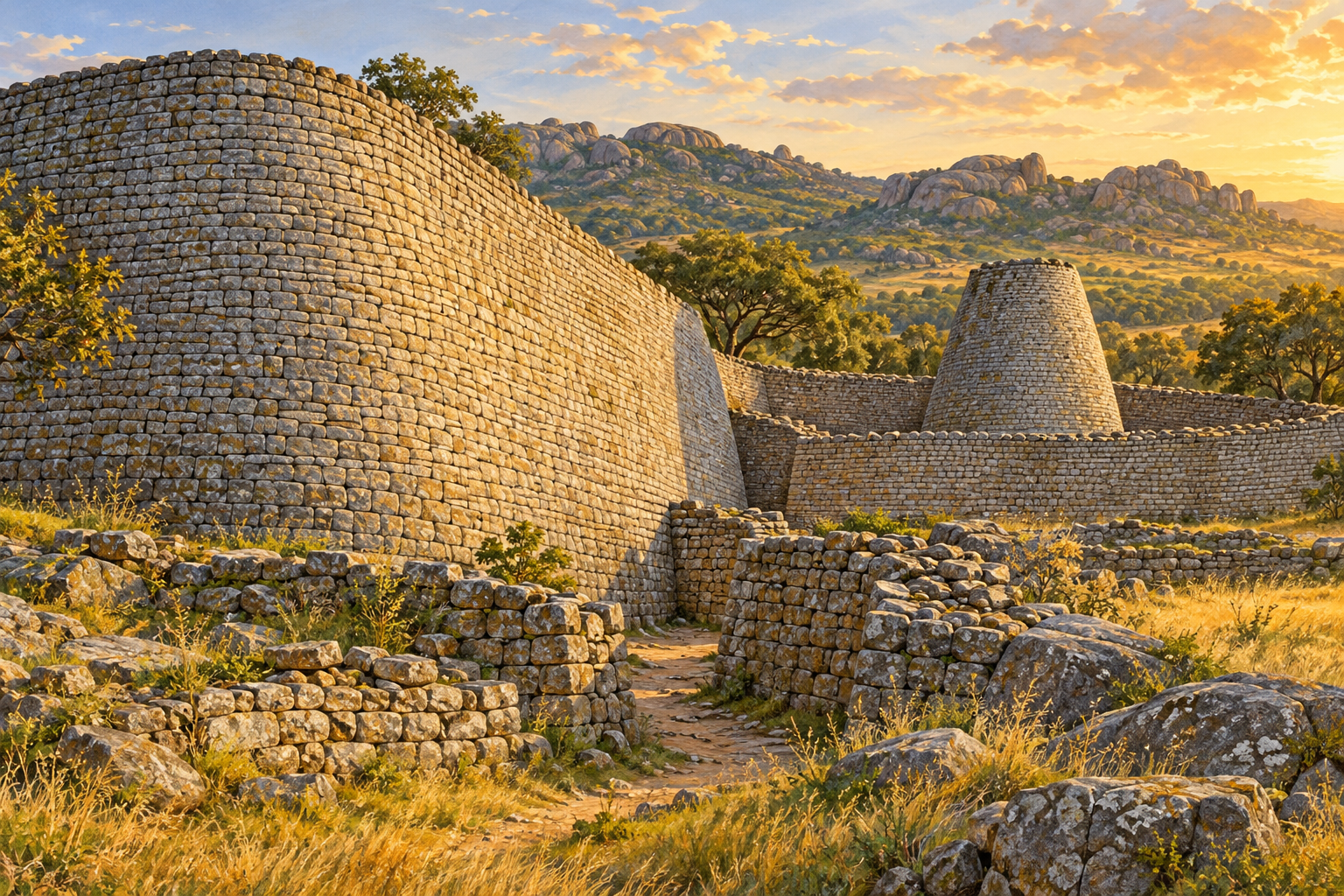
The walls of Great Zimbabwe do not need sharp corners to make an impression. They curve through the landscape in long courses of carefully fitted granite. Their scale is striking, but their craft is just as interesting: blocks laid without mortar, an architectural tradition shaped by local material and local knowledge.
A city, not just a surviving wall
Great Zimbabwe was a major African settlement and the capital of a state that influenced much of the Zimbabwean plateau. Its development began in the medieval period, with economic prominence especially between the twelfth and fifteenth centuries.
The best-known surviving areas include the Hill Complex, Great Enclosure and Valley Enclosures. The large stone walls were part of a built environment that also contained earthen structures. Surviving stone can therefore give an incomplete impression of what the occupied city looked like.
Granite from surrounding hills supplied an important resource. It could split into slabs and be worked into manageable blocks. Later masonry demonstrates especially close, level courses and flowing forms. The walls' broad bases and tapering profiles also contribute to their stability.
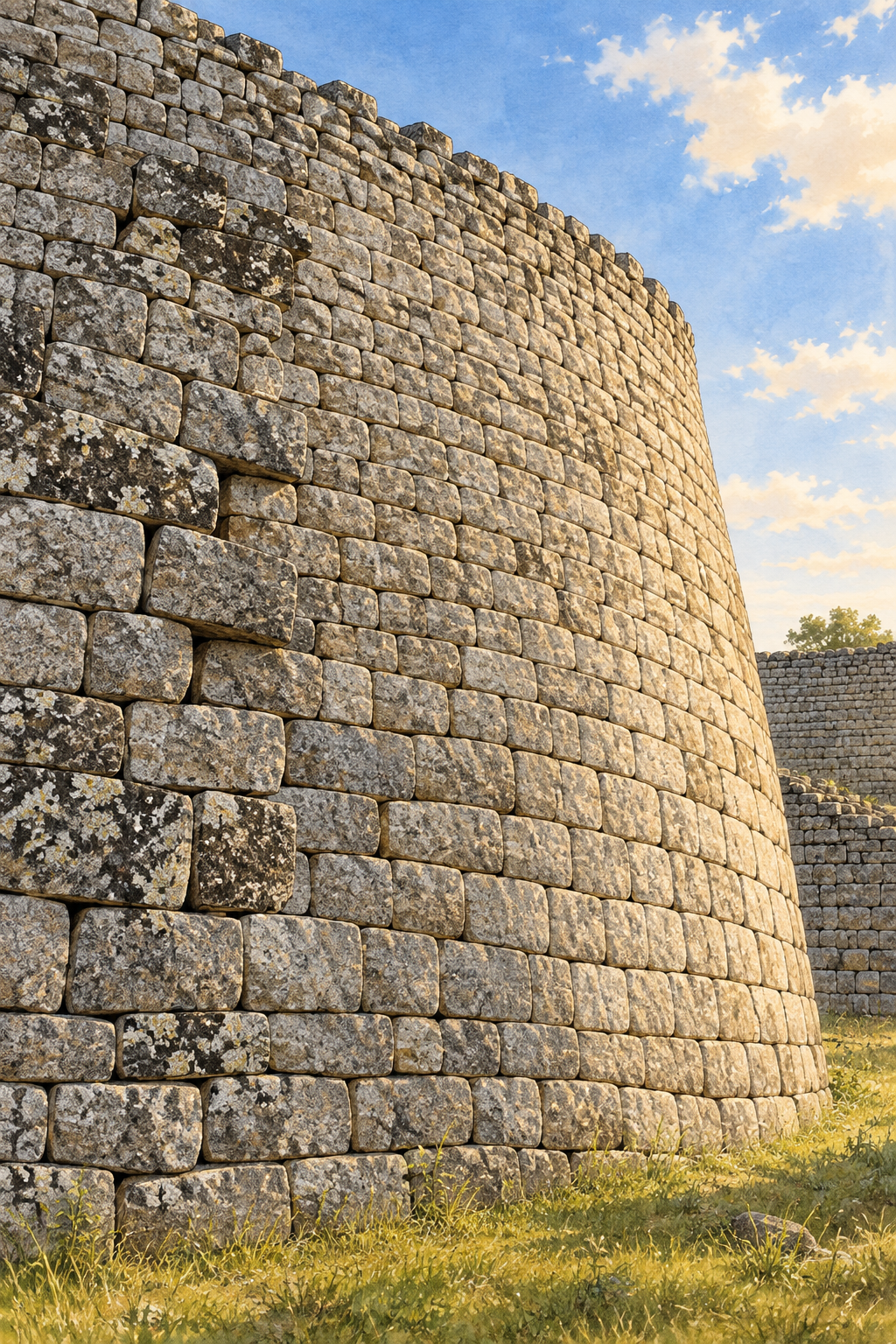
Architecture connected to an economy
The city was sustained by more than impressive building. Archaeological evidence points to cultivation, livestock, weaving, metalworking and exchange. Imported glass beads and ceramics show connections extending toward Indian Ocean trade.
Those connections are part of the city's achievement, not a reason to assign its construction to outsiders. Earlier European claims of a foreign origin reflected prejudice, and archaeological investigation established its local African history. The builders belonged to the ancestors of Shona communities.
The carved soapstone birds associated with the site add an artistic dimension. Their exact meanings remain debated, though they have been interpreted in relation to authority and religious significance. Their modern role as national symbols gives the ancient work a continuing public life.
The questions worth asking now
Knowing who built a place does not mean that all questions about it have been answered. Researchers continue to investigate daily life, craft production, food systems and the surrounding settlements that supported the city.
A 2025 account by Tawanda Mukwende, a scholar at Great Zimbabwe University, emphasizes both material evidence and the importance of local Shona concepts in interpretation. A city's history is not adequately understood by measuring its walls alone.
The architecture offers a particularly useful lesson in what survives. Durable stone captures our attention, while the earthen buildings, wooden tools and ordinary activities may require different kinds of reconstruction. The monumental part and the everyday part belonged to the same society.
Great Zimbabwe is not an unexplained object waiting for an exotic origin story. It is a locally built city whose history becomes richer as investigators ask more precise questions. Look closely at the fitted blocks and then imagine the workshops, households and networks around them. The walls are a beginning, not the whole place.
Sources and further reading: Tawanda Mukwende's 2025 account; The Met: architectural tradition and historical interpretation; UNESCO World Heritage description.
Explore more art and cultural history at Incoprea.