Showing posts with label Biochemistry. Show all posts

Wednesday, October 14, 2026

Gympie-Gympie: Plant Defense at the Molecular Scale

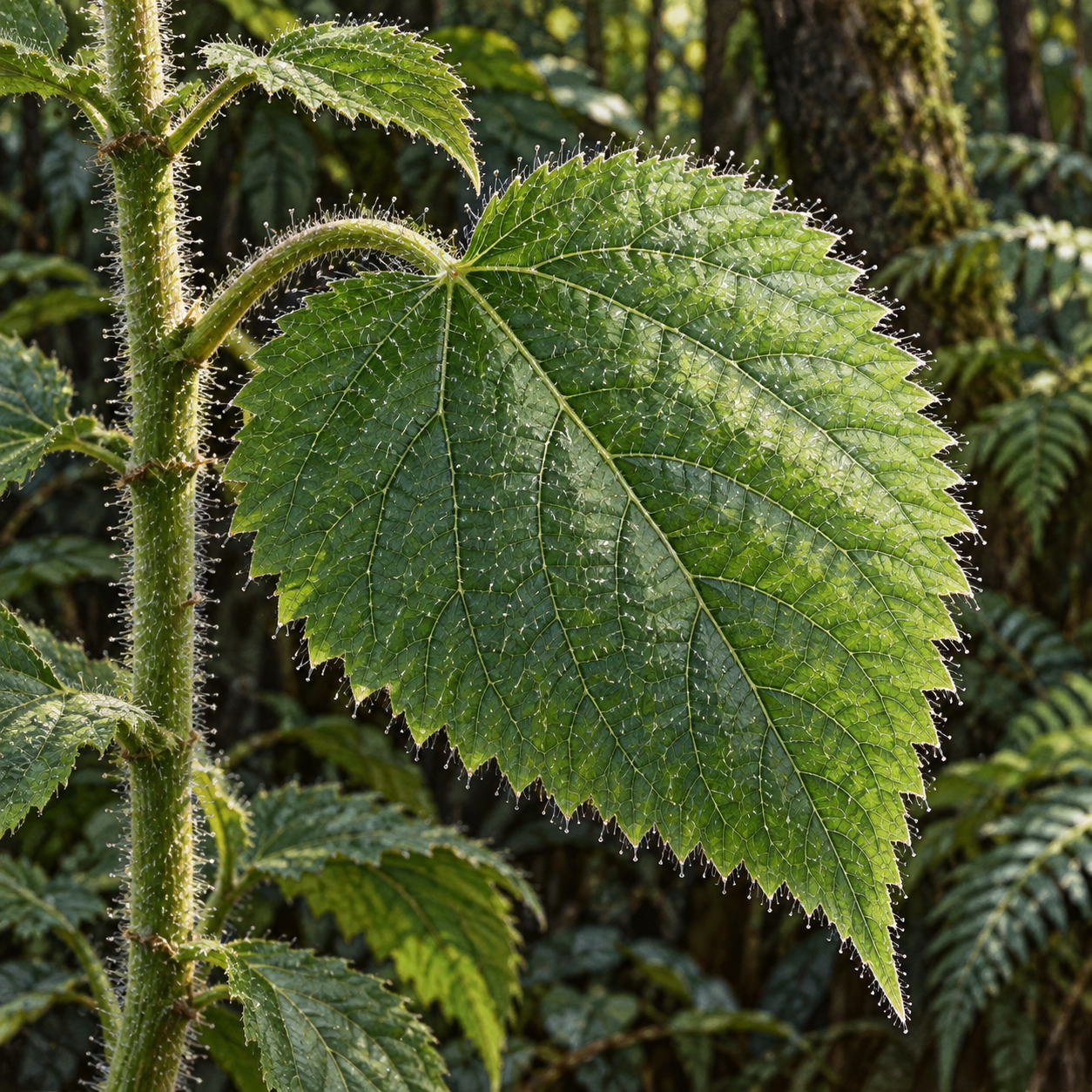
Illustration of a broad toothed stinging-tree leaf covered in fine hairs.
The leaf and its hairs are an artistic botanical view, not an identification guide or a microscopic measurement.

A broad, heart-shaped leaf can look soft because its surface is covered in fine hairs. In gympie-gympie, that impression is misleading. The hairs are part of a delivery system capable of causing intense and persistent pain. The interesting explanation begins when we separate the structure that delivers the sting from the molecules that act afterwards.

Dendrocnide moroides belongs to Australia’s stinging trees in the nettle family. It should be observed without touching. Its biology can be explored through photographs, research figures, and molecular evidence; a personal encounter with the sting adds nothing necessary to understanding it.

A leaf, a delivery structure, and a payload

The hairs are called trichomes. In these plants, they can introduce toxin-containing material when contact breaks the delicate tip. A microscope view therefore answers a structural question: how can a leaf surface deliver something beneath an animal’s skin?

It does not by itself answer the chemical question. A needle can explain entry while leaving the effect of its contents unexplained. Earlier investigations of familiar small molecules did not adequately account for the characteristic severity and persistence associated with these stinging trees. That gap encouraged a search for additional active components.

The common name can also conceal differences between species. Research on this toxin family includes both D. moroides and the giant stinging tree, D. excelsa. A finding obtained with a molecule from one species should keep that identity when used to explain the wider family.
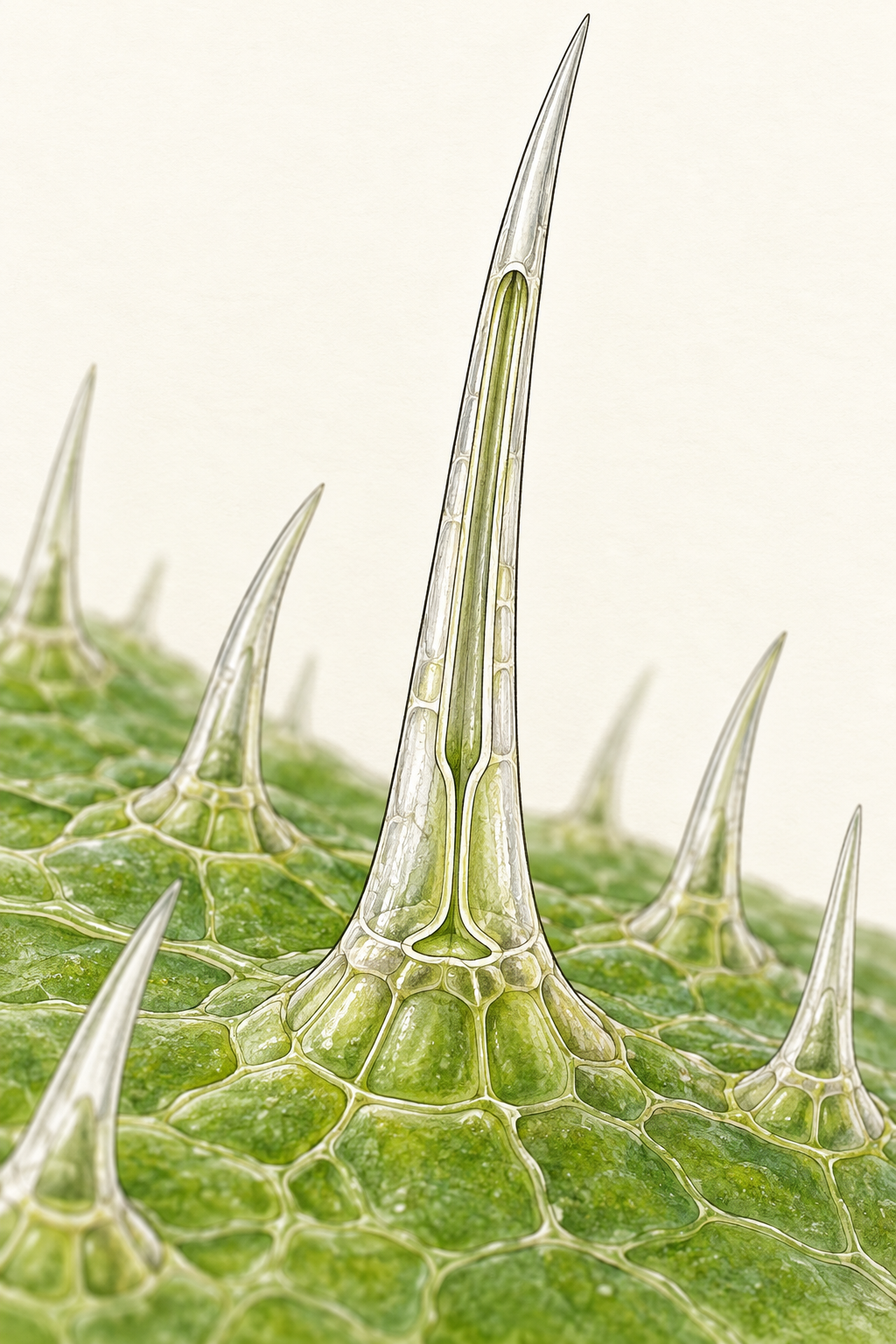
Enlarged schematic of a narrow hollow stinging hair on a leaf surface.
Delivery structures and the effects of their payload are separate research questions. This schematic simplifies hair anatomy and is not a micrograph.

What the 2020 discovery added

In 2020, researchers reported a family of small protein toxins called gympietides. The name draws on the Indigenous name for these stinging trees. The work combined chemical identification, structural analysis, and tests of biological activity. It offered a more specific explanation than describing the leaf as containing a powerful irritant.

A protein is a chain of amino acids that folds into a three-dimensional structure. The order of its components and its final shape are different properties. Gympietides were particularly interesting because their folded architecture resembled that of some animal toxins despite limited similarity in their amino-acid sequences.

The resemblance does not mean a plant acquired an identical vial of spider or cone-snail venom. It points to related structural solutions and effects reached in very different organisms. A useful comparison names what is similar: the fold, the target system, or the biological response. “The same venom” would erase those distinctions.

The 2020 experiments examined effects on voltage-gated sodium channels involved in sensory nerve signalling. These channels help control electrical activity by regulating ion movement across a cell membrane. Changing their behaviour can alter how readily a nerve cell produces or sustains signals.

A missing partner changes the result

A 2023 study revealed another important part of that explanation. The action of a studied gympietide, ExTxA, depended on a membrane-associated protein called TMEM233 in the experimental sodium-channel system. The toxin’s effect was therefore not explained by considering the channel in isolation.

This is a consequential discovery because researchers often simplify a system to investigate it. Simplification is useful, but it can remove a necessary participant. A cell expressing a channel may behave differently from a sensory neuron containing that channel and its relevant partners.

Imagine two test systems with the same named channel. One contains a required partner and the other does not. A different response to the toxin would not automatically mean that one channel was labelled incorrectly. It could reveal a dependency the simplified description had omitted.

Which observation answers which question?

Follow the mechanism across scales
EvidenceQuestion it addresses
Microscopy of a stinging hairHow is the material delivered?
Chemical identificationWhich molecules are present?
Structural analysisHow does a molecule fold?
Controlled cellular comparisonsWhich components are needed for an effect?

Choose one row and imagine trying to answer its question with evidence from another row alone. A photograph cannot identify every active molecule. A molecular structure cannot by itself establish the duration of a real-world sting. These methods become powerful when their findings connect, while each retains its own limits.

Then look back at the two illustrations. The broad leaf places the defence in its botanical setting. The enlarged hair draws attention to delivery. Neither picture is intended to replace microscopic measurements or the experiments that identified the active peptides.

The plant has a life beyond the dramatic nickname

Calling gympie-gympie a frightening plant can make its habitat and conservation disappear from the story. The NSW Government’s species profile treats D. moroides as an organism with a distribution, ecological setting, and threats. Those questions matter alongside what happens when a person touches a hair.

The NSW account places the species in lowland rainforest, particularly gaps and disturbed sites, and describes it as very rare in the southernmost part of its range. Listed threats include fragmentation, roadworks, weeds, and clearing by people concerned about the hairs. A strong defence against touch does not protect a plant against habitat loss. The same organism can be hazardous to handle and vulnerable to changes in its landscape.

There is also a limit to the medical promise of a toxin discovery. A well-characterized molecule can become a tool for understanding nerve function and a starting point for further research. That is a different claim from showing that a leaf, extract, or newly described molecule is a treatment. The mechanism is the finding here.

Gympie-gympie rewards attention across several scales: leaf shape, hair structure, folded peptide, and membrane proteins. Its dramatic sting brings those scales to our attention. The deeper story is how experiments connect them, revealing that an apparently simple leaf surface can depend on an intricate molecular relationship.

Explore more creative curiosity at Incoprea.

Horseshoe Crab Blue Blood: Two Different Biological Stories

Blue blood makes a memorable headline. In a horseshoe crab, however, the color and the laboratory-testing story come from different biological systems. One moves oxygen around the animal. The other helps defend it against bacterial material. Keeping the two separate reveals more than treating the whole circulatory fluid as one mysterious blue ingredient.

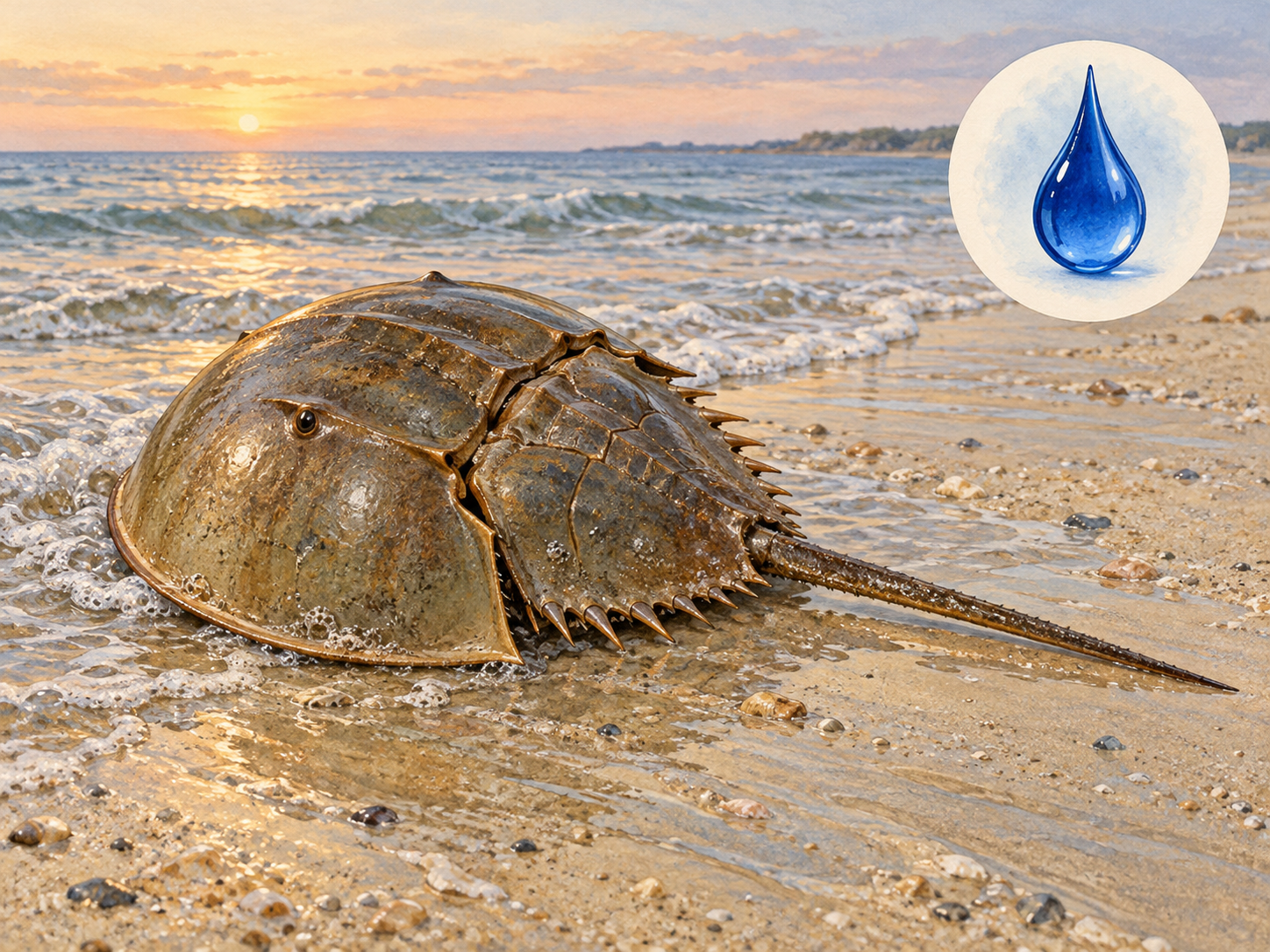
A brown horseshoe crab at the tidal edge beside a separate artistic blue-droplet vignette.
A horseshoe crab with a separate blue-droplet vignette representing its oxygenated circulatory fluid.

The Atlantic horseshoe crab, Limulus polyphemus, is a chelicerate, more closely related to spiders and scorpions than to true crabs. Its armored outline and long tail are conspicuous features of an animal with an active coastal life. The chemistry inside it belongs first to that life, before it becomes useful to human laboratories.

The color belongs to an oxygen carrier

Horseshoe crabs use hemocyanin, a copper-containing protein, to transport oxygen in their circulatory fluid. Oxygenated hemocyanin gives the fluid its blue appearance. Human blood uses hemoglobin, whose iron-containing heme contributes to its red color. The difference concerns organized molecules and how they bind oxygen, rather than ordinary metal coloring dissolved through a body.

Binding is only half the transport job. Oxygen must also be released where it is useful. A carrier that held on permanently would be a poor delivery system. Researchers consequently investigate both affinity, how readily oxygen binds, and the conditions under which it dissociates. A photograph of blue fluid cannot reveal those properties.

Bolling Sullivan and colleagues examined multiple hemocyanin components in Limulus. Their 1974 study found differences in oxygen affinity and responses to chemical conditions, including acidity and chloride. The findings show that an apparently uniform blue fluid contains a respiratory system with functional variation. Color identifies a striking feature; experiments reveal how that feature participates in physiology.

The test begins with a defensive cell

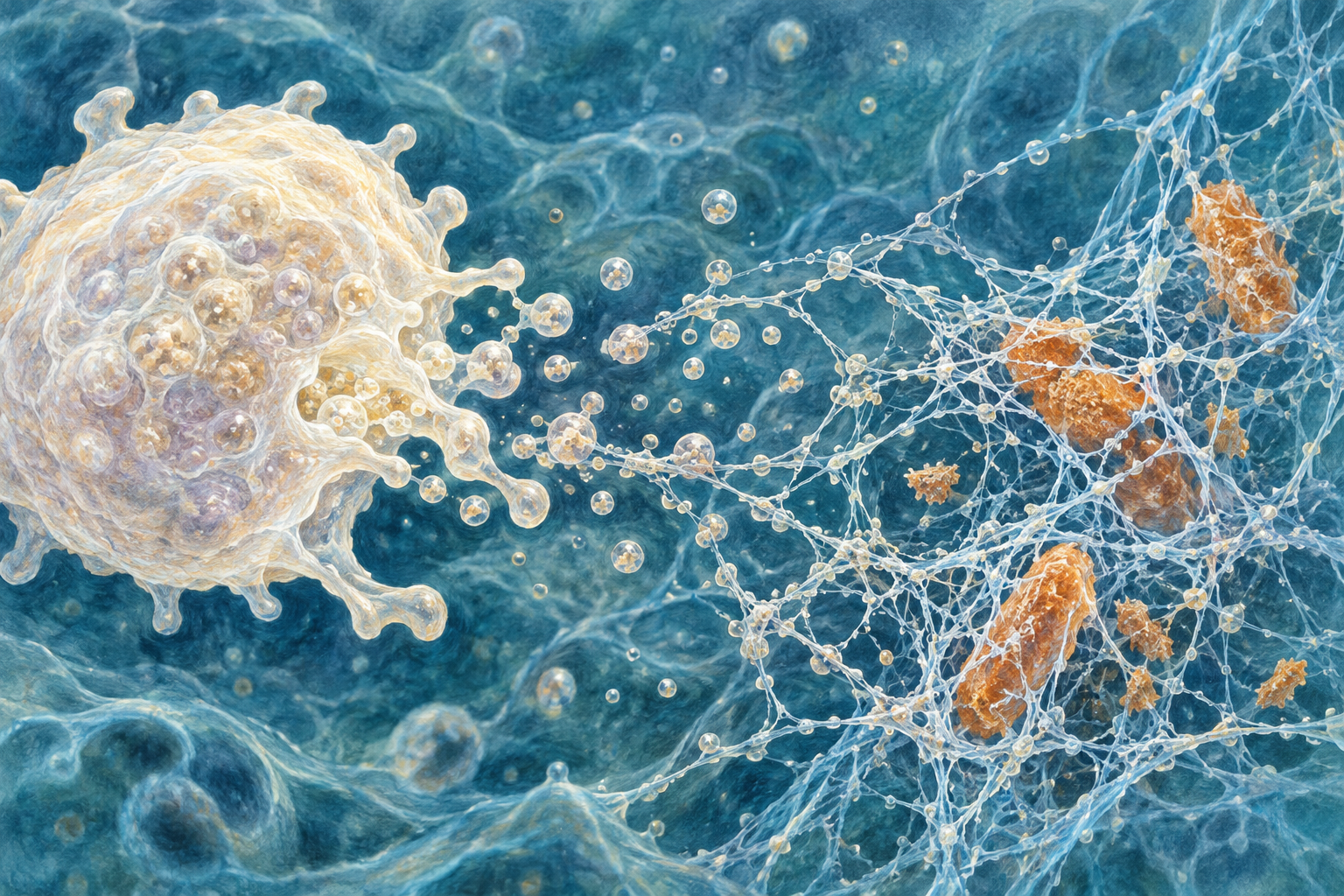
The laboratory story concerns amebocytes, cells involved in the animal's defense. Their contents include a coagulation system responsive to lipopolysaccharide, or LPS, bacterial material commonly discussed as endotoxin. Limulus amebocyte lysate, abbreviated LAL, is an extract from those cells. It is not another name for the blue oxygen-carrying protein.

A conceptual immune cell releases components toward a forming mesh around bacterial fragments.
A microscopy-inspired conceptual view of immune-cell clotting activity. Colors, particles, and proportions are illustrative rather than measured anatomy.

A coagulation cascade involves a sequence of molecular events rather than one pigment changing its mind about its job. In a 1993 study, R. I. Roth and P. S. Tobias investigated LPS-binding proteins within LAL. Their work distinguished contributions within the extract, illustrating how a useful biological reaction can depend on multiple components and regulatory interactions.

Here is a quick mechanism test. Which component would you investigate if your question were how oxygen delivery changes with acidity? Which would you investigate if your question were how bacterial LPS triggers a defensive reaction? Hemocyanin belongs to the first investigation; the amebocyte-derived coagulation system belongs to the second. Both occur in the animal's circulation without being the same explanation.

The distinction also explains why the reaction could be adapted as an assay. Researchers identified something specific the system responds to and developed ways to measure that response. An evolved defense became an analytical tool. The tool's usefulness depends on the relationship between the target material, the reaction and the conditions of the test.

A sensitive test still asks a defined question

An endotoxin assay is not a universal detector of every undesirable thing in a sample. Its name identifies a target. A result about endotoxin does not automatically answer separate questions about all microorganisms, other chemicals or every possible hazard. This is an important distinction in understanding testing without needing to perform or interpret a laboratory assay yourself.

Imagine a smoke detector that is excellent at detecting smoke. Its silence would not establish that a house had no water leak. That analogy is deliberately simple, but it captures specificity: a test can be valuable precisely because its response is tied to a defined problem. General reassurance is broader than the question any one detector answers.

The same reasoning applies to the attractive phrase “horseshoe crab blood protects medicines.” Several steps connect the organism to a controlled testing method. Understanding those steps makes the achievement more impressive, because it reveals the experimental work needed to turn a natural response into a reliable answer to a practical question.

The animal is not an unlimited source

The Smithsonian notes that some horseshoe crabs die following collection, bleeding and release. Habitat degradation and harvest for bait add other pressures. Their eggs also feed coastal wildlife, including migratory birds. A discussion confined to the price or usefulness of blood leaves out both the animal's own survival and its relationships in a shoreline ecosystem.

Reducing dependence on animal-derived reagents therefore has a biological as well as a technical purpose. Recombinant methods reproduce selected components of the endotoxin-response system through biotechnology. The goal is to retain a useful analytical function while changing how the necessary reagents are obtained. Reproducing a component does not require recreating an entire horseshoe crab.

A concrete example came in an FDA announcement dated August 31, 2026. The agency described an internationally coordinated assessment of a protocol allowing a manufacturer to transition biological products to a recombinant endotoxin test. The review concluded with approval in June 2026. This was a specific documented transition, not evidence that every manufacturer had already stopped using LAL.

The two biological stories now connect without merging. Oxygen-binding chemistry explains the blue. Defensive-cell chemistry explains the original assay. Research on replacement reagents shows how understanding a natural system can eventually reduce dependence on collecting it. The animal remains more than either discovery: a living participant in coastal habitats whose internal systems have taught humans how to ask unusually precise questions.

Explore more creative curiosity at Incoprea.

Famous Last Meals is now in paperback — stories, history and 25 recipes

Famous Last Meals: Stories, History, and Recipes is now available in paperback on Amazon. The illustrated collection brings together 23 his...