A termite worker can carry a record of aging on its back. In Neocapritermes taracua, older workers develop conspicuous blue material in paired dorsal pouches. The color is striking. The more revealing fact is that the material belongs to a defense whose parts remain separate until the worker's body ruptures.
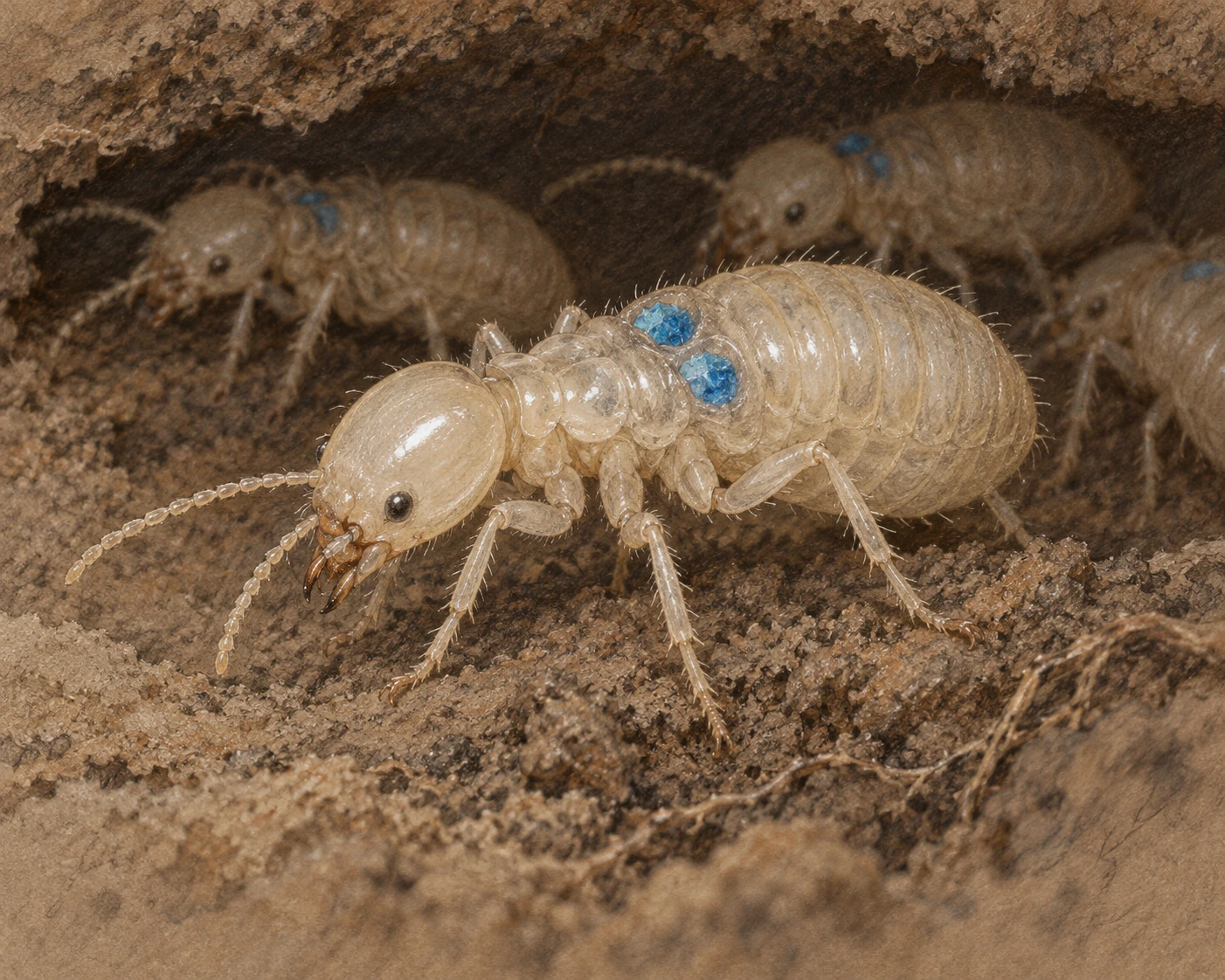
There is no need to imagine a tiny animal packing a conventional explosive. “Explosive backpacks,” the memorable title of the 2012 research paper, refers to a biological arrangement. Blue protein crystals are carried outside the main body cavity. Their contribution changes when they meet material from the labial glands.
An age pattern, rather than a uniform workforce
The original study connected older workers with a larger defensive load and a greater readiness to rupture during encounters. Their ability to contribute through food collection declined with age. Defense therefore became more prominent during a stage when another contribution was weakening.
That is a colony-level pattern of changing work and capacity. It is not evidence that a worker reflects on its remaining life or chooses a retirement plan. Describing a biological function is strongest when it stays close to what researchers could observe and compare.
For a reader, the useful surprise is that a worker category can conceal substantial differences. Two individuals both called workers need not have the same age, physiology or defensive equipment. A social insect colony is more interesting when its members are allowed to vary.
The color belongs to an enzyme
A 2016 molecular investigation identified the major blue-crystal protein, BP76, as a laccase. The identification linked protein analysis with transcriptomic information. When the components mix after rupture, the enzyme helps convert relatively less harmful gland compounds into a more toxic defensive mixture. Keeping the components apart is central to the arrangement.
Before reading further, predict what would need comparing. The crystals alone, the gland material alone and the combined material answer different questions. An account that mentions only the striking blue pouch skips this comparison. Looking for the comparison gives a reader a practical way to distinguish the location of a component from the mechanism of the complete defense.
Three statements should remain separate: the blue material contains an enzyme; rupture brings components together; reactions contribute to the resulting defense. Compressing them into “the blue crystal explodes” gives the wrong mechanical picture. The enzyme is a catalyst in a two-part system, rather than a miniature lump of gunpowder.
A stored protein faces a difficult job
Proteins must keep their useful structure long enough to function. Here the challenge is especially clear because the defensive material is stored on aging workers. A 2024 structural study examined native BP76 and identified a compact fold, glycosylation, disulfide connections and a tight dimer interface. The authors related those features to stability and retained catalytic activity in the stored material.
A crystal structure answers a different question from a behavioral encounter. It shows how a protein is arranged. Together with functional evidence, that arrangement helps explain durable performance. It does not by itself tell us how frequently wild colonies deploy the defense or how much it changes survival in every ecological setting.
Read the evidence in three layers
| Evidence | Strong question | Question left open |
|---|---|---|
| Workers of different ages | Does defensive capacity change with age? | What is the lifetime benefit in the field? |
| Separated and mixed components | Which components contribute to the active mixture? | How variable is deployment across encounters? |
| Protein structure | What arrangement supports a stable enzyme? | How did that arrangement evolve step by step? |
Use that table as a reading tool. When a striking natural-history headline appears, first identify the level at which its evidence was collected. Behavior, chemistry and molecular structure can reinforce one another. None needs to pretend to answer every question.
The termite's blue pouches are memorable because they are visible. The deeper interest lies in a sequence of separations: younger from older workers, one stored component from another, structural evidence from an evolutionary explanation. Once those separations are clear, the unusual defense becomes understandable without losing its strangeness.
Sources and further reading: Explosive backpacks in old termite workers (2012); Molecular mechanism of the two-component suicidal weapon (2016); Crystal structure of blue laccase BP76 (2024).
Explore all 80 new articles · Browse the complete illustrated collection
Explore more art, ideas, and independent projects at Incoprea.