A hammer orchid is an excellent reminder that a flower is not primarily a picture made for us. What looks small and odd to a passing person can be a highly effective signal to a particular insect. In Drakaea, the invitation is directed at male wasps, and the promise is misleading.
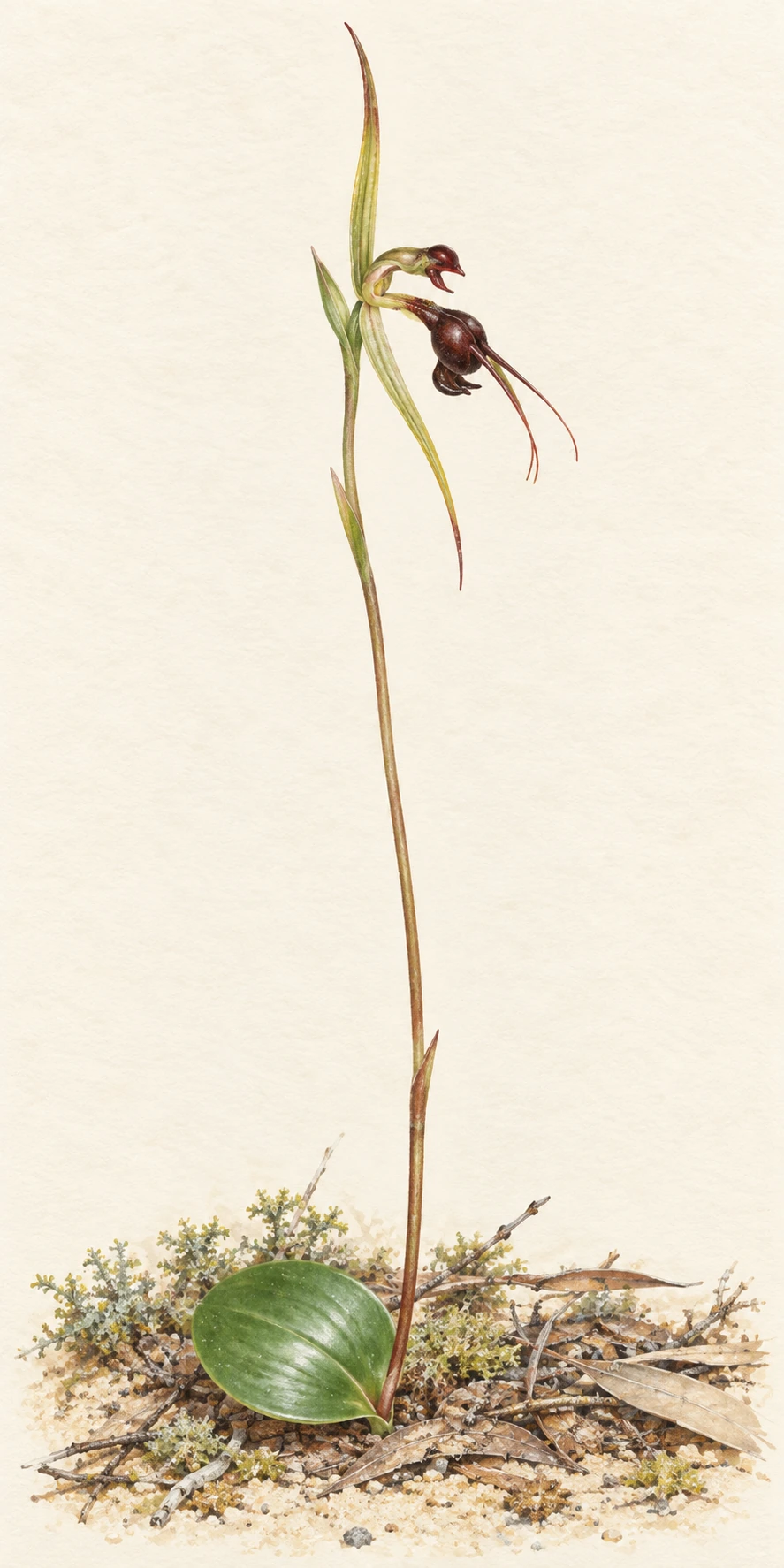
The central object is a modified petal called the labellum. In these orchids it resembles a small insect and sits on a hinge. The geometry matters, but scent begins the encounter before contact. To understand the flower, follow the visitor's sequence rather than judging the display from a standing human viewpoint.
The visitor is following a meaningful smell
In a 2014 investigation of Drakaea glyptodon, researchers combined chemical analysis, tests of wasp antenna responses, synthesis and field bioassays. They identified compounds used in both the female wasp's sex signal and the orchid's attraction system. The male wasp is responding to information that would ordinarily help it locate a mate.
That combination of methods is crucial. Finding a compound in a flower does not establish that a wasp detects it. An antenna response does not establish that the insect will approach and perform the relevant behavior. Field tests connect chemistry with an actual response.
The hinge turns an approach into contact
The natural female wasp is wingless; a male can carry her during mating. When a male grips the orchid's labellum and attempts to fly away with it, the hinged structure swings him toward the flower's reproductive column. Contact can remove or deposit pollen. The orchid exploits both attraction and a specific pattern of movement. The paper's photographs and supplementary movie show the interaction more precisely than an illustration can.
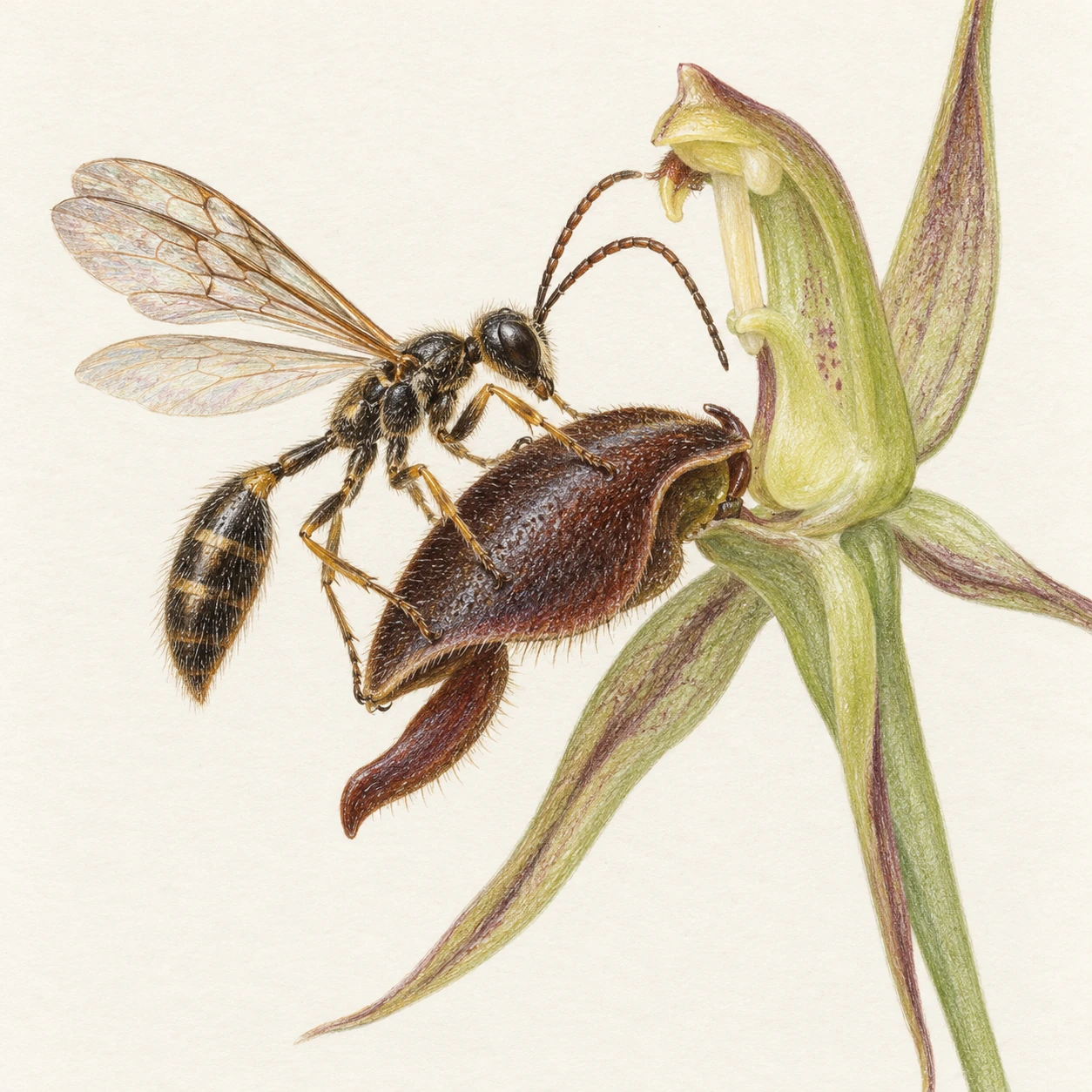
Try tracing the encounter with three verbs: approach, grasp, pivot. Remove one verb and the explanation becomes incomplete. A convincing scent with no suitable contact would not necessarily transfer pollen. A perfect hinge would accomplish little if its intended visitor never arrived.
For each stage, choose a different kind of record: a chemical test, a filmed approach or a close view of contact. This gives the flower several complementary descriptions. Its appearance supplies the scene; the sequence reveals how the interaction works.
One name can hide several chemical invitations
A study of Drakaea livida identified three floral ecotypes with distinct volatile profiles and different wasp pollinators. Some distributions were associated with pollinator distributions, but pollinator availability did not explain every boundary. A species name and a similar-looking flower were therefore insufficient descriptions of the ecological interaction.
That finding changes what “protecting an orchid” can mean. The relevant unit may include a local form of the plant and its partners. At the same time, it would be a mistake to turn specialization into a universal explanation for rarity. Each proposed restriction needs a test.
A 2011 study asked whether specialized fungal partners explained rarity in studied hammer orchids. Seed-baiting and fungal analyses found no difference in germination rates between rare and common studied species, and suitable fungi could occur in unoccupied habitat. Microhabitat still mattered. The study did not support the simple claim that rarer orchids were rare because their required fungi were uniquely scarce.
A hands-off observation sheet
The printable sheet below separates three things a visitor can easily confuse: an insect approaching a flower, touching it and visibly moving pollen. It also records observation duration. Ten minutes without a visitor is an observation, not proof that a population lacks pollinators.
Hands-off flower-visitor observation sheet
Print or save a structured log separating approach, contact and visible pollen transfer.
Open hands-off flower-visitor observation sheet in its own window.
Use it from an existing path or authorized viewing point. Record broad habitat and weather without moving flowers, operating hinges or broadcasting sensitive locations. A blank field is better than a guessed identification. The sheet is useful even if no hammer orchid is nearby: it trains the distinction between attraction, contact and demonstrated pollination.
The flower's strangeness becomes richer when its partners enter the story. A tiny hinge, a chemical signal and an insect's ordinary behavior meet in a precise sequence. Seeing those links is more rewarding than treating the orchid as a visual imitation alone.
Sources and further reading: Discovery of pyrazines as pollinator sex pheromones and orchid semiochemicals (2014); Three chemically distinct floral ecotypes in Drakaea livida (2022); Do mycorrhizal symbioses cause rarity in orchids? (2011).
Explore all 80 new articles · Browse the complete illustrated collection
Explore more art, ideas, and independent projects at Incoprea.