The butterfly returns to a flower, then another, and later appears at the first again. To a casual observer, the visits can look like wandering. For a pollen-feeding Heliconius, a familiar landscape may instead contain a repeatable set of useful places.
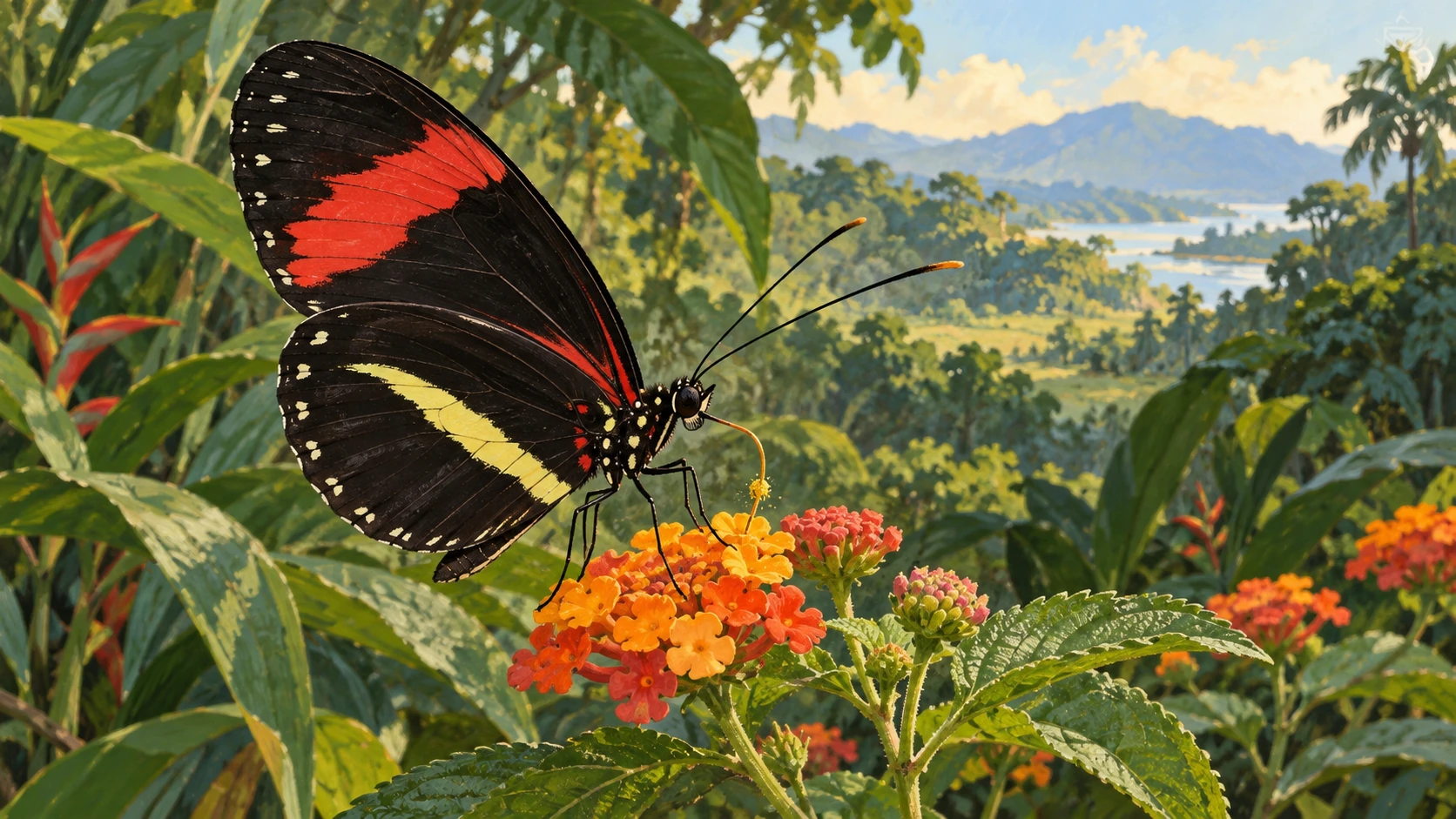
These butterflies add pollen to the nectar-feeding life we usually imagine. The extra food changes the questions worth asking. How is it processed? How does a butterfly find productive plants again? And what evidence would distinguish a remembered route from repeated attraction to a conspicuous flower?
A meal handled outside the mouth
The research review on Heliconius pollen feeding describes pollen collection and processing on the proboscis, with saliva helping bind the grains and make nutrients available. Pollen supplies amino acids that complement a sugar-rich diet. The links among feeding, longevity, learning and repeated foraging form an adaptive suite, but their evolutionary sequence remains a subject for investigation.
It is tempting to turn that suite into a neat ladder: first a new food, then a larger memory system, then a longer life. The evidence does not require such a tidy order. Traits can facilitate one another, and reconstructing their origin is harder than demonstrating their present association.
Staying nearby is not the same as finding home
Suppose researchers mark butterflies and keep recapturing them in the same patch. That shows stability, but it leaves two explanations. The butterflies may actively prefer a known place, or they may simply move little. A displacement experiment changes the question by releasing animals away from their original sites.
In work on H. erato and H. melpomene, all recaptured animals in the initial mark-release-recapture phase were found in their original habitat. In a separate displacement phase, most recaptured butterflies returned to their site of origin. The researchers also examined initial flight orientation. Together the results supported genuine site fidelity rather than low dispersal alone.
The denominator matters here. “Most recaptured butterflies” does not mean every released butterfly was followed home. Animals not recaptured remain an uncertainty. Reporting the measured group preserves the result's strength without adding an imaginary complete set of tracks.
What scenery carries the memory?
A 2024 study tested H. erato with artificial feeders and manipulated visual cues. The butterflies learned rewarded positions, but did not use a nearby individual landmark in the predicted way, even when it was made the reliable cue. The results instead supported use of broader visual-scene information under the tested conditions.
This is a more interesting outcome than “butterflies remember landmarks.” Spatial learning does not imply that every visible object becomes a useful marker. The scale of the cue, the task and the animal's experience can matter. A result in a flight cage also does not identify every mechanism used in a forest.
Make a route log before making a claim
The small downloadable log below is designed for stationary observation of flower visitors. Give plants neutral names such as A, B and C. Record time, visit order and whether you can confidently recognize an individual. Leave the individual field uncertain when you cannot.
Flower-visitor route log
A blank visit-sequence log with explicit identity-confidence and missed-observation fields.
A sequence A–B–C–A is a useful record. It does not by itself establish a complete trapline or prove a memory mechanism. Repeated watches can reveal patterns, while missing visits and uncertain identity limit what can be inferred. Do not mark or move wildlife to fill the gaps in a casual log.
One rewarding exercise is to write two explanations for the same sequence. Perhaps the butterfly remembers useful locations. Perhaps the nearest newly rewarding flowers lead it along a similar path each time. Then list an observation that would distinguish those accounts. The research becomes easier to appreciate when you can feel why its manipulations were necessary.
A familiar butterfly can thus change a familiar garden. Instead of seeing an ornamental visitor passing through, you begin to see a small animal negotiating a landscape of reliable places, incomplete information and repeated decisions.
Sources and further reading: Pollen feeding in Heliconius butterflies: the singular evolution of an adaptive suite (2020); True site fidelity in pollen-feeding butterflies (2022); Heliconius butterflies use wide-field landscape features, but not individual local landmarks, during spatial learning (2024).
Explore all 80 new articles · Browse the complete illustrated collection
Explore more art, ideas, and independent projects at Incoprea.




