Showing posts with label Ceramics. Show all posts

Friday, October 23, 2026

Moche Portrait Vessels: A Face Is More Than a Likeness

Before looking into the eyes, look above the head. A loop rises behind it and joins a narrow spout. The face is part of a ceramic container. Forgetting that fact is easy: Moche makers gave some vessels such convincing cheeks, brows, and lips that we want to introduce ourselves to the person represented.

The attraction is valuable, but it can hurry us past the object. A recognizable face is not the same thing as a recovered identity. A vessel can resemble an individual while also communicating a role, circulating among people, and participating in practices we understand only partly.
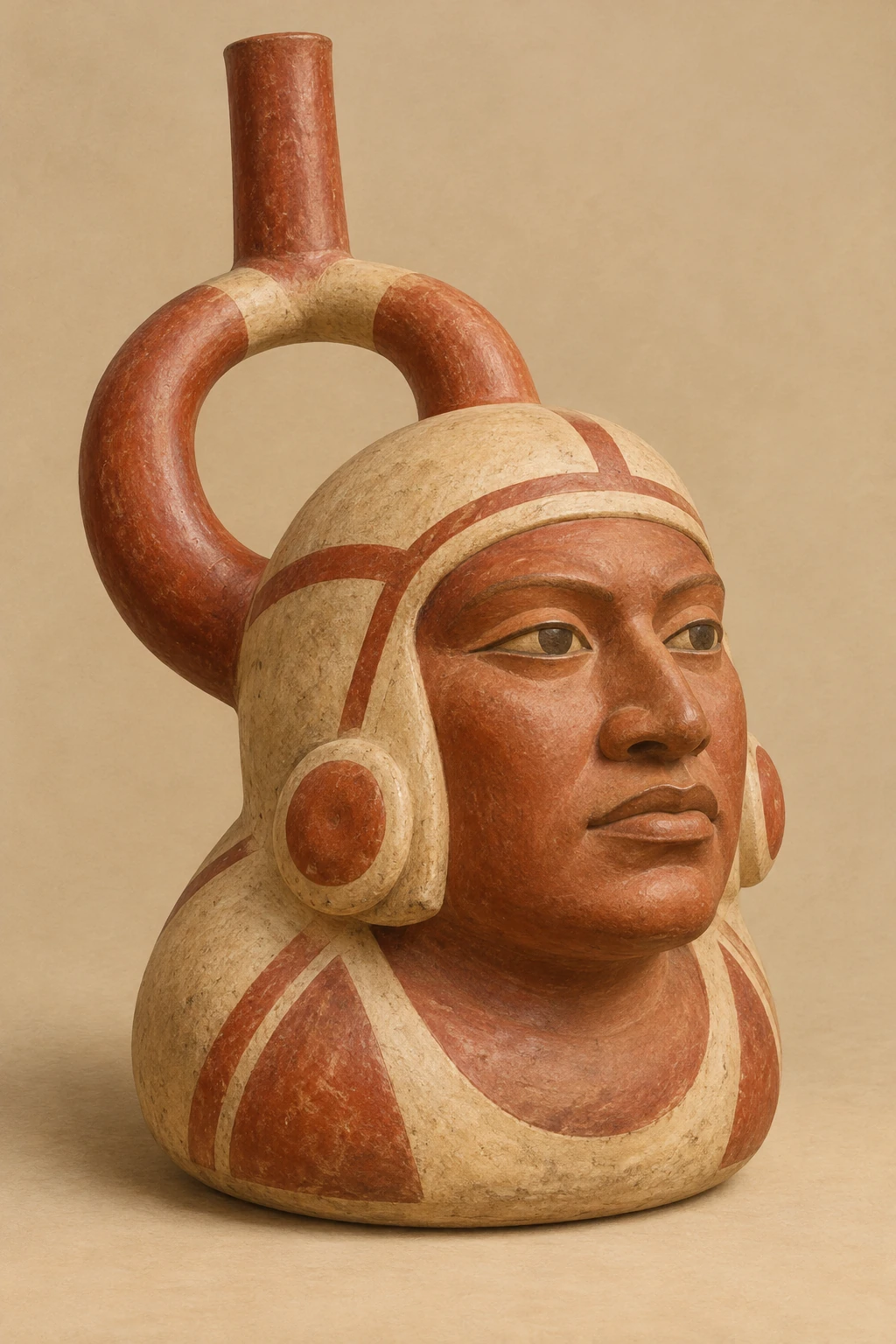
An original Moche-inspired stirrup-spout portrait vessel, seated as an object on plain sand-colored ground.
The face, hollow body, and stirrup spout must be read together. The invented form is not a portrait of an identified ancient person.

Three objects, three different questions

Use the museum records linked below as a small comparison set. The illustration above is an invented Moche-inspired vessel, so it cannot supply evidence about a specific excavated individual. The collection records provide the actual objects, measurements, and curatorial discussions.

Object to openA firm starting pointA useful question
Bottle 64.228.22Ceramic and slip;500–800 CE;27.9 cm high.How do headcloth, ear ornaments, and spout organize the head?
Bottle 67.167.22Single spout; third–sixth century;21.3 cm high.What changes when the container has a different upper form?
Human and fox heads comparedThe museum places two differently shaped head bottles together.Which assumptions did “portrait” make us bring to the human example?

Read across the table before choosing a favorite. The small set already prevents a universal claim about one spout form. It also reminds us that dimensions matter. A cropped screen image can make two vessels seem the same size even when the records tell us otherwise.

What the surface establishes

The record for 64.228.22 describes a cream-colored headcloth, red designs on a headband, and modeled earspools. A pierced septum may once have held a metal nose ornament. The distinction between a surviving hole and a proposed missing ornament is worth preserving. One is visible evidence; the other is a qualified reconstruction.

Try writing a description with no personality words. Instead of “stern,” record the line of the mouth. Instead of “proud,” describe the head's position. This is not a ban on responding emotionally. It gives you a stable description to place beside your response, so the two do not become indistinguishable.

The same discipline applies to costume. Clothing and ornaments invite questions about affiliation and status. They do not function as a modern name badge whose full meaning we can recover by recognizing a shape. A careful account asks how such features recur across objects and how they relate to archaeological contexts.

A face that could be made again

Joanne Pillsbury's survey explains that later portrait heads were often made with molds, allowing multiple vessels from a matrix. Some surviving examples appear to represent the same person at different ages. The survey also notes that contents remain uncertain and that evidence of wear and fragments suggests use before final deposition in tombs.

Molding complicates a familiar expectation. We often imagine a portrait as one artist's unique encounter with one sitter. A repeatable ceramic head makes us consider a different relationship between likeness and circulation. More than one object could carry a related face into more than one setting.

That possibility does not make the work less expressive. It changes the questions. Which details belong to the mold, which to finishing or painted treatment, and which reflect later damage? Two objects can share an underlying form without having identical histories. A repeated face and a repeated social act are not necessarily the same thing.

What “portrait” helps us see—and can hide

In From Cloth to Clay, art historian Sarahh Scher challenges approaches that treat Moche ceramic representations as straightforward records of lived identity. The durable object makes selected features of bodies and clothing permanent. It cannot preserve everything about the contingent, changing life of a person.

This is a productive warning for any viewer. A headcloth fixed in clay cannot be rearranged. A face fixed at one moment cannot answer a question. The vessel may preserve a remarkable representation while withholding the lived circumstances that would let us interpret it confidently.

Compare the human and fox-head bottles in the museum's discussion of faces. The pairing interrupts an easy division between literal human likeness and everything else. It asks us to examine the representational choices shared by objects that a modern viewer might place in separate categories.

There is another practical check: read the provenance separately from the date of manufacture. “Gifted in 1964” describes an event in a museum object's later history; it does not describe an ancient findspot. A modern accession record can preserve an object's collecting history while leaving important archaeological context unknown. Keep those two histories on separate lines, and resist treating the completeness of one as a substitute for the other.

Likewise, a broad date range is a statement about current knowledge. It does not mean the object took three centuries to make. When comparing two vessels, overlapping date ranges permit questions about relationships, but they do not establish that both came from the same workshop or were used together.

A label you can improve

Here is an intentionally inadequate imaginary label: “A powerful man, shown exactly as he looked, used this bottle for maize beer.” It turns four different propositions into certainty. How would you repair it using the sources?

  1. Keep the object type, place, and date range supplied by its record.
  2. Describe the modeled and painted features before interpreting them.
  3. Qualify any claim that the face represents a particular person.
  4. State that contents are uncertain unless evidence for this object establishes them.

A better label may feel less like a complete biography. It is more useful because a reader can see which parts are secure and which remain questions. You can still feel the force of the face without pretending to know its owner's name, mood, occupation, or last thought.

Finish by looking again at the whole container. The opening, hollow body, surface, and represented head belong together. The vessel's strangeness is part of its interest: a face we can almost recognize, made repeatable in clay, participating in a world that exceeds what likeness alone can explain.

Sources and further exploration

Explore all 80 new articles · Browse the complete illustrated collection

Continue exploring art, ideas, and unexpected connections at Incoprea.

Before European Porcelain Settled Down: The Soft-Paste Experiment

Imagine trying to copy a material by looking at its finished surface. You can see whiteness, translucency, a fine edge, and perhaps an elegant painted decoration. You cannot see the quarry, the washed clay, the kiln atmosphere, or all the failed pieces that came before it.

The European history of porcelain is partly a history of that gap between appearance and production. The labels “soft-paste” and “hard-paste” preserve different solutions to a demanding materials problem. They are not judgments about the artistic worth of the finished object.

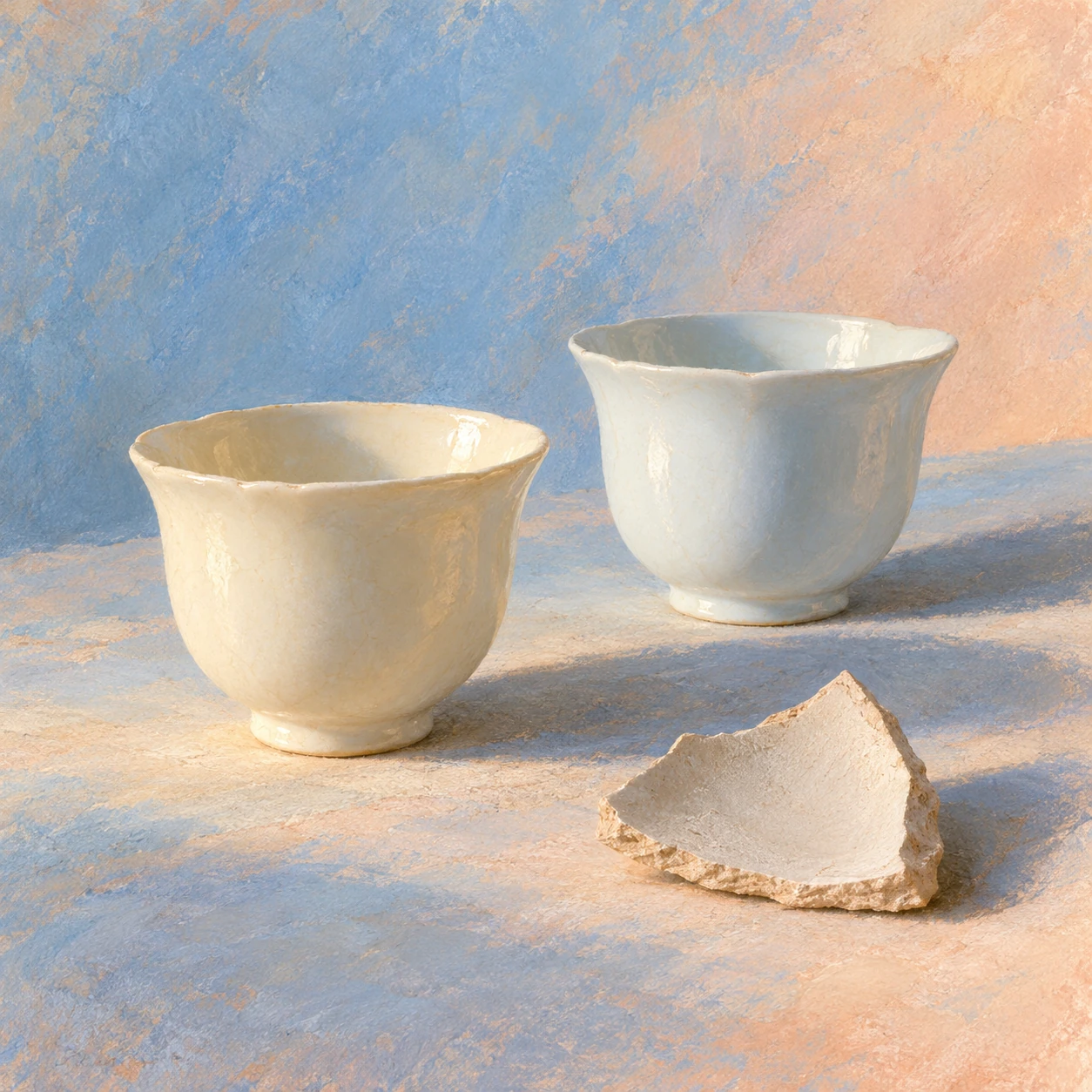
Two small undecorated eighteenth-century French porcelain-inspired cups, one creamy white and one cool white, plus a separate unglazed ceramic shard.
Two invented cups invite a materials comparison. Color alone cannot reliably distinguish soft-paste from hard-paste porcelain.

A name for a body, not just a glaze

The V&A's ceramics guide connects hard-paste porcelain with its raw materials and high firing temperatures. Kaolin, or china clay, belongs to that story, along with a material that helps the body fuse. The fired ceramic can combine whiteness, translucency, strength, and low porosity.

Soft-paste bodies developed through other formulations as European makers sought effects associated with imported Asian porcelain. “Soft” does not mean a cup remains flexible after firing. It identifies a different ceramic family, with different behavior in manufacture. A material can require extraordinary care in the kiln and still become a highly finished luxury object.

There is a useful lesson here for reading any technical label: find out what the adjective modifies. The name may concern the unfired mixture, a manufacturing difficulty, the fired body, or a later classification. Familiar everyday meanings can take you in the wrong direction.

Sèvres did not change materials in a single clean leap

The Met's factory history places the start of the enterprise at Vincennes in 1740 and its move to Sèvres in 1756. Soft-paste production continued during the eighteenth century even after hard-paste porcelain entered the story. A new formulation did not instantly make an established repertoire disappear.

Calling a ceramic “porcelain” does not tell us which production problem its makers were solving. Compare the body with the decoration rather than assuming that either explains the other. Ask what kind of evidence would connect a particular formulation to a particular artistic result.

That history complicates a simple progress story. Makers were not only asking which body was strongest. They also needed forms, surfaces, colors, and decorative effects to work together. A formulation that suits one object or palette may create difficulties for another. Technical development and artistic intention were entangled.

The clay deposit was a beginning

A Metropolitan Museum Journal study of Sèvres plates describes the importance of kaolin discovered near Saint-Yrieix around 1768 and Pierre Joseph Macquer's hard-paste production in 1769. It also follows processing, shaping, and firing problems. Locating a necessary raw material did not supply a complete working factory.

Washing and preparing a material changes what reaches the potter. Shaping it into a plate presents another set of problems. Firing requires the body and surface to behave together. The study is especially useful where it admits that exact records of a forming method are absent. A plausible account based on object appearance remains an interpretation, not a recovered workshop instruction sheet.

Three questions that should stay separate
QuestionUseful evidence
What does the object look like?Color, translucency, surface, thickness, and decoration.
What is the body made from?Documented recipes, material analysis, and production records.
How was this particular piece made?Marks, joins, molds, archival evidence, and comparison with related objects.

Try this distinction with two collection records rather than two cups at home. Compare the museum's named medium, date, factory, and dimensions. Then look at the photographs. Which differences can you actually see? Which depend on the record? Avoid scratch tests or heating experiments: the point is to learn from documentation, not to turn an object into a sample.

Porcelain becomes more interesting when “the secret” expands into a network of deposits, preparation, skills, equipment, and aesthetic choices. The finished white surface is not an absence of history. It is a place where much of that history has become difficult to see.

When reading a catalog, keep the material, maker, place, and date in separate columns. A factory attribution and a description of the ceramic body answer different questions. One may be revised without changing the other. That small habit prevents a label from becoming a single indivisible verdict.

Sources and further exploration

Explore all 80 new articles · Browse the complete illustrated collection

Continue exploring art, ideas, and unexpected connections at Incoprea.
A Pattern Inside the Glaze: Goryeo Celadon and the Work of Inlay

The pattern looks as though it belongs to the glaze, yet its contrasting material can sit underneath it, fitted into the body of the vessel. This is the quiet surprise of sanggam, the inlay technique closely associated with Goryeo celadon.

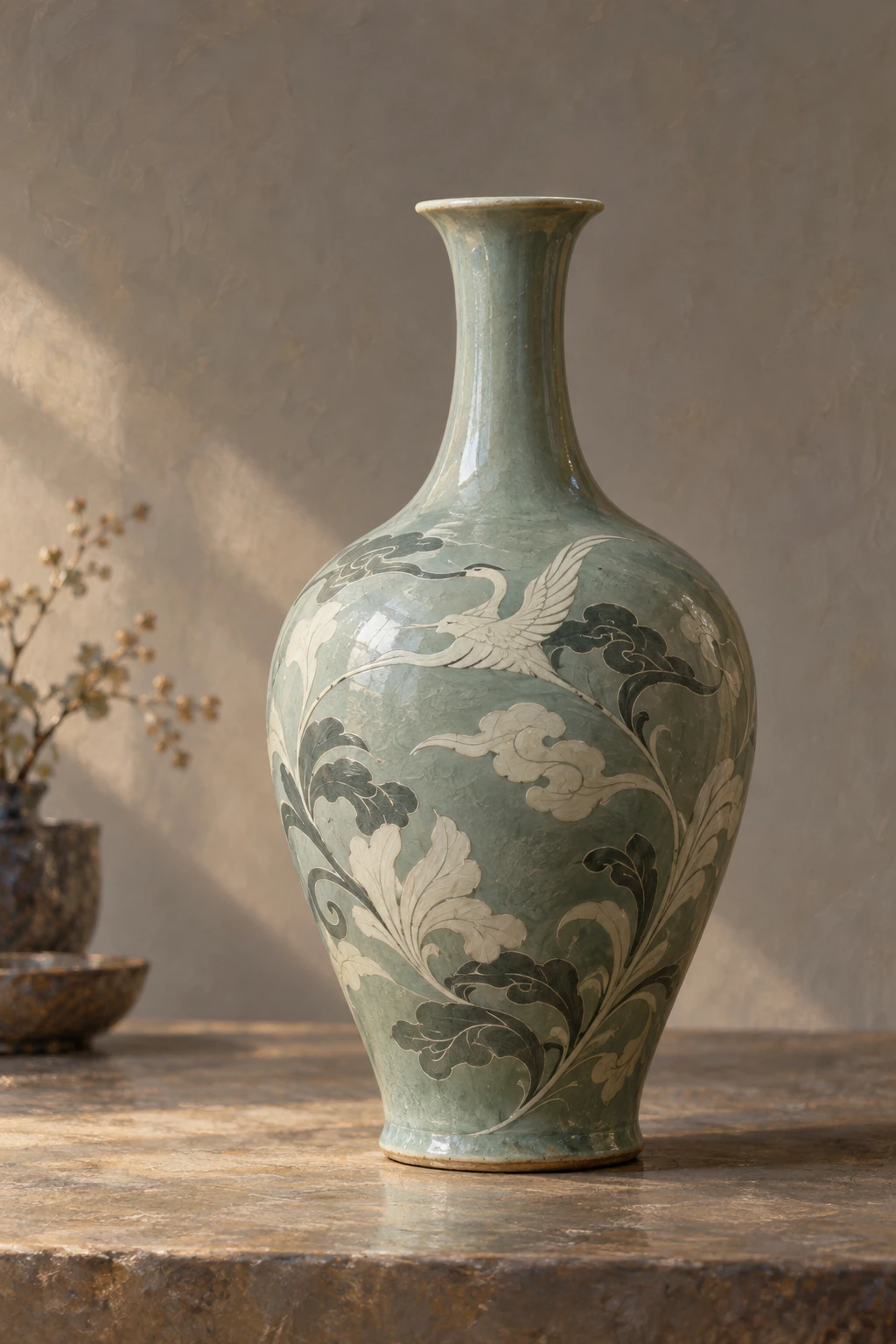
One invented Goryeo-style celadon bottle with a restrained white and dark clay-inlaid cloud-and-crane-inspired abstract floral pattern beneath translucent gray-green glaze.
Light and dark clay inlays sit within the ceramic surface beneath a greenish glaze. This invented vessel illustrates the relationship of layers.

A decorative line might be scratched, painted, impressed, carved, or filled. Those verbs can produce related-looking marks in a small photograph, but they describe different decisions. Learning to distinguish them makes a ceramic object much more interesting than simply calling it green.

Find the pattern's physical address

The Met's Korean art teaching resource explains inlay as a sequence. A design is cut into clay that has firmed enough to work. Contrasting clay fills the recesses. Excess is removed so that the pattern remains within the surface. Glazing and firing then complete the ceramic relationship.

The difference from painting is fundamental. In a simplified comparison, a painted line places material on a surface; an inlaid line occupies a prepared space within it. That distinction changes the work needed before glazing. The maker must think about the shape of a recess, the behavior of filling material, and how the cleaned pattern will read through the final surface.

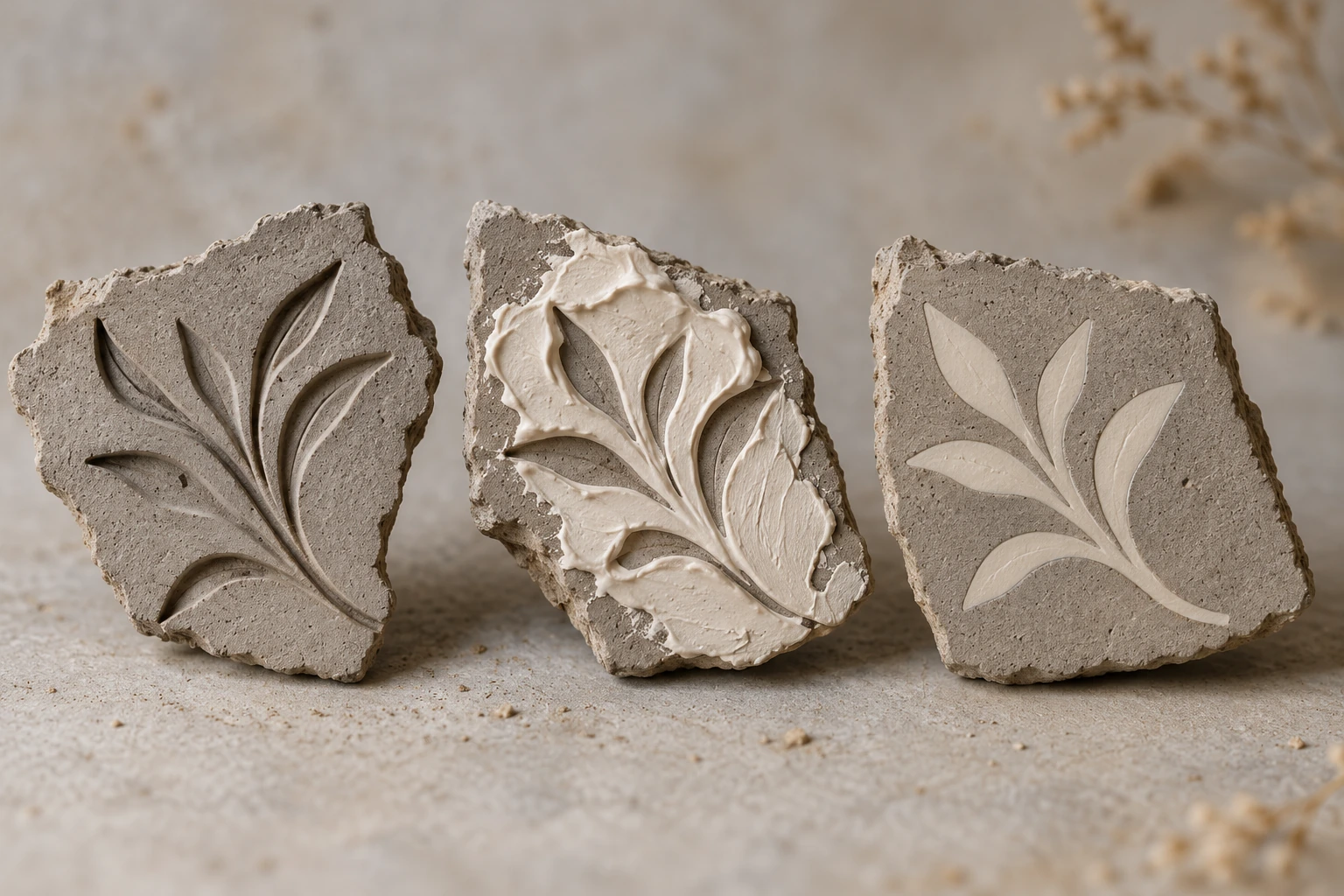
Extreme close-up arranged horizontal study of three separate greenware ceramic sample fragments: left incised shallow plant curves in gray clay, center those grooves filled with pale slip with surplus still on surface, right wiped flush pale inlay in gray clay.
The enlarged fragments separate incision, filling, and wiping. Their simplified pattern explains inlay without reconstructing a particular workshop.

The three illustrative fragments above separate incision, filling, and removal of surplus. They are enlarged explanations, not excavated stages from one production site. Their value lies in making the order understandable. Historical workshop practice still has to be studied through objects and archaeological evidence.

Follow a pattern below the glaze

A qualitative four-stage layer model separates incision, filling, wiping, and glaze.

Open follow a pattern below the glaze in its own window.

In the layer model, move from incision to filling, then remove the surplus. The pattern becomes clearer through subtraction. Turning on the final glaze stage adds another material relationship. The controls deliberately omit recipes, drying times, and firing schedules; an explanatory model is not a potter's reconstruction experiment.

Green is a range of outcomes

The Met's survey places Goryeo celadon within the dynasty of 918–1392 and describes a family of gray-green effects shaped by raw materials and firing conditions. It also includes plain, carved, incised, impressed, and inlaid examples. “Celadon” therefore does not name one decoration method or a single standardized color.

That range is important when an online image seems strongly blue, olive, pale gray, or warm green. Lighting, camera settings, display, glaze thickness, and the object itself all affect what you see. An image is useful for comparison, but its apparent hue should not be treated as a measured chemical diagnosis.

The National Museum of Korea's 2012 exhibition account emphasizes both the prized glaze and sanggam craftsmanship. This is a record of that exhibition, not a promise that those objects are currently on display. The distinction between a historical museum page and a current visiting guide matters when following old links.

A small cup can contain several techniques

Consider the Met's thirteenth-century cup with handle, 2025.598. At only 9.5 centimeters wide, it combines sculpted fish, incised details, inlaid external motifs, and a handle added before glazing. The record describes an object whose waterside imagery becomes especially engaging when the cup contains liquid.

Here the vessel's use changes the viewing experience. A photograph from above, a side view, and an imagined filled cup do not reveal the same relationships. You do not need to invent an original owner's thoughts to notice how the rim, fish, and reflective liquid could work together.

Try a technique-first comparison

Open the cup record and one inlaid bottle from the Met's survey. Choose a single feature on each: a line, a raised shape, a handle, or a patch of contrast. Write the verb you think describes its making. Then check the medium and curatorial explanation. If you cannot distinguish inlay from paint in the photograph, record that uncertainty rather than forcing an answer.

The reward is a slower, more active way of looking. A vessel can hold a pattern in its clay, a color in its glaze, and a changing image in the light it reflects. Those layers make the object vivid without requiring us to reduce it to either technical ingenuity or decorative beauty alone.

Sources and further exploration

Explore all 80 new articles · Browse the complete illustrated collection

Continue exploring art, ideas, and unexpected connections at Incoprea.
Friday, September 4, 2026

Ceramics: 30 Artists to Discover

Artists by Medium · Part 10 of 20

Ceramics joins shaping with irreversible firing. Clay body, construction method, glaze, decoration, and kiln atmosphere can each become part of an artist's language.

The 30 profiles below pair a source-based identity note with one item-level work record verified through The Met API. Every embedded image is marked Public Domain by The Metropolitan Museum of Art, and each credit retains its object page and Open Access link.

publications

New this week Two novels in six stories each, from The Night Shift . New — a novel in six documents Small Print A Novel in Six Do...