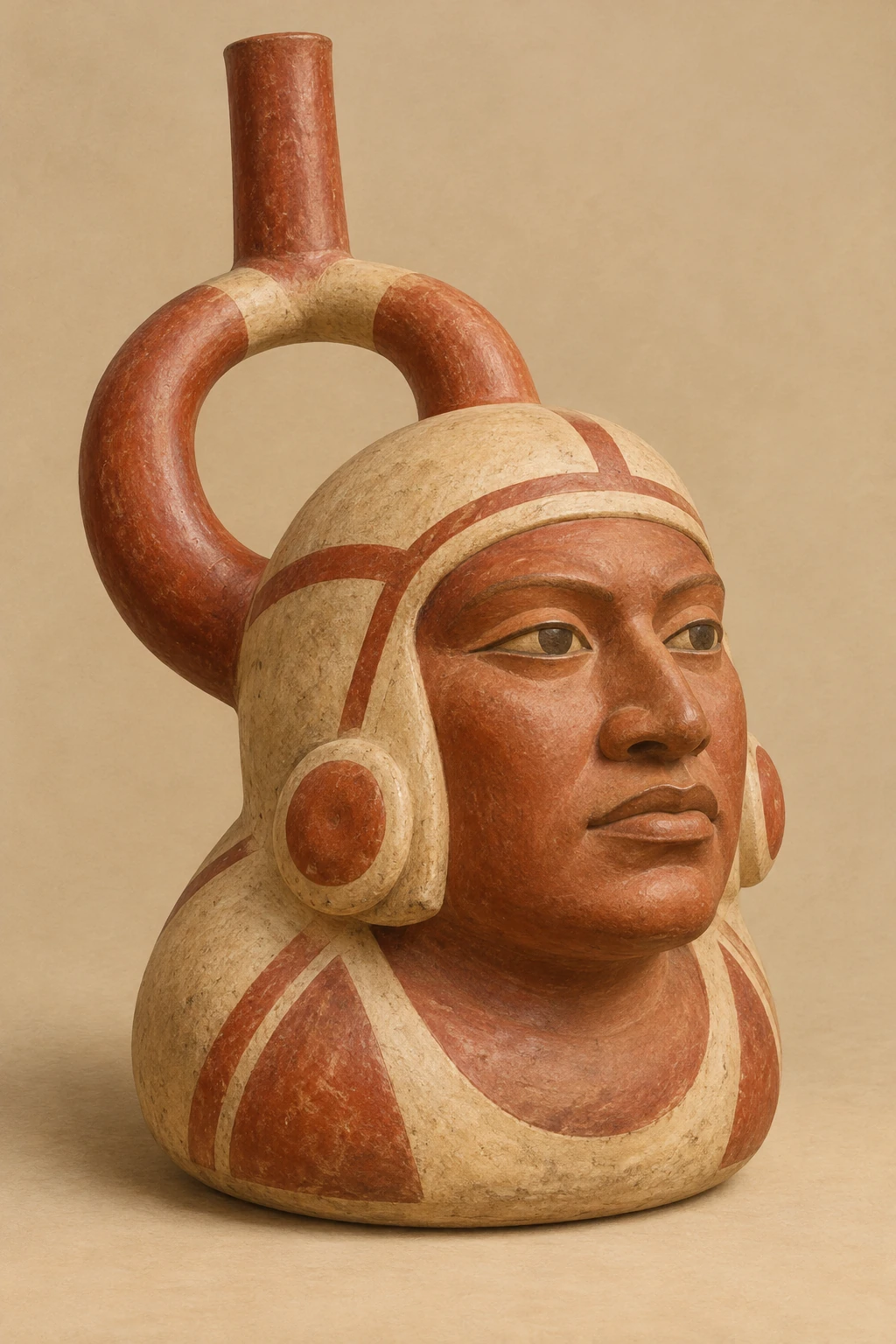
Before looking into the eyes, look above the head. A loop rises behind it and joins a narrow spout. The face is part of a ceramic container. Forgetting that fact is easy: Moche makers gave some vessels such convincing cheeks, brows, and lips that we want to introduce ourselves to the person represented.
The attraction is valuable, but it can hurry us past the object. A recognizable face is not the same thing as a recovered identity. A vessel can resemble an individual while also communicating a role, circulating among people, and participating in practices we understand only partly.
Three objects, three different questions
Use the museum records linked below as a small comparison set. The illustration above is an invented Moche-inspired vessel, so it cannot supply evidence about a specific excavated individual. The collection records provide the actual objects, measurements, and curatorial discussions.
| Object to open | A firm starting point | A useful question |
|---|---|---|
| Bottle 64.228.22 | Ceramic and slip;500–800 CE;27.9 cm high. | How do headcloth, ear ornaments, and spout organize the head? |
| Bottle 67.167.22 | Single spout; third–sixth century;21.3 cm high. | What changes when the container has a different upper form? |
| Human and fox heads compared | The museum places two differently shaped head bottles together. | Which assumptions did “portrait” make us bring to the human example? |
Read across the table before choosing a favorite. The small set already prevents a universal claim about one spout form. It also reminds us that dimensions matter. A cropped screen image can make two vessels seem the same size even when the records tell us otherwise.
What the surface establishes
The record for 64.228.22 describes a cream-colored headcloth, red designs on a headband, and modeled earspools. A pierced septum may once have held a metal nose ornament. The distinction between a surviving hole and a proposed missing ornament is worth preserving. One is visible evidence; the other is a qualified reconstruction.
Try writing a description with no personality words. Instead of “stern,” record the line of the mouth. Instead of “proud,” describe the head's position. This is not a ban on responding emotionally. It gives you a stable description to place beside your response, so the two do not become indistinguishable.
The same discipline applies to costume. Clothing and ornaments invite questions about affiliation and status. They do not function as a modern name badge whose full meaning we can recover by recognizing a shape. A careful account asks how such features recur across objects and how they relate to archaeological contexts.
A face that could be made again
Joanne Pillsbury's survey explains that later portrait heads were often made with molds, allowing multiple vessels from a matrix. Some surviving examples appear to represent the same person at different ages. The survey also notes that contents remain uncertain and that evidence of wear and fragments suggests use before final deposition in tombs.
Molding complicates a familiar expectation. We often imagine a portrait as one artist's unique encounter with one sitter. A repeatable ceramic head makes us consider a different relationship between likeness and circulation. More than one object could carry a related face into more than one setting.
That possibility does not make the work less expressive. It changes the questions. Which details belong to the mold, which to finishing or painted treatment, and which reflect later damage? Two objects can share an underlying form without having identical histories. A repeated face and a repeated social act are not necessarily the same thing.
What “portrait” helps us see—and can hide
In From Cloth to Clay, art historian Sarahh Scher challenges approaches that treat Moche ceramic representations as straightforward records of lived identity. The durable object makes selected features of bodies and clothing permanent. It cannot preserve everything about the contingent, changing life of a person.
This is a productive warning for any viewer. A headcloth fixed in clay cannot be rearranged. A face fixed at one moment cannot answer a question. The vessel may preserve a remarkable representation while withholding the lived circumstances that would let us interpret it confidently.
Compare the human and fox-head bottles in the museum's discussion of faces. The pairing interrupts an easy division between literal human likeness and everything else. It asks us to examine the representational choices shared by objects that a modern viewer might place in separate categories.
There is another practical check: read the provenance separately from the date of manufacture. “Gifted in 1964” describes an event in a museum object's later history; it does not describe an ancient findspot. A modern accession record can preserve an object's collecting history while leaving important archaeological context unknown. Keep those two histories on separate lines, and resist treating the completeness of one as a substitute for the other.
Likewise, a broad date range is a statement about current knowledge. It does not mean the object took three centuries to make. When comparing two vessels, overlapping date ranges permit questions about relationships, but they do not establish that both came from the same workshop or were used together.
A label you can improve
Here is an intentionally inadequate imaginary label: “A powerful man, shown exactly as he looked, used this bottle for maize beer.” It turns four different propositions into certainty. How would you repair it using the sources?
- Keep the object type, place, and date range supplied by its record.
- Describe the modeled and painted features before interpreting them.
- Qualify any claim that the face represents a particular person.
- State that contents are uncertain unless evidence for this object establishes them.
A better label may feel less like a complete biography. It is more useful because a reader can see which parts are secure and which remain questions. You can still feel the force of the face without pretending to know its owner's name, mood, occupation, or last thought.
Finish by looking again at the whole container. The opening, hollow body, surface, and represented head belong together. The vessel's strangeness is part of its interest: a face we can almost recognize, made repeatable in clay, participating in a world that exceeds what likeness alone can explain.
Sources and further exploration
- Joanne Pillsbury: Moche Portrait Vessels
- Metropolitan Museum: Bottle with portrait head,64.228.22
- Metropolitan Museum: Single Spout Portrait Head Bottle,67.167.22
- Sarahh Scher: From Cloth to Clay,2021
- Metropolitan Museum: What’s in a Face? Moche comparison
Explore all 80 new articles · Browse the complete illustrated collection
Continue exploring art, ideas, and unexpected connections at Incoprea.