A pale plaster surface can look like the least interesting part of an ancient building. Stone blocks and carved figures claim attention; the coating seems merely to cover them. But plaster is made, not found. It records a sequence of material transformations and choices that helped give a building its finished surface.
At Copán in present-day Honduras, a 2023 study brought some of those choices into unusually close focus. Its most useful lesson is not that one mysterious ingredient explains every surviving Maya wall. It is that combining archaeological materials, living craft knowledge, and controlled experiments can answer a carefully bounded question.
First, separate the wall from its finish
UNESCO's account of Copán describes a major political, civil, and religious center with temples, terraces, plazas, and successive phases of construction. A coating belongs to this larger architectural setting. It may conceal masonry while also creating the surface people encountered, decorated, repaired, or built over.
“Made of stone” can therefore be an incomplete description. Ask which stone is structural, which material binds or covers it, and which surface was meant to be visible. A ruin presents the materials that survived and remained exposed. That is not automatically the same view its builders prepared for a finished monument.
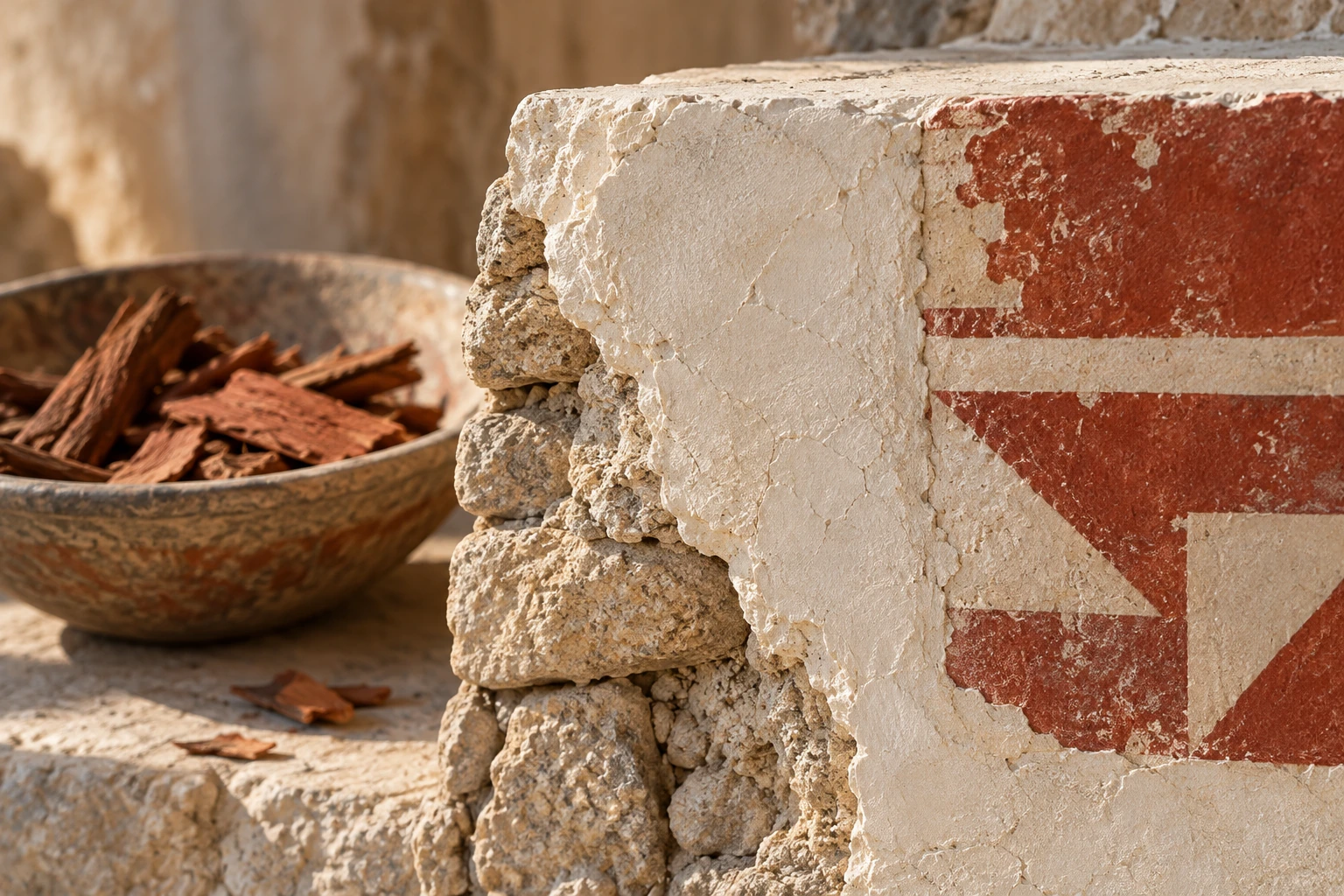
The conceptual illustration brings a broken edge and a smooth surface together. Its bowl and decorative geometry are illustrative choices, not objects from a documented excavation. Use it to notice the difference between bulk material and finish, then turn to the study for the actual samples and their locations.
Stone changed into a binder
In the basic lime cycle, heating limestone releases carbon dioxide and produces quicklime. Reacting quicklime with water produces slaked lime. As an air-lime material hardens by carbonation, it takes up carbon dioxide and forms calcium carbonate again. These are chemical transformations, not simply grinding a white rock into smaller pieces.
The cycle is a helpful outline, but it is not a complete account of a historical plaster. A finished material also has a structure: pores, grains, interfaces, layers, and sometimes added substances. Those relationships help determine how it behaves. Knowing the names of ingredients is only a beginning.
Nor does a chemical cycle mean the final surface has returned to the original rock in every respect. A quarried stone and a newly formed binder may contain related minerals while differing in texture and arrangement. “Back to limestone” is memorable shorthand, but it can obscure the very features a materials researcher wants to examine.
The Copán experiment
Carlos Rodriguez-Navarro and colleagues analyzed plaster samples from Classic-period Copán structures. Some contained organic material within a calcite-rich binder. Following advice from Maya-descendant masons, the team prepared replicas with extracts from chukum and jiote bark. Compared with additive-free controls, the replicas helped demonstrate how incorporated organics could change crystal structures and improve toughness and weathering resistance.
The paper's author-hosted full text makes clear that the ancient samples were not all identical. That qualification matters. This is evidence for particular materials and a tested mechanism, not a license to assign one formula to every Maya city or every century.
Traditional knowledge was part of choosing what to test. Laboratory instruments did not conjure the practical use of tree extracts from nowhere. At the same time, a modern replica does not recreate every action in an ancient workshop. The relationship is strongest when both contributions are described precisely.
How to read a materials claim
A useful research question has more moving parts than “did the additive work?” What counts as working? Resistance to cracking, behavior while wet, long-term weathering, and ease of application are different properties. A material can improve in one respect without becoming universally superior.
Historic Environment Scotland's account of mortar analysis shows why complementary methods matter. A hand specimen, a microscope, and mineral identification provide different information. Observing texture is not the same operation as identifying minerals. A sample's location also matters because its function and exposure help explain its condition.
| Question | Evidence that helps | What it cannot do alone |
|---|---|---|
| What is present? | Composition and mineral analysis. | Reconstruct every workshop action. |
| How is it arranged? | Microscopy and layers in a sample. | Tell us every maker's intention. |
| Does a proposed change affect behavior? | A comparison with a suitable control. | Guarantee identical performance in every wall. |
| Where does the result apply? | Sample context, test conditions, and replication. | Turn a local result into a timeless universal recipe. |
Keep the last column beside the first two. It does not weaken the research. It shows the boundary of each kind of evidence. The most convincing account is one in which the conclusion fits inside those boundaries.
Why a stronger material may be the wrong repair
Modern conservation introduces another question: what belongs next to an existing wall? Historic Environment Scotland's repair guidance emphasizes compatibility with existing materials, exposure, and aftercare. Strength by itself is an inadequate goal. An unsuitable repair can affect neighboring fabric and moisture movement.
This guidance concerns modern conservation practice, not a direct instruction from Copán's builders. Its relevance is the decision it forces us to articulate. Are we trying to reproduce a historical surface, protect old material, understand a mechanism, or design something new? Those aims overlap, but they are not interchangeable.
When a headline promises an ancient secret for modern buildings, try writing the missing specification. Which tested property matters? In what climate? On what substrate? For how long was it measured? You do not need to solve all those questions to see why the single word “better” is doing too much work.
The reward for this slower reading is considerable. A wall coating becomes evidence of learned practice, demanding material choices, and knowledge that can still inform research. Its endurance is interesting because it can be investigated, not because it has to remain mysterious.
Sources and further exploration
- Rodriguez-Navarro and colleagues, Science Advances 9,eadf 6138,2023
- Author-hosted copy of the 2023 plaster study
- UNESCO: Maya Site of Copan
- Historic Environment Scotland: What is mortar analysis?
- Historic Environment Scotland: lime mortar repair principles
Explore all 80 new articles · Browse the complete illustrated collection
Continue exploring art, ideas, and unexpected connections at Incoprea.