A purple thread looks like an answer: someone wanted purple. For an archaeologist, it is the beginning of several questions. Which coloring material was used? Where could it have been obtained? What part of the process happened here? Does the object's color tell us anything secure about the person who wore it?
Tyrian purple is associated with particular Mediterranean sea snails and a demanding dyeing tradition. But “purple” is also a broad visual category. The history becomes more interesting when we resist treating every purple textile, every shell heap, and every royal story as pieces of one interchangeable puzzle.
One color name, several kinds of evidence
The dye material comes from a gland secretion, not simply from pulverizing the shell into purple powder. Production involves transforming the extracted material and applying the color to fibers. Different conditions can produce different shades. A single bright screen swatch is therefore a poor standard for identifying an ancient dyestuff.
A useful comparison comes from a quite different place and period. The Metropolitan Museum's record of an Andean tunic, dated to the fifteenth or early sixteenth century, reports that its purple/blue areas contain cochineal. They are not evidence of Mediterranean murex dye. The example separates a visible result from the material route used to achieve it.
This does not make the tunic an imitation of Tyrian purple. It belongs to its own textile tradition. Placing the records beside each other is a comparison of how color is identified, not a claim of shared origins, direct influence, or a universal hierarchy in which one culture's purple is the authentic version of another's.
Timna: a result small enough to be precise
In a 2021 study of textiles from the Timna Valley, Naama Sukenik and colleagues identified three examples dyed with murex-derived material. Their chemical analysis detected characteristic brominated indigo compounds. The finds came from a copper-smelting site whose radiocarbon chronology places the context in the late eleventh to early tenth centuries BCE.
The researchers discuss prestige and social organization, but a dye identification is not a recovered owner's name. “Royal purple,” in the article's title, names a historically prestigious material. It does not prove that a particular king wore these fragments. The distinction allows the evidence to remain important without adding an unsupported royal wardrobe.
Think of the inference as a series of doors. Analysis can open the material door. Archaeological context helps open the place-and-date door. Identifying an individual wearer requires another kind of key. Leaving that door closed is a more accurate account than assuming that the first result opened every room.
A shell heap is a question, not a complete workshop
The Timna paper also warns that shells can be associated with uses other than dye production. A deposit needs contextual interpretation. At a different site, the team studying Alatzomouri-Pefka on Crete combined evidence for basins and vessels with chemical residues. Their account emphasizes why a painted garment alone cannot establish the dyestuff used in a real textile.
This is a good example of evidence becoming stronger through combination. A feature that looks like a basin may support several explanations. A residue helps narrow them. A pattern of related features can strengthen an interpretation further. None of that requires pretending that one attractive find speaks in a complete sentence.
The Penn account also describes two dyestuffs found in one vessel while acknowledging uncertainty about whether they were mixed or used separately. Finding substances together does not automatically reconstruct their sequence of use. An accumulated history and a single deliberate mixture can leave overlapping traces.
Make a simple inventory of the evidence before drawing a route on a map. A textile establishes a colored object at its find context. A workshop residue points toward processing at another location. A written description establishes that an author discussed a practice. Connecting those points may be a reasonable hypothesis, but the connecting line is an argument. It is not another excavated object. Labeling that line as a hypothesis keeps a useful map from becoming a misleading picture of certainty.
Pliny: expertise, complaint, and a translated voice
Turn from laboratory analysis to Book 9 of Pliny's Natural History. In the 1601 English translation hosted by the University of Chicago, the discussion distinguishes different purple products, processing choices, and prices. It also criticizes expensive display. Technical description and moral judgment occupy the same passage.
Read that mixture rather than editing the author's attitude away. A complaint about luxury is evidence that someone wanted to criticize luxury. It may also preserve information about products and practices. Those are related uses of the text, but one should not be mistaken for the other.
The translation adds another layer. Terms such as “purple,” “violet,” and “scarlet” arrive through a historical English vocabulary as well as an ancient Latin one. They should not be converted casually into precise digital color values. The text is describing materials and appearances within a particular linguistic world.
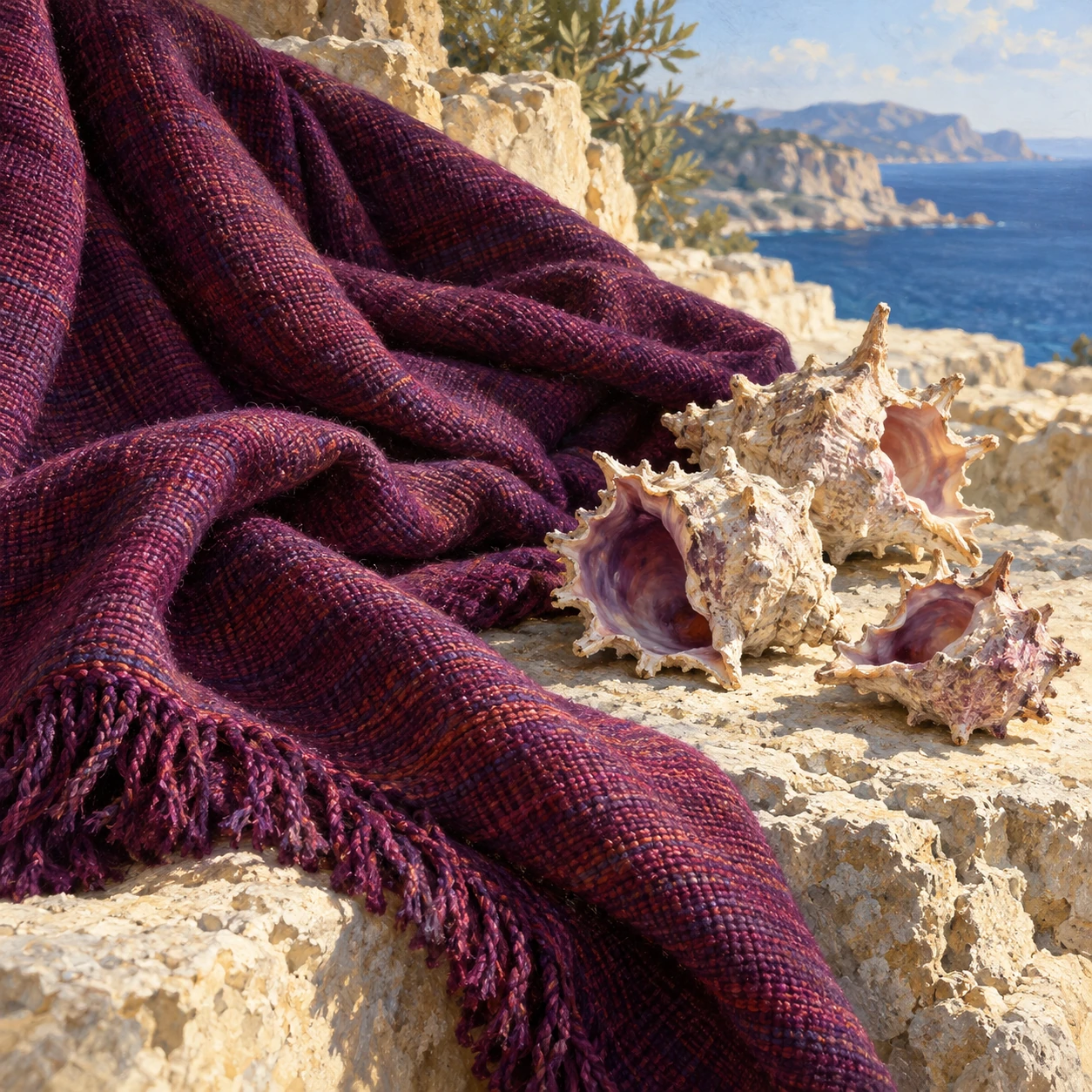
Finally, return to the image of folded cloth beside shells. It gives the subject a visual form, but it cannot certify a chemical composition or reconstruct a specific ancient garment. The research does that work through particular samples and explicit reasoning.
The fascination of Tyrian purple lies partly in the distance between appearance and process. A small area of color can connect skilled production, exchange, social ambition, and the survival of perishable things. Following those connections carefully gives us something richer than the familiar sentence that purple was expensive.
Sources and further exploration
- Sukenik and colleagues: purple textiles from Timna,2021
- Pliny, Natural History Book 9, Philemon Holland translation 1601
- Penn Museum: Aegean Dyes, by the research team
- Metropolitan Museum: Tunic, Arica(?),1979.206.954
Explore all 80 new articles · Browse the complete illustrated collection
Continue exploring art, ideas, and unexpected connections at Incoprea.