A black lacquer box with a few gold grasses can appear almost weightless as a design. Light slides over the lid, the grasses rise and bend, and the wooden body seems to disappear. Looking closely reverses that impression. The apparent simplicity rests on a sequence of surfaces, preparations, and carefully timed work.
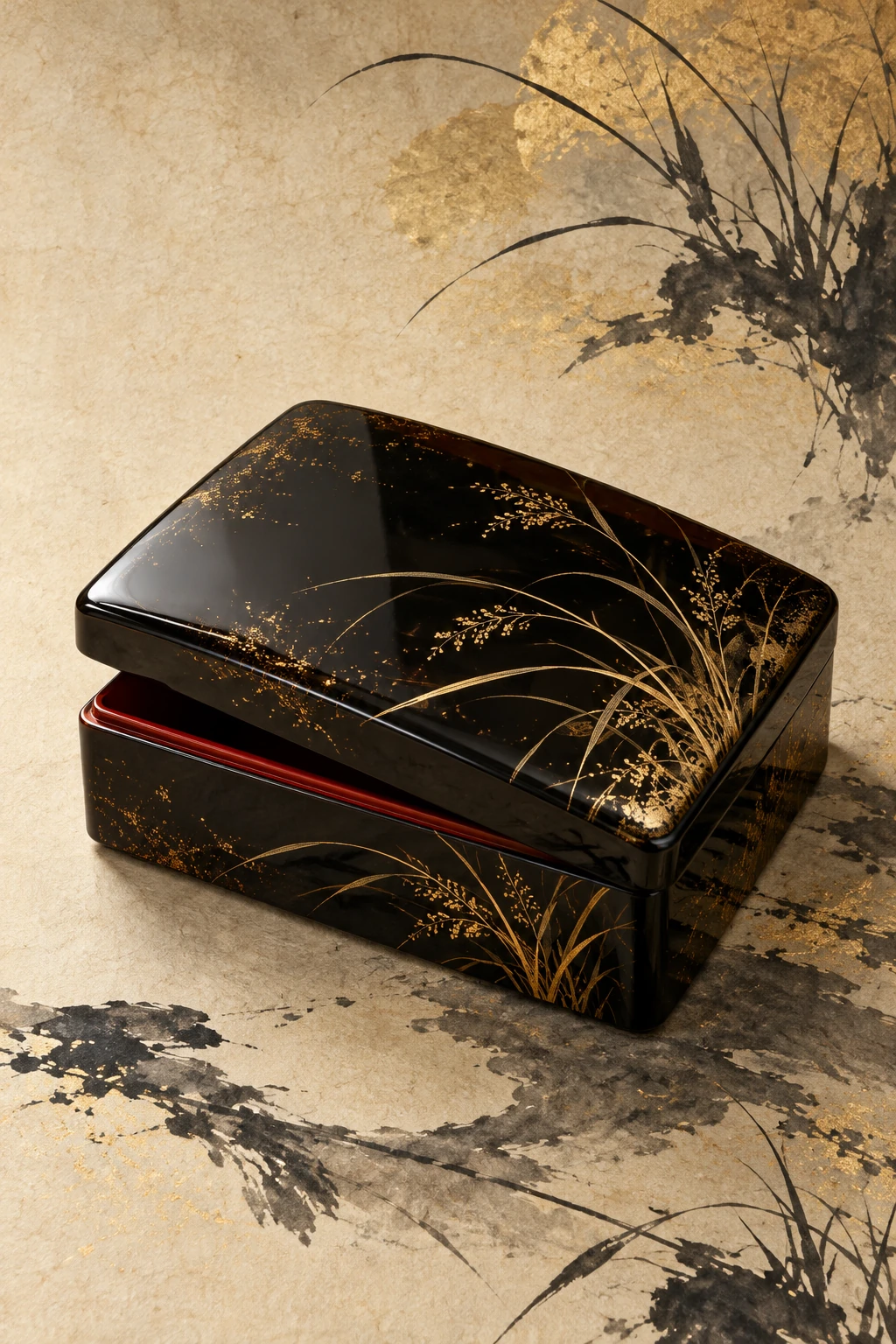
The word urushi refers to the lacquer derived from the sap of the urushi tree. A V&A documentary follows artist Kenji Honma in Japan's Okukuji region. His practice includes cultivating trees, harvesting and refining sap, turning wood, and applying successive coatings. The film makes a useful introduction because the finished vessel is shown as the end of a much longer material story.
Watch the stages that a finished object hides
Before watching, write down the actions you expect the phrase “lacquer a bowl” to include. Then compare your list with the film. Pay attention to changes of scale: a landscape of trees, a small quantity of sap, a shaped wooden body, and a surface being worked by hand.
Honma is a named contemporary artist with a particular integrated practice. His film should not be treated as proof that every historical lacquer object was made by one person who also grew its trees. The value is more precise: it makes visible connections that a short materials label compresses into one word.
The Met's survey of East Asian lacquer describes repeated thin applications and a warm, humid environment for curing. A lacquer surface is not simply a dry paint film that appears once a solvent has disappeared. Its preparation and hardening conditions are part of the craft.
Different lacquer traditions use different decorative approaches. Carving built-up layers, inlaying material, and applying metal powder are not interchangeable descriptions. Even when two objects share a glossy black ground, their making may differ considerably.
Gold can be particles as well as a painted color
In maki-e, metal powder participates in a design made with lacquer. Powder can be sprinkled onto a prepared design, and different techniques build, cover, expose, or polish it in different ways. A bright gold passage is therefore a physical arrangement of material, not merely a yellow shape.
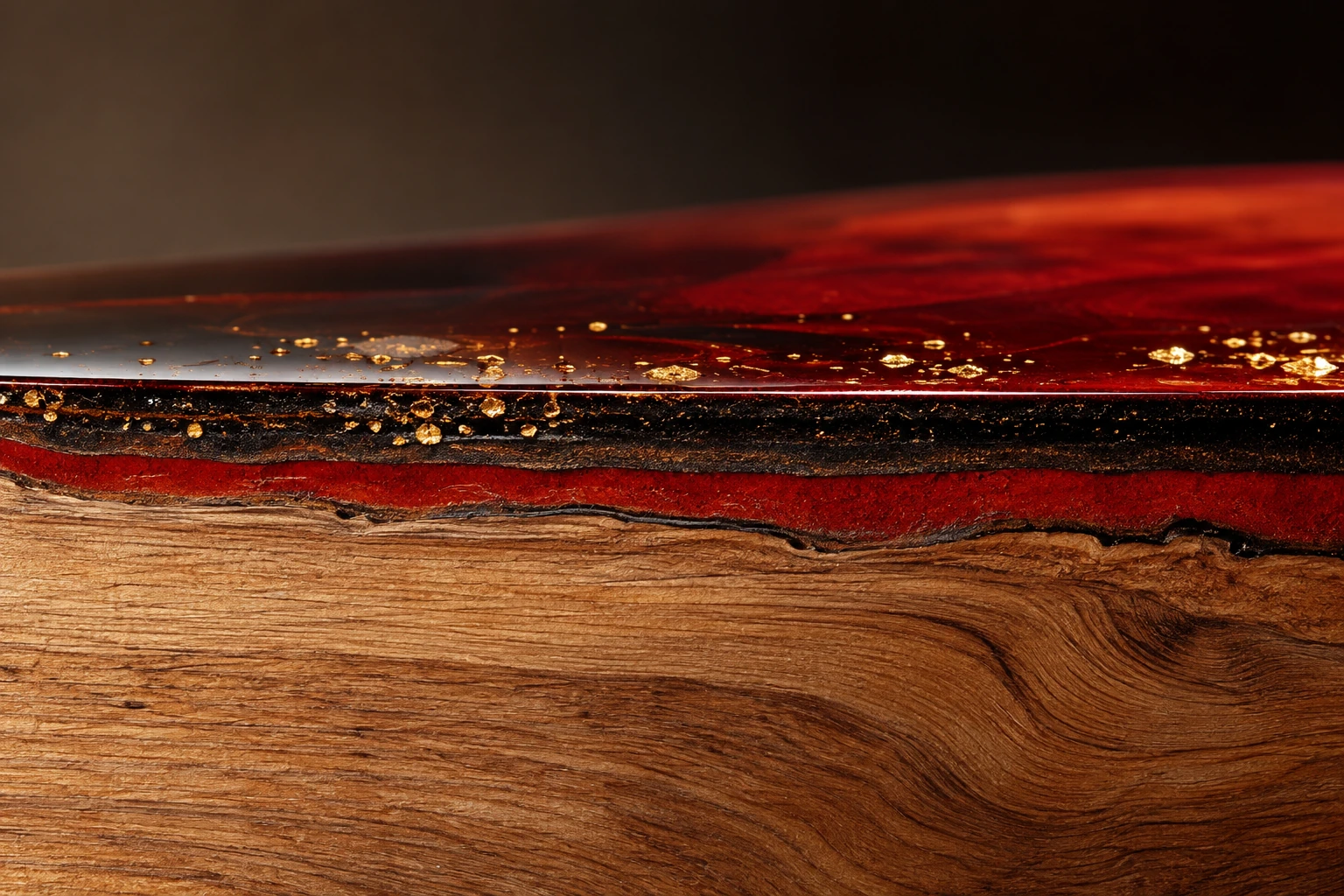
The conceptual detail above exaggerates a layered edge so the relationship is easy to see. It is not a microscopic section, and its thicknesses are not measurements. Real objects can have more complicated preparations, varied sequences, and decoration that occupies different levels of the finished surface.
A lacquer surface has a sequence
Qualitative layer explorer with technique-specific limitations; not a raw-urushi recipe.
The layer explorer separates support, preparation, lacquer, and decoration. Move through it to practice naming what each part does. Its final stage is deliberately conditional: covering and polishing depend on the specific technique. There is no universal five-step recipe hidden behind every lacquer object.
Open a writing box rather than stopping at the lid
For a historical comparison, open the Met's writing box attributed to Igarashi Dōho, dated to the second half of the seventeenth century. Its record identifies raised, flat, and polished maki-e techniques alongside foil and mother-of-pearl. Inside are an inkstone, a water dropper, and trays for brushes and ink cakes.
Those contents change how we read the exterior. The box organizes a practice as well as presenting an image. Its opening creates a sequence: closed lid, interior scene, arranged equipment. The object rewards a viewer who follows that sequence rather than treating its outer surface as a picture detached from a container.
Compare the record's interior and exterior images. Which motifs continue, which surfaces change, and where does the equipment interrupt the image? You do not need to decide that every choice has one hidden symbolic meaning. Describing the relationships accurately is already a worthwhile form of attention.
Try one last change of view: imagine the box closed in storage, open during writing, and displayed with its tools arranged for a museum photograph. The same object supports different kinds of attention in each setting. Its finish, compartments, and imagery remain connected even when the viewer concentrates on just one of them.
Finally, notice the phrase “attributed to.” It signals a scholarly judgment about authorship rather than an unquestioned signature. The surface can be closely studied even when its maker's identification remains qualified. Lacquer rewards that combination of patience and precision: looking through a beautiful finish toward the labor and material decisions it carries.
Sources and further exploration
- V&A: What is lacquer (urushi) and where does it come from?
- Metropolitan Museum: Lacquerware of East Asia
- Metropolitan Museum: writing box attributed to Igarashi Dōho,2023.226a–g
Explore all 80 new articles · Browse the complete illustrated collection
Continue exploring art, ideas, and unexpected connections at Incoprea.