An orange thread curls through the air beside a green stem. It has no eyes, no nose, and no legs, yet its direction can be influenced by chemicals released from another plant. Dodder makes the space around vegetation look different: apparently empty air can contain useful information about a potential host.
Dodders belong to the parasitic plant genus Cuscuta. Their thin stems can coil around hosts and form specialized connections called haustoria. Through those interfaces, a parasite obtains resources from the host. The obvious tangle is only the visible outcome. Before it can exploit a plant, a young dodder must reach one.
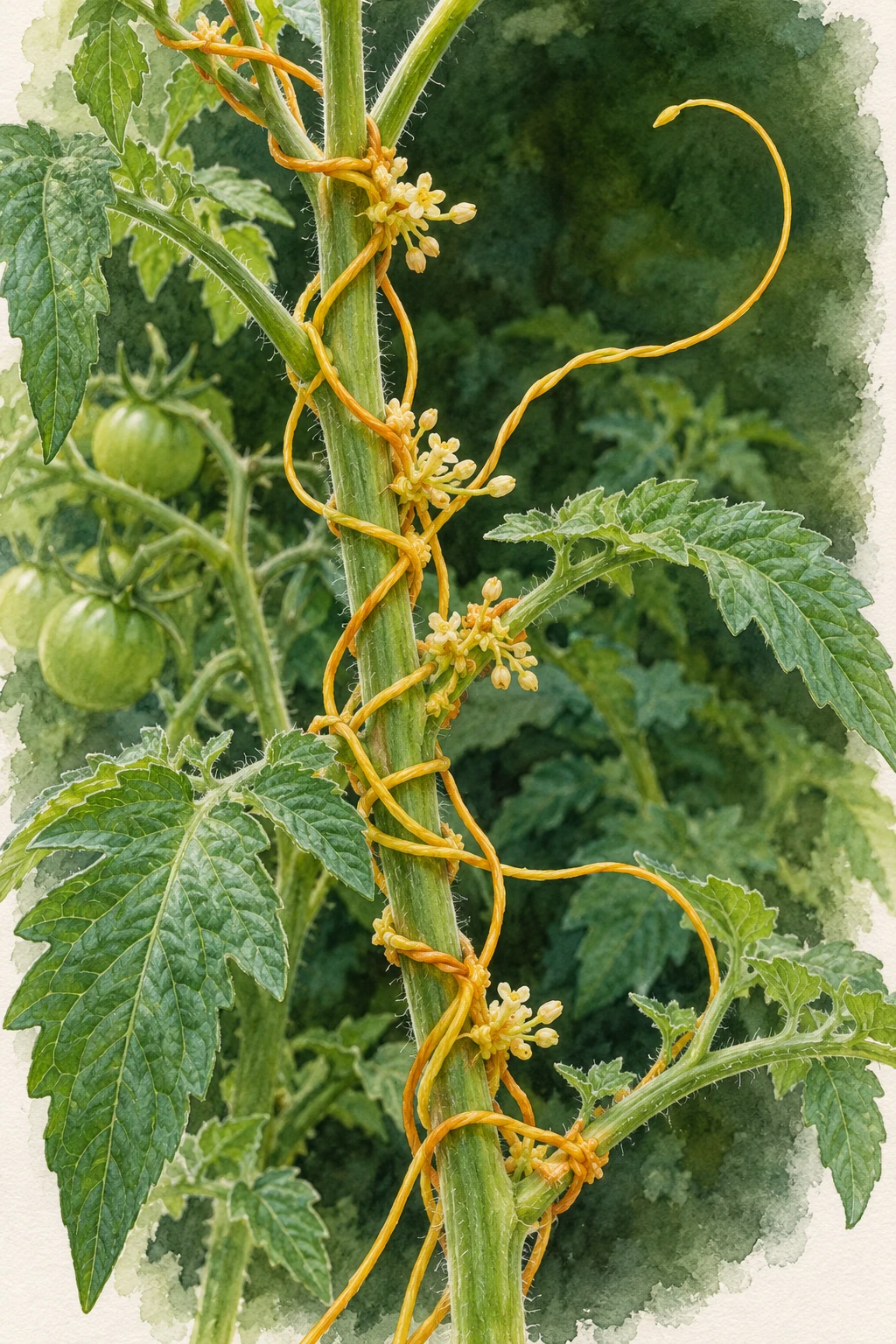
How to distinguish a smell from a silhouette
In experiments published in 2006, Cuscuta pentagona seedlings grew toward nearby tomato plants and toward extracted tomato volatiles presented without the whole plant. They also responded to other plants, but preferred tomato over wheat volatile cues in the comparison. Certain individual compounds attracted growth, while one wheat compound was repellent.
The important step was separating possible cues. A whole tomato plant supplies light, shade, humidity, contact opportunities, and chemicals. A seedling curving toward it cannot tell us which of those mattered. The Penn State account describes tests with artificial visual stand-ins and extracted chemical cues. The researchers did not infer a chemical response solely because the growth looked purposeful.
“Smelling” is an accessible shorthand for detecting airborne chemicals. It should not imply a nose, a mammal's sensory experience, or a plant consciously choosing lunch. The directly supported description is that chemical information changed directional growth under the tested conditions. That statement is already surprising enough.
Growth can be a way of moving toward information
We tend to imagine behavior as an animal changing position rapidly. A plant can instead alter where its next tissue is added. Over time, differential growth changes a stem's direction and the contacts it is likely to make. A time-lapse reveals the result much more readily than a glance at a garden bed.
That difference in timescale can make plants seem passive when they are not, or tempt a viewer to give them animal intentions when the film is sped up. Both shortcuts lose the mechanism. The useful questions concern the cue, the growth response, and whether that response improves access to a host.
A controlled result in one dodder species also does not establish the same cue hierarchy for every Cuscuta species in every habitat. Wind, the mixture of neighboring plants, distance, and the stage of development can change what information is available. The experiment identifies a capacity and a mechanism worth studying, rather than a universal rule for every orange vine.
The connection moves more than water and sugar
Once dodder attaches, the interface is biologically intimate. Genomic work described in a 2014 Virginia Tech thesis examined messenger-RNA movement between parasite and hosts. By sequencing tissues from the parasite, attachment region, and nearby host, researchers could distinguish transcripts associated with the different plants. The work documented extensive cross-species RNA traffic.
Finding a molecule on the other side of a connection is not automatically proof that it has a particular function there. That is a separate experimental question. Messenger RNA normally carries information used in making proteins; detecting its movement opens possibilities, but each claimed consequence needs evidence.
Later research supplied a more specific example of functional influence. A 2018 study summarized by Penn State showed dodder-derived microRNAs associated with reduced expression of targeted host genes, including genes relevant to defense. MicroRNAs are short regulatory molecules, distinct from messenger RNAs. The Axtell Lab overview explains their role as sequence-specific regulators of gene expression.
The sequence of discoveries is useful: a plant can be located through airborne information; attachment creates a resource connection; molecules crossing that interface can also affect regulation. These are different mechanisms operating at different stages. Combining them into “plants talk” would be less informative than keeping the stages separate.
For agriculture, dodder is not merely a botanical curiosity. A parasite connected to a crop creates a difficult management problem because host and parasite are physically and physiologically linked. Understanding that link can suggest research directions for resistance, but a mechanistic discovery is not the same as an immediately available control method. Gardeners should use local extension guidance rather than cultivating the parasite for an experiment.
The orange thread is therefore an entry point into a layered relationship. Airborne chemistry guides growth before contact. A specialized organ then links two plants. Across that link, the interaction can reach the level of gene regulation. What looks like a tangle on a stem is also a meeting of detection, development, and molecular exchange.
Follow the evidence: Runyon, Mescher and De Moraes: volatile-cue experiments; Penn State: the host-location experimental design; Kim: cross-species messenger-RNA movement; Penn State: dodder microRNAs regulate host genes; Axtell Lab: plant microRNA biology.
More curious connections, art and independent projects at Incoprea.