Showing posts with label Music. Show all posts

Saturday, October 24, 2026

The Scale That Climbs Back to Its Starting Point

Imagine a staircase whose next step is always higher, yet one complete circuit leaves you exactly where you began. A drawing can suggest that contradiction. A carefully constructed sound can make it feel surprisingly plausible to the ear.

Copper steps curl upward around a dark blue architectural shaft.
A visual metaphor for an apparent ascent. The sound demonstration below uses finite frequencies and a repeating construction.

A Shepard-tone sequence is not a single frequency rising without limit. It combines several components and changes their balance so that an upward step can remain convincing while the overall pattern returns to its beginning. The interesting question is where the returning information hides.

Hear the stack, then hear the step

UC San Diego's explanation describes sinusoidal components separated by octaves beneath a fixed spectral envelope. Components near the low and high extremes are quiet. As the frequencies rise, high components fade away and quiet low components become available. After twelve semitone steps, the construction can return to its initial state.

Picture several identical name tags on different floors: C on one floor, C an octave above it, and another C higher still. All move upward together. Lighting is brightest on the middle floors and dim at the extremes. A tag entering below becomes visible gradually while one leaving above fades out. This is an analogy for amplitude weighting, not a literal picture of a cochlea.

Hear a loop conceal its reset

Click-start sine-wave sequence, finite duration, single-component comparison, visible loop counter and Stop button.

Open hear a loop conceal its reset in its own window.

The demonstration starts only when you press a play button and stops automatically after a short sequence. Begin at a low device volume. You can choose the layered sequence or a single middle component. The display reports the twelve-step loop position, making the return available to the eye while the ear follows the apparent ascent.

What “higher” means in this experiment

In his 1964 paper, Roger Shepard reported a set of complex tones that could produce circular judgments of relative pitch. Neighboring tones around the constructed circle could be judged successively higher, while diametrically opposed comparisons were ambiguous. This is evidence about a special stimulus set and perception, not evidence that ordinary frequency has become circular.

The distinction is easier to feel with a familiar melody. Two versions an octave apart can sound related in note identity while differing in register. “Same note name” and “same overall height” are different claims. The Shepard construction deliberately makes the relationship between those aspects hard to settle.

Listen to one short run with your eyes away from the counter. Does it seem to ascend? Write your answer before revealing the step number. Then play another run while watching the reset. Your perception need not agree with someone else's description on every presentation. Hearing, playback equipment, the envelope, and attention can all affect an informal demonstration.

The quiet parts do essential work

Switch to the single-component version. Its return to a lower starting frequency is more exposed. Now restore the layered version. The contrast helps identify what the stack contributes: another component can preserve an apparent upward continuation while a quieter part changes role.

The local synthesis uses a small, finite set of sine waves and a smooth amplitude envelope. It is an educational implementation, not a replication of Shepard's experimental equipment or an individual hearing assessment. Its low-level start, fade-in, and automatic ending are presentation choices, not ingredients that prove the illusion.

Graduated translucent rods fade into shadow at the extremes while the middle remains bright.
A visual metaphor for the weighting: middle components stay prominent while the extremes fade. The actual synthesis values appear in the model.

A neighboring illusion asks a different question

Diana Deutsch's tritone-paradox work uses tones ambiguous in octave height to study how listeners judge pairs separated by half an octave. Her account distinguishes pitch class from height and reports systematic differences between listeners. That phenomenon should not be treated as merely another name for an endlessly rising scale.

Visit her examples after using the local twelve-step sequence. Ask what changed in the task. Following adjacent steps around a loop is different from deciding whether a widely separated pair rises or falls. A shared kind of ambiguous tone can support different experiments.

If the climb does not seem endless

That is an observation, not a failed test. Try the layered and single-component settings once each, at the same comfortable volume, and compare their resets. Do not turn the sound up to force an effect. You can still understand the construction by following the listed frequencies and amplitudes as they exchange roles.

At step zero, the component list begins at 55 hertz and includes octave multiples. Advancing the silent counter changes every frequency by the same semitone ratio. After step eleven, the display returns to its original list. The reset is exact in the recipe even if the sequence still feels directional when heard.

The satisfying part comes when explanation and experience coexist. You can know that the sequence repeats, watch the counter return to zero, and still hear a compelling next step. The contradiction belongs to the judgment your auditory system builds from the available cues. The frequencies remain finite, and the staircase has a carefully concealed landing.

Sources and further exploration: UC San Diego: Shepard-tone construction; Roger Shepard: circularity in relative-pitch judgments; Diana Deutsch: the tritone paradox.

Explore all 50 new articles · Browse the complete illustrated collection

Explore more art, ideas, and independent projects at Incoprea.

Friday, October 23, 2026

The Wolf Interval Hides in a Tuning System’s Unpaid Remainder

Suppose you tune one note, then tune another a perfectly pure fifth above it. Keep going. After twelve fifths you expect to return to a familiar note name, seven octaves higher. The arithmetic disagrees. The journey overshoots, leaving a small remainder that cannot be wished away by careful workmanship.

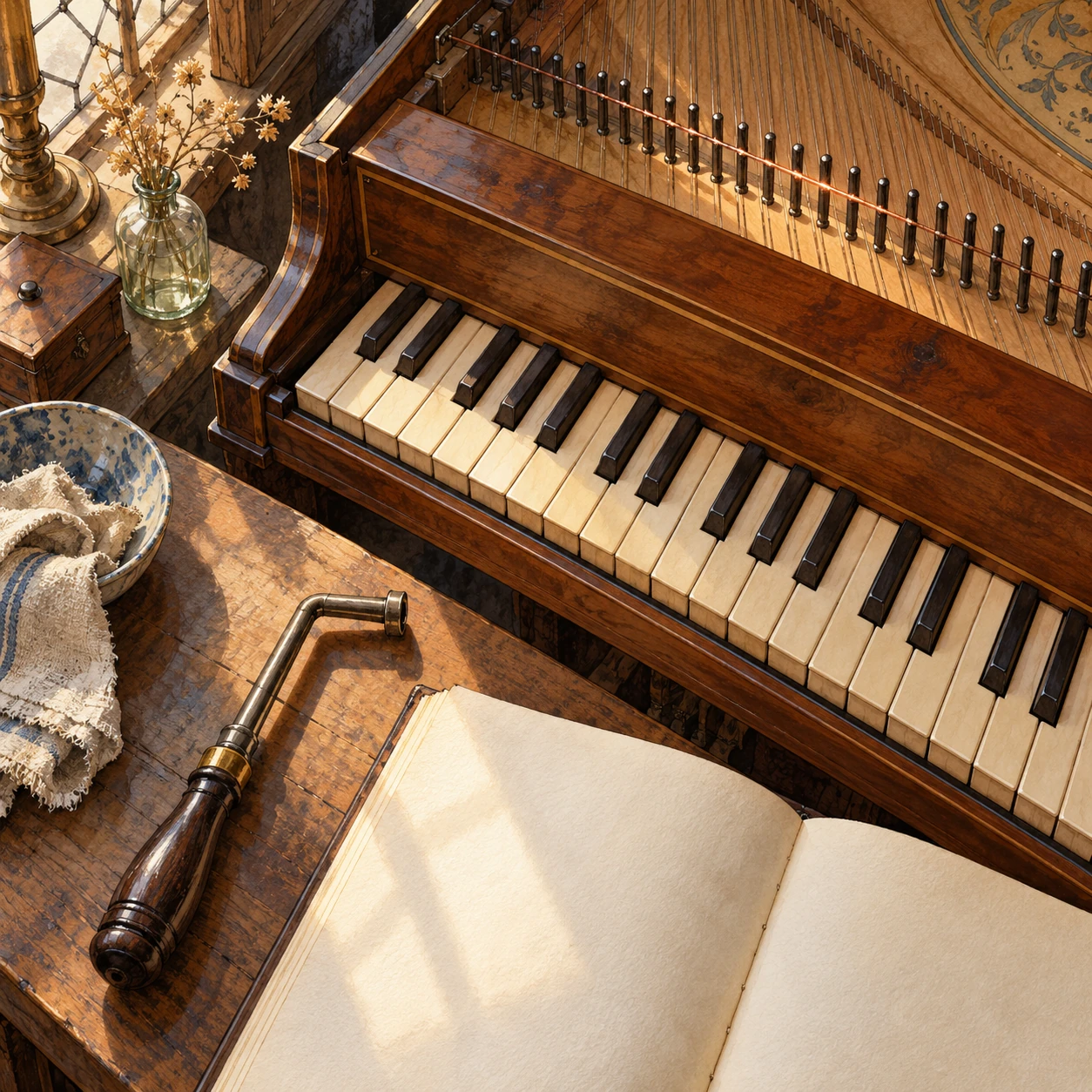
A tuning tool and a blank notebook lie beside a wooden keyboard.
A fixed keyboard asks a limited set of pitches to serve many relationships. The arithmetic model below exposes one compromise.

This is a design problem disguised as a mistake. A fixed keyboard asks a finite set of keys to serve many harmonic relationships. Some desirable frequency ratios refuse to fit together exactly. A tuning system decides where that disagreement will be heard.

Do the journey with ratios

In John Baez's mathematical account, a pure fifth has frequency ratio 3:2 and an octave 2:1. Twelve fifths multiply frequency by (3/2)12; seven octaves multiply it by 27. Their quotient is 531441/524288, approximately 1.01364. This discrepancy is the Pythagorean comma.

The two routes end about 1.36 percent apart in frequency. That percentage is calculated from the ratio, not measured in a performance here. Musical intervals are more conveniently compared logarithmically in cents: 1,200 cents make an octave. The same remainder is about 23.46 cents.

You can verify the issue with a calculator. Multiply 1.5 by itself twelve times and compare the result with 128. Now ask a different question: how much must each of twelve identical steps be adjusted if their combined journey is to close? The answer concerns a repeating ratio, so simply subtracting a fixed frequency from every note is the wrong operation.

A wolf is tied to a particular compromise

The Lehman College physics notes compare open, closed unequal, and equal temperaments. In a twelve-note Pythagorean arrangement, preserving eleven pure fifths leaves a substantially narrowed closing interval. It is often called a wolf fifth. Other temperaments can produce a different wolf with a different size and direction of error.

Keep that last distinction. The famous wide wolf in quarter-comma meantone is not numerically the same interval as the narrowed Pythagorean closure demonstrated below. “Wolf” is a family resemblance in the problem a listener encounters, not one universal frequency ratio.

Move the closing interval

A silent ratio calculator compares a Pythagorean closing link with equal-tempered fifths. No measured instrument data.

Open move the closing interval in its own window.

The model uses twelve abstract links in a closed chain. It compares eleven pure fifths plus one closing remainder with twelve equal-tempered fifths. It deliberately avoids a historical keyboard's spelling and octave-placement conventions. Moving the marked closure changes its location in the chain, not the amount of arithmetic left over.

Give the remainder an address

Imagine programming a small musical instrument for only one piece. If the piece never crosses a particular harmonic relationship, putting the largest mismatch there might be a practical choice. Now lend the instrument to someone playing in distant keys. The hidden compromise may become the first thing they notice.

Move the closing link in the model. Choose three neighboring links as your imaginary piece's territory. Can you place the special interval outside that territory? Expand the territory to all twelve. You can no longer keep one exceptional link out of every possible journey. The exercise turns an abstract comma into a question about intended use.

Equal does not mean all ratios are pure

Equal temperament makes each semitone the same ratio, 21/12. Its seven-semitone fifth is 700 cents, slightly narrower than the pure fifth's approximately 701.96 cents. The mismatch is spread instead of collected in a single closure. This removes the exceptional fifth within this ideal twelve-note model, while giving up pure 3:2 fifths.

The Tune Smithy creator's listening notes distinguish the Pythagorean example from the original meantone use of the term. Its examples can extend the arithmetic into listening, but compare the tuning names before comparing impressions. Different demonstrations may be talking about different compromises.

What the model leaves out

Real piano strings are not ideal harmonic oscillators, and practical tuning may stretch octaves. This calculator does not model that, individual instruments, historical tuning procedures, or judgments of musical beauty. It isolates the incompatibility between closing a twelve-link chain and keeping every fifth at 3:2.

There is another way to check the calculator: multiply all twelve displayed link ratios. In either arrangement their product should be 128, the seven-octave span. That check tests the closure independently of the displayed cents. The two systems agree on the journey's endpoint while disagreeing about the size of its individual steps.

The wolf is interesting because it exposes a system's priorities. A tuner can favor certain relationships, distribute discrepancies, or make additional pitches available. The question is not whether arithmetic can be defeated. It is which musical possibilities a particular compromise makes comfortable—and which relationship is asked to carry the remainder.

Sources and further exploration: John Baez: mathematics of tuning systems; Lehman College: temperament and pitch; Tune Smithy: different wolf fifths.

Explore all 50 new articles · Browse the complete illustrated collection

Explore more art, ideas, and independent projects at Incoprea.
The Ondes Martenot Puts a Singing Voice Between Two Hands

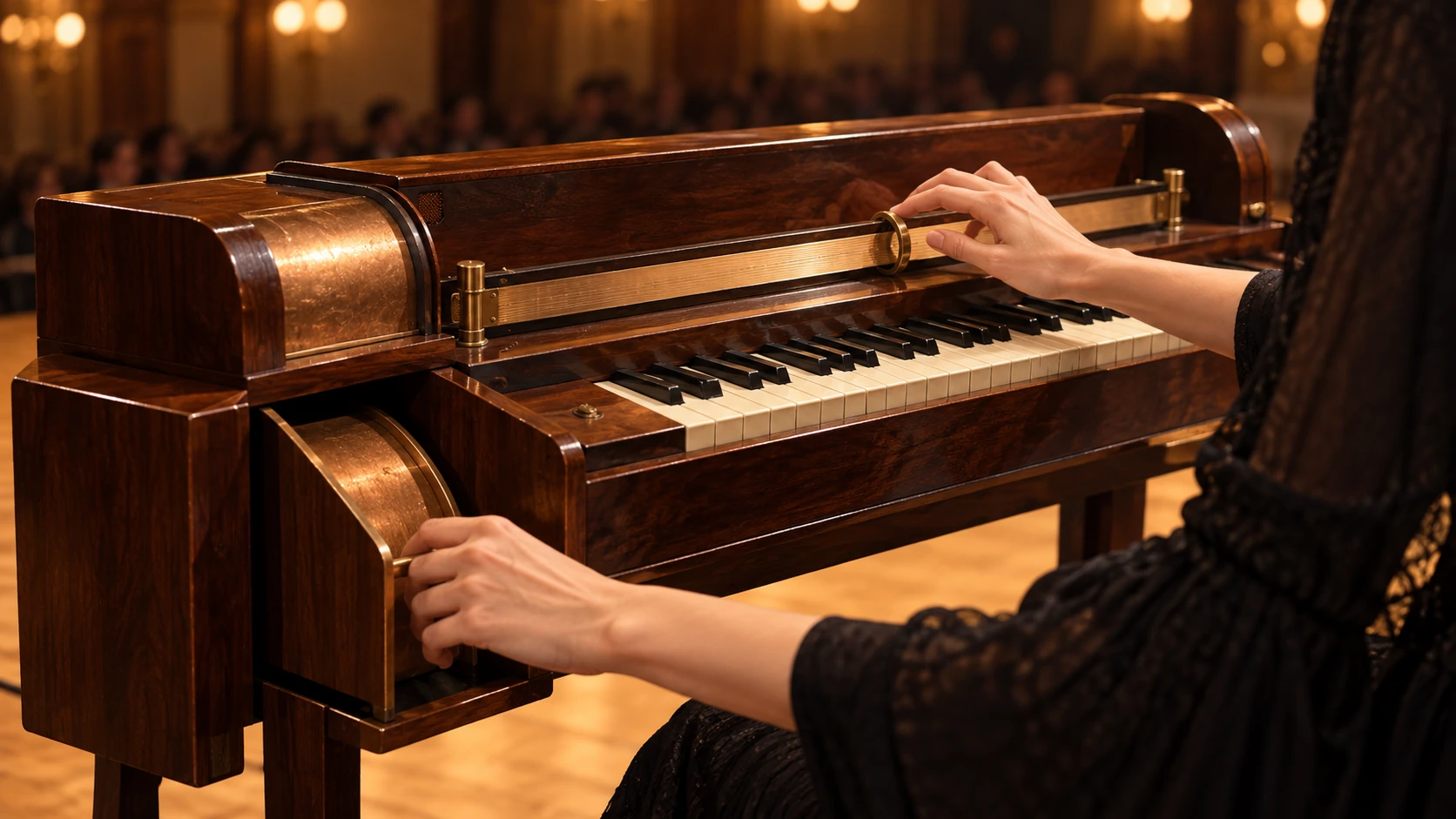
Watch the player's right hand before you listen for a melody. A finger travels along the front of a keyboard, apparently ignoring the keys. The sound bends with the gesture. Meanwhile, the left hand works inside a small drawer. One hand decides where the note goes; the other decides how it arrives.

A musician uses a ring control in front of a wooden keyboard and a separate left-hand drawer.
The two hands have different jobs. This interpretive scene shows the ribbon-and-drawer idea rather than a particular museum model.

The ondes Martenot makes an unusually clear invitation to watch music being shaped. Its electronic sound can seem remote or ghostly, but the control is close, physical, and practiced. The instrument rewards a question more specific than “What makes that strange noise?” Ask which hand is responsible for the change you just heard.

Separate the jobs before joining them

The LAM acoustics laboratory describes a division between pitch control with the right hand and amplitude control with the left-hand expression key. Electronic oscillation supplies the tone. Changing the signal's shape supplies different timbres. Those are related parts of a performance, but they are not the same control.

You can explore the distinction without an instrument. Trace a slow rising line in the air with one hand. With the other, mime a pressure that starts gently, grows, and releases. Repeat the rising line with a sudden attack instead. The pitch route is unchanged; the imagined phrase is different. This is a movement exercise, not a claim that air gestures reproduce the instrument's resistance.

The ring makes the spaces between keys available

In performer Thomas Bloch's description, a ring on a ribbon allows the right index finger to travel continuously along the keyboard's front. A later mobile keyboard can also support vibrato through lateral movement. A familiar piano-like layout therefore sits beside a very different way of reaching and connecting pitches.

Imagine singing a single syllable while sliding between two notes. Now imagine playing the intervening piano keys one after another. Both gestures rise, but one crosses a continuous space while the other selects steps. A composer can use either kind of movement deliberately. Neither is automatically more expressive; each makes certain relationships easier to articulate.

In Bloch's linked demonstrations, choose a passage with an exposed solo line. First watch with the sound low and predict where a slide begins. Then listen at a comfortable level. Look for moments when the hand stops moving but the tone still changes in strength. You are listening for the relationship between controls, rather than trying to name a mood.

A museum object has a particular version

The Musée de la musique's 1930–1934 instrument is a useful antidote to treating every ondes Martenot as identical. Its account traces the 1928 public presentation, describes early ribbon playing, and identifies the expression key in the drawer. It also distinguishes that object's loudspeaker arrangement from additional diffusers introduced on later models.

That matters when reading a photograph. A feature described for a late concert instrument might not belong to an earlier surviving example. Before identifying a control in a video or museum image, look for a date or model description. A missing component can reveal the instrument's development rather than damage or incompleteness.

A close-looking checklist for a performance

Follow one phrase three times. On the first pass, track only horizontal right-hand movement. On the second, watch how the left hand starts and ends sounds. On the third, listen for whether the character changes while the melodic register stays similar. Write one observation for each pass. Leave uncertain mechanisms as questions instead of guessing from the sound alone.

The loudspeaker can belong to the instrument

Bloch describes different diffusers, including a conventional loudspeaker and resonating devices that add their own response. The sound reaching the listener is therefore shaped after the electrical signal is created. This is a useful reminder for any electronic music: the thing that radiates sound into a room can participate in its character.

Try a final thought experiment. Keep the same short melody, then change just its envelope: a slow swell, a clipped pulse, a gentle release. Next keep that envelope and replace the sliding route with discrete steps. You have altered two independent dimensions, one at a time. When you return to the performance, the seemingly mysterious voice becomes a set of decisions you can follow.

The fascination does not vanish when the controls become understandable. It moves into coordination. A line that sounds effortless may require both hands to solve different problems at exactly the same moment. Listen for the breath of the phrase, and watch where that breath is being made.

Sources and further exploration: LAM: the expression controller; Thomas Bloch: instrument and demonstrations; Musée de la musique: a 1930–1934 ondes Martenot.

Explore all 50 new articles · Browse the complete illustrated collection

Explore more art, ideas, and independent projects at Incoprea.
A Bell Rings Several Notes Before You Hear One

A bell can announce a note while producing a collection of frequencies that refuses to behave like a neat musical ladder. Its sound seems at once pitched and crowded: a low body, a bright edge, and a changing shimmer that lingers after the first impact has gone.

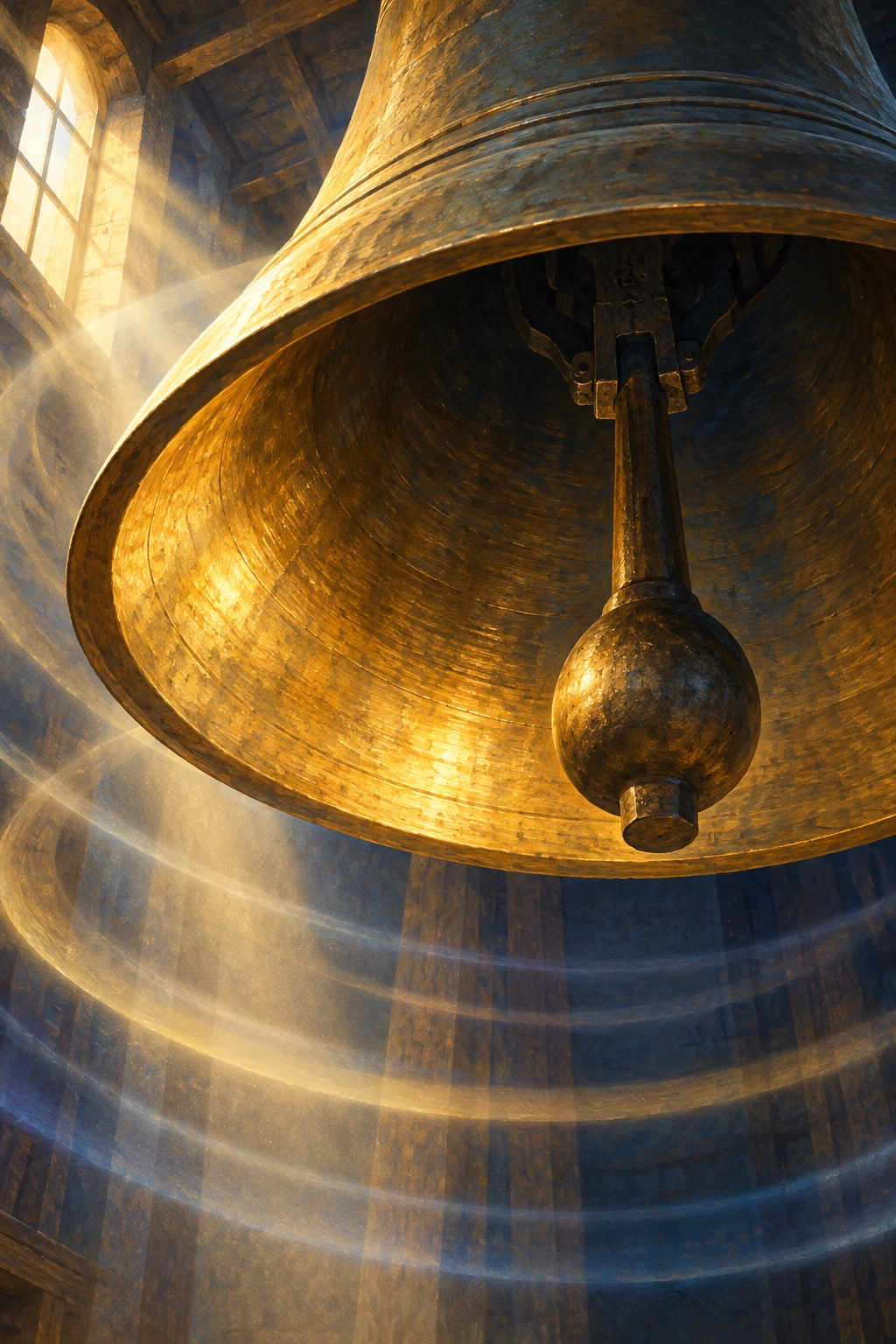
A bronze bell and clapper catch warm light in a quiet tower
A bell’s curved shell can vibrate in several patterns at once.

To explore that sound, listen in three passes. First notice the attack. Then attend to the middle of the ring. Finally follow the fading tail. Those are three views of one event, but they can emphasize different components. A bell’s identity is partly in how its ingredients change their relative importance over time.

A partial is an ingredient; a harmonic is a particular relationship

A partial is a frequency component of a complex sound. Harmonics form an integer-multiple family: f, 2f, 3f, and so on. If f is 200 Hz, that family includes 400, 600, and 800 Hz. The distinction matters because a sound may have partials without arranging them into one complete harmonic series.

A bell has several modes of vibration. Different regions of its curved shell move in different patterns. Its shape and thickness distribution help determine their frequencies. A strike excites a mixture, and the clapper, striking position, support, and surrounding space influence what reaches a listener. The familiar bronze outline is therefore also a carefully consequential acoustic structure.

Musicians and bell founders use names including hum, prime, tierce, quint, and nominal for important partials of conventional church bells. These names help discuss a complicated spectrum; they do not imply that every historical bell has exactly the same ratios or that its perceived note must be the loudest line in a frequency plot.

Hear the ingredients separately

The listening tool below builds two explicitly synthetic sounds. One uses a simple harmonic family. The other uses a deliberately inharmonic set. They share a modest overall gain and fade automatically. Neither is a recording, a calibrated loudness comparison, or a faithful model of a particular foundry’s bell.

Build a ringing sound

User-started synthetic component comparisons and frequency table.

Open build a ringing sound in its own window.

Begin with a single component. Then hear the harmonic group and the inharmonic group. Try listening again without looking at the buttons. You need not name the pitch accurately to notice that the ingredients combine differently. The displayed frequency table makes the exercise accessible without sound and keeps the construction inspectable.

Now attend to the tail. In the model, components have different decay rates. The initial sound can feel brighter or denser than the sound a second later because some frequencies fade faster. This is a useful listening principle, but the model’s decay settings are chosen for illustration. They are not measured decay constants of the pictured bell.

The heard note need not be a frequency that is physically present

Pitch perception can combine information across components. In a missing-fundamental example, a harmonic family may support a pitch associated with f even when the sound contains 2f, 3f, and higher components but no energy at f itself. That does not mean the missing component has secretly appeared in the air. It means perceived pitch is not a simple inventory of spectral peaks.

Hibbert, Taherzadeh, and Sharp’s 2017 experiments investigated virtual pitch using sounds modeled on church bells. Changing the spacing of partials shifted the pitches participants matched. Their first experiment involved thirty subjects; a further test involved seventeen. The paper’s results are about those controlled comparisons, not proof that all listeners hear every bell identically.

Try a small detective task with any quiet bell recording you already have. Hum the note you think you hear, then replay the sound and listen specifically for a higher ringing component. Does the component you can isolate seem different from the overall note? There is no need to turn the sound up. The exercise asks you to separate two listening questions that are easily merged.

A flat plate can reveal why shape and support matter

The UNSW bell-plate experiments are a particularly good companion because they offer actual recorded comparisons. Researchers altered plate shapes and examined how the modes and ringing behavior changed. A plate that looks only slightly different can lose the ability to sustain a strong tone when held in the same way.

The support point matters because a mode has places that move strongly and places with little or no displacement. Holding or damping a strongly moving region can remove energy from that mode. A suitable tang or handle position can allow useful vibrations to survive while the player holds the instrument. The object’s outline is not just decoration wrapped around a tone generator.

On the university page, compare the triangular plate examples with and without the additional partial. Read the caption before listening: the point is to know what the experiment changes. This is more informative than collecting several unrelated bell recordings and attributing every difference to the metal.

Do not make the string the perfect opposite

An ideal flexible string is a useful route to an integer harmonic family. A real instrument is more complicated. The UNSW acoustics FAQ explains, among other examples, how the bending stiffness of piano strings shifts their partial frequencies. “String” and “bell” are not two boxes containing perfectly harmonic and perfectly inharmonic objects.

The contrast is still useful if you keep its purpose narrow. It asks how relationships among components shape a sound, not which instrument obeys the simplest rule. A bell can contain approximately harmonic subsets within a more complicated spectrum. A string can depart from the ideal model. Listening becomes more interesting when those exceptions remain audible.

The next bell you hear may announce an hour, a visitor, or the end of a performance. Give its tail another second of attention. The note is only one part of the event. The slower disappearance of some components and the quicker loss of others are the sound of a shaped object revealing its several ways of moving.

Follow the evidence: Hibbert, Taherzadeh and Sharp: virtual pitch in church bells; UNSW: acoustics of bell plates; UNSW: music acoustics FAQ.

Explore all 80 new articles · Browse the complete illustrated collection

Explore more art, ideas, experiments, and independent projects at Incoprea.
Two Hands, One Cycle: Learning Three Against Two

Ask one hand to tap twice while the other taps three times, with both beginning and ending the cycle together. The instruction is short. The first attempt often feels as though one hand has quietly hired the other to do its job. Both fall into the same pulse, or the cycle begins to stretch.

Hands play a woodblock and hand drum in a colorful rehearsal-room collage
Different rhythmic parts can share the same cycle.

The useful trick is to stop treating the task as two competing clocks. Give both hands one shared span of time. One divides it into halves. The other divides it into thirds. Their agreement is at the scale of the whole cycle, even though most of their attacks happen at different moments.

Six places to put five attacks

Divide the shared cycle into six equal slots. Put the three-part rhythm on slots one, three, and five. Put the two-part rhythm on slots one and four. The hands meet at slot one, separate for the rest of the cycle, and meet again when the next cycle begins.

One complete three-against-two cycle
Slot123456
Three-part handTapRestTapRestTapRest
Two-part handTapRestRestTapRestRest

There are five individual attacks but only four distinct attack times, because both hands strike together at the beginning. This is a small counting detail that helps when the rhythm feels busier than the table looks. The combined sequence is together, three-part hand, two-part hand, three-part hand, then together again at the next cycle.

Three against two practice player

Separate and combined synthetic percussion, stopped by default, with accessible timing table.

Open three against two practice player in its own window.

The player starts silently and plays only after you press a button. Listen to either part alone, then the combination. A full cycle is the unit shown in the tempo control, so there is no hidden assumption that one hand owns the “real” beat. The pulse table remains available if you prefer to work without sound.

Give your hands a small, achievable assignment

Begin with the three-part hand alone, using a comfortable light tap. Count all six slots slowly, making taps on one, three, and five. Keep the count going after the sixth slot rather than pausing to restart. The return to one is the boundary that both parts must share.

Next practice the two-part hand by itself on one and four. Its two gaps should be equal, including the gap from four through the end of the cycle to the next one. A common error is to crowd the second tap toward the first because the remaining empty slots feel too long.

Finally add the combined sequence at a slow pace. If the hands collapse into unison, return to one cycle, stop, and inspect the table. The goal is not endurance. It is learning the placement of the middle attack and the different gaps around it. A table can be a better teacher than a fast recording that invites you to imitate a blur.

The ratio describes a relationship

The Open University’s music-theory course explains how a duration can be divided into equal twos or threes. In this exercise those two subdivisions coexist. Calling the result three against two tells you how many equal attacks each layer makes across the same span.

It does not automatically tell you the time signature, the musical style, or which layer a performer feels as the main pulse. The same attack relationship can be notated or accented in different ways. A classroom grid is deliberately explicit about time positions, while a performance adds dynamics, articulation, phrasing, and expectations.

Open Music Theory’s rhythmic techniques chapter places such relationships among several ways music can organize competing groupings. Polyrhythm, polymeter, and a change of tempo are related listening questions, but they are not interchangeable labels for anything complicated.

Do not confuse three against two with every pattern containing a three and a two

Our three-part layer has equal spacing. Our two-part layer also has equal spacing. A pattern described as 3+3+2 instead divides eight small units into unequal groups. A son clave has its own structured pattern and cycle. Those are important musical ideas, but neither is simply a different spelling of the six-slot exercise.

Berklee PULSE’s polyrhythm lesson is useful for moving beyond the abstract ratio. It connects layered rhythm with New Orleans music and African diaspora histories and includes performance examples. A numerical demonstration should invite that listening, not imply that one little grid stands in for whole musical traditions.

Change what you attend to

Once the two layers are comfortable, keep the sound the same and shift your attention. Follow the slower two-part pattern. Then follow the faster three-part pattern. Finally hear the combined arrangement as one recurring shape. The attacks have not moved, yet the organizing experience may change.

Try the reverse assignment with your hands. If one direction is easier, that says something about your practiced coordination, not that the ratio has a preferred handedness. Try tapping the cycle boundary with a foot only after the hands feel stable; adding another task before the first two are comfortable can obscure what needs practice.

The pleasure arrives when the conflict starts to feel like cooperation. Each part has room for its own even rhythm, and the shared boundary keeps them together. You have not made one hand ignore the other. You have given both a larger agreement.

Follow the evidence: Berklee PULSE: polyrhythms; Open University: rhythm and metre; Open Music Theory: twentieth-century rhythmic techniques.

Explore all 80 new articles · Browse the complete illustrated collection

Explore more art, ideas, experiments, and independent projects at Incoprea.

Thursday, October 22, 2026

Your Brain Can Hear a Bass Note That Is Missing

A loudspeaker can leave out a low frequency and still make a note seem to have that low pitch. This is not a secret subwoofer hiding in the room. A complex tone can carry a pattern of higher components from which the auditory system derives a pitch associated with an absent fundamental.

The surprise comes from treating pitch as though it were a label attached to one frequency in a recording. A recording contains physical pressure variations. Pitch is a percept. The two are closely related, but the missing-fundamental effect shows why they cannot simply be substituted for each other.

A conceptual piano illustration uses an empty low-key space as a metaphor for an absent fundamental.
Musical metaphor, not a piano construction diagram. The audio examples are original deterministic synthesis, not generated recordings.

Start with three sounds

The short original signals below let you compare a reference with two harmonic complexes. Set a comfortable low listening level. There is no need to turn the volume up to search for a hidden bass sound. Depending on hearing, equipment and attention, you may hear the relationship more or less strongly.

1. A 200 Hz reference

A single synthesized sinusoid, 2.5 seconds. It establishes a reference pitch; it is not a musical instrument recording.

2. A harmonic complex including 200 Hz

Synthesized components at 200, 400, 600, 800, 1000, 1200, 1400 and 1600 Hz, with decreasing amplitudes.

3. The complex with the 200 Hz component omitted

The synthesis includes components from 400 through 1600 Hz at 200 Hz spacing. No 200 Hz sinusoid was included. All examples have brief fades and comparable digital RMS levels.

Listen first for whether the third sound seems to belong near the same musical pitch as the first, rather than asking whether they have the same quality. They do not: their timbres differ substantially. A shared pitch can coexist with a changed brightness or roughness. If you focus on a high component, the experience may differ again.

A pattern can survive a missing member

The University of New South Wales music-acoustics guide distinguishes a fundamental from the harmonics of a periodic sound. In the example here, higher components remain integer multiples of 200 Hz even when the component at 200 is removed. Their relationship still identifies a common repetition rate.

For the synthesis, 400 Hz completes two cycles in five milliseconds, 600 completes three, and 800 completes four. All return to their starting phase after five milliseconds. The combined waveform can therefore repeat at that interval without containing a sinusoidal component at the corresponding 200 Hz. “Repeats every five milliseconds” and “contains a 200 Hz sine wave” describe different properties.

This does not mean a brain literally runs the arithmetic in this paragraph. It is a description of information available in the stimulus. Competing accounts of pitch perception ask how frequency structure, temporal information and neural processing contribute under different conditions.

The researchers have to rule out shortcuts

One complication is distortion. A playback system or the ear's nonlinear responses can create additional components, including combination tones. A careful experiment must therefore ask whether listeners are using the intended harmonic relationship or an unintended cue.

Bonnie Lau and Lynne Werner's infant study tested missing-fundamental discrimination while changing spectral details, adding masking noise and limiting spectral-edge cues. These controls matter as much as the striking age of the participants. A response that survives relevant cue changes gives a different kind of evidence from a response to one unchanging pair of sounds.

The home examples here are demonstrations, not replications of that experiment. They do not include its masking conditions or behavioral procedure. Their value is to make the stimulus distinction audible and inspectable. They cannot diagnose an individual's hearing or settle a theory of the auditory system.

Keep the spacing, move the frequencies

There is a sharper test hiding in the relationship among the components. Start with three components at 400, 600, and 800 hertz. Now add 25 hertz to every component. The resulting frequencies, 425, 625, and 825 hertz, are still separated by 200 hertz. Their ratios to 200 have changed, however. They are no longer its second, third, and fourth harmonics.

Organ pipes of different lengths stand in a sunlit workshop, with an empty support at one end.
Organ-pipe metaphor. The physical gap is not a spectrum or an acoustic test.

This is ordinary arithmetic, but it creates an experimental opportunity. If a percept depended only on the difference between neighboring components, this manipulation would preserve the relevant difference. If another feature mattered, keeping the spacing fixed might fail to preserve the experience. In Micheyl and colleagues’ 2010 experiments, uniformly shifted complexes produced less consistent pitch matches and poorer discrimination than the harmonic comparison sounds under their tested conditions.

The calculator below makes the stimulus distinction inspectable without adding another listening demand. Set the shift to zero, then 25. Compare the adjacent differences with the displayed harmonic ratios. Its common-repeat calculation assumes ideal sinusoids with integer-hertz frequencies. It does not predict a listener’s pitch from that mathematical repeat rate.

Shift, spacing, and harmonic ratios

A silent frequency-table calculator separates additive shifting, harmonic ratios, and exact mathematical repetition.

Open this activity in its own window.

Try a second prediction: multiply every original frequency by 1.1 instead of adding the same number. The new set is 440, 660, and 880 hertz. Its spacing changes to 220 hertz, and it remains a second–third–fourth harmonic series, now relative to 220. Adding and multiplying make different experiments even when both operations raise every component.

A separate 2009 study by Oxenham, Micheyl, and Keebler examined proposed timing cues in unresolved harmonics. Altering noise and stimulus level to make distortion products inaudible removed the evidence for that particular cue interpretation. The scope is specific: it concerns those tested stimuli and an alternative source of information, rather than disproving pitch perception from complex sounds.

That is a productive way to enjoy a demonstration twice. The first encounter asks what you hear. The second asks which physical relationship would have to survive a change for your explanation to remain plausible. A small frequency table can turn a surprising note into a much more exact question.

“Too high to carry pitch” was a testable assumption

In a 2011 experiment, Andrew Oxenham and colleagues found robust pitch judgments for harmonic complexes with fundamentals below 2 kHz even when all components were above 6 kHz. The authors used that result to challenge established limits in explanations of pitch. The finding concerns specified stimuli and tasks, rather than a claim that every high-frequency sound gives an equally clear note.

That kind of experiment reveals the scientific opportunity hidden in an illusion. Removing a component is not only a trick. It changes the evidence available to a listener in a way that can distinguish predictions. The result becomes more informative when the experiment specifies what remained, what was removed and which alternative cues were controlled.

A missing bass component leaves a useful distinction behind: the world delivers a structured signal, and perception extracts properties from that structure. Hearing a note is not always finding a matching line in a spectrum. Sometimes it is recognizing a relationship whose most obvious member is absent.

Sources and a closer look: UNSW: pitch, harmonics and missing fundamentals; Lau and Werner: controlled infant pitch experiments; Oxenham and colleagues: high-frequency harmonic pitch.

Explore art, experiments and other unexpected connections at Incoprea.

The Sound That Seems to Keep Climbing Forever

The sound takes another step upward. Then another. It returns to where it began, yet the next step still seems to rise. A Shepard sequence can give the impression of climbing without reaching a higher final floor. The impossibility belongs to the interpretation of a changing mixture, not to a physical frequency increasing beyond every limit.

The metaphor of a circular staircase is useful if it does not conceal the mechanism. There are several tones at once, spaced by octaves. Their strengths change across the spectrum so that the high and low edges become inconspicuous. The sequence gives local evidence of upward movement while making absolute height harder to pin down.

An imagined circular staircase made from piano-key-like steps evokes repeated ascent.
Architectural metaphor. The accompanying sound is an original synthesized Shepard-style demonstration; the artwork is not an acoustic diagram.

An original 24-step Shepard-style sequence

Two traversals of a twelve-step pitch-class cycle. The octave-spaced sinusoids use a fixed smooth amplitude envelope; components fade at the range edges. This short file stops normally and does not autoplay or loop.

Listen at a comfortable low level. Before looking at the construction below, note whether the second traversal feels higher, similar, or less convincing than the first. There is no required reaction. A listener can follow one component, notice a reset, or experience a strong overall ascent. Those reports ask different questions about the same signal.

One name, several heights

A musical C can occur in many octaves. The note name identifies pitch class; the octave helps specify height. Tamara Smyth's UC San Diego explanation describes Shepard tones as octave-separated sinusoids beneath a fixed spectral envelope. As their pitch classes move, low components enter quietly and high components leave quietly. After twelve semitone steps the pattern can return to its beginning.

The quiet edges do important work. Imagine a line of people walking up an escalator while the lowest person joins behind a curtain and the highest disappears behind another. If you follow the middle group, you see continual upward movement without clearly seeing the membership change. The sound uses an analogous redistribution of components, though the auditory experience is not literally a visual tracking process.

In the sequence here, the twelve pitch-class states are repeated. The physical ingredients do not march to infinitely high frequencies. What repeats is a set of mixtures arranged so adjacent states support an ascending judgment. Repetition and perceived direction can coexist because judging a small step is not the same task as assigning an absolute position to the whole mixture.

What an experiment can ask that a demo cannot

The Praat reference entry identifies Roger Shepard's 1964 paper, Circularity in Judgments of Relative Pitch. The crucial phrase is “judgments of relative pitch.” A laboratory can present tone pairs in controlled orders and measure the pattern of higher/lower responses rather than rely on one person's impression of an endless scale.

For a simple paper model, draw twelve positions around a clock. Mark each neighboring clockwise step “up.” Following those local labels eventually returns you to the same position. The diagram does not prove the auditory illusion; it clarifies the logical shape of the result. A consistent relationship between nearby pairs need not create one globally ordered line.

Pitch circularity is not confined to one sound recipe

Diana Deutsch, Kevin Dooley and Trevor Henthorn's 2008 study produced circularity with tones containing full harmonic series, using changing relative harmonic amplitudes. Sixteen participants judged ordered tone pairs. This was a different construction from the classic octave-spaced mixture, and the study examined individual differences as well as the overall pattern.

That extension matters because it separates a perceptual question from one famous demonstration's engineering. If several stimulus families can produce related judgments, an account must explain more than one clever audio file. It also warns against treating the staircase image as a literal recipe: different physical constructions can support a similar perceptual relationship.

The original demonstration in this article uses the simpler octave-spaced approach. It does not replicate the 2008 harmonic-amplitude experiment. Naming that boundary lets you compare the methods without confusing shared vocabulary with identical stimuli.

What happens halfway around the circle?

Neighboring steps make one question inviting: what happens when the two pitch classes are equally far apart in either direction? C and F-sharp are separated by six semitones on a twelve-position circle. Count clockwise and counterclockwise. Both routes take six steps, so the shortest-path rule alone supplies no preferred direction.

Translucent copper and turquoise ribbons curl around a row of organ pipes.
Overlapping ribbons suggest fading and replacement. Their shapes do not encode the sound’s frequencies.

Diana Deutsch’s creator-hosted tritone-paradox page offers four tone pairs using this half-octave relationship. The tones have ambiguous octave placement. Listeners can disagree about the direction of an identical pair, and one listener can judge different pairs differently. This is a related investigation using octave ambiguity; it is not an extra traversal of the ascending file above.

Before playing the examples at a comfortable level, draw four short horizontal lines. After each pair, mark up, down, or uncertain, and add a confidence word. Keep the first report before replaying. If another willing listener joins you, compare notes after both have written their answers. A disagreement is a result to record, not an error to correct by playing the clip louder.

The original 1986 paper, A Musical Paradox, reports systematic pitch-class relationships for six of its eight musically trained participants, with striking differences between those listeners. Its interest lies in the pattern across pairs. A single arrow on your four-line card cannot establish such a pattern, and it cannot identify a cause for your response.

For a silent alternative, label the twelve positions with note names and connect each opposite pair. Rotating the starting note changes the labels while preserving the six-step geometry. The drawing clarifies why equal interval size does not settle the experienced direction of these particular sounds. It cannot tell you what they sound like.

Finally, compare the questions asked by the two activities. The Shepard sequence asks how a succession of small changes supports continued ascent. The tritone pairs ask how an ambiguous larger interval is heard across starting notes and listeners. Keeping those questions distinct gives the circular-pitch idea more reach without making every unusual sound the same illusion.

Why the illusion is useful to a composer

A composer can exploit a directional impression without literally exhausting the instrument's register. The effect may suggest building tension or movement, but a description of the synthesis cannot dictate a listener's emotion. Loudness, harmony, rhythm, context and personal associations still participate.

The same caution makes the illusion more rewarding. It is possible to understand exactly how the file is constructed and still hear a compelling rise. Explanation does not have to erase experience. It can give you two parallel ways to follow it: the frequencies and amplitudes cycling through a bounded arrangement, and a percept that keeps interpreting the next local step as upward.

Sources and a closer look: UC San Diego: Shepard-tone construction; Praat: Shepard 1964 bibliographic reference; Deutsch, Dooley and Henthorn: harmonic-series pitch circularity.

Explore art, experiments and other unexpected connections at Incoprea.

Wednesday, October 14, 2026

Kecak: The Balinese Chorus With a Modern Performance History

At first, the sound seems to arrive from everywhere. A circle of voices repeats a clipped syllable, hands rise, and a figure steps into the open space. Then your ear catches something smaller: one pattern returning while another slips between its attacks. The excitement is being assembled, contribution by contribution.

An interpretive circle of kecak chorus members raises coordinated hands in a dusk stage setting.
Interpretive illustration of a kecak stage chorus. It is not a documentary image of a named troupe, venue or ritual.

This is a rewarding way into Balinese kecak. You can enjoy the theatrical spectacle immediately, but hearing the relationships inside the chorus reveals a second performance. What seems like one enormous voice is coordinated work. Its history is equally intricate: the familiar dance drama took shape in the twentieth century through artists adapting inherited materials for changing audiences.

A chorus that behaves like an ensemble

The liner notes for Smithsonian Folkways’ The Bali Sessions describe kecak as a vocal orchestra. Interlocking parts create a texture that a listener cannot explain by following only the loudest voice. The repeated “cak” sound gives the genre its name, but naming the syllable does not explain the music any more than naming a drumstroke explains a whole rhythmic arrangement.

Listen for where a part lands in relation to its neighbors. Two contributions can be individually straightforward while their combination feels quick and densely populated. A useful question is therefore not simply “How fast are they chanting?” Ask which figure returns, which fills a gap, and which signals that the ensemble is moving into a new passage.

Body movement adds another layer of information. The circle can draw the eye toward a dramatic figure, expand a gesture across many performers, or change its collective shape. You do not need to decode every movement on a first viewing. Begin by noticing whether a change in posture coincides with a change in the vocal texture.

A modern form with older relationships

Ethnomusicologist Kendra Stepputat’s study of sanghyang dedari and kecak traces a close relationship between the trance-possession ritual and the later tourist performance. Related musical and movement materials traveled into a different setting. That historical connection does not make a ticketed stage presentation the same event as a community ritual.

The genre’s development in the 1930s is often associated with Balinese dancer I Wayan Limbak and expatriate artist Walter Spies. Yet a two-person origin story leaves little room for the ensembles, villages, and successive choreographers who made a repeatable performance possible. Stepputat’s broader research follows those interactions rather than treating the dance as a single invention preserved unchanged.

Many familiar productions draw dramatic episodes from the Ramayana. This helps explain the popular nickname “monkey chant,” but the nickname can also misdirect attention. A viewer looking only for monkey characters may overlook the chorus as musicians, or assume that all its sounds imitate animals. The dramatic story and the ensemble’s musical construction are related parts of the event, not interchangeable descriptions.

Tourism belongs in the story

The University of Music and Performing Arts Graz’s account of Stepputat’s research emphasizes the continuing interaction between Balinese performers and international audiences. It includes the genre’s economics alongside choreography, music, and history. That is a useful correction to the idea that a performance becomes culturally interesting only when visitors have had no part in shaping its presentation.

Think about the work required to make an evening performance happen again tomorrow. Performers need reliable cues and shared expectations. They also make choices about pacing, dramatic emphasis, and what an unfamiliar audience can follow. Repetition and creativity can occupy the same production. The question is how particular artists use the form, not whether a tourist happens to be watching.

Stepputat’s analysis of movement also distinguishes the histories of the soloists’ vocabulary and the chorus’s movement. A stage contains more than one line of development. Looking for those differences gives a viewer something more precise to consider than a general impression of timelessness.

Hear the same passage three ways

“Kepandung Sita,” credited to Sekaa Kecak Puspita Jaya, provides a named performance to explore through Smithsonian Folkways. The album page offers listening options; full streaming may require membership. Use an available excerpt, or a credited performance you can already access, and return to the same short passage for each pass.

A listening notebook for one passage
PassGive your attention toWrite one observation
One: a recurring partOne short figure you can recognize when it returns.Describe its rhythm in your own words.
Two: the spaces around itSounds that arrive between or across those returns.Does the texture feel fuller while the first figure stays familiar?
Three: the group’s decisionsA collective change in emphasis, sound, or movement.Note the point in the recording so you can find it again.

Do not worry if the first part becomes hard to follow. That difficulty is useful evidence about your listening attention. On the next pass, choose a shorter stretch or a more conspicuous sound. The aim is to hear a relationship you missed, not to demonstrate that you can keep track of every performer.

If the recording includes video, try one pass without watching. Then restore the picture and see whether visible gestures help you anticipate a change. A camera close-up can make one contribution seem central even when the sound places it inside a larger texture. Listening and watching separately helps you notice that choice.

A small experiment in shared space

With a partner, mark an even pulse softly on a table. Let one person tap on the pulses and the other tap halfway between them. Stop after a few seconds, then exchange roles. You have not recreated kecak; you have isolated the general problem of placing one contribution in the spaces of another.

Now return to the performance. The simple experiment makes coordination easier to appreciate without pretending to teach a repertoire or replace the musicians’ knowledge. The satisfying discovery is that an ensemble’s density need not come from everyone doing more. It can come from people doing different things in a well-maintained relationship.

Carry the performers’ names away with you alongside the sound. Kecak becomes more compelling when its modern history, skilled collective work, and individual productions remain visible. The circle is not a frozen image of a distant past. It is a group of artists making an event happen together.

Keep exploring

Compare a different kind of ensemble identity in Gamelan Tuning: Why an Ensemble Has Its Own Musical Voice, then hear coordinated musical lines emerge from one performer in The Kora: Two Hands, Many Musical Lines.

Explore more art, ideas, and independent projects at Incoprea.
Gamelan Tuning: Why an Ensemble Has Its Own Musical Voice

A gong sounds, and its resonance seems to open a room inside the music. Faster notes continue around it. A voice or bowed string may draw your attention elsewhere, yet the next deep stroke feels like arriving somewhere you have been before. You are hearing pitches, but you are also hearing a group organize a shared sense of return.

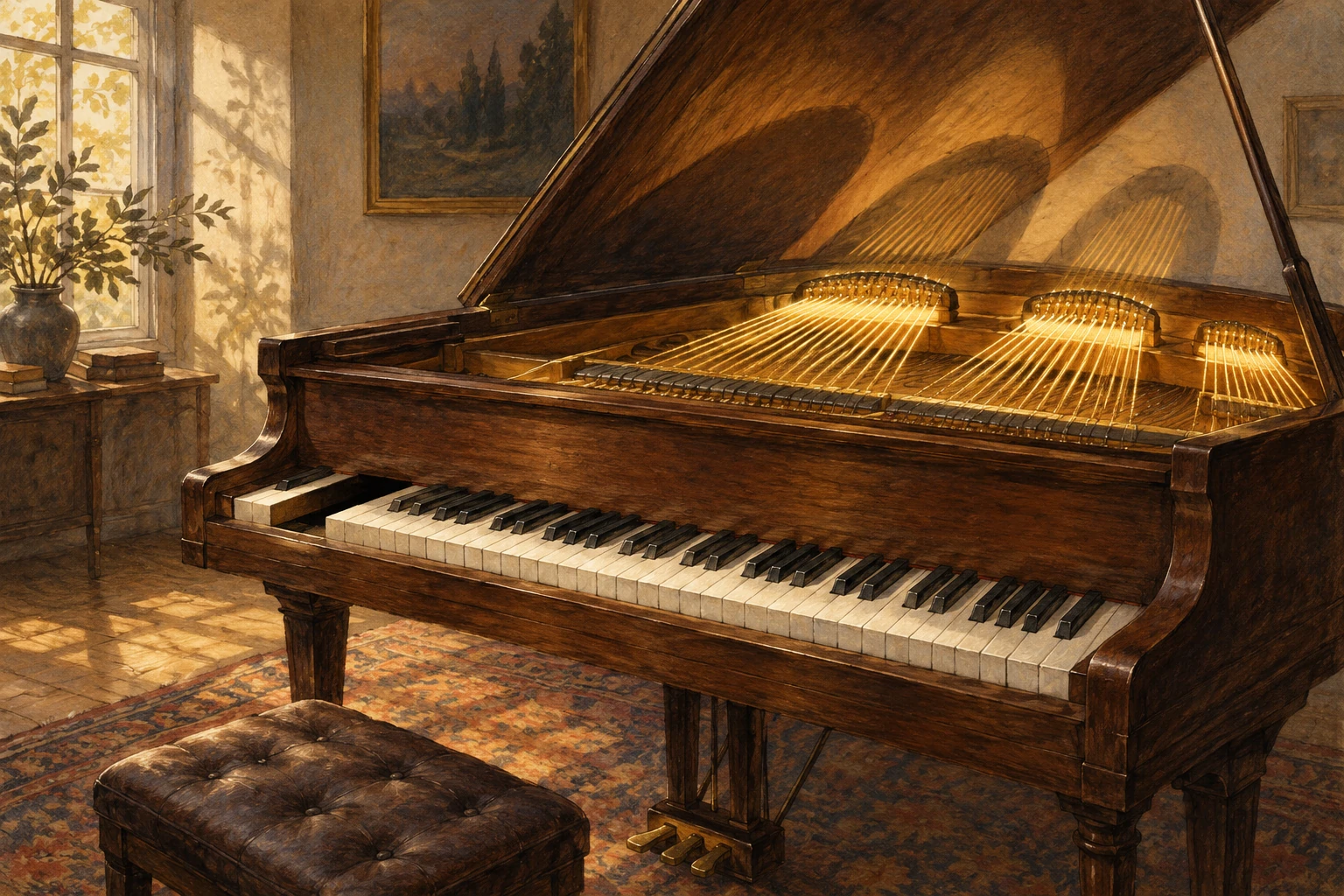
An interpretive gamelan arrangement includes bronze keys, kettle gongs, a hanging gong, drum and flute.
Illustration of a generalized gamelan arrangement. It is not a documented ensemble or a diagram of any particular set’s tuning.

Gamelan rewards that kind of listening. The word can refer to an ensemble and its instruments, not one standardized object or a single Indonesian sound. Central Javanese, Sundanese, and Balinese traditions need their own introductions. For this first encounter, begin with a particular Javanese performance, then ask how tuning, instrumental roles, and musical time belong together.

One familiar word, several questions

UNESCO’s account of gamelan includes instrumentalists and vocalists alongside makers and tuners. It also describes transmission through both informal learning and formal education. That broader view matters. The sound is sustained by people who build, maintain, teach, rehearse, and perform, not by an inventory of bronze objects alone.

A useful first question is “Which ensemble am I hearing?” Follow it with “What kind of event is this?” Music associated with a dance, a theatrical episode, a ceremony, or a concert is being heard in a particular setting. A recording title and its notes can make that setting visible before you learn a single instrument name.

Five or seven does not tell the whole tuning story

In Sumarsam’s introduction to Javanese gamelan, the tuning systems sléndro and pélog provide an important starting point. Sléndro has five pitch positions within the octave, with relatively similar steps. Pélog has seven, with more conspicuously unequal spacing. A piece need not use every available pitch with equal frequency.

A first listening guide to two Javanese tuning systems
TuningWhat the name helps you ask
SléndroHow do phrases move through five pitch positions with comparatively even spacing?
PélogWhich of seven available positions does this piece emphasize, and how do its unequal steps shape a phrase?

The same account explains that particular sets have their own patterns of interval sizes. The category does not specify one universal frequency for each note. Instruments from different gamelan sets are therefore not automatically interchangeable. A complete Javanese ensemble may include separate groups of instruments for the two tuning systems.

This is a useful reason to resist testing a recording against the nearest piano key and stopping there. A reference pitch can help describe a sound, but the ensemble’s relationships are what the musicians have learned to work with. A small difference from your expectation is not, by itself, a failed version of a familiar scale.

Look at one instrument closely

The Met’s nineteenth-century Saron Panerus Slendro provides a manageable object to examine. Its record identifies teak, bronze, and paint, describes it as high-pitched within the ensemble, and notes the use of a wooden or horn mallet. Here the tuning category belongs to a specific surviving instrument with a date, materials, and dimensions.

Open the photograph and follow the row of keys. Then widen your attention to their support and the space beneath them. What can the photograph show about construction? What would require hearing the instrument, seeing it played, or reading a fuller record? Keeping those questions distinct turns a museum image into a starting point for inquiry.

A tuning can be something a community works to recover

A fieldwork-based essay on Kamasan, Bali makes the stakes of ensemble identity tangible. It describes residents rebuilding a seven-tone gamelan for a musical tradition whose earlier set had been destroyed. The project drew on remembered tuning and the intervals of suling gambuh, with a gamelan smith and the temple community contributing to the new instruments.

This Balinese case is not a tuning chart for the Javanese concert below. It offers a different lesson: recovering a repertoire can require recovering the material relationships that make it playable. Community memory, instrument-making, and musical practice become parts of the same undertaking.

The story also changes what “preservation” can mean. It may involve making and deciding, rather than simply keeping an old object still. A finished instrument set carries the work of those decisions into every later rehearsal.

Enter a concert at two clear places

The Smithsonian National Museum of Asian Art’s Javanese gamelan recording supplies a timed program for a performance recorded on 1 November 2013. The named ensemble and guest artists give you a particular event to hear, not an anonymous example of a national style.

  • 0:00: Ladrang Sri Widada, identified as pélog, pathet barang.
  • 21:08: a program section containing Ladrang Sri Karongron and Ketawang Cakrawala, identified as sléndro, pathet sanga.

Begin with about a minute of the first passage. Listen for a deep recurring punctuation, then choose a more active part that continues around it. Return to the beginning and exchange your focus. The same minute can feel different when you follow a large structural return instead of a stream of quicker notes.

Now enter at 21:08. Notice the contour of a short phrase and the distances between pitches as you hear them. Write down a difference before consulting the tuning labels again. The two passages also differ in composition and musical activity, so this is a comparison of performances, not a controlled test that isolates tuning.

The program notes explain the role of recurring gong cycles. On another pass, wait for a return you can recognize without trying to count every beat. If you lose your place, choose a shorter segment. Recognition is a useful first accomplishment; a complete formal analysis can come later.

Hear the set as a relationship

After listening, make a three-line note: the ensemble and recording, one sound you followed, and one relationship you noticed. That small record is more useful than a general verdict that the music was soothing, strange, or busy. It gives you something you can return to and test with your ears.

The ensemble’s voice emerges through several kinds of agreement: among pitches, among instrumental roles, and among people sharing musical time. A scale diagram reveals one part of that work. A particular performance lets the relationships become audible.

Listen along another path

Hear interlocking parts made by voices in Kecak: The Balinese Chorus With a Modern Performance History, then follow repeated and changing lines within one player’s coordination in The Kora: Two Hands, Many Musical Lines.

Explore more art, ideas, and independent projects at Incoprea.

The Kora: Two Hands, Many Musical Lines

Watch a kora player’s thumbs and index fingers for a moment, then close your eyes. The sound may seem to widen. A low figure returns, higher notes move across it, and a phrase appears to answer another phrase. Open your eyes again: the flowing texture is still being made by one person, using four plucking fingers.

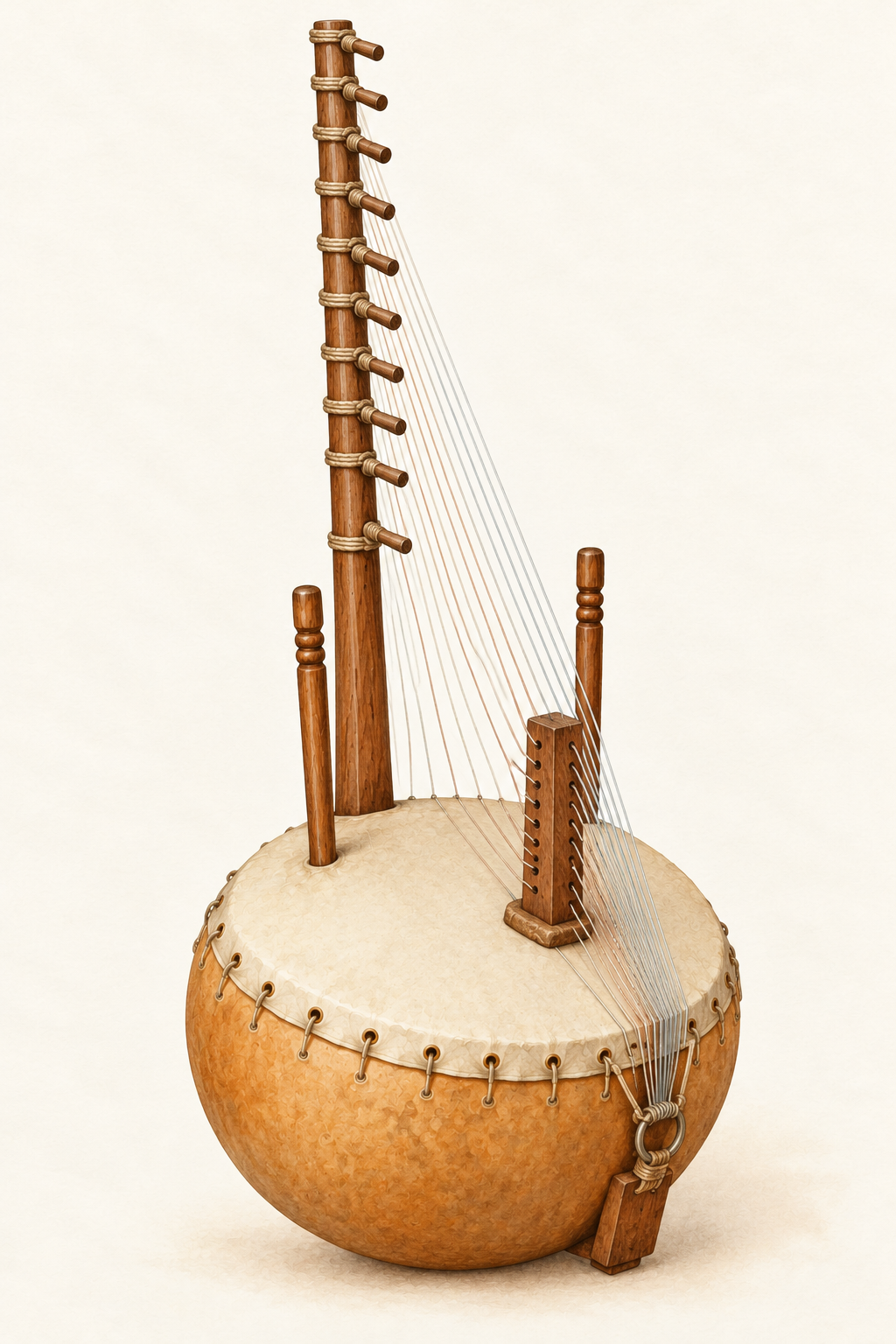
An interpretive kora has a long plain neck, handles, gourd body and a separate upright bridge.
Illustration of a generalized kora design. String arrangement and dimensions are stylized; it is not a measured instrument diagram or a specific historical artifact.

The instrument invites a useful change in listening. Instead of asking how many notes the player can fit into a second, ask which notes give the music somewhere to return. Repetition becomes an active musical choice, and a changing phrase gains meaning through its relationship with that dependable pattern.

Begin with the bridge, not the string count

A common kora has 21 strings distributed along two sides of a tall bridge. Its calabash body is covered by a skin soundboard. A long neck carries string tension, while two handholds steady the instrument. The Metropolitan Museum of Art’s nineteenth-century Mandinka kora offers a detailed record of that construction and identifies the object as a harp.

The bridge is crucial to understanding the arrangement. The strings do not form a guitar-like surface that the player presses against frets. They present separate pitches to fingers working on either side. Watching the hands therefore means watching how notes are distributed across a physical space. The apparent independence of musical lines grows from learned relationships among those positions.

Follow a plucked string toward the bridge, then the bridge toward the soundboard. That route helps connect a small finger movement with a resonating body. The gourd is more than the instrument’s striking silhouette: construction, strings, and the player’s touch contribute to the sound you hear.

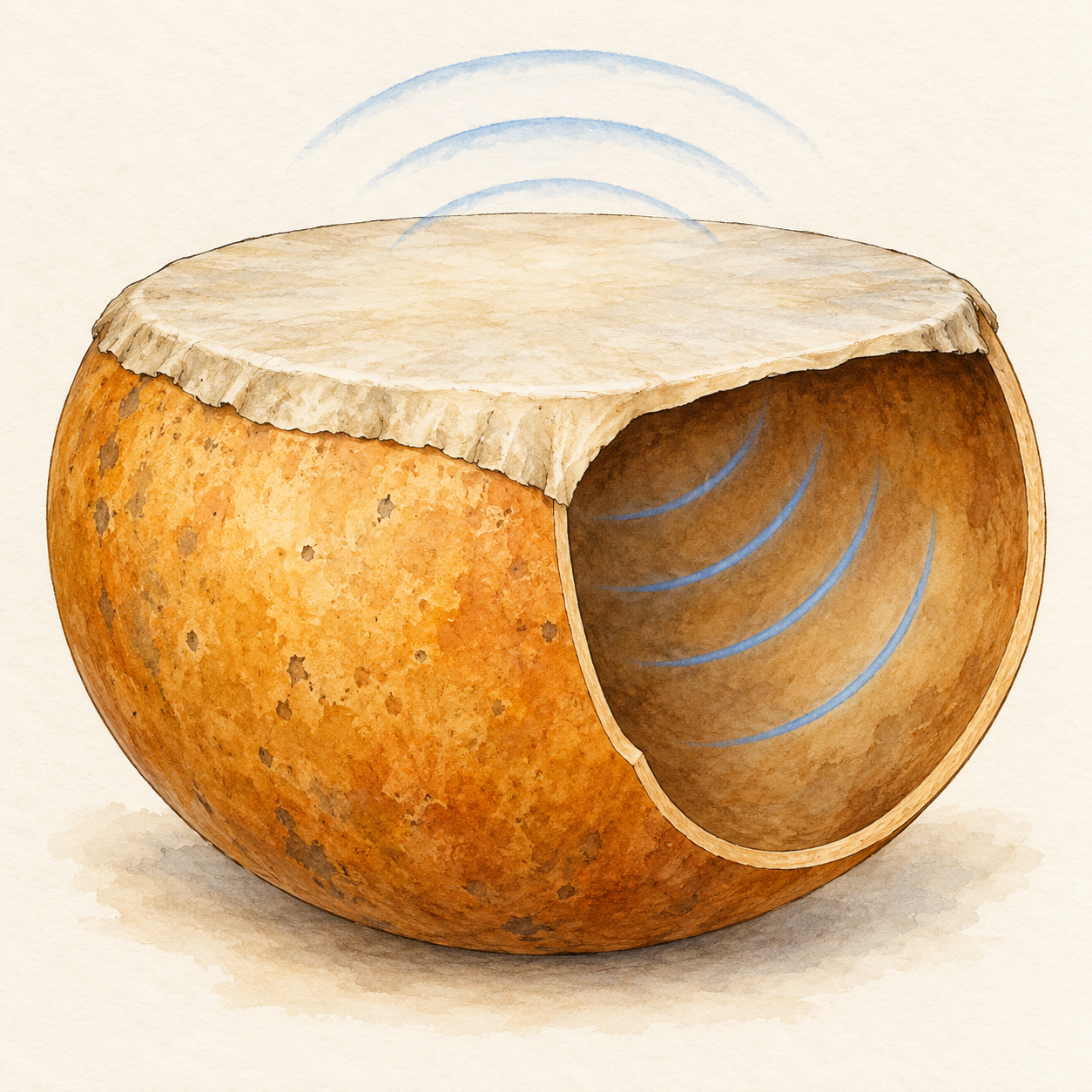
A conceptual cutaway shows a gourd cavity covered with a hide soundboard and abstract sound curves.
Conceptual illustration of a kora’s resonating body. The cutaway and blue sound curves are explanatory, not measured acoustic modes or construction instructions.

The illustration above isolates the resonating body so that you can look at those relationships separately. For an actual historical instrument, return to the museum’s photographs and measurements. A simplified cutaway and a surviving object answer different looking questions.

One museum object has traveled with musicians

The Sierra Leone National Museum’s kora record makes the instrument’s working life unusually tangible. The museum acquired this example in 1977 from a member of Bongi Makeba’s touring band. Its record also notes a significant absence: the bridge is now missing.

That detail changes how you look. A photograph of a museum instrument may show an object that cannot currently make its intended sound. If you cannot see a bridge, do not immediately invent an alternative construction principle. Check the record for loss, repair, replacement, and collection history. A musical instrument is both a designed sounding system and a material object that has passed through time.

Compare that example with the Met’s instrument. Identify one feature both records describe and one feature whose present condition differs. You are comparing particular objects, not choosing one museum specimen as the universal form of every kora.

What stays, and what moves?

The Met’s account describes kumbengo, a recurring pattern that helps establish a piece, alongside melodic and rhythmic lines. Grinnell College’s instrument collection similarly distinguishes recurring patterns from more ornate passages, using the term birimintingo for the latter. These names direct attention toward musical activity rather than treating the performance as a continuous cascade of interchangeable notes.

For a listener, a repeated part is like a place recognized on successive walks. Its return lets you notice what has changed around it. A phrase can become busier without losing that point of reference, or briefly pull attention away before the pattern becomes easy to hear again.

Avoid assigning every low sound to one hand and every high sound to the other just because that would make a neat diagram. The instrument’s physical distribution and the player’s coordination deserve to be observed. When a camera angle hides a finger, mark the movement as uncertain instead of filling the gap from the sound alone.

The musical knowledge belongs to people

Kora traditions are strongly associated with the Mandé region of West Africa and with jali or jeli musicians. The terms appear with different spellings across languages and sources; “griot” is also widely used. Their work can connect music with historical knowledge, praise, relationships, and public life. A description limited to the instrument’s engineering would leave that social knowledge unheard.

In Carnegie Hall’s introduction, Malian musician Yacouba Sissoko describes a specific path through that tradition. Born into a jeli family in Kita, he began learning the kora and associated oral traditions from his grandfather at nine. His later training, touring, and work in the United States belong to the same life. An inherited practice can support individual development and collaboration across settings.

Listening to a named musician also gives you a better starting point than searching for a single sound that represents an entire continent. Keep the performer, piece, recording, and context together in your notes. Those details make your next musical discovery more informed.

Hear an accompaniment grow

Carnegie Hall’s “Kelefaba” lesson with Yacouba supplies a particularly clear comparison. It includes a simple two-note accompaniment, a fuller accompaniment, and a sung performance. The song’s teaching context also connects music with the jeli’s role in peacemaking.

  1. Start with the simple accompaniment. Follow the return of its two notes. Tap a comfortable pulse only if that helps you hear the pattern.
  2. Listen to the fuller accompaniment. Notice what has entered between the points you already recognize. Describe a change in density, register, or movement rather than merely calling the second version better.
  3. Add the voice. Decide when your attention follows the singer and when it returns to the instrumental pattern. Can you hear both without losing the point of return?
  4. Watch once more. Choose one visible thumb or finger and follow a few movements. Then widen your attention to the two hands together.

Make a short note after each pass before replaying. Your first impression is worth retaining: a detail that becomes obvious on the fourth hearing was not necessarily obvious on the first. Repeated listening lets the texture become legible without demanding that you understand all of its musical vocabulary immediately.

A living instrument can change its materials

The Met contrasts older string and tuning arrangements with nylon strings and mechanical tuning systems used on contemporary koras. Such changes help explain why two instruments with a recognizable family resemblance may look different at the neck. “Traditional” need not mean that every material and fitting has remained fixed.

Return finally to the opening impression of several musical lines. The wonder has not disappeared now that you can name a pattern or trace a bridge. You have more ways to hear the player’s decisions. The kora’s richness lies in the meeting of a resonating object, coordinated hands, a particular musical voice, and knowledge shared between people.

Follow another musical thread

Listen for coordination across many performers in Kecak: The Balinese Chorus With a Modern Performance History. For a different meeting of hands, mechanism, and expression, explore The Ondes Martenot Puts a Singing Voice Between Two Hands.

Explore more art, ideas, and independent projects at Incoprea.

Famous Last Meals is now in paperback — stories, history and 25 recipes

Famous Last Meals: Stories, History, and Recipes is now available in paperback on Amazon. The illustrated collection brings together 23 his...