Ask one hand to tap twice while the other taps three times, with both beginning and ending the cycle together. The instruction is short. The first attempt often feels as though one hand has quietly hired the other to do its job. Both fall into the same pulse, or the cycle begins to stretch.
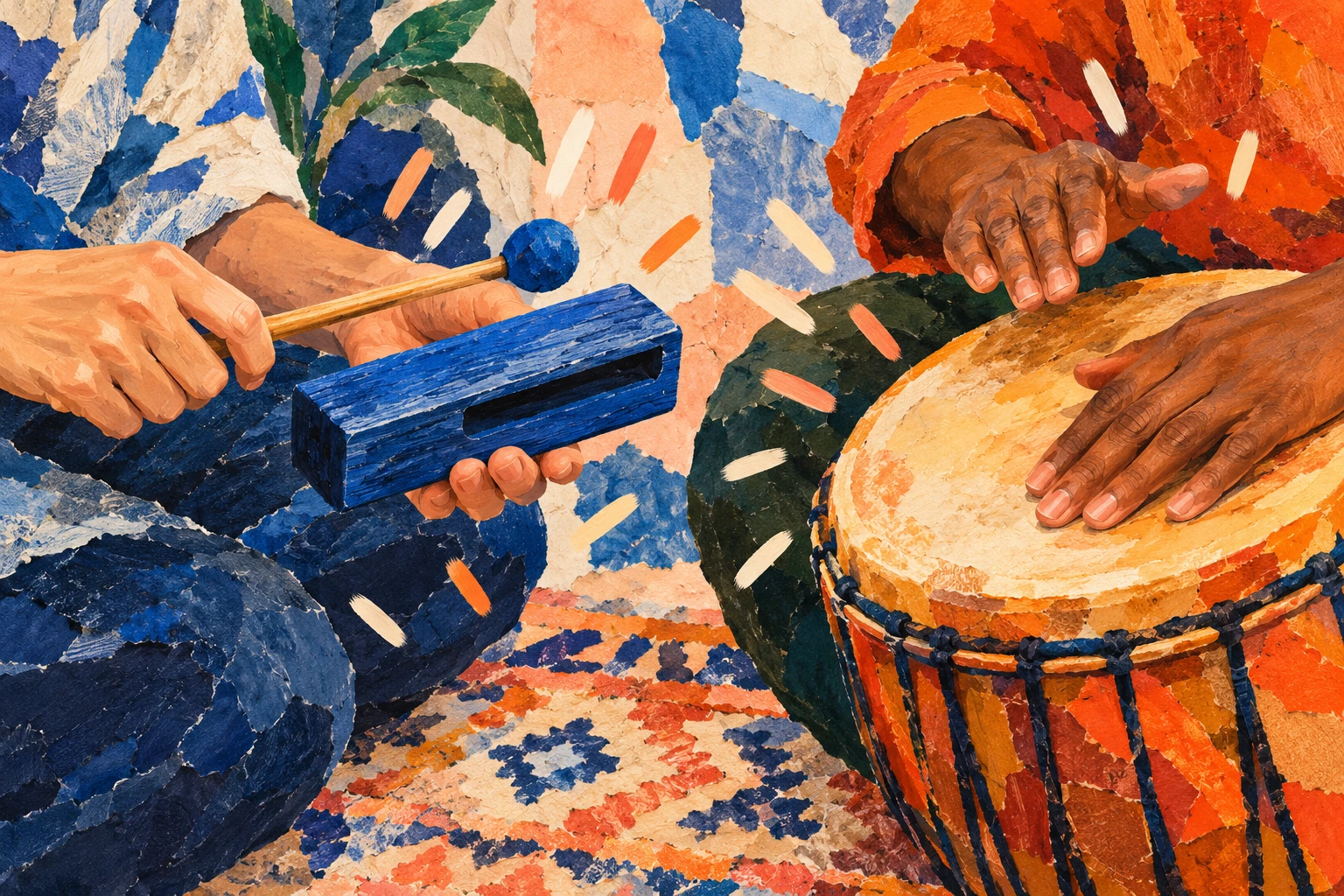
The useful trick is to stop treating the task as two competing clocks. Give both hands one shared span of time. One divides it into halves. The other divides it into thirds. Their agreement is at the scale of the whole cycle, even though most of their attacks happen at different moments.
Six places to put five attacks
Divide the shared cycle into six equal slots. Put the three-part rhythm on slots one, three, and five. Put the two-part rhythm on slots one and four. The hands meet at slot one, separate for the rest of the cycle, and meet again when the next cycle begins.
| Slot | 1 | 2 | 3 | 4 | 5 | 6 |
|---|---|---|---|---|---|---|
| Three-part hand | Tap | Rest | Tap | Rest | Tap | Rest |
| Two-part hand | Tap | Rest | Rest | Tap | Rest | Rest |
There are five individual attacks but only four distinct attack times, because both hands strike together at the beginning. This is a small counting detail that helps when the rhythm feels busier than the table looks. The combined sequence is together, three-part hand, two-part hand, three-part hand, then together again at the next cycle.
Three against two practice player
Separate and combined synthetic percussion, stopped by default, with accessible timing table.
The player starts silently and plays only after you press a button. Listen to either part alone, then the combination. A full cycle is the unit shown in the tempo control, so there is no hidden assumption that one hand owns the “real” beat. The pulse table remains available if you prefer to work without sound.
Give your hands a small, achievable assignment
Begin with the three-part hand alone, using a comfortable light tap. Count all six slots slowly, making taps on one, three, and five. Keep the count going after the sixth slot rather than pausing to restart. The return to one is the boundary that both parts must share.
Next practice the two-part hand by itself on one and four. Its two gaps should be equal, including the gap from four through the end of the cycle to the next one. A common error is to crowd the second tap toward the first because the remaining empty slots feel too long.
Finally add the combined sequence at a slow pace. If the hands collapse into unison, return to one cycle, stop, and inspect the table. The goal is not endurance. It is learning the placement of the middle attack and the different gaps around it. A table can be a better teacher than a fast recording that invites you to imitate a blur.
The ratio describes a relationship
The Open University’s music-theory course explains how a duration can be divided into equal twos or threes. In this exercise those two subdivisions coexist. Calling the result three against two tells you how many equal attacks each layer makes across the same span.
It does not automatically tell you the time signature, the musical style, or which layer a performer feels as the main pulse. The same attack relationship can be notated or accented in different ways. A classroom grid is deliberately explicit about time positions, while a performance adds dynamics, articulation, phrasing, and expectations.
Open Music Theory’s rhythmic techniques chapter places such relationships among several ways music can organize competing groupings. Polyrhythm, polymeter, and a change of tempo are related listening questions, but they are not interchangeable labels for anything complicated.
Do not confuse three against two with every pattern containing a three and a two
Our three-part layer has equal spacing. Our two-part layer also has equal spacing. A pattern described as 3+3+2 instead divides eight small units into unequal groups. A son clave has its own structured pattern and cycle. Those are important musical ideas, but neither is simply a different spelling of the six-slot exercise.
Berklee PULSE’s polyrhythm lesson is useful for moving beyond the abstract ratio. It connects layered rhythm with New Orleans music and African diaspora histories and includes performance examples. A numerical demonstration should invite that listening, not imply that one little grid stands in for whole musical traditions.
Change what you attend to
Once the two layers are comfortable, keep the sound the same and shift your attention. Follow the slower two-part pattern. Then follow the faster three-part pattern. Finally hear the combined arrangement as one recurring shape. The attacks have not moved, yet the organizing experience may change.
Try the reverse assignment with your hands. If one direction is easier, that says something about your practiced coordination, not that the ratio has a preferred handedness. Try tapping the cycle boundary with a foot only after the hands feel stable; adding another task before the first two are comfortable can obscure what needs practice.
The pleasure arrives when the conflict starts to feel like cooperation. Each part has room for its own even rhythm, and the shared boundary keeps them together. You have not made one hand ignore the other. You have given both a larger agreement.
Follow the evidence: Berklee PULSE: polyrhythms; Open University: rhythm and metre; Open Music Theory: twentieth-century rhythmic techniques.
Explore all 80 new articles · Browse the complete illustrated collection
Explore more art, ideas, experiments, and independent projects at Incoprea.