Two fences can make a third pattern that belongs to neither fence. Walk past one mesh with another behind it and large dark bands seem to travel across the view. Each wire stays where it was. The moving pattern comes from a changing relationship between repeated structures.
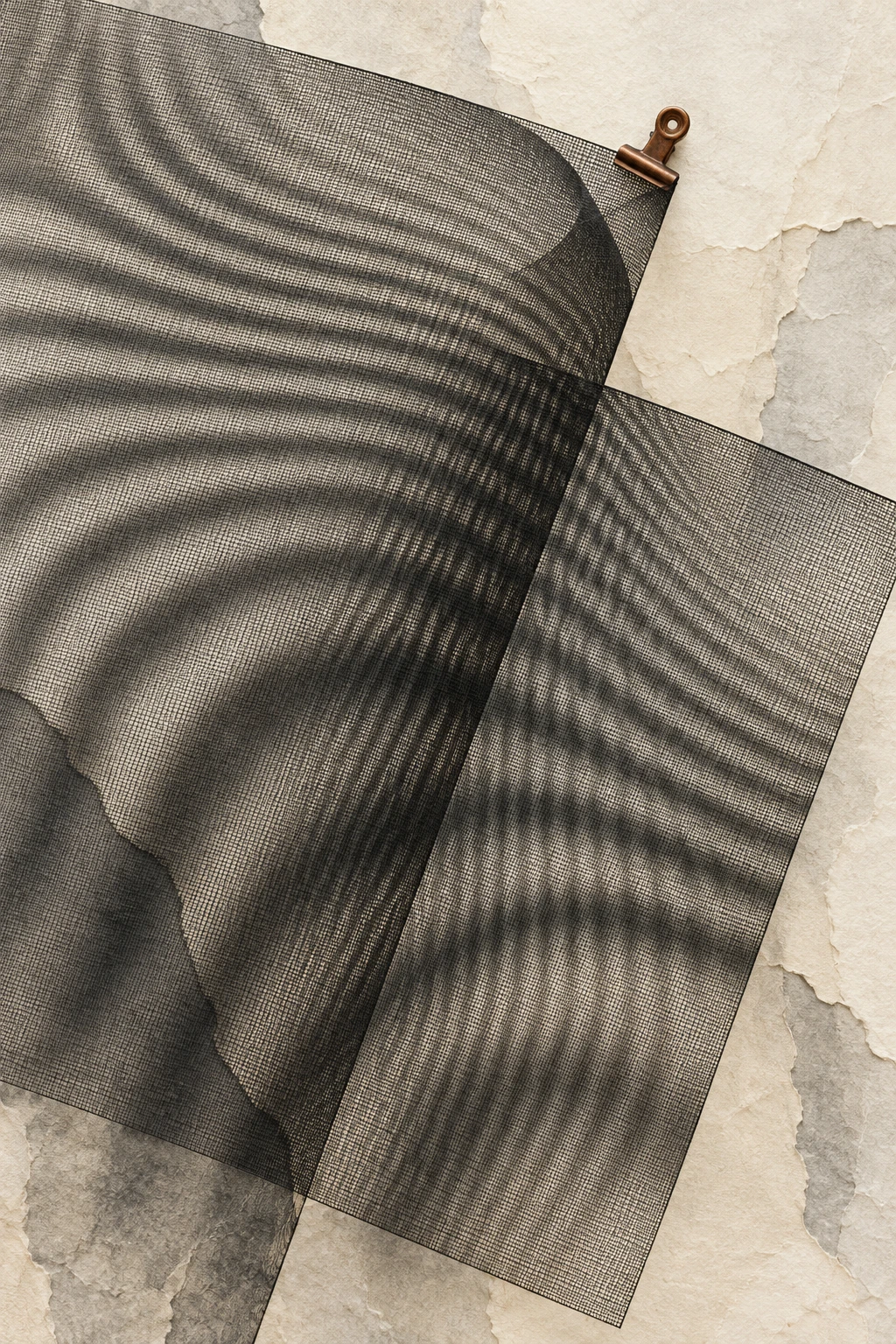
This is moiré. It can make a fine striped shirt misbehave in a photograph or turn layered sheets of mesh into an unexpectedly large visual rhythm. The broad bands are easier to follow than the tiny lines that create them, which is why a very small mismatch can announce itself at a much larger scale.
Make the mismatch larger than its ingredients
Begin with two transparent sheets carrying parallel dark lines. Give one a line every ten millimeters and the other a line every eleven. Near a point where the lines align, much of the open space remains clear. Move along and the second set gradually slips relative to the first. Farther on, its lines occupy different parts of the gaps.
The local light transmission changes with that alignment. After 110 millimeters, eleven ten-millimeter intervals and ten eleven-millimeter intervals have brought the patterns back into register. The resulting repetition is much wider than either original pitch. For ideal parallel line patterns, the beat spacing is p × q ÷ |p − q|. Ten and eleven give 110.
That equation describes a simplified geometric relationship. Actual contrast depends on line thickness, opacity, illumination, and the surface being viewed. A photograph adds its own pixel grid and processing. But the simple arithmetic explains why almost matching patterns can produce surprisingly wide bands.
Layer two grids
Adjust pitch and relative angle with static grids and a numerical beat-spacing readout.
The model keeps the two layers separate enough to inspect. Change the second pitch while leaving the first fixed, then return to equal pitches and rotate one layer slightly. If the lines are difficult to resolve on your screen, use the text readout and compare the broad bands rather than judging individual fine lines.
A rotation creates a different route to repetition
Equal pitch does not prevent moiré. Rotate one layer by a small angle and the lines cross. Their changing alignment produces a new, larger-scale arrangement. As the relative angle grows, the broad pattern changes. The display is a stationary mathematical construction controlled by you, not a flashing or automatically moving optical test.
The Marquette physics laboratory notes distinguish pitch mismatch from rotation and explain how grids attached to a specimen can reveal deformation. In the basic occluding-grid case, the bands arise geometrically. They do not require light waves to diffract through the mesh.
This distinction prevents an attractive but misleading explanation. The large pattern can look like a water-wave interference pattern. A similar mathematical idea of relative phase is useful, but visible bands made by one black grid covering another need not be a demonstration of optical wave interference.
Use the bands as a magnifying relationship
Imagine drawing a fine grid on a sheet before stretching it. Compare the stretched grid with an unchanged reference. A tiny difference in spacing can create a broader fringe pattern that is easier to count. The measurement comes from a known relationship between the reference and the altered specimen.
Try this as a paper thought experiment. If the first pitch is ten units and the second becomes 10.1, their beat spacing is 1,010 units. Make the mismatch larger, to eleven, and the beat spacing shrinks to 110. A wider fringe does not necessarily mean a larger underlying change. Close agreement can produce the widest visible beat.
This is also a good prediction challenge for the model. Before adjusting the slider, decide whether a second pitch moving closer to the reference should spread the bands apart or squeeze them together. The calculation supplies an answer even when display resolution makes a particular view imperfect.
The camera can become the second grid
A real subject does not always need a second physical mesh behind it. A digital image samples spatial detail. When the subject contains repeated structure too fine for that sampling arrangement, the recorded image can contain a larger pattern absent from the intended subject. Changing distance, angle, or image processing can change the result because the relationship between subject detail and sampling has changed.
For a photographer, the important question is where the pattern was introduced. Inspect the actual fabric, the camera’s original file, and the final resized image separately. A pattern that appears only after resizing points to a different stage from one visible in the original capture. This is a diagnostic exercise, not a promise that one adjustment fixes every camera or fabric.
The Exploratorium’s pattern table invites visitors to layer and rotate transparencies. Its companion Moiré Patterns exhibit gives the same phenomenon a physical setting. Both offer an appealing starting point because you can watch the ingredients remain simple while their combination changes dramatically.
Read a relationship, not a hidden object
The broad dark band is not an extra strip of material laid across the fences. It is a region where the repeated structures combine to transmit less light. Move your viewpoint and the relationship changes, so the apparent band can travel without any wire following it.
That is what makes moiré useful beyond its visual appeal. It teaches you to look for an interaction between systems before inventing a third object. A small mismatch, seen through repetition, can become the biggest and most noticeable feature in the scene.
Follow the evidence: Marquette physics laboratory: low-frequency moiré; Exploratorium: Moiré Patterns Table; Exploratorium: Moiré Patterns.
Explore all 80 new articles · Browse the complete illustrated collection
Explore more art, ideas, experiments, and independent projects at Incoprea.