The wheel is turning forward. The video seems to disagree. Its spokes creep backward, pause, and then start forward again as the vehicle changes speed. This is a puzzle about missing observations: the camera records selected moments, while you have to decide what happened between them.
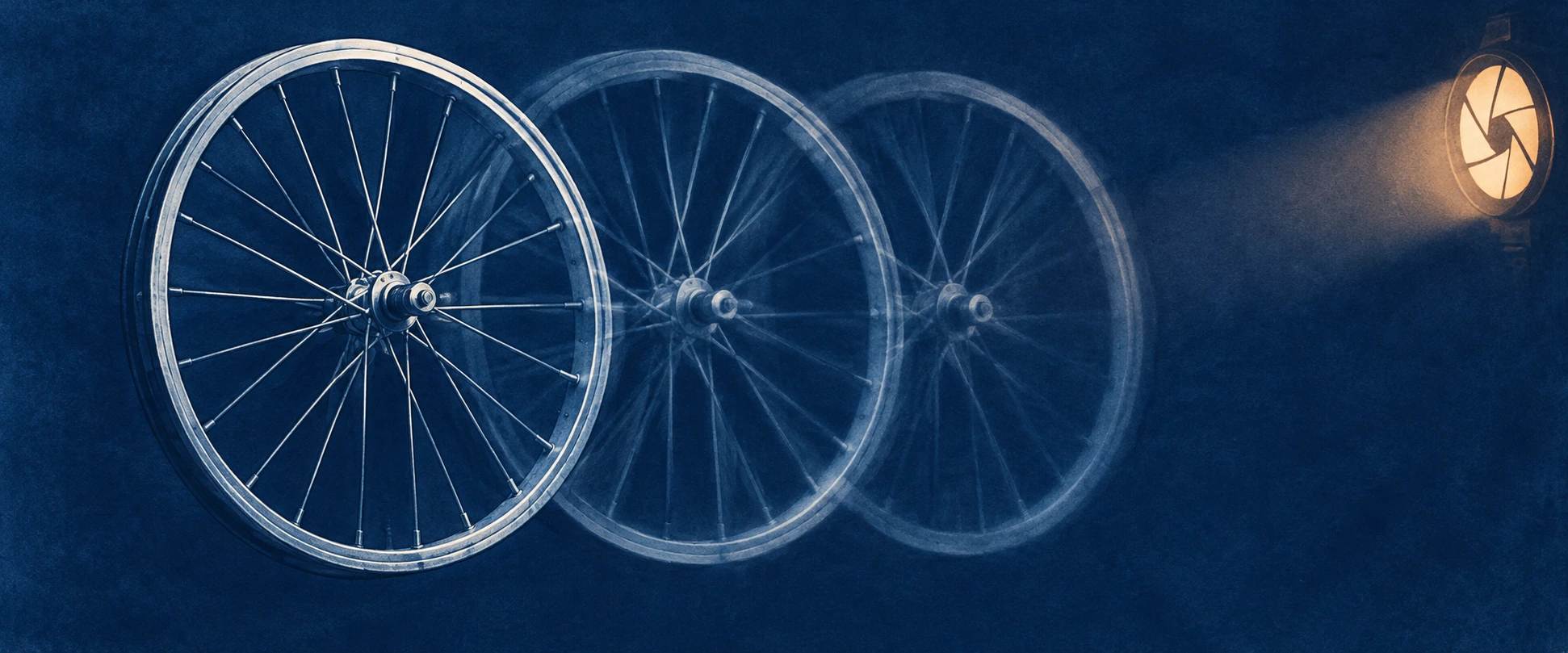
A wheel with twelve identical spokes repeats its appearance every thirty degrees. Rotate it by one full spoke spacing and an unmarked photograph cannot tell the difference. That repeating geometry gives the camera many ways to record a position without revealing which spoke has arrived there.
The missing twenty-eight degrees
Build an imaginary sequence. Between exposures the wheel advances twenty-eight degrees clockwise. In the first picture a spoke points up. In the next, a different spoke is just two degrees counterclockwise from that position. The pictures are consistent with a large clockwise move and a small apparent backward move. If the sequence repeats, the slow backward interpretation can look remarkably persuasive.
The arithmetic is simple because we deliberately chose a tidy wheel. Twelve spokes mean a thirty-degree repeat. Twenty-eight degrees is the same repeating pattern position as minus two degrees. With twenty-four exposures per second, the underlying wheel in this example turns at 28 × 24 ÷ 360, or about 1.87 revolutions per second. The visually economical interpretation advances the repeating pattern only minus two degrees per frame.
Those figures are an original demonstration, not a measurement of a particular film. They also depend on identical, evenly spaced spokes. Put a bright identifying mark on one spoke and the ambiguity changes: the marked feature repeats only after a full revolution, even while the unmarked spoke pattern continues to offer shorter repeats.
Wheel sampling detective
Choose spokes and angular advance; inspect actual and apparent direction with a static sample table.
Predict before revealing
In the sampler, choose twelve spokes and a twenty-eight-degree advance. Compare the actual clockwise advance with the smallest signed pattern displacement. Then try thirty degrees. Every sample returns the pattern to an equivalent position. The captured sequence can look stationary while the wheel is moving briskly between observations.
At thirty-two degrees, the shortest pattern displacement is plus two degrees instead. A small speed increase has carried the sampled appearance through backward, stationary, and forward motion. The object has not obeyed a mysterious new force. A recurring pattern has crossed a boundary in how it is sampled.
Now reduce the number of spokes. A six-spoke wheel repeats every sixty degrees. The same twenty-eight-degree step is now below half a pattern repeat, so the smallest apparent displacement has the forward sign. The relevant comparison is not simply frames per second against wheel revolutions per second. Repetition in the visible object contributes an additional frequency.
Sampling records an answer to a narrower question
MIT’s sampling chapter develops aliasing as a general problem: different underlying signals can produce the same sampled observations. A movie wheel is an especially tangible example because the missing events can be imagined as spokes traveling through the gaps between frames.
This does not mean all motion has one true frame rate that a camera either discovers or misses. Motion, texture, lighting, and recording all interact. An unpatterned disk gives fewer spoke positions to confuse. A wheel with fine repeated markings can introduce additional ambiguities. A moving shadow or a flickering light may add another rhythm.
The classroom model deliberately leaves those complications out. It calculates exact orientation steps for a perfectly repeating wheel. Its sample table is more important than any smooth animation: you can inspect the same angles that produce the apparent reversal without relying on your eyes to agree on a moving display.
An exposure has a duration
A camera frame is not necessarily an instantaneous sample. During an exposure, a moving spoke can sweep across several positions and leave a blur. MIT’s discussion of video sampling treats this exposure time as part of the recording process. Frame interval and shutter duration describe different things.
A short exposure may preserve crisp spokes and make the discrete pattern easier to track. A longer exposure blends positions, potentially obscuring the spokes that supplied the alias. This is why changing a camera setting can change the look of a spinning object even if the nominal frame rate remains fixed.
The Exploratorium’s Whirling Watcher uses interrupted viewing to investigate related stroboscopic effects. You do not need to build a flashing light to follow the argument here. The static sequence and numeric controls expose the same missing-information problem.
What the wheel does not prove about your eyes
It is tempting to explain the illusion by saying the brain takes pictures at a fixed number of frames per second. That is not what this camera demonstration establishes. It establishes that discrete recorded observations of a repeating object can be ambiguous. Reports of reversal under continuous illumination involve additional perceptual questions and should not be collapsed into a camera specification.
A useful habit follows from the wheel: when a measurement gives a strangely slow or reversed result, ask what could have happened between samples. The same question matters when reading a sparsely logged sensor, comparing occasional photographs, or interpreting a repeating vibration. An observation can be completely accurate about the sampled moments and still leave the motion between them unresolved.
Follow the evidence: MIT: time series sampling and aliasing; MIT computational photography: temporal sampling; Exploratorium: Whirling Watcher.
Explore all 80 new articles · Browse the complete illustrated collection
Explore more art, ideas, experiments, and independent projects at Incoprea.