You can stare at a quartz watch for a minute and see sixty decisive movements of its second hand. What you cannot see is the much faster event behind them: a small resonator flexing thousands of times between those visible steps. The hand is a display at the end of a counting system. Its apparently simple tick hides a translation between two very different speeds.
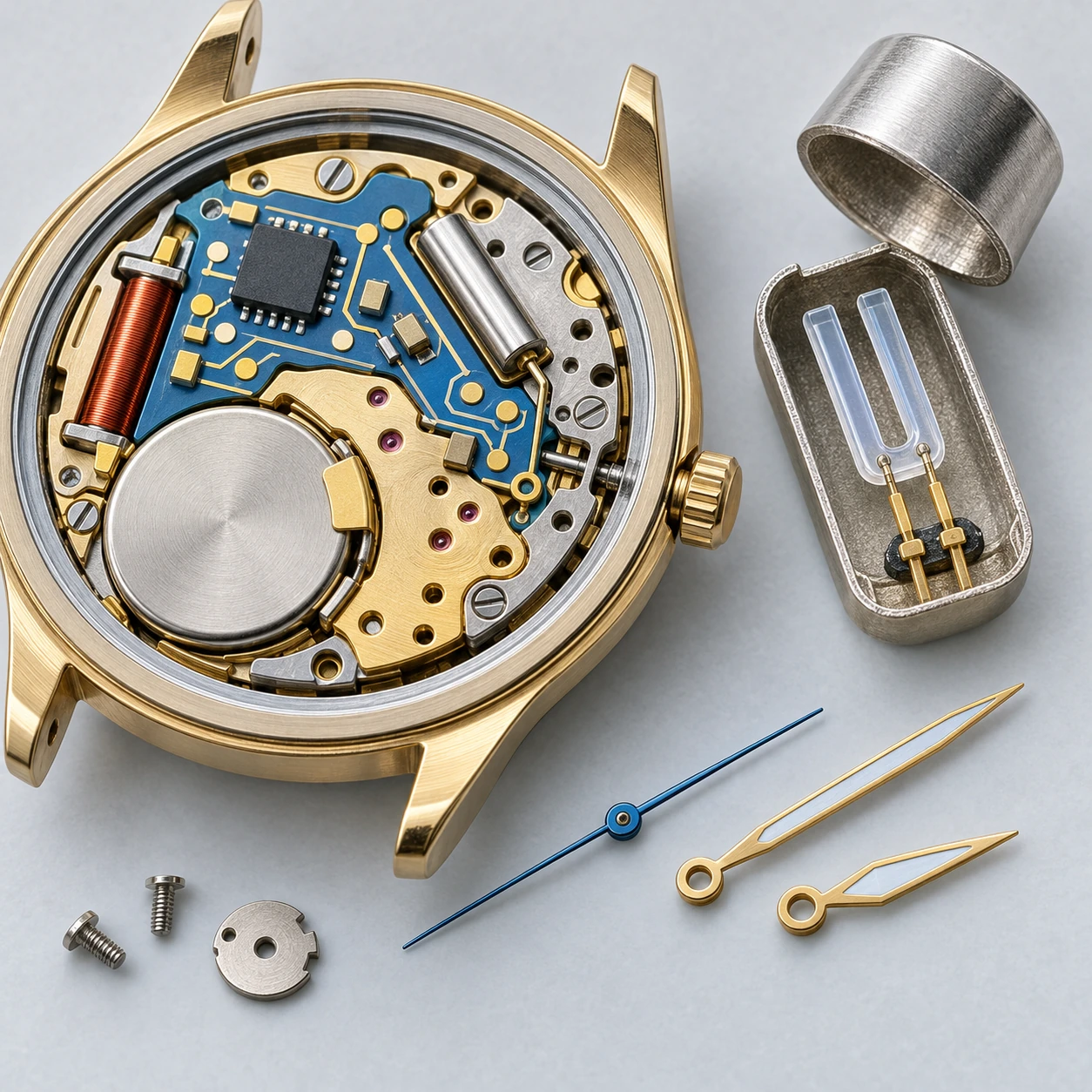
A common watch oscillator runs at 32,768 cycles per second. That peculiar number is a clue. Keep halving it and you reach 16,384, then 8,192, then 4,096. Continue until fifteen divisions by two have turned the original rate into one cycle per second. The crystal stays intact. It is the electrical frequency that the circuit divides.
Start with the part that moves too quickly to watch
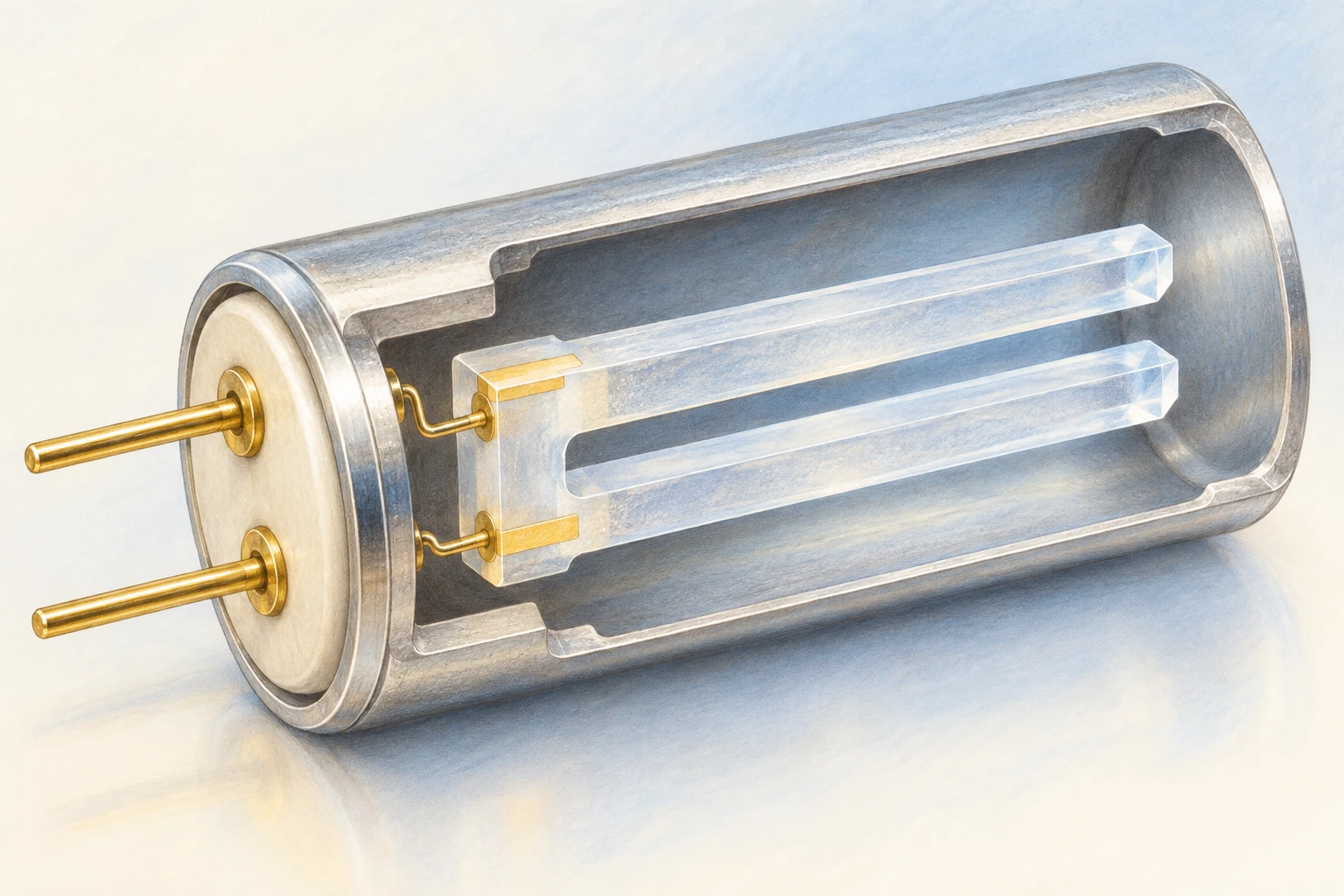
Quartz couples mechanical deformation and electrical behavior through piezoelectricity. In a suitable oscillator circuit, a carefully made resonator provides a sharply defined rhythm while electronics replenish losses. A tuning-fork shape allows a compact resonator to flex at a useful low frequency for a watch. The familiar metal capsule is packaging; the quartz element inside is much smaller than an ordinary musical tuning fork.
NIST researcher Michael Lombardi’s history follows the path from piezoelectric experiments to practical quartz timekeepers. The mechanism is more interesting than the slogan that quartz “makes electricity.” The battery supplies energy. The crystal and circuit organize repeated motion into a usable timing reference.
Think of an imaginary turnstile that admits one visitor on every second incoming pulse. Put another identical turnstile after it. That second stage passes one pulse for every four at the entrance. Each stage has only a two-way decision, but a chain of stages can count a surprisingly large number of original cycles. Real divider circuits use changing electrical states rather than tiny gates or miniature workers.
Follow the count yourself
The model below lets you choose a divider stage and see the rate that remains. It begins with an ideal 32,768 Hz source, not a microphone reading or a measurement of your own watch. The last stage is slow enough to connect with the visible second. Earlier stages remind you how much counting happens between two hand movements.
Divide a watch frequency
Choose one of fifteen divide-by-two stages and calculate its output rate.
Try stage ten first. Five more halvings remain. Predict the result before moving to stage fifteen. Then work backward: a one-second signal needs two incoming events at the previous stage, four one stage earlier, and so on. Nothing about this arithmetic requires a dial. The same idea can supply a digital display, a timing controller, or the drive sequence of an analog movement.
The rate is not the time of day. A watch could count seconds beautifully while showing the wrong hour. Setting it establishes an initial relationship to a reference. Keeping time means preserving that relationship as the count continues. This distinction is why a perfectly regular classroom metronome does not automatically know whether it is noon.
A small error can become a visible appointment
Suppose an imaginary oscillator is one part per million fast. That means one extra cycle for every million cycles it should produce. Across a day of 86,400 seconds, the resulting gain is 0.0864 second. Over thirty days it is about 2.59 seconds. These are calculated examples, not a promised specification for any watch.
Now try ten parts per million. The daily gain becomes 0.864 second. This is why temperature response, manufacturing tolerances, adjustment, aging, and the design of the oscillator matter. A high starting frequency is useful for division, but frequency alone does not guarantee a particular accuracy. A counter will faithfully divide a reference that is slightly wrong.
NIST’s clock explanation makes the common 32,768-to-one division explicit. Read it alongside the numerical example rather than treating all quartz timekeepers as identical. A specification has conditions: the interval of measurement, the temperature range, and sometimes the way the watch is worn or synchronized.
Even the familiar number has exceptions
The common architecture is not a definition of quartz timekeeping. Citizen’s Caliber 0100 announcement describes an AT-cut oscillator operating at 8,388,608 Hz. That is 256 times 32,768. It also shows why an illustration of a tiny fork should not become a claim about the shape inside every quartz watch.
Radio control or satellite synchronization adds another distinction. A watch may have a local oscillator that does the counting between occasional corrections from an external reference. The source of its long-term agreement and the device that carries it through the next few seconds are then different parts of the story.
Next time you look at a second hand, watch the empty interval between movements. Imagine the unseen count filling it, then being reduced through fifteen simple binary decisions. The small surprise is not that a crystal can move. It is that an electrical circuit can turn a motion too fast to follow into a rhythm slow enough to organize a human day.
Follow the evidence: NIST: how clocks count; Michael Lombardi: the evolution of quartz clocks; Citizen: Caliber 0100.
Explore all 80 new articles · Browse the complete illustrated collection
Explore more art, ideas, experiments, and independent projects at Incoprea.