Look at a straight machine-sewn seam from above. It is easy to imagine a single thread being pushed repeatedly through the cloth. Turn the fabric over and there is another line to explain. In a lockstitch, the familiar visible needle works with a second thread stored below the sewing surface.
The puzzle is geometrical. A needle with its eye near the point can carry an upper thread down through the cloth and back up. How does that motion make the upper and lower threads interlock, when neither thread is simply being pulled all the way through like a hand-sewing needle?
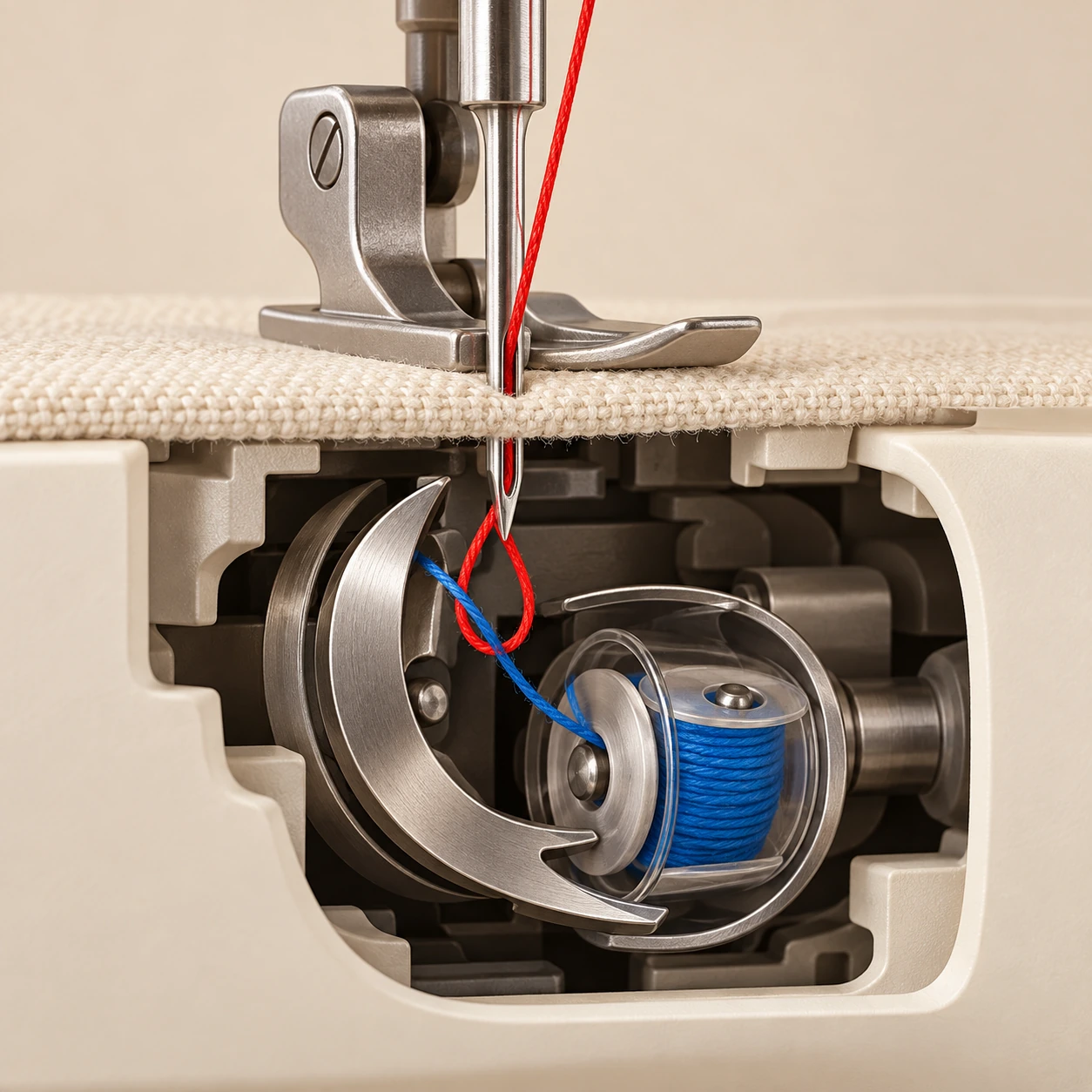
The important event happens just after the descent
As the needle begins to rise, a loop of the upper thread can form below the cloth. A hook or shuttle mechanism catches and manages that loop. In a rotary-hook design, the loop is carried around the bobbin case so that it can engage with the lower thread. Take-up and tension then draw the stitch into its completed position.
A Singer patent describing a bobbin-winding arrangement also sets out the familiar lockstitch action: the hook seizes the needle-thread loop and carries it around the bobbin case. It is a useful primary description of the loop path, even though the patent's new contribution concerns another part of the mechanism.
Read the cycle as four different jobs
- Present the upper thread. The eye-pointed needle brings it through the cloth.
- Catch a loop. The lower mechanism meets the thread during the appropriate part of the needle's movement.
- Arrange the interlock. The loop passes around the lower-thread arrangement in the design's particular way.
- Take up and advance. The stitch is tightened, and the fabric moves for the next one in coordination with the needle.
This sequence names functions rather than giving service settings. The exact timing, hook motion, feed mechanism, and thread path depend on the machine. The illustration is a conceptual paused view, not a pattern for rebuilding a sewing mechanism.
What would go missing in a needle-only explanation?
The lower-thread encounter. Moving a loop through fabric is not the same as arranging that loop around another thread. A clear explanation must account for both thread supplies, the loop-taking mechanism, and the return to a tightened stitch. “The needle goes up and down” describes only the most conspicuous motion.
One stitch, more than one mechanical solution
The Smithsonian's Allen Wilson patent-model account compares shuttle and rotary-hook developments. An earlier shuttle carried a second thread through a needle-thread loop. Later arrangements changed how the loop and bobbin met. The common result did not require every machine to use the same path or shape of moving part.
That makes museum models valuable reading material. A model lets you ask which motion an inventor changed and what difficulty the change addressed. The question is more precise than asking which person “invented the sewing machine,” as if the complete modern object appeared in one indivisible step.
The Smithsonian record for Isaac Singer's 1851 model describes a straight eye-pointed needle and a reciprocating shuttle, along with specific claimed improvements involving tightening and thread control. Those details restore the invention to an actual mechanism rather than only a famous brand name.
A seam can preserve the relationship
If you have an ordinary lockstitched scrap, inspect both sides in good light. Find an existing loose end rather than cutting a garment you need. Try to follow which visible segments belong to the upper and lower thread. The completed seam offers clues about an event that took place beneath the cloth.
A classroom sample sewn with contrasting upper and lower colors makes that reading easier. The red-and-blue convention in the illustration serves this purpose; real thread colors do not have to differ. It is the interlocking relationship, not the pigment, that defines the explanation.
The machine's achievement is a carefully repeated meeting. An upper thread becomes a loop; the lower mechanism gives that loop a route; the stitch is tightened before the next meeting. A straight line of stitches can look quiet because a complicated conversation has been made repeatable.
Follow the evidence: Smithsonian: Allen Wilson sewing-machine model; Smithsonian: Singer 1851 patent model; Singer patent US4259914A.
Explore all 80 new articles · Browse the complete illustrated collection
Explore more art, ideas, experiments, and independent projects at Incoprea.