A fountain pen contains enough ink to make an impressive blot, yet a working nib usually gives paper only a narrow line. Gravity is present, but the pen cannot simply be a bottle with a small hole. It has to supply liquid while preventing an uncontrolled pour, and it has to replace the space left by the ink that departs.
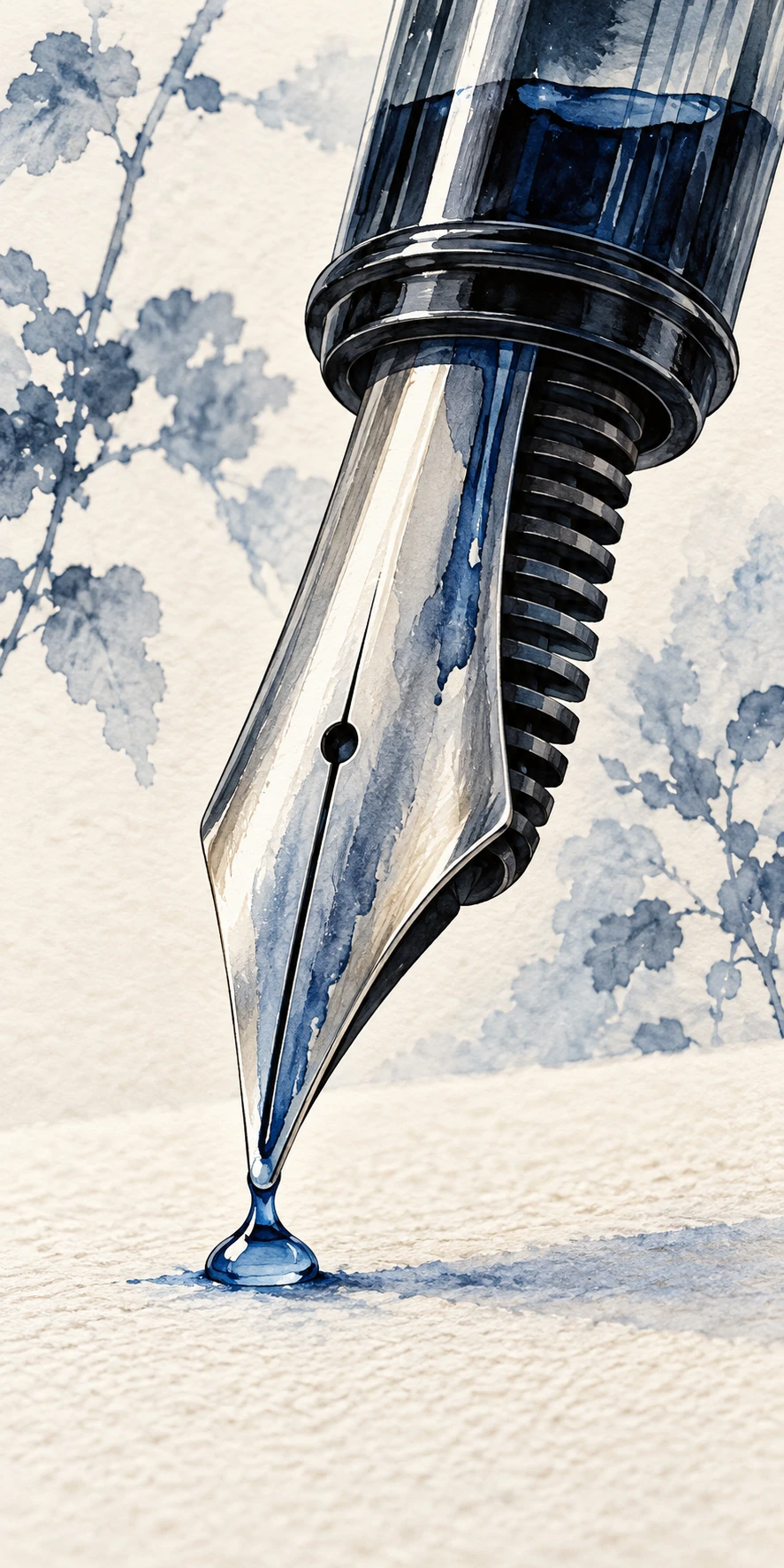
The familiar shiny nib is only the most visible part of the arrangement. Under it sits the feed, a component whose small channels and fins can look less glamorous but do essential work. A continuous written sentence depends on an exchange between ink, air, solid surfaces, and absorbent paper.
A narrow space can help a liquid move
Capillary action involves the behavior of a liquid at narrow spaces and surfaces, including attraction to the material and cohesion within the liquid. The US Geological Survey's explanation uses familiar examples to show why liquids can move through small passages without a tiny mechanical pump at every point.
Paper makes the pen-and-page combination especially interesting. Its fibers and the spaces among them draw liquid away from the contact. The page is an active participant in making a line. Two papers can therefore give the same pen and ink a different-looking result, even before anyone changes their handwriting.
The feed is also an air-management device
PILOT's illustrated technical lesson describes ink grooves that carry liquid, comb-like grooves that hold surplus ink, and an air path into the reservoir. Ink can leave smoothly only if the changing reservoir conditions allow it. Air entering as ink is consumed is part of that continuing supply.
Imagine a rigid, perfectly sealed reservoir with a fixed amount of air above the ink. Let some liquid depart without admitting replacement air. The trapped gas expands and its pressure falls. That changing pressure resists continued outflow. The exact behavior of a real pen depends on its reservoir and feed design, but the thought experiment shows why “make the ink channel narrower” is not the complete solution.
A nineteenth-century problem still recognizable today
Lewis Waterman's 1884 patent describes a feed piece with a groove and narrow fissures. Its text discusses outward ink movement and incoming air, including the problem of bubbles interfering with the ink duct. The document is useful because it makes the engineering problem explicit in the inventor's own description.
A patent is not proof that one person invented every part of an entire technology. It is a specific claim, with drawings and an argument about an arrangement. Looking at it this way is more revealing than treating it as a simple first-inventor certificate. The interesting continuity is the need to regulate a flow that otherwise alternates between too little and too much.
Watch the paper before blaming the nib
You can make a useful comparison without dismantling a pen. Use a working pen normally on two papers you already have. Write the same short word with a similar pace and light, ordinary pressure. Note the line edge, apparent width, drying behavior, and any visible spreading along the fibers. Keep the pen and ink constant.
Do not change paper, ink, pressure, and writing speed together and then attribute the result to one variable. A rougher edge is an observation. Saying it proves a defect in the feed is a much larger conclusion. The page, nib, ink formulation, and pace all belong to the writing system.
Predict the effect of removing one participant
If the page stops drawing ink away as effectively, a full reservoir alone cannot guarantee the same line. If air exchange is obstructed, an initially wet nib may still write briefly from ink already near its tip. A short successful stroke and a long uninterrupted page test different parts of the supply chain.
The blue line is therefore a record of cooperation. A reservoir stores ink, small spaces control its movement, air makes room for its departure, and a fibrous surface accepts it. A fountain pen can feel personal because it makes this physical conversation unusually visible at the point where a hand becomes a sentence.
Follow the evidence: PILOT: why fountain-pen ink flows smoothly; US Geological Survey: capillary action; Lewis Waterman:1884 fountain-pen patent.
Explore all 80 new articles · Browse the complete illustrated collection
Explore more art, ideas, experiments, and independent projects at Incoprea.




