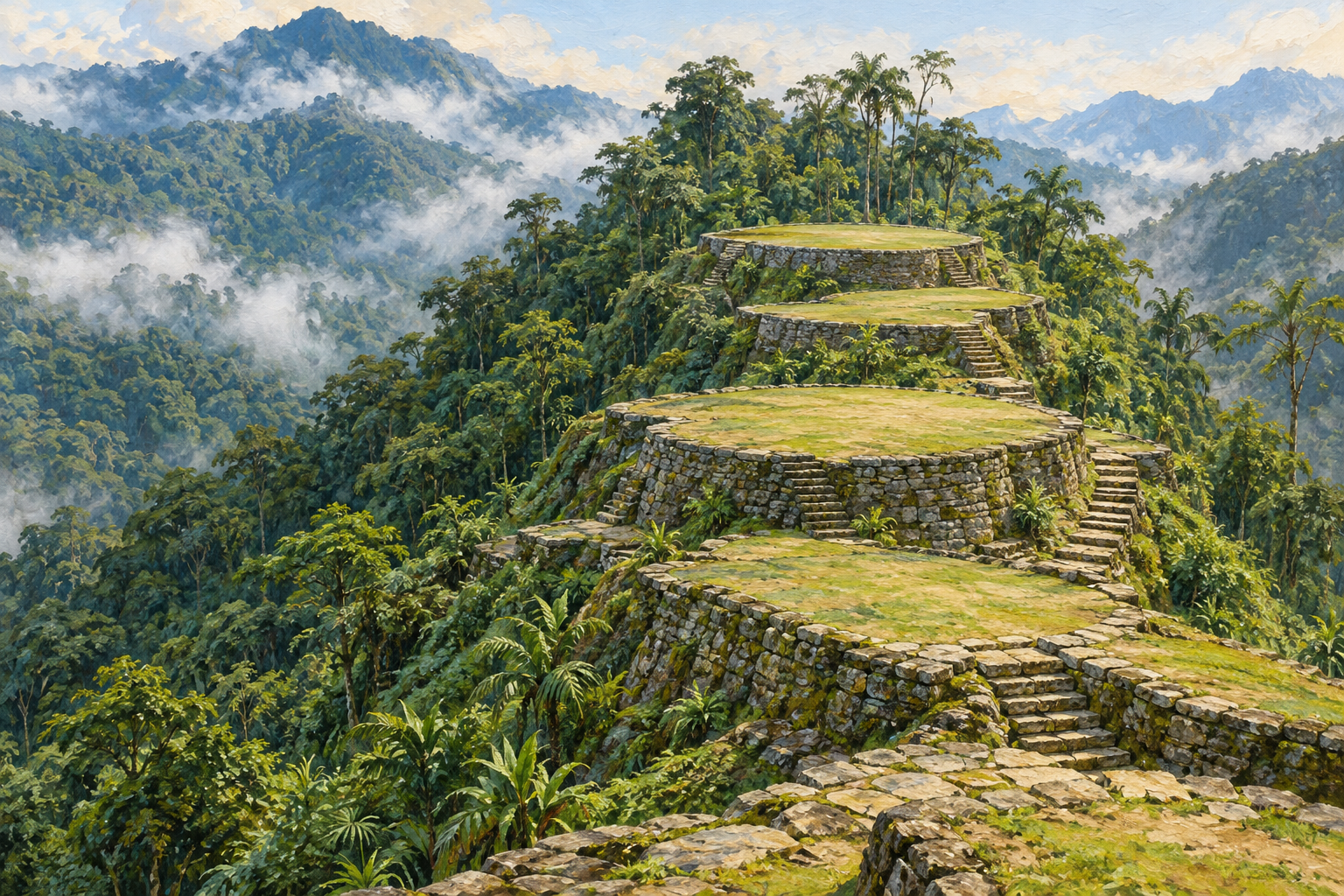
Some ruins impress by standing above a landscape. Teyuna impresses by following one. Its stone terraces step along a steep, forested ridge in Colombia's Sierra Nevada de Santa Marta, turning uneven mountain ground into places where people could gather and build.
The site is widely called Ciudad Perdida, or “Lost City.” That name is memorable, but it can also make a living cultural landscape sound as though its history ended when outsiders stopped looking at it.
A settlement shaped around a mountain
Teyuna belongs to the region's pre-Hispanic Tairona heritage. The Sierra Nevada is a coastal mountain massif separate from the Andes, with striking changes of elevation and environment over short distances. Here, architecture had to respond to slopes rather than assume a convenient flat plain.
In photographs of the surviving settlement, rounded platforms, retaining walls and narrow stairways make that response visible. Look at the connections between levels as closely as the platforms themselves: movement was part of the design. The stone remains are also an incomplete picture. An archaeological foundation does not preserve every material, activity or relationship that once made a place a home.
Rediscovery came with destruction
ICANH, Colombia's anthropology and history institute, explains that the modern archaeological investigation followed destructive looting. Its research, conservation and restoration program began in 1976. This was not an untouched treasure simply waiting for an adventurous visitor; illicit digging had already damaged evidence.
Conservation therefore means more than clearing vegetation for a better photograph. World Monuments Fund describes stabilization, recording, archaeological mapping and work with neighboring communities. Knowing what has been repaired, recorded or disturbed helps researchers interpret what survives.
The landscape still has people
The Sierra Nevada is home to the Arhuaco, Kankuamo, Kogui and Wiwa peoples. Their publicly documented ancestral knowledge traditions connect community life, territory and care for sacred places. Those traditions are living knowledge, with their own authorities and rules of access.
That changes a useful question. Instead of asking only how a city could be “lost,” we can ask who remembers a landscape, who protects it, and whose account appears on the sign. Teyuna's stonework deserves attention on its own terms, alongside the people for whom this mountain is much more than a remarkable ruin.
Look closer: Explore World Monuments Fund's photographic story and 360-degree view, then compare the real surviving terraces with the interpretive artwork above.
Sources: ICANH: Parque Arqueológico Teyuna · World Monuments Fund: Ciudad Perdida visual exhibition · UNESCO: Knowledge of the four Indigenous peoples of the Sierra Nevada
Explore more creative curiosities at Incoprea.




