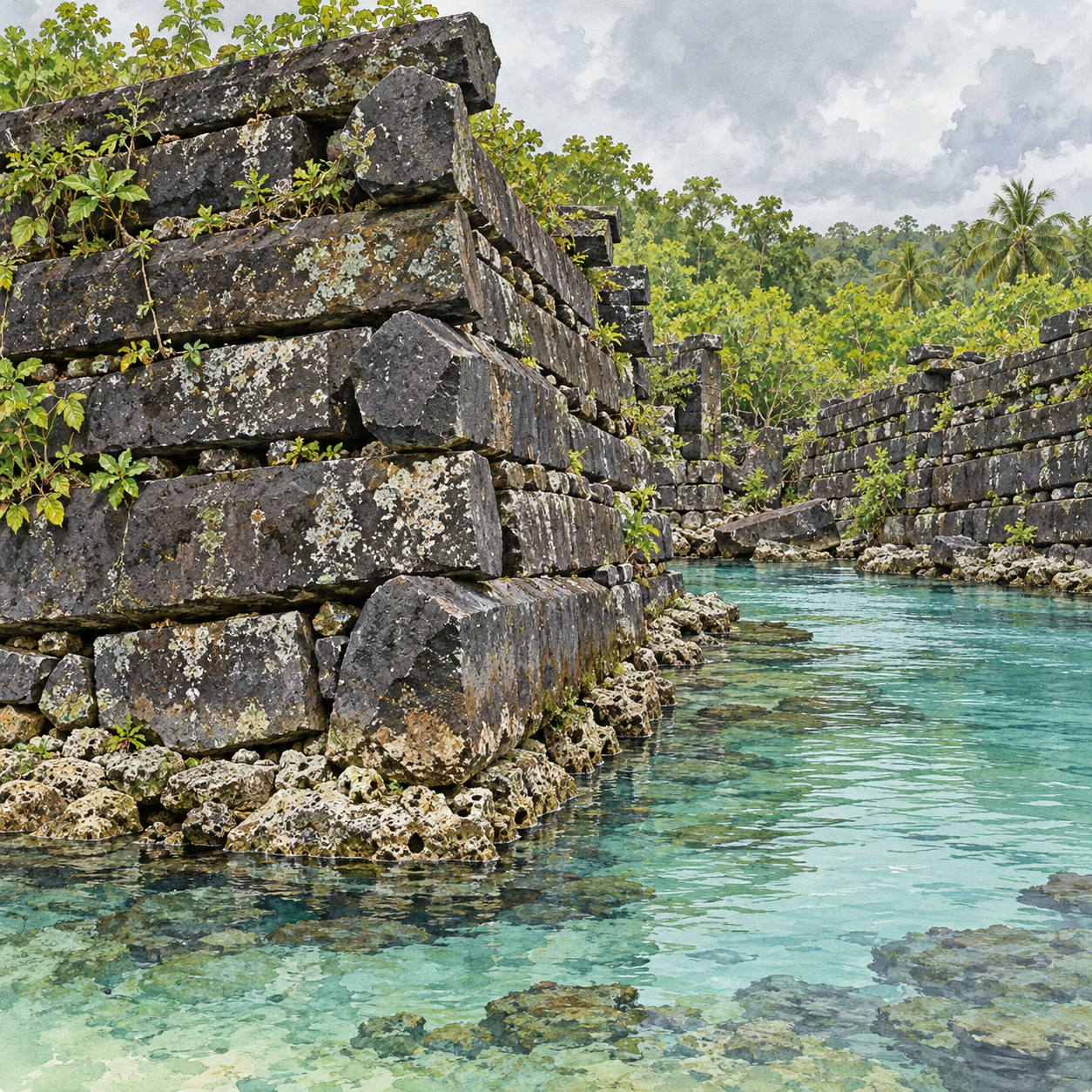
From the water, some walls at Nan Madol look almost like stacks of enormous stone logs. Their long basalt columns meet at angles and corners, enclosing artificial islets beside Pohnpei in the Federated States of Micronesia. The materials are geological. The arrangement is unmistakably human.
This was a major ceremonial and political landscape associated with the Saudeleur rulers. Calling it a mystery can be an invitation to investigate. It becomes misleading when it erases the Pohnpeian people who made and remember it.
Nature supplied the columns, people supplied the architecture
Basalt can fracture into long polygonal columns as lava cools and contracts. Nan Madol's builders used this natural form as a building material, placing massive stones in walls with alternating orientations. Natural geometry did not move them, select their positions or organize the labor.
UNESCO describes more than a hundred constructed islets containing ceremonial, residential and mortuary remains, with monumental development principally between the thirteenth and sixteenth centuries. Archaeological work also identifies earlier occupation and earlier phases of islet construction. A date for a monumental wall is not automatically the birthday of the entire settlement.
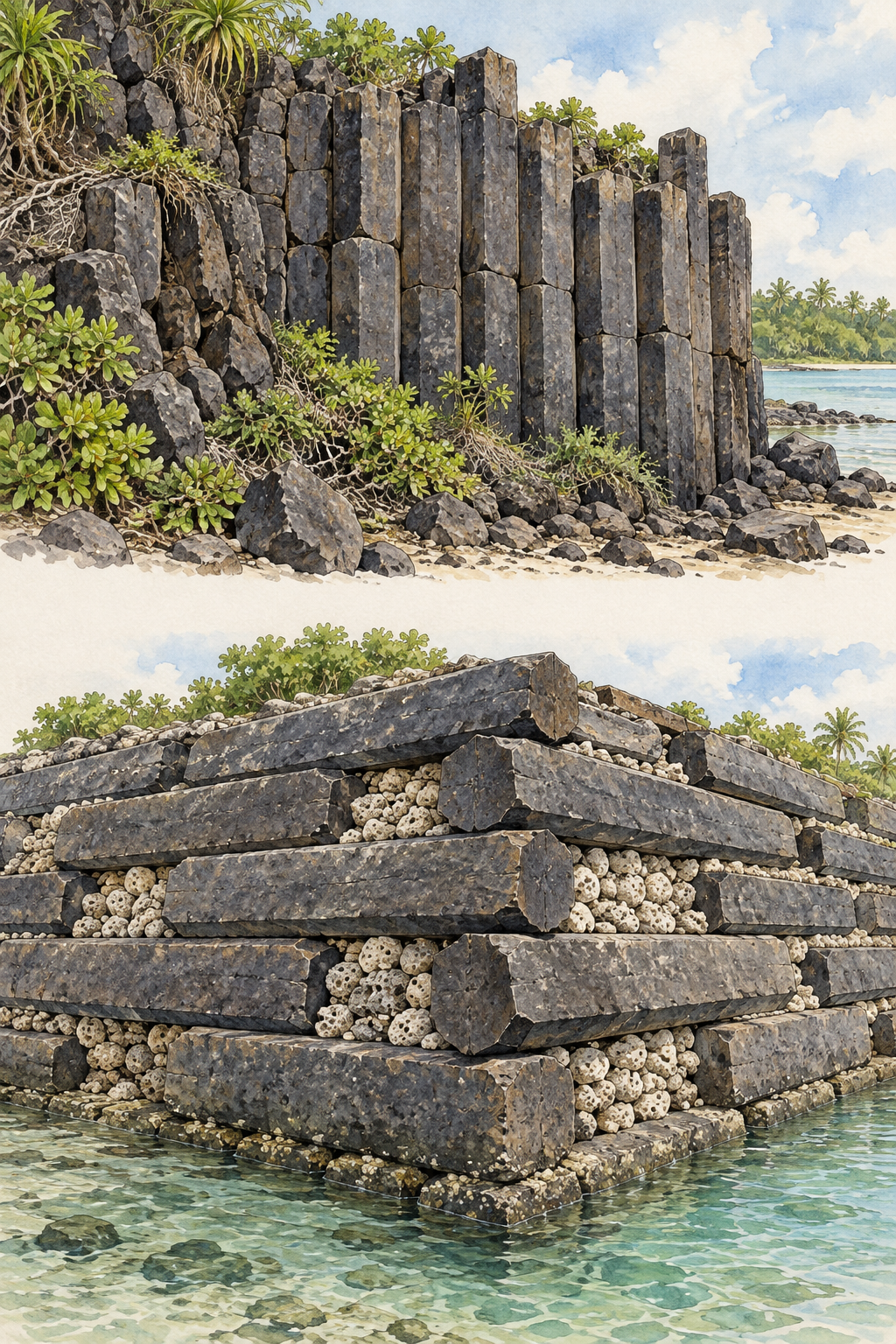
Two kinds of evidence, two different questions
A 2016 study combined geochemical examination of basalt with uranium-thorium dating of coral associated with a major burial monument. The stone chemistry helped connect building materials with volcanic sources on Pohnpei. The coral helped constrain the monument's chronology, placing major construction around the late twelfth and early thirteenth centuries.
These methods answer complementary questions. A chemical match can indicate where a stone originated; it does not reveal every stage of the journey. A date from construction material needs archaeological context before it can be attached to a particular building event.
The practical challenge remains impressive without adding an unsupported transport story. Researchers can establish that heavy stones traveled across the island while continuing to investigate exactly how particular loads were moved and placed. An unanswered detail is a research problem, not evidence that the builders lacked the ability.
A place with continuing authority
Nan Madol also belongs to Pohnpei's continuing social and ceremonial traditions. UNESCO explicitly recognizes its relationship to the Nahnmwarki system of traditional authority. Empty residential spaces do not make a place culturally ownerless.
Water is central to both its appearance and its conservation. Channels separate the islets, while silt, vegetation and damage to stone structures create difficult preservation problems. Protecting the site requires understanding the relationships among masonry, lagoon conditions and people.
The most revealing view is therefore more than a dramatic wall. It is the whole arrangement: stones gathered from elsewhere, islands constructed in shallow water, different spaces given different roles, and a cultural history that continues beyond the period when the great walls were built.
Sources: UNESCO: Nan Madol · IARII: Archaeological investigations at Nan Madol · McCoy and colleagues: Coral dating and stone sourcing, 2016
Explore more creative curiosities at Incoprea.




