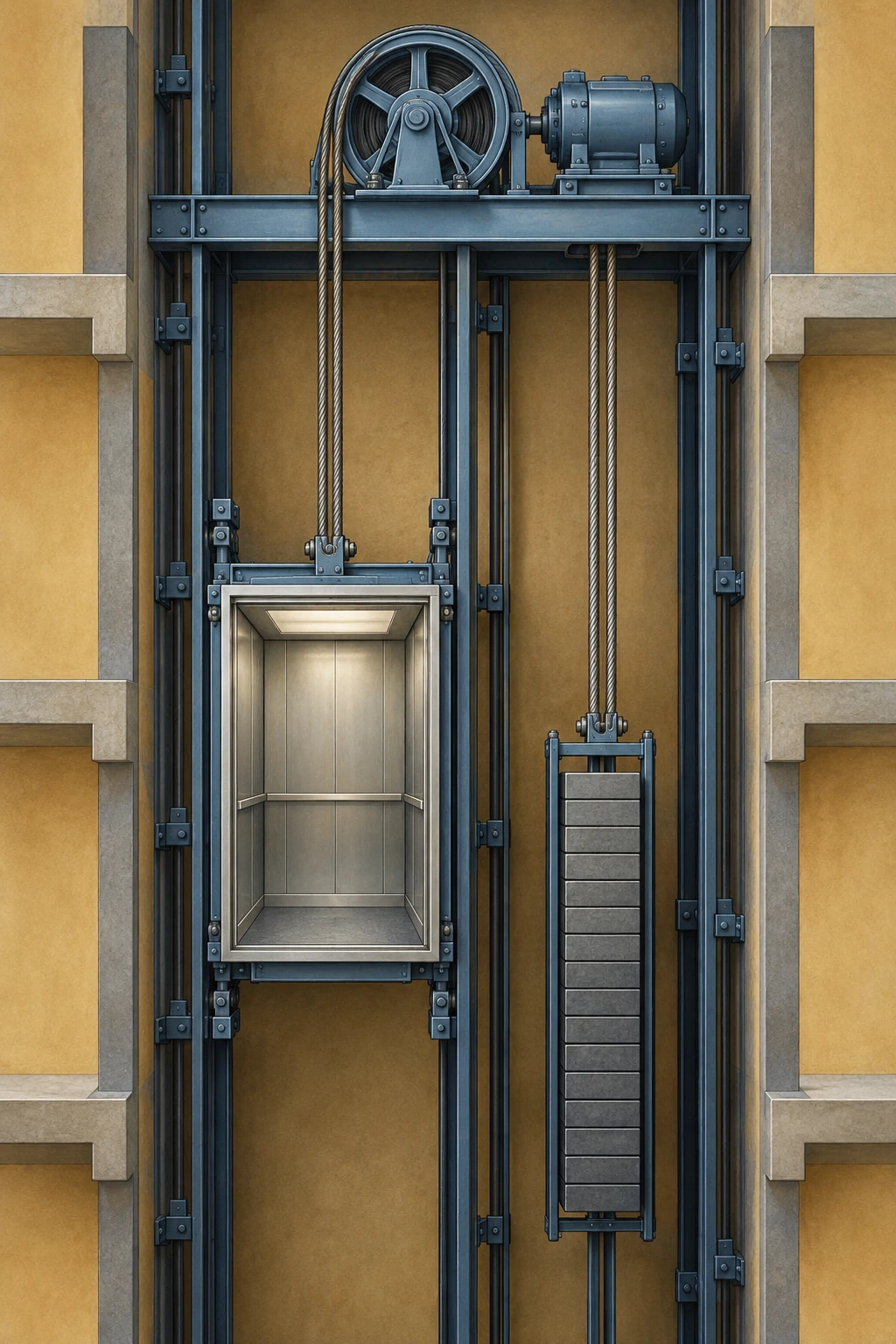
You step into an elevator and see a room. Somewhere beside it, another mass is taking the opposite journey. When your car rises, its counterweight descends. When your car descends, that mass has to rise.
This hidden partner makes the energy story more interesting than “lifting people takes power.” The drive moves a coupled system. Whether gravity helps or resists a particular trip depends on the difference between the two sides and the direction they travel.
Balance one load and the others remain unbalanced
KONE’s engineering glossary defines balanced load and balancing ratio in terms of the passenger load at which car and counterweight weights match. The chosen ratio is a design parameter. It is not a promise that the car stays balanced as people enter and leave.
Use a fictional example: an empty car has a mass of 1,000 kilograms and is rated for another 800 kilograms. Give it a 1,400-kilogram counterweight. With 400 kilograms of passengers aboard, the sides match. Empty, the counterweight is 400 kilograms heavier. Fully loaded, the car is 400 kilograms heavier.
Notice why matching a fully loaded car would not remove every difficulty. It would make the counterweight heavier than the empty car by the entire passenger capacity. Moving that empty car downward would require lifting the much heavier other side.
Count both changes in height
Near Earth’s surface, gravitational potential energy changes by mass times gravitational acceleration times height. Feynman’s lecture on conservation of energy develops the underlying height-and-weight relationship. Applying it to both sides keeps the accounting honest.
Raise the loaded car ten metres while lowering the counterweight ten metres. The car side gains gravitational energy, but the counterweight side loses it. The combined change is the mass difference multiplied by 9.81 and by ten. The relevant mass difference can be positive, negative or zero.
Which way does gravity help?
A two-mass calculation separates gravitational energy change from the other demands on an elevator drive.
Set the passenger load to zero and choose upward travel. The calculation gives −39,240 joules: the heavier counterweight descending releases more gravitational energy than the empty car gains. Now choose downward travel. The sign reverses. The empty car going down requires the heavier counterweight to go up.
At 800 kilograms of passenger load the pattern reverses again. A full car moving up needs energy added to raise the heavier side; moving down releases gravitational energy. At the chosen 400-kilogram balance point, the model’s net gravitational change is zero in either direction.
Power asks a further question
Energy and power are not interchangeable labels. If an ideal displacement needs 39,240 joules, supplying that amount over ten seconds corresponds to an average 3,924 watts for this term. Spread the same ideal energy change over twenty seconds and the average is 1,962 watts. The height and mass difference have not changed; the time has.
A real drive must also handle the changing power during acceleration and deceleration. These averages are a unit exercise, not a motor rating. They explain why a calculation that contains kilograms and metres but no time cannot tell you the necessary peak electrical power.
Zero in the model is not a free real journey
The demonstration isolates one term. It excludes friction, the energy used during acceleration and braking, the motion of ropes and rotating parts, drive losses and auxiliary equipment. The model compares equal start and end speeds; it is not plotting the power at every instant.
A balanced system still needs controlled motion. It has inertia. Doors, controls and lighting do not cease to exist. It is therefore misleading to read the zero-gravity case as a zero-electricity specification for an installed elevator.
KONE’s account of regenerative drives explains how a suitable drive can recover energy during generating conditions and feed it back into the building’s electrical network. That does not mean every elevator regenerates, or that the recovered amount equals the ideal gravitational calculation. Equipment and operating conditions matter.
Make four predictions before moving the controls
- Empty car upward: is the heavier side rising or falling?
- Empty car downward: which side must gain height?
- Full car upward: what changed about the mass difference?
- Full car downward: where could released energy go?
Use the model to check signs, then change the travel distance. Doubling the distance doubles this ideal energy term without changing which side is heavier. It does not tell you how much faster the trip can be made.
The quiet block of material beside the car changes the problem from lifting an entire room to managing a difference between moving masses. The next elevator ride contains an unseen exchange of height, load and energy. The partner going the other way is doing useful work in that story.
Sources and further exploration: KONE glossary: balanced load and balancing ratio; Feynman: conservation of energy; KONE: regenerative drives.
Explore all 50 new articles · Browse the complete illustrated collection
Explore more art, ideas, and independent projects at Incoprea.


