Showing posts with label Trade. Show all posts

Friday, October 23, 2026

Bergen’s Warehouses: Following a Fish Through a Trading Town

The colorful gables at Bergen's Bryggen make a memorable waterfront. But a row of facades is a poor diagram of a trading town. The useful question is what happened behind them. A dried fish could pass through spaces for storage, assessment, bargaining, and dispatch. People had to sleep, cook, keep accounts, and reduce the chance that one fire would destroy their working world.
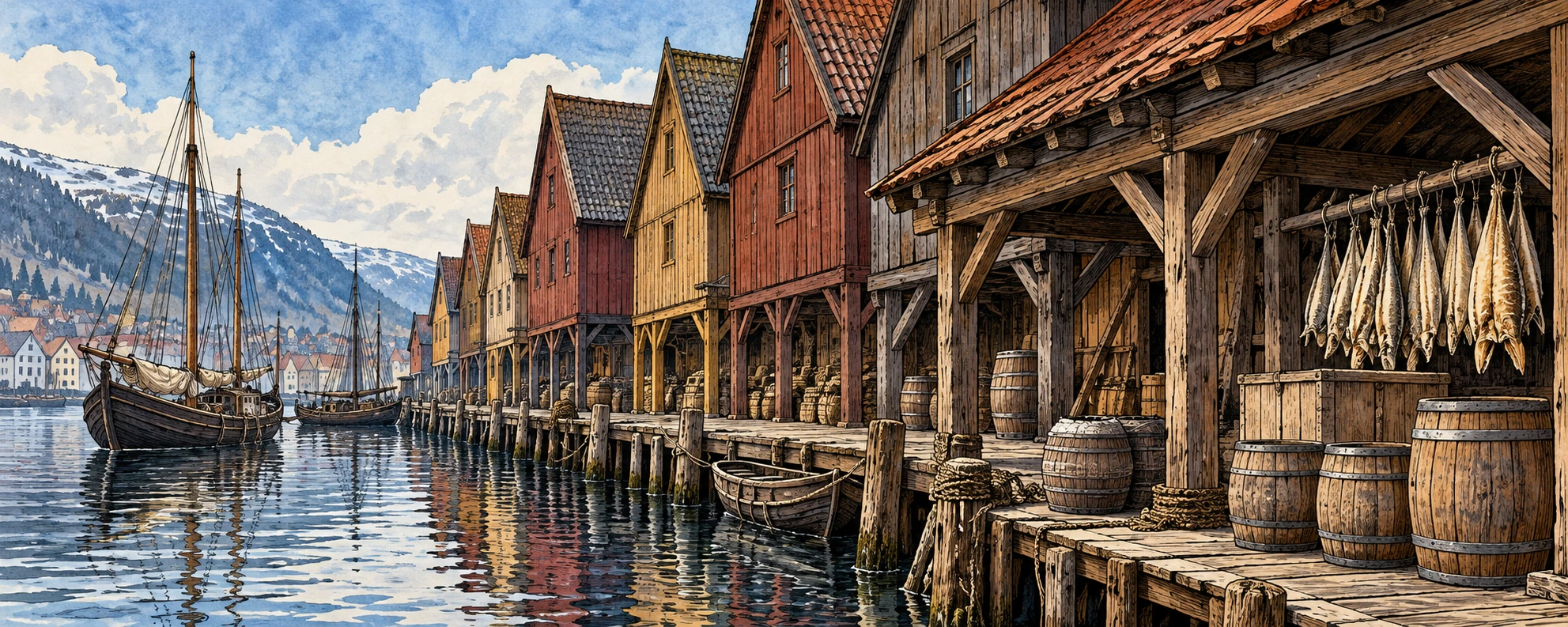
An interpretive medieval Bergen warehouse wharf, steep-gabled narrow timber waterfront buildings and covered walkways, a small stack of pale dried fish under shelter and simple wooden cargo barrels.
Storage, handling, and access to the harbor connect buildings to trade. The invented wharf is not a reconstruction of one dated Bryggen phase.

Read Bryggen from the water toward the back, then downward into the ground. This is an interpretive walk through its documented organization, rather than a claim that every surviving doorway performed one fixed task for centuries. The district changed. Its layout nevertheless preserves unusually clear relationships between commerce, domestic life, and shared space.

Begin with the cargo

Stockfish is fish preserved by drying, usually cod and sometimes coley. The European Hansemuseum's Bergen audio stop follows the exchange of this northern Norwegian product for goods such as grain. It explains why keeping qualities mattered to long journeys and why grading fish was expert work. Much of the supply came from the Lofoten fishery.

That turns a seemingly simple object into a coordination problem. A dried fish in a warehouse is also the result of catching, processing, transport, and agreements between people who may never share a meal. Its usefulness at the destination depends on what happened before it arrived. Looking at the final commodity alone hides those dependencies.

Try describing the trade without using the word “merchant.” You need a fisher, someone handling the catch, people moving cargo, an assessor, and a buyer. You also need provisions moving in the other direction. The exercise makes the waterfront less like a collection of picturesque houses and more like a junction between livelihoods.

At the front: where a transaction acquired a record

Norway's heritage directorate describes offices and dwellings at the front of the building rows, warehouses farther in, and assembly rooms, kitchens, and fireproof stone cellars toward the back. The Hanseatic office was established in the fourteenth century. Trade in stockfish from northern Norway was central to its influence.

Put the account beside the cargo in your imagination. A pile of fish is physical; a claim to payment is an agreement. Trading requires the two to remain connected. That observation does not identify the contents of a particular lost account book. It explains why an office belongs in the same architectural story as a storeroom.

From the front, the buildings can look independent. Follow the narrow spaces inward and the length of a property becomes more apparent. A useful photograph therefore includes the passages and the rear as well as the gables. A waterfront panorama answers “what did the town show?” A view into a row begins to answer “how did it work?”

In the middle: value was something people judged

Storage is easy to overlook because it looks like waiting. Yet keeping goods between arrival and departure is part of trade, not an interruption to it. A warehouse allows a product to be separated in time from the ship that delivered it. It also concentrates the consequences of mistakes.

Expert grading adds another layer. “Dried fish” names a broad category. A transaction needs distinctions within that category. When you read the museum's account, notice that the assessment belongs to people with learned judgment. A quantity and a quality are different kinds of information. Counting one cannot substitute for understanding the other.

This is a good place to resist an attractive fictional detail. We can imagine a noisy argument over a bundle, but an imagined argument is not evidence of a recorded event. The stronger reconstruction explains the decisions the setting required without inventing named participants, dialogue, prices, or one typical day that supposedly represents several centuries.

At the back: the working community

Assembly rooms and cooking facilities bring collective life into the picture. They remind us that a trading establishment had to organize people as well as goods. The 2024 Climate Vulnerability Index report treats these relationships, along with the less visible archaeological deposits, as parts of one heritage property.

The distinction matters when judging what should survive. If only the waterfront silhouettes remained, a recognizable image might endure while much of the evidence for how the place functioned disappeared. Preserving a relationship between spaces can be as significant as preserving an attractive surface.

Below the floor: water can protect wood

The buildings now visible largely follow rebuilding after the fire of 1702, within older property boundaries. Under them are deep cultural deposits containing earlier structures and traces of work. Riksantikvaren's monitoring account explains that drainage, drying, and compression can damage both the deposits and the buildings above them. Stable groundwater is therefore part of caring for the district.

“Keep a wooden building dry” and “keep buried wooden remains waterlogged” can both be sensible aims in different conditions. They concern different environments. The apparent contradiction disappears when we ask which material, in which location, under which conditions. Conservation cannot be reduced to one slogan about water.

NIKU's project description records archaeological mapping, test investigations, and advice about where interventions could occur without disturbing intact deposits. A modern drainage decision therefore requires knowledge of a buried town. The ground is an archive and a support, not simply empty space beneath the visible attraction.

Return mentally to the waterfront. The gables now stand at the end of a longer chain: fisheries, assessments, stores, shared rooms, fires, rebuilding, and carefully managed ground. Bryggen becomes more interesting when its beauty is allowed to include the practical arrangements that made the town possible.

Sources and further exploration

Explore all 80 new articles · Browse the complete illustrated collection

Continue exploring art, ideas, and unexpected connections at Incoprea.

Thursday, October 22, 2026

The Stamp on an Amphora Handle: A Small Mark in a Large Trade Network

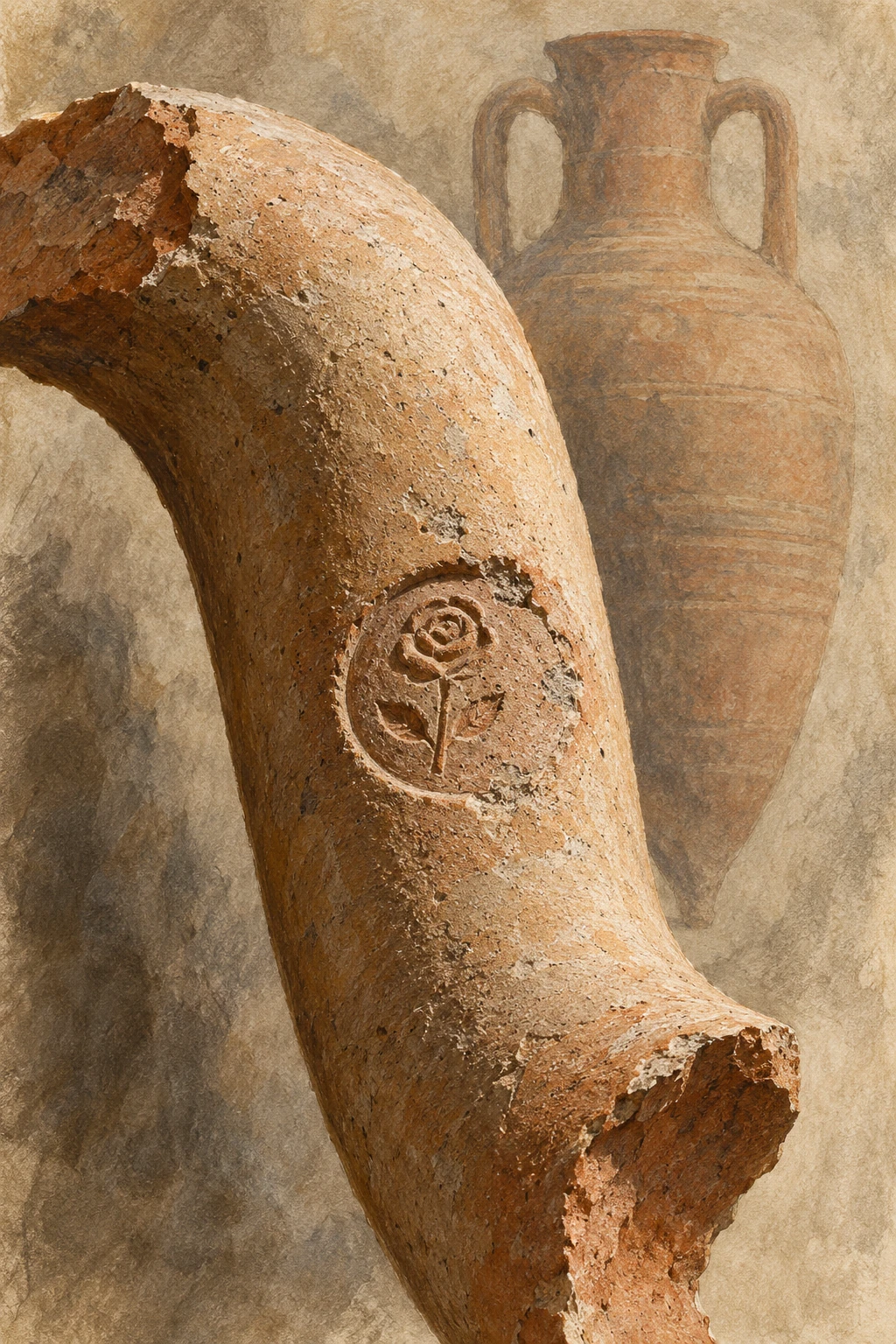
A broken terracotta amphora handle with a worn rose-like stamp, set before a faint whole-jar silhouette.
Conceptual archaeology illustration. The impression is an original generic motif, not a readable ancient inscription.

In a case of ancient pottery, a broken handle may look like the part that survived after the interesting object disappeared. Turn it toward the light and a small stamp can reverse that impression. A name, a symbol, or a month impressed into clay may make the fragment more informative than an unmarked complete jar.

Transport amphoras carried goods through Mediterranean trade networks. Their stamped handles can help researchers investigate production, chronology, and distribution. They are not universal ancient shipping labels. The meaning of a stamp depends on the particular system that produced it.

Read one example before making a rule

The Acropolis Museum’s Rhodian handle provides a concrete starting point. The museum dates it to 230–220 BCE and records its discovery on the south slope of the Acropolis in 1957. It interprets the stamp’s inscription as referring to the potter Kreon and the month Panamos.

That is already several layers of information: a surviving impression, a reading of letters, an interpretation of the names, and an archaeological findspot. A visitor seeing only the handle is seeing the material end of a much larger chain of scholarly comparison.

A British Museum example from Rhodes has a circular stamp with a rose symbol and the name Damokles. Its catalog records a production date of 176–174 BCE and a possible Alexandria findspot. The question mark attached to that findspot matters. It should remain a question mark when the object is retold in a lively story.

The stamp is made; the jar then has a life

A stamp marks a stage in production. The place where a fragment is later excavated belongs to a different stage: use, reuse, breakage, and deposition. The two locations can support a story of movement, but they do not tell us the exact time between manufacture and discard.

This is why archaeological context remains essential. A handle might enter a later deposit. A jar might be reused. A stamp date can contribute to dating a context without making every object nearby exactly contemporary with the jar’s manufacture. The right question is how the fragment got into that particular layer.

The American School of Classical Studies’ Agora collection brings together amphoras and stamps as evidence for the ancient economy. Its history also makes visible Virginia Grace’s long work developing and recording the material. A tiny impression becomes useful through an accumulated reference collection, not through an isolated flash of recognition.

Annual officials can give a narrow chronological handle

In an interview about his study of Thasian stamps, archaeologist Chavdar Tzochev explains how annually changing officials make some stamps particularly useful chronological indicators. He also describes a stamping system that formed part of state oversight, while warning that the larger system remains incompletely understood.

Thasian evidence should not be treated as a rule for every Rhodian, Knidian, or other stamp. The value of a comparative collection is that it preserves differences. An official’s name, a producer’s name, a place name, and a month are not interchangeable categories just because all appear as ancient letters in a small rectangle.

The interview also describes experimental die engraving. Reproducing a general picture was easier than duplicating an engraver’s detailed lettering. That observation helps explain why researchers examine the individual die as well as the text. Two impressions can have more in common than a shared name.

Follow a die across two fragments

The British Museum catalog notes that its Damokles stamp shares a die with an example from the Athenian Agora. This is an especially satisfying connection: two surviving impressions can be related through the tool that made them. It is a different claim from saying the amphoras traveled together or belonged to one merchant.

To practice the distinction, imagine making five impressions from one ordinary rubber stamp on five separate envelopes. The shared design relates the envelopes to a tool. It does not establish that the envelopes contained the same message, went to the same address, or were sent on the same day. The analogy is deliberately narrow, but it clarifies what a die link can establish.

Watch the boundary around the stamp as closely as its central sign. A partial mark can reflect limited space, an uneven impression, later breakage, or an incomplete photograph. Those alternatives affect whether two handles can be compared confidently. Before counting a missing letter as a different name, establish whether that portion of the surface actually survives.

The archive behind a tiny impression

A stamp becomes more informative when somebody has made it comparable with thousands of others. The American School’s Virginia Grace Papers finding aid lists separate files for names, shapes, deposit groups, chronological sequences, and pairs of stamps on whole jars. The arrangement is a useful antidote to the idea that archaeological identification is simply recognizing a familiar picture.

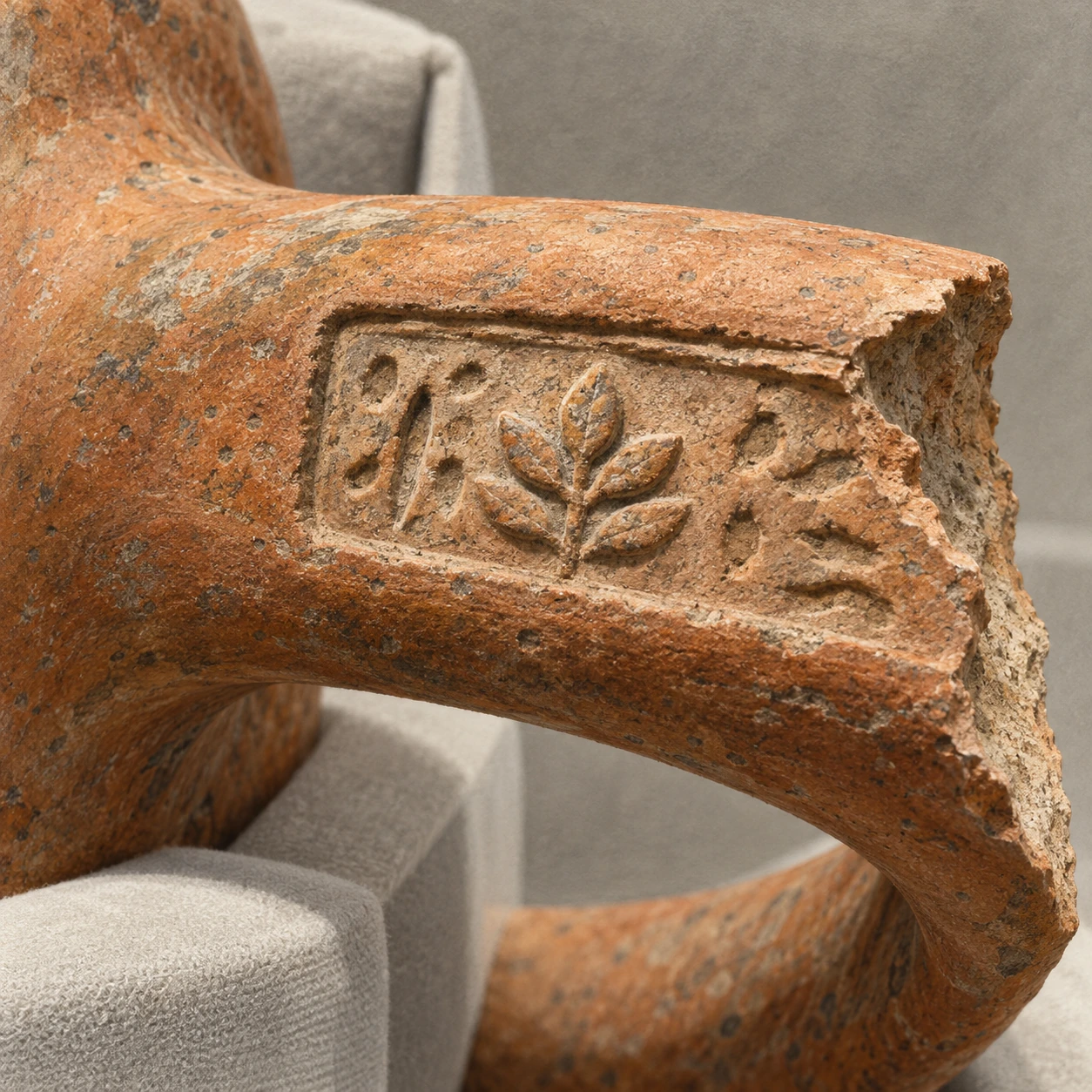
Terracotta handle detail with a worn generic leaf stamp and a broken frame edge.
Conceptual surface study. The marks are not a readable historical inscription.

The School’s account of Grace’s working legacy describes the records she assembled across collections. This long, collaborative reference work is part of the evidence. A date attached to a handle may compress many comparisons, corrections, and exchanges into one short museum sentence. The fragment does not arrive in the ground carrying a ready-made modern catalog entry.

Consider three invented finds. Handle A has a clear leaf emblem but damaged lettering. Handle B has complete lettering and a different border. Handle C is a second impression whose tiny repeated edge flaw resembles A. Which pair is most promising for investigating a shared die? A and C deserve closer comparison. A shared emblem or name alone is a weaker basis for that particular claim, because more than one tool can carry the same general design.

The model below offers three deliberately fictional comparison cases. Each asks what can be inferred before you reveal the explanation. It uses plain text descriptions rather than simulated ancient letters, so nothing in it can be mistaken for a new reading of an archaeological inscription.

Names, emblems, and die links

Three fictional cases distinguish shared design, individual tool, and shared journey.

Open this activity in its own window.

After trying the cases, look at the finding aid again. Notice how research can be organized by an object’s place in a deposit, its manufacturing class, its shape, or a name in its stamp. Each ordering makes a different relationship easy to see. None is a complete biography of the vessel.

There is a practical lesson for readers who collect information of any kind. Record the source and the uncertainty beside the observation while it is still fresh. A photograph separated from its scale or find context becomes harder to use. An attractive comparison separated from the reasons for it becomes harder to check. The labor of organizing small records is what allows another person to ask a larger question later.

A broken handle therefore connects us with two kinds of work: the ancient production and circulation of a jar, and the modern production of reliable comparisons. Paying attention to both makes the stamp’s apparent precision more understandable.

A four-column reading card

When you meet a stamped handle online or in a museum, make a small card with four headings. Keep observation and interpretation in their own spaces.

SurfaceReadingContextLimits
What shape and marks are visible?What letters or symbols do specialists identify?Where and how was it found?Which details are uncertain or missing?
Broken edge, worn center, partial frameA personal name, month, or emblem, if supportedA documented excavation layer or a less secure old collection historyNo contents analysis, no known carrier, or incomplete inscription

Now try writing one sentence using only the first column. Then add a second sentence using the catalog. This small discipline prevents the authority of a museum label from dissolving into an unsupported personal guess.

The same care applies to quantity. A collection of stamps can help investigate trade, but surviving and recovered handles are not a complete count of all ancient cargo. Different excavation histories and preservation conditions affect what reaches the dataset. A number becomes more meaningful when we know how it was assembled.

A broken handle will never provide the whole biography of its jar. It offers something more precise: a small surviving point where production, administration, movement, and later research intersect. Once you know how to ask what kind of evidence it is, the missing vessel becomes a larger and more interesting absence.

Sources and a closer look

Acropolis Museum: Rhodian stamped handle; British Museum: Rhodian handle 1848,0703.126; ASCSA: amphoras and amphora stamps collection; ASCSA: Chavdar Tzochev on Thasian stamps.

Find more art, ideas, and unexpected connections at Incoprea.
The Tusk’s Second Archive: What Walrus DNA Reveals About Medieval Greenland

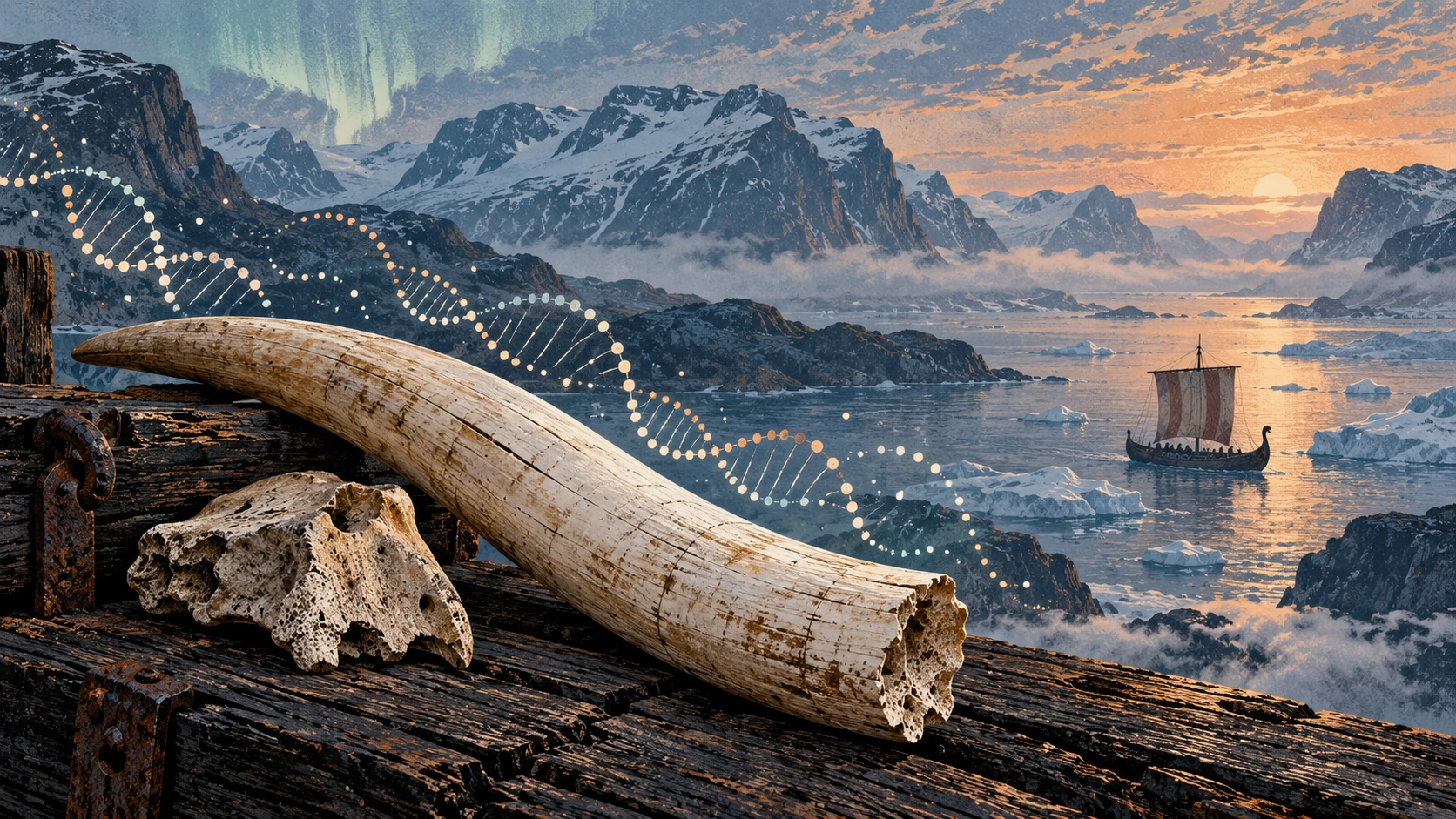
Conceptual tusk fragment and skull fragment overlooking a Greenland fjord and distant medieval vessel.
Historical concept; the vessel and molecular motifs do not document a specific route or DNA sequence.

A medieval ivory carving has at least two histories. One begins with a craftsperson deciding what to make from a tusk. The other begins long before that decision, with the animal that grew the material. Ancient DNA can sometimes recover part of the second history from fragments that look far less impressive than a finished sculpture.

That possibility has changed the study of walrus ivory associated with Norse Greenland. A worked object may have lost the shape that identifies a tusk. Waste or skull fragments may preserve biological evidence alongside the archaeological context of trade. The challenge is to connect those records without pretending they tell us every step of a journey.

Start at the destination, then step back

The British Museum’s Lewis chessman 1831,1101.81 is cataloged as walrus ivory: a seated king with carved details extending onto the throne. It offers a clear example of the material’s transformation into a prestigious European object. It is not being presented here as a specimen genetically tested in the studies below.

That sentence is a necessary boundary. A genetic finding about an archaeological sample cannot simply be attached to the most famous ivory carving in a museum. To make an object-specific origin claim, we need evidence about that object, or a carefully justified connection to the material assemblage to which it belongs.

Still, putting the carving beside an undecorated fragment changes what we value. The finished piece preserves decisions about image and use. A discarded rostrum—the part of the skull associated with the tusks—can preserve information about supply. Archaeological importance need not follow artistic finish.

The broad shift seen in 2018

A 2018 study by Bastiaan Star and colleagues analyzed mitochondrial genomes from thirty-seven archaeological walrus specimens. It identified two major maternal lineages and used their geographic distribution to investigate twenty-three specimens found in Europe. Across the medieval period, the researchers found a shift toward material associated with Greenland’s western Atlantic walrus populations.

The result linked Greenland more firmly to the ivory supplied to European markets. It did not require a surviving merchant’s label saying where a particular animal had been hunted. Biological inheritance supplied a different form of evidence, interpreted through comparative samples and archaeological dating.

Notice the scale of the conclusion: a change across a set of specimens and periods. “Every medieval European walrus ivory came from Greenland” would be a stronger statement than the evidence supports. Geographic sourcing depends on which populations can be distinguished and how well the reference material represents them.

A finer map in 2024

The 2024 study Greenland Norse walrus exploitation deep into the Arctic used higher-resolution genetic sourcing to investigate more specific stocks. Its results indicate increasing reliance in the later period on distant northern hunting grounds, especially the North Water Polynya, or Pikialasorsuaq, between northwest Greenland and northeast Canada.

The paper considers both direct Norse hunting and exchange with Arctic Indigenous people as ways such ivory could have reached Norse networks. Biological origin alone does not decide between those social routes. The authors also call for more directly dated artifacts and further archaeological work, including a less exclusively European-centered understanding of Indigenous mobility and interaction.

The associated Dryad data record makes part of the study’s evidence trail available for inspection. It describes the comparative mitogenome material used in the analysis. Data access does not make interpretation automatic, but it allows qualified researchers to examine how results were produced and to extend the comparison.

Four links that must not be collapsed

QuestionEvidence that may help
Where did the animal’s population live?Genetic comparison with geographically informative samples.
When was the animal killed?Appropriate dating evidence, with its uncertainty and calibration.
Who obtained or exchanged the tusks?Archaeological context, historical evidence, and evidence of contact.
Where was the final object carved?Workshop evidence, technical and stylistic comparison, and documented context.

A strong answer to the first question does not fill all four rows. A tusk can move; an object can be curated before burial or loss; a findspot can be distant from both a hunting ground and a workshop. A map that draws one continuous arrow risks hiding those separate inferences.

Read a trade map with removable arrows

Try an evidence exercise with three plain paper labels: “animal population,” “archaeological find,” and “finished carving.” Put them apart on a table. Join them with strips of paper rather than permanent ink. On each strip write the evidence needed to support that connection.

Now remove any strip whose evidence is unavailable for the specific example you are discussing. You may retain an association between a tested fragment and a population while losing the link to an individual craftsperson. That is a productive result. It shows which discovery would change the reconstruction most.

For a more detailed version, add two dates to each label: the event being investigated and the evidence’s degree of precision. An archaeological layer can provide a range rather than a year. A genetic relationship can be strong while the specimen’s deposition date remains broad. Confidence has several dimensions.

The packaging can preserve a trade step

A 2020 study by Barrett and colleagues adds a material sequence to the genetic account. Their analysis of medieval walrus rostra investigates modified skull sections in which tusks were transported, combining working traces, biological evidence, and archaeological context. Its associated NCBI BioProject record, PRJEB35165, identifies the molecular research project. A sequence archive and a carved object catalog provide different kinds of access to the same broad historical question.

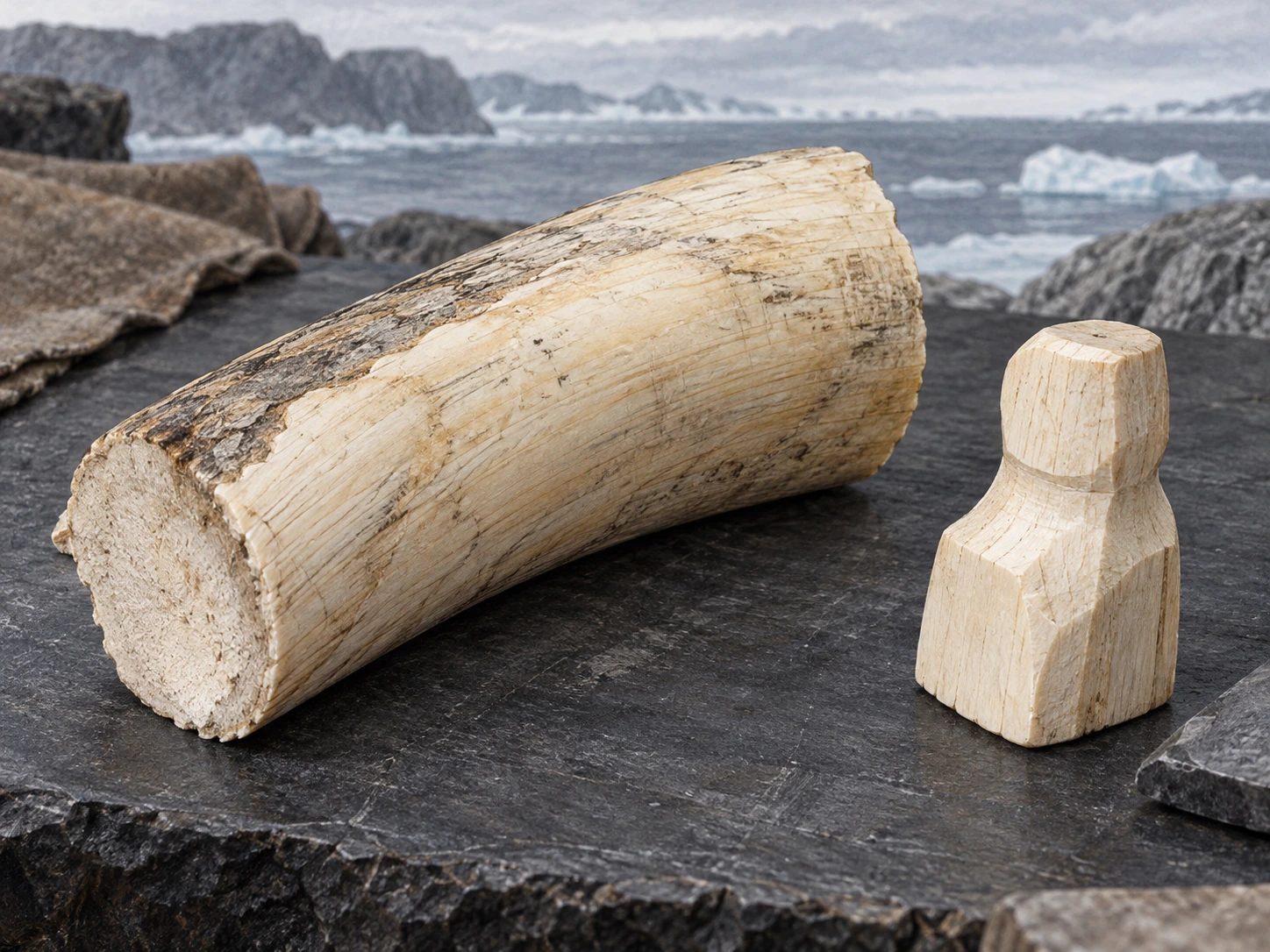
Undecorated tusk fragment and a simply shaped carving blank contrast material and workshop stages.
Interpretive supply-and-workshop study, not a genetically tested specimen.

The rostrum is useful partly because it is neither a finished sculpture nor simply an untouched animal part. Its modification can record an intermediate stage. That gives researchers a reason to study what a workshop or consumer might otherwise regard as packaging and waste.

Try a supply-chain exercise with an ordinary piece of fruit bought in a package. Separate five stages on paper: biological growth, collection, preparation for transport, delivery, and final use. List what evidence each stage might leave. A label may name a producer; a cut or trimmed surface may show preparation; a sales receipt may record a transaction. None necessarily identifies every person who handled the object.

Now translate the questions, without transferring the modern answers, to an archaeological tusk-bearing skull section. Which traces concern the animal? Which concern deliberate modification? Which concern the context where the fragment was discarded? A strong interpretation connects those categories while keeping the evidence for each visible.

There is another numerical trap worth testing. Suppose a fictional assemblage contains five skull fragments, two complete tusks, and one finished carving. Adding them gives eight catalog entries. It does not automatically give eight animals, eight cargoes, or eight carving commissions. Parts can belong to the same individual or arrive through different histories. A meaningful count needs a clearly defined unit and an explicit method of avoiding double counting.

The same issue appears when comparing studies. Check whether a stated sample consists of specimens, individuals, genomes, rostra, or worked objects. A larger number in one column is not automatically a larger or more representative trade dataset. Chronological and geographic coverage matter alongside quantity.

The tusk’s second archive therefore includes more than a genetic signature. Its preparation, movement, and discard can preserve different stages in the conversion of an animal resource into a valued material. The story becomes more human when we can identify those stages precisely, while refusing to fill the unrecorded intervals with a single imagined merchant’s journey.

Supply is a human and ecological story

The ivory record connects distant consumption with animals, travel, skilled labor, and encounters among communities. The 2024 authors discuss increasing pressure on accessible stocks as one interpretation of the changing geography. It would go beyond this evidence to make walrus ivory a single sufficient explanation for the eventual end of Norse settlement in Greenland.

Nor should Indigenous people enter the story only as anonymous suppliers appearing when Europeans need them. The uncertainty about exchange is a reason to investigate their histories and strategies more fully, not to write them out.

A small fragment can therefore enlarge a story while making its boundaries clearer. The carving tells us what people made visible. The tusk’s biological archive can help reveal where material came from. The most interesting history emerges when those kinds of evidence are allowed to meet without being forced to say the same thing.

Sources and a closer look

British Museum: Lewis ivory chessman 1831,1101.81; Star and colleagues, 2018: Ancient DNA and walrus ivory trade; Ruiz-Puerta and colleagues, 2024: Greenland Norse walrus exploitation; Dryad: Data for the 2024 study.

Find more art, ideas, and unexpected connections at Incoprea.
Wednesday, October 14, 2026

Baltic Amber: How a Small Bead Can Reveal a Long Journey

Suppose a bead is excavated far from the sea where its raw material is thought to have been collected. How much of its journey has been recovered? A material identification can establish an important connection, yet leave the number of journeys, traders and workshops entirely open.

Baltic amber makes that problem unusually tangible. It is attractive enough to be collected, worked and exchanged, while its chemistry can preserve evidence that appearance alone cannot supply. Follow a bead from resin to object to archaeological sample, and the story becomes more interesting than a single arrow labelled Amber Road.

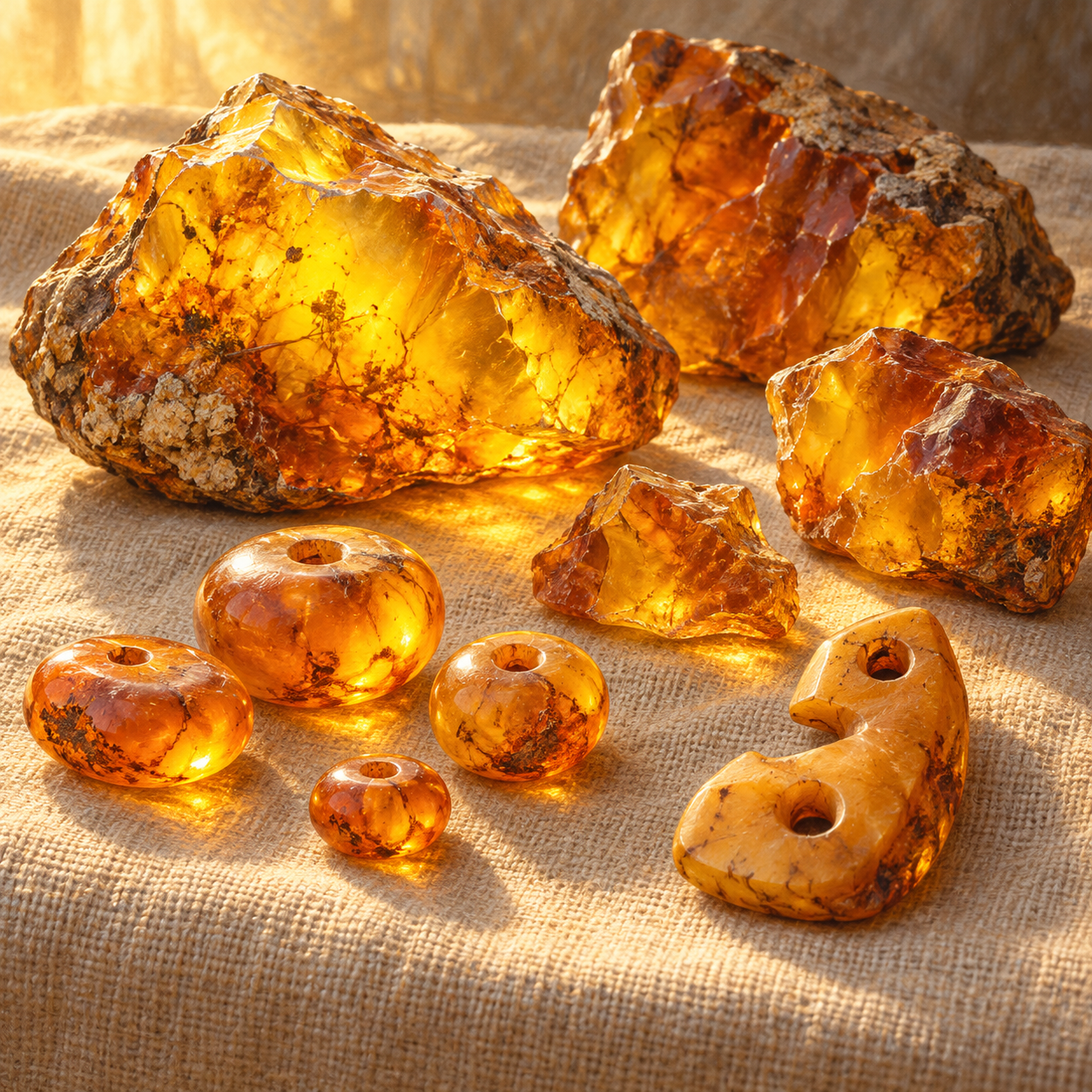
Illustration of rough amber, polished drilled beads and an imagined carved pendant.
These invented examples distinguish raw material from worked objects; they are not a group of excavated finds.

A material already moved by nature

Amber is fossil resin. Getty's account identifies Baltic amber, also known as succinite, as a major Old World source. Its rich deposits include the region around the Samland peninsula near the southeastern Baltic. But the geological story involves redistribution by water and ice over long periods.

The place where resin formed, the deposit from which it weathered and the beach where a person collected it need not be identical. That distinction is easy to miss when “Baltic” appears as a compact label in a museum description. It names a material tradition and region, not a stamped collection address.

Before reconstructing human trade, therefore, we already have to consider natural movement. A sample's relationship to a recognised amber type can be strong even when its exact ancient collection place is unknown. Good sourcing reduces uncertainty without necessarily reducing it to one point on a map.

The object adds another journey

Getty's Bronze Age survey describes amber in beads, embellishments and other worked forms across the Mediterranean. At Mycenae, some burials contained substantial numbers of beads. The survey also notes Italian evidence, including Frattesina in the Po valley, for exchange involving both raw material and finished products.

That last distinction changes the story. A lump could travel to a workshop and become a bead there. A finished bead could travel further. An object could be restrung or reworked. Finding northern material in a southern burial does not tell us that one traveller carried it all the way from a Baltic shore.

There are consequently several kinds of history to recover: the resin's geological origin, a workshop's treatment of it, its circulation as an object and its eventual deposition. They can intersect without following one uninterrupted route. A bead is a compact object with a potentially complicated biography.

What the laboratory can see

Infrared spectroscopy examines how a material absorbs infrared radiation. Getty Conservation Institute researchers describe a characteristic feature in Baltic amber's spectrum and explain how analysis can help identify the material. They also studied selected objects using complementary chemical methods.

The investigators compared material from objects' interiors and weathered surfaces, and considered earlier conservation treatments. Those are practical matters, not merely laboratory fine print. A surface altered by burial, deterioration or treatment may not preserve exactly the same chemical information as the material within.

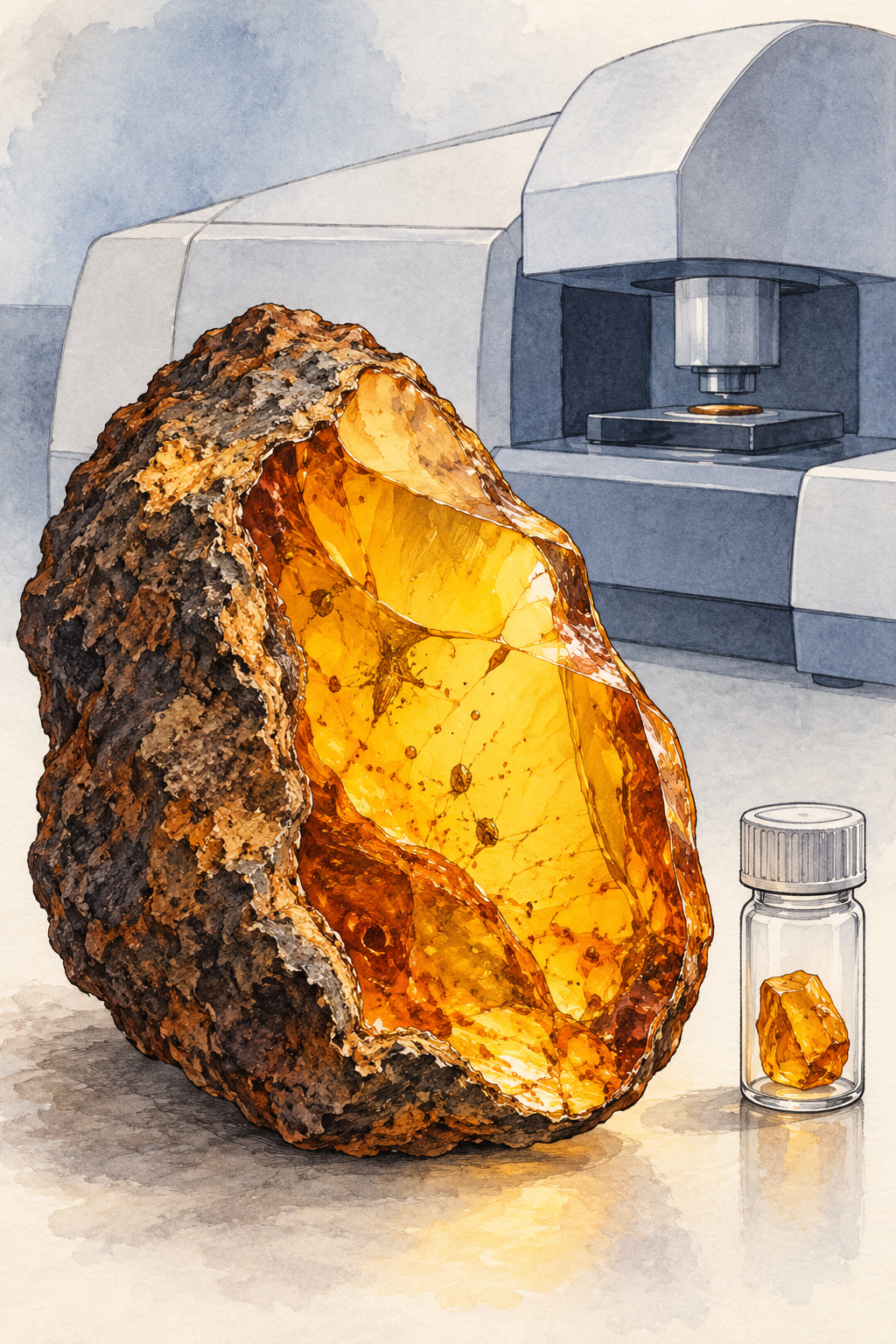
Conceptual illustration of weathered amber and its inner material near an analytical instrument.
Surfaces, inner material and treatment history can all matter to chemical interpretation. This is not a real sample, spectrum or instrument record.

The illustration separates surface and interior as ideas; it is not a measured spectrum. For actual results, open the Getty technical essay's figures and tables. Start by identifying what was sampled and what was being compared before attempting to interpret the shapes of plotted lines.

Colour alone is an unreliable shortcut. Translucency, bubbles, inclusions and alteration can affect how amber looks. An appealing honey-coloured photograph is therefore weaker evidence for a source than an appropriate analysis connected to a documented object.

Build three possible biographies

Try this deliberately hypothetical exercise. An ancient bead found in Italy has been identified as Baltic amber. Its precise workshop is unknown. Which of the following accounts remains possible on those facts alone?

  • Raw amber travelled south and was carved into the bead near its final place of use.
  • A finished bead arrived through several exchanges and was incorporated into local jewellery.
  • An older imported object was reworked into a bead before burial.

All three could fit the limited statement. Now ask what further evidence would help distinguish them. Workshop waste, unfinished objects, tool marks, the distribution of a distinctive form and securely dated contexts are possible lines of investigation. None needs to be assumed in advance.

From claim to supporting evidence
Proposed claimEvidence to seek
The material belongs to a Baltic amber typeDocumented analytical identification and suitable comparisons.
The bead was made locallyManufacturing evidence connected to a workshop or local production sequence.
A particular route carried itChronologically compatible finds and additional evidence of connections along that route.

The exercise is useful because it resists an attractive but unnecessary choice between a complete story and no knowledge at all. We can have confidence in one stage of the biography while leaving another unresolved.

Read a museum catalogue in two directions

Getty's online amber publication allows you to move between object entries, historical essays and technical analysis. Choose a worked object and first examine its form. Where is it pierced? What surfaces are carved? Does the catalogue describe damage or restoration that changes what can be seen?

Then follow the technical discussion back towards the material. Notice how the questions change. A carved figure may invite discussion of imagery and use, while an analytical sample addresses composition and alteration. One object can support both conversations without either replacing the other.

Return finally to the imagined journey. The familiar phrase Amber Road can help us recognise long-distance connections, but routes varied across place and time. A network of successive exchanges may explain a distribution better than one fixed highway. The small bead remains beautiful; careful analysis gives its beauty a history with room for both evidence and unanswered questions.

Sources and further reading

Explore more art, stories and discoveries at Incoprea.

Uluburun: A Bronze Age Trade Network on the Seabed

One kind of cargo promises many future objects. Copper and tin can become bronze tools or vessels. A glass ingot can become something quite unlike its transport form. A bead, by contrast, may already be ready to wear. The Uluburun shipwreck carried these stages of manufacture together across the Late Bronze Age Mediterranean.

The ship stopped travelling near the coast of what is now Turkey. Its excavated contents let researchers examine exchange in motion: raw materials, manufactured goods, equipment and belongings caught within one archaeological setting.

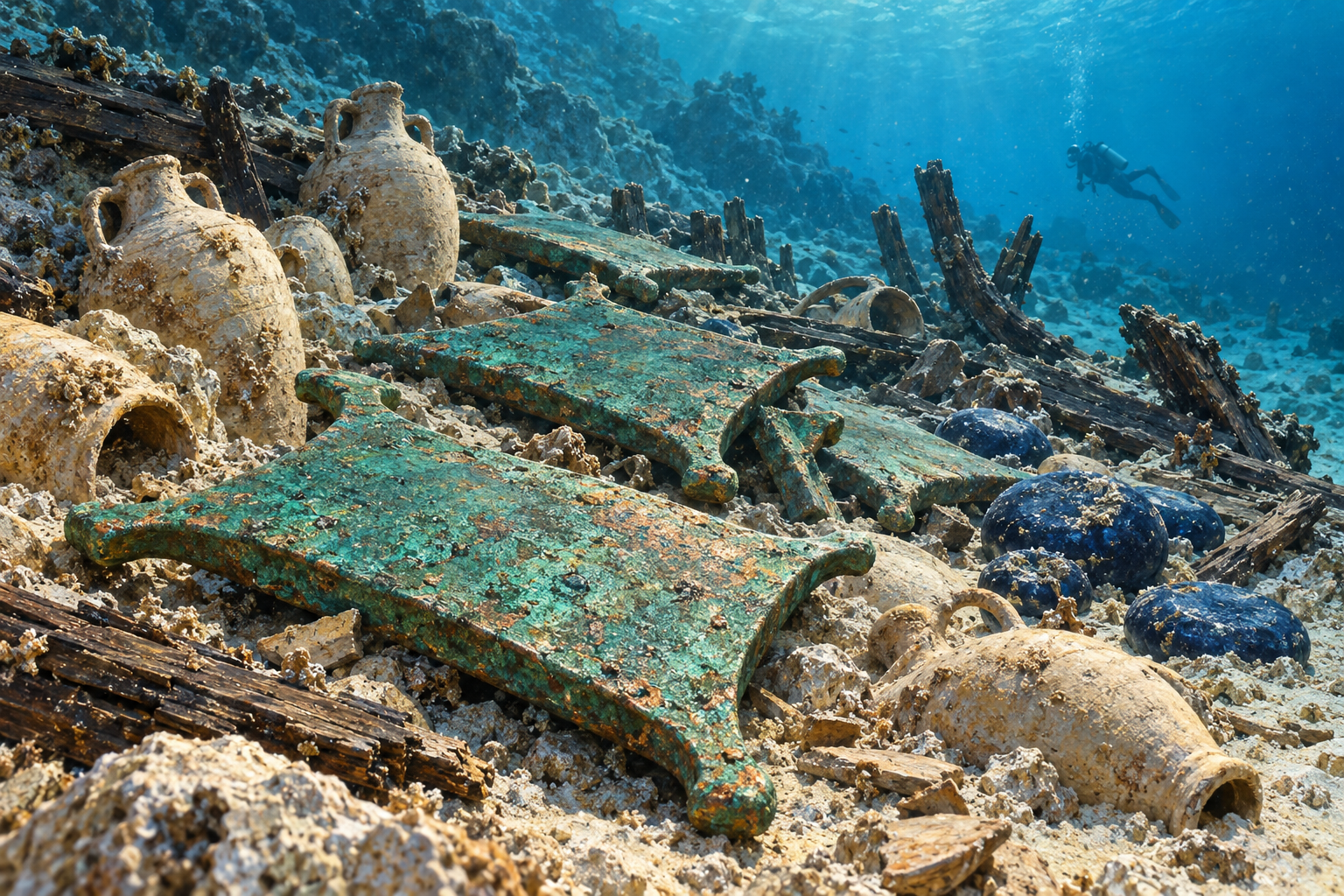
Illustration of Bronze Age copper ingots, storage jars and glass cargo on an underwater wreck site.
A cargo-inspired scene, rather than a reconstruction of the excavated site layout.

From a diver's clue to a documented site

In 1982, a Turkish sponge diver reported unusual objects on the seabed near Kaş. The Institute of Nautical Archaeology describes his comparison to metal biscuits with ears. The projecting corners of copper oxhide ingots made the shapes distinctive.

INA excavated the site over eleven seasons from 1984 to 1994. The wreck belongs to the late fourteenth century BCE. The work required thousands of dives and careful documentation of material scattered across a sloping seabed. Finding a valuable object was only the beginning of recovering its context.

Cemal Pulak's account explains that the hull collapsed and objects shifted down the slope. Recording and reassembling fragments helped reconstruct parts of the cargo's earlier arrangement. The seabed was therefore not a neatly preserved photograph of a loaded hold.

Cargo at different stages of becoming

Copper and tin formed the bulk cargo, alongside other materials such as glass ingots and unworked ivory. Finished objects included jewellery and carved containers. Pottery could itself be cargo, packaging or a vessel holding something else.

These categories change what a trade connection means. A raw material points towards extraction and subsequent manufacture. A finished object carries evidence of craft already performed. A container can preserve a relationship between the object and its contents that would be lost if they were catalogued separately.

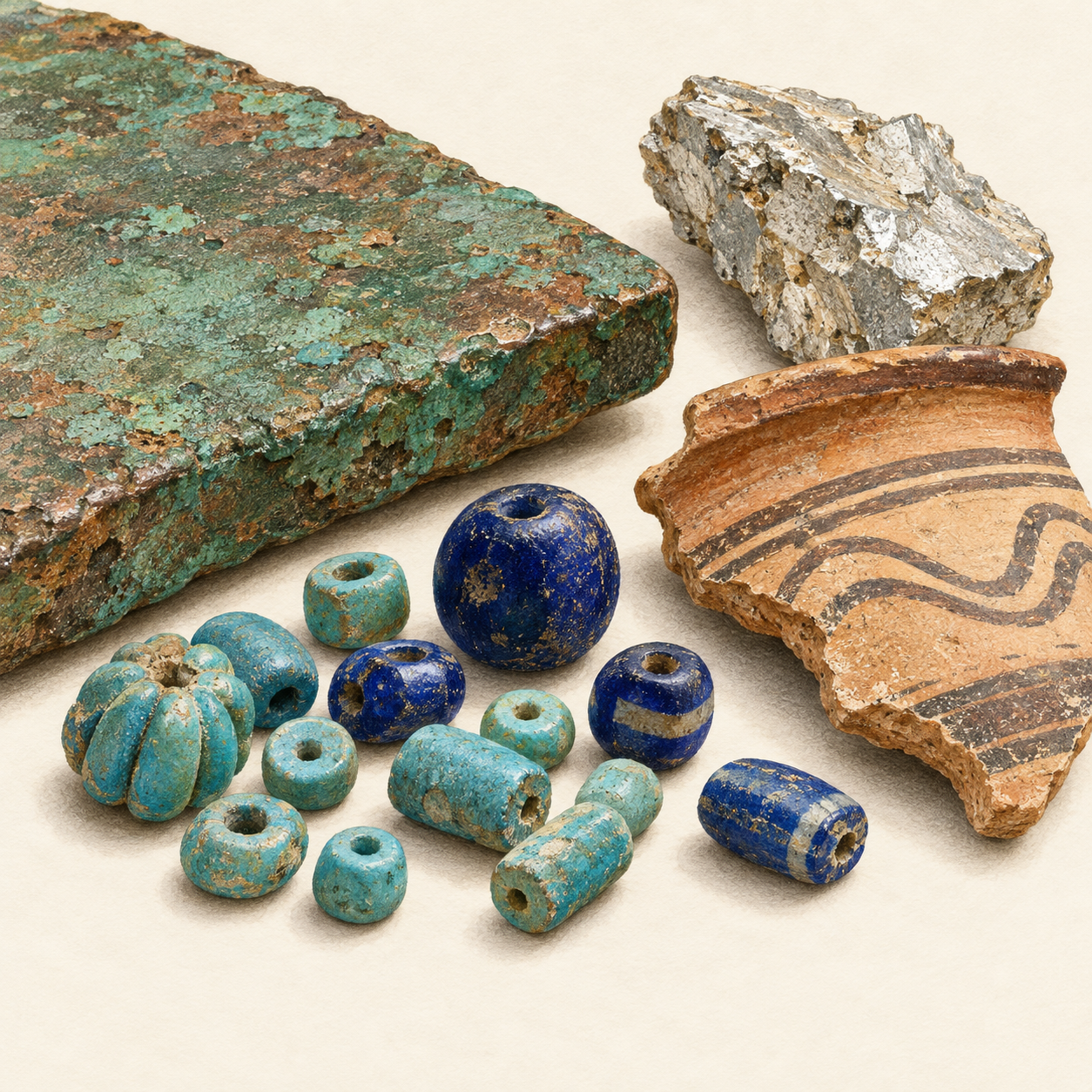
Illustration of beads, copper, tin and pottery inspired by the range of Uluburun cargo.
Different materials reveal different connections. These interpretive examples are not a catalog of exact finds or relative sizes.

The illustrative material grouping is an invitation to compare stages, not an exact manifest or scale display. For the actual assemblage, follow the excavation records. Ask what work had already been done to each item and what work was still expected at its destination.

A voyage carrying mixed stages could connect several industries at once. The ship's importance is consequently not confined to a single prestige object. Its assemblage joins the histories of metal, glass, pottery, ornament and transport in one place.

Let the smallest cargo test the larger story

Rebecca Suzanne Ingram's Texas A&M study examines the wreck's faience and glass beads. It describes approximately seventy-five thousand faience beads and ninety-five hundred glass beads. Their scale makes them a major commodity rather than incidental decoration around a handful of celebrated finds.

Some evidence concerns how the beads travelled. A concreted group of small glass beads associated with a Canaanite jar supports interpretation as packaged cargo. Other, less numerous categories may have belonged to people aboard. Similar-looking objects can occupy different roles depending on context.

Beads can also remain in use for long periods. A securely associated wreck assemblage helps constrain the date of their presence on this voyage, without necessarily identifying the moment every bead was made. The distinction is useful for an object small enough to be restrung, retained or passed on.

Three possible roles aboard one ship

Try sorting the following deliberately general finds into cargo, equipment and personal belongings: a jar full of matching beads, a balance weight and an individual ornament. Your first choices may seem obvious. Now ask what additional context could change each one.

A balance weight could support transactions, but its position and associations matter. An ornament might be a personal possession or a saleable item. A container's contents can support bulk transport more strongly than the isolated discovery of one bead. Archaeological categories are arguments supported by relationships, not properties stamped on the objects.

Questions to ask before drawing a trade route
ClueUseful question
Material identificationWhere might the raw material originate?
Object form and manufactureWhere and how could it have been made?
Position and associationWhat role did it have aboard this vessel?
Distribution of parallelsWhich connections fit the period and evidence?

The answers need not identify the same place. Source, workshop, owner, last port and intended destination are separate parts of a journey. Combining them too quickly turns a complex network into an unjustifiably simple itinerary.

The less glamorous remains keep the cargo afloat

The surviving hull fragments and stone anchors are essential evidence too. INA describes cedar construction and pegged mortise-and-tenon joins. Even a small amount of wood can help investigate how a ship capable of carrying heavy materials was assembled.

The reconstruction has limits because much of the hull is gone. A proposed ship shape draws on surviving structure and archaeological inference. It should be distinguished from the material that was actually recovered. Cargo, anchors and timber illuminate one another without supplying an intact vessel.

A visual visit from bead to seabed

Begin with the INA excavation account. Choose one raw material, one manufactured object and one piece of shipboard equipment. Write a question that each could answer better than the other two.

Then follow the bead study or Pulak's discussion back to context. The important move is from an object admired alone to an association documented during excavation. That is where a bead can become packaged merchandise and a scattered fragment can help reconstruct a load.

Uluburun makes the Bronze Age feel connected through work: collecting, shaping, packing, weighing and sailing. Its route is not completely known, but the relationships are substantial. The wreck preserves a world in which materials and finished things travelled together, linking many lives through one unfinished voyage.

Sources and further reading

Explore more art, stories and discoveries at Incoprea.

Famous Last Meals is now in paperback — stories, history and 25 recipes

Famous Last Meals: Stories, History, and Recipes is now available in paperback on Amazon. The illustrated collection brings together 23 his...