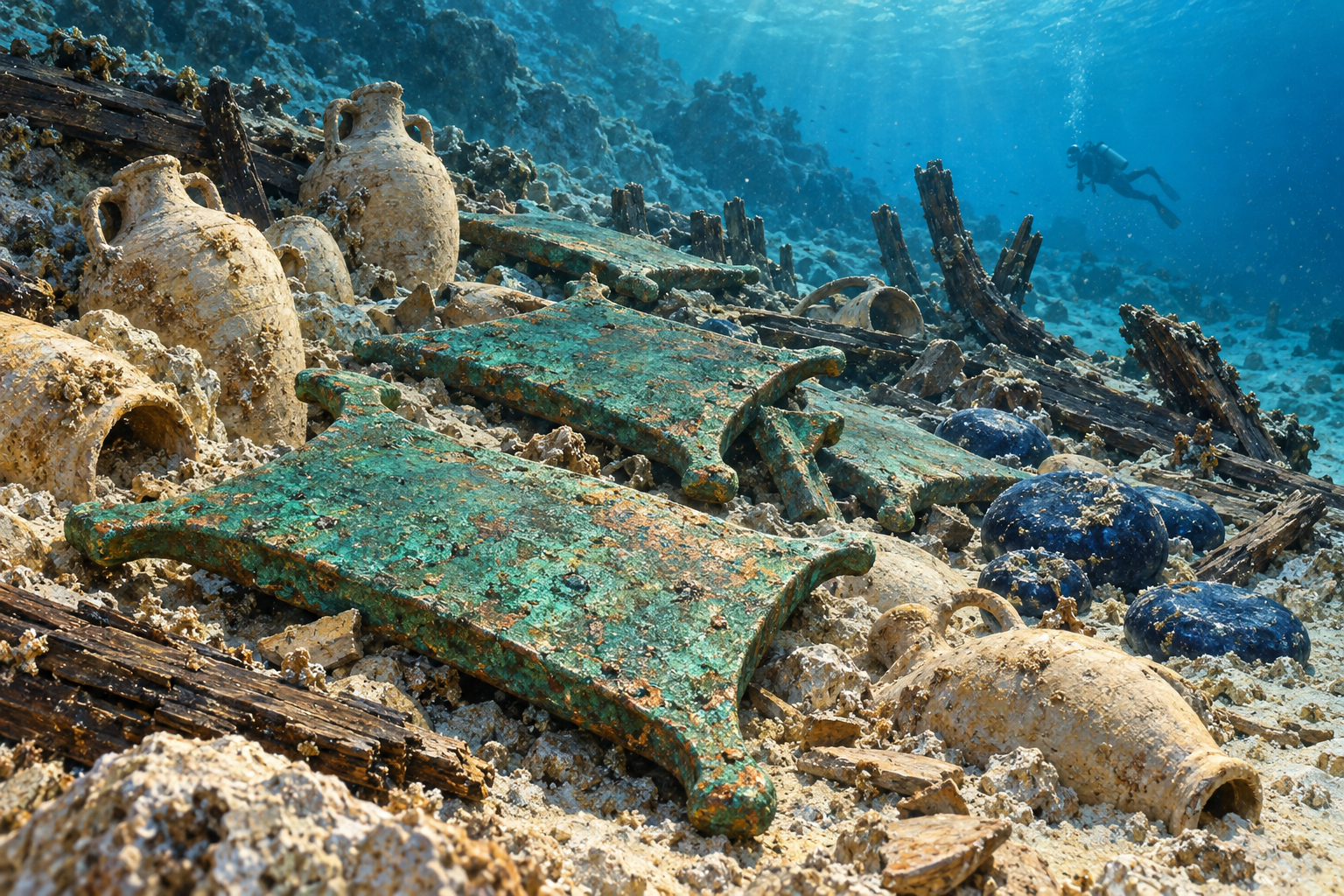
The first clue was a strange shape on the seabed. In 1982, a Turkish sponge diver spotted objects he described as metal biscuits with ears. They were part of a shipwreck that would offer an extraordinary view of Late Bronze Age exchange: the Uluburun wreck, near Kaş on Turkey's Mediterranean coast.
A cargo larger than one story
The Institute of Nautical Archaeology excavated the wreck over eleven seasons between 1984 and 1994. The ship sank more than three thousand years ago, around the late fourteenth century BCE. Its cargo included substantial quantities of copper and tin, the metals combined to make bronze.
Many copper ingots had an oxhide shape: broad slabs with projecting corners. Those distinctive forms were the diver's biscuits with ears. They make raw material visible as organized cargo, rather than as a finished tool in a museum case.
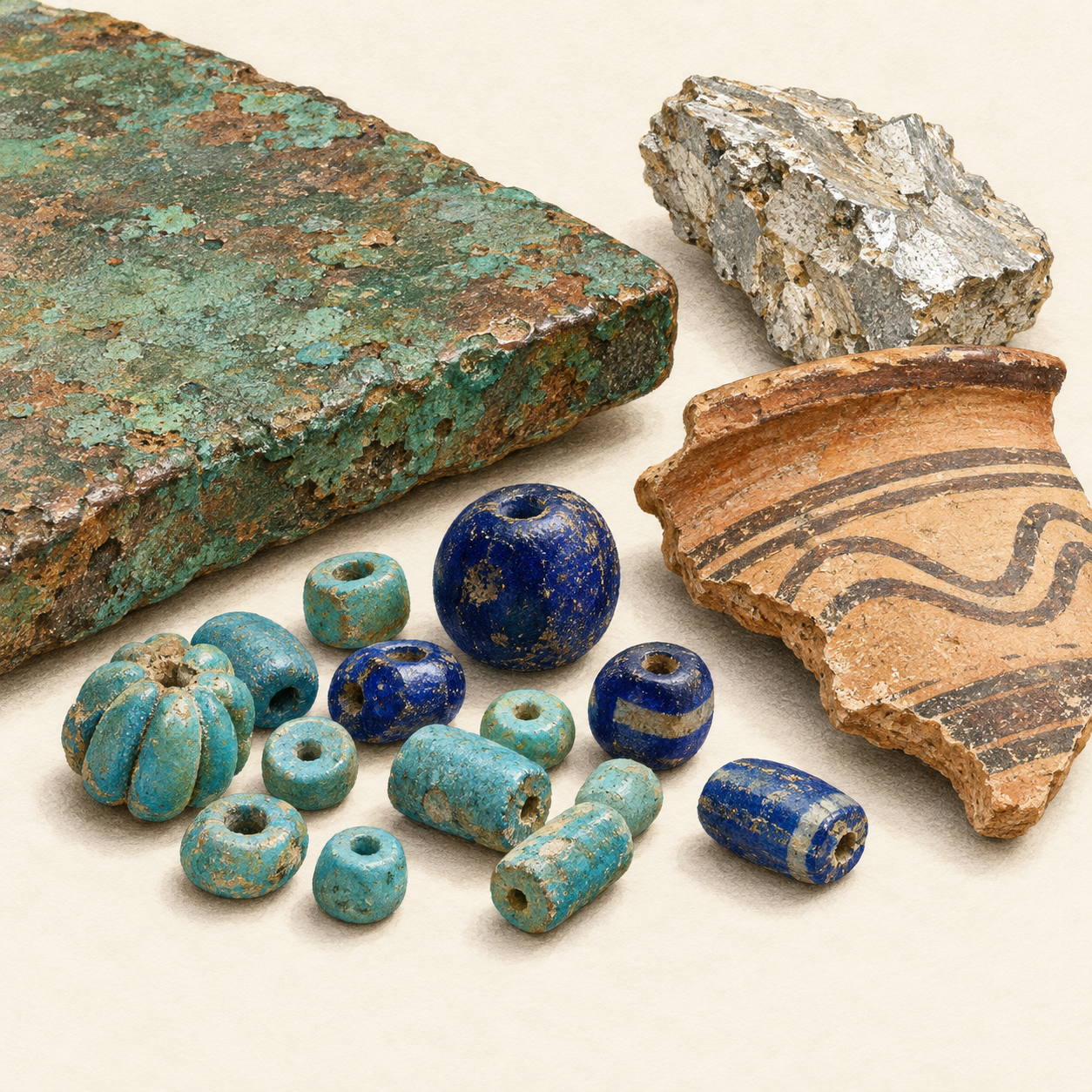
Other finds included pottery, glass ingots, ivory, jewelry and beads. Some objects were valuable finished goods; others were materials waiting to be transformed. A single voyage could link extraction, manufacture, transport and elite consumption.
Small objects explain the large network
A study at Texas A&M examined the wreck's many faience and glass beads. Their abundance points to beads as an important trade commodity, not merely incidental decoration. Ordinary-looking units of cargo can reveal the scale of an industry.
Personal belongings and shipboard equipment add another layer. They need to be distinguished from goods intended for delivery. A balance weight might help explain exchange practices, while an object belonging to a traveler raises a different question.
Cemal Pulak's account of the wreck emphasizes the diversity of the assemblage: raw materials, manufactured objects, personal effects and equipment found together. That association is what makes a carefully excavated shipwreck so powerful. Objects that might be isolated clues on land arrive as parts of one archaeological setting.
Connected does not mean fully mapped
The cargo points toward a highly interconnected Mediterranean world. It does not hand researchers a complete shipping manifest, exact route or uncontested identity for every person aboard. A material's source, an object's style, the owner's origin and the ship's last port are different questions.
Scientific analysis and comparison can narrow those possibilities. The surviving hull and anchors also matter, even when they are less glamorous than jewelry. They help investigate how such a load traveled at all.
The wreck's fascination lies in that mixture of scale and detail. A heavy ingot belongs to metallurgy; a small bead belongs to adornment; a storage jar belongs to packaging and provisions. Together they show people moving diverse goods across long distances.
Uluburun makes the Bronze Age feel less like a collection of separate civilizations and more like a world of relationships. The ship stopped traveling, but the objects it carried still let us follow connections that once crossed the sea.
Sources and further reading: Institute of Nautical Archaeology excavation account; Cemal Pulak: Uluburun Shipwreck; Texas A&M study of faience and glass beads.
Explore more history, art and curiosity at Incoprea.